Hello everyone, I'm Cody, a guest analyst for Odaily. I wish all my readers a happy Lantern Festival in advance!
Looking back at last week's Bitcoin market, the overall trend largely followed the previously established trading framework and rhythm. In terms of short-term strategy, market movements closely matched short-term predictions, resulting in a short position (1x leverage) executed according to the short-term trading strategy, achieving a profit of approximately 2.12% on a single trade (see Table 2 for details). Regarding the medium-term strategy, Bitcoin continued to follow the previously established medium-term approach, maintaining the short position established at $89,000 (1x leverage). By the close of last week's trading, the price had fallen back to approximately $65,770 , resulting in a paper profit of approximately 26.10% for this medium-term trade, with a maximum unrealized profit of approximately 32.58% during the period.
From a market analysis perspective, Bitcoin remained in a weak, range-bound trading pattern last week, consistent with the previous assessment of a C-2 wave rebound . The nature of the short-term rebound has not changed.
Furthermore, I remain optimistic about HYPE's performance, so this week's report will continue to provide weekly tracking and analysis of HYPE's multi-timeframe price structure. Last week, based on my own short-term structural analysis, I completed a short-term long position (1x leverage), achieving a profit of approximately 11.14% in a single trade. The trading logic and execution results are well-aligned (see Table 1 for details).
The following section will provide a more detailed explanation of the above content, focusing on market prediction, strategy logic, trade execution, and result review.
I. HYPE Trend – The Prelude to the Beginning of Wave III?
In my weekly review on February 22nd, I first highlighted the investment opportunity in HYPE , clearly pointing out that its original downward trend might reverse, and that the current market was in the second wave correction phase after the first wave of the upward trend, with a potential major upward ( third wave) trend in the near future. The core basis for this analysis is as follows: (see Figure 2)
• In the first wave of the upward trend, the price has effectively broken through the long-term downtrend line connecting the September 2025 high (approximately $59.48) and the October 2025 high (approximately $50.17) (blue line in the chart).
• At the beginning of wave I , our self-constructed momentum model has issued a daily-level momentum divergence signal;
• At the beginning of wave I , our self-developed price spread quantitative model has triggered a strong bottom warning signal (white bar in the figure).
It should be noted that the effectiveness of the signals issued by the two models mentioned above has been confirmed by the market through the strong upward performance of prices in the first wave of the market.
1. HYPE Short-Term Trading Review (1x Leverage): (February 22 - March 1)
Last week, we strictly followed the trading signals generated by our self-developed spread trading model and momentum model , and combined them with our prediction of the main upward trend of wave III , to complete a short-term ( long ) operation, successfully profiting 11.14% .
(See Table 1)
• Summary of HYPE short-term trading details: (leverage * 1x)

Table 1
• Entry decision (see Figure 3): Based on the prediction of a major upward trend; at the same time, the price spread quantitative model issued multiple bottom warning signals (red dots in the figure), which subsequently formed a bottom resonance signal with the momentum quantitative model ; and the price effectively stabilized after breaking through the previous key area. Therefore, a long position was opened at $27.28 .
• Closing position decision: The price spread quantitative model and the momentum quantitative model issued a top resonance signal, so the position was closed near $30.32 .
• Trading Summary: This operation successfully captured the upward opportunity in the early stage of wave III , resulting in a profit of approximately 11.14%.
HYPE 30-minute candlestick chart
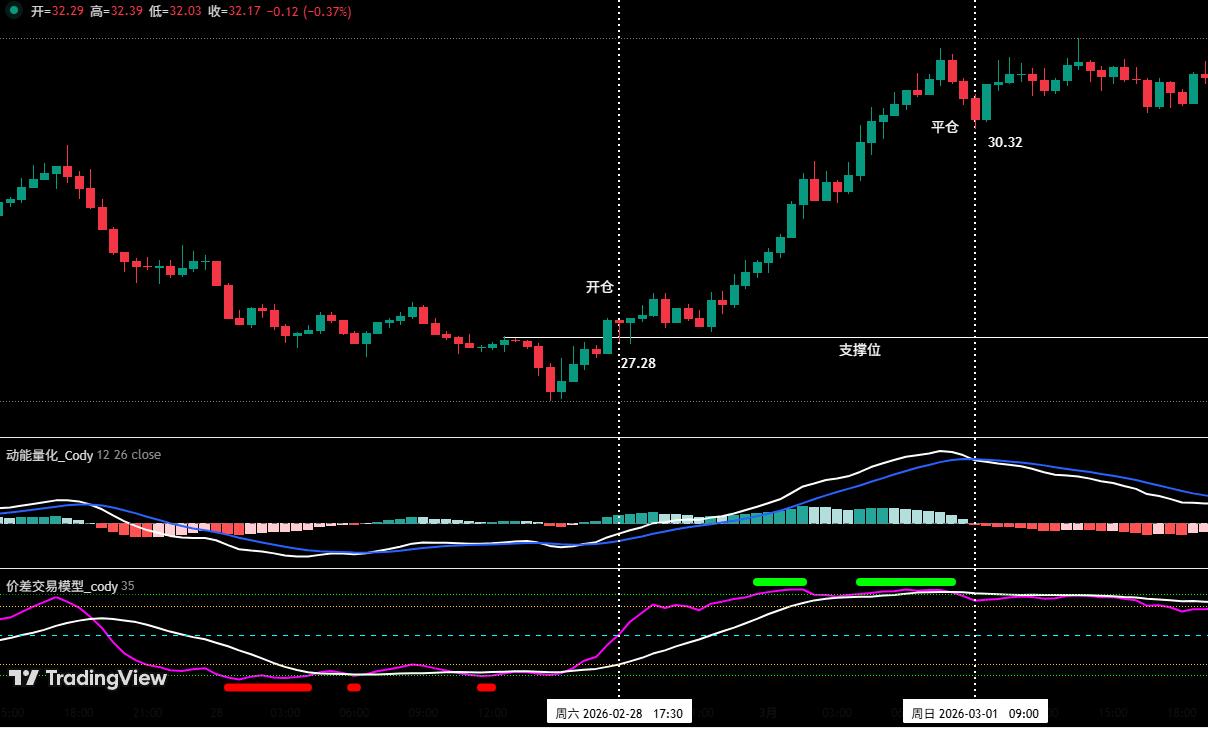
Figure 1 (Short-term trading illustration)
2. The preliminary daily chart trend structure is as follows: (Based on market developments since January 21st)
HYPE Daily Candlestick Chart
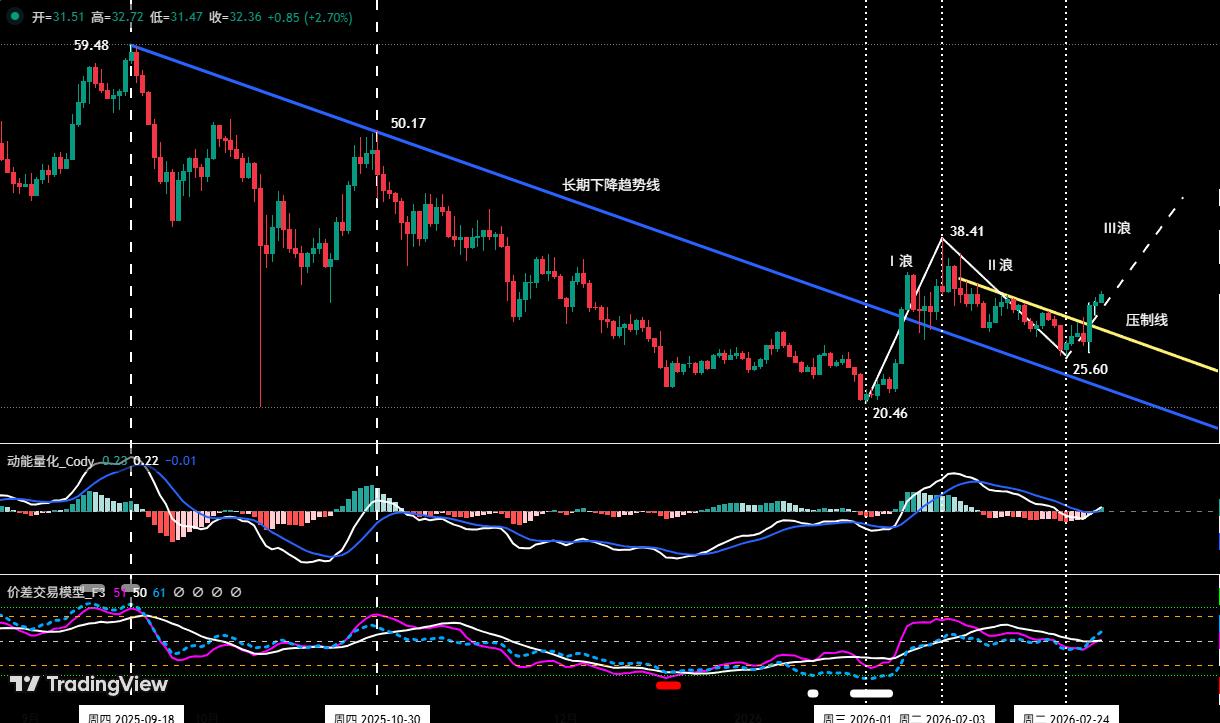
Figure 2
• Wave I (Drive Wave): It began at the low of $20.46 on January 21 and ended at the high of $38.41 on February 3. It lasted 14 days and saw a maximum increase of 87.73%, constituting the first major drive wave of this upward cycle.
• Wave II (Corrective Wave) : Began at the high of $38.41 on February 3 and ended at the low of $25.60 on February 24. It lasted 20 days, correcting Wave I , with a maximum retracement of 33.35%.
• Wave III (Potential Impulse Wave) : Starting from the low of $25.60 on February 24, the market is currently in progress, and the third impulse wave is often the most explosive wave.
• Confirmation of the validity of the wave III starting point: The current trend has exhibited several technical characteristics consistent with the initial stage of a strong driving wave:
a. Breakout of a key resistance line: The price successfully broke through an important resistance line (yellow line in the chart) since the second wave correction, after failing to break through this line three times in a row. This signifies a shift in the balance of power between the bulls and bears.
b. Strong Momentum Verification: The rebound from the low point on February 24th completely erased the losses of the previous 10 days in just 6 days. In particular, the large bullish green candle with a gain of 14.25% on February 28th showed significant strength, consistent with the characteristics of strong momentum in the early stage of wave III .
c. Structural trend reversal: The current price high has surpassed two important structural points adjacent to the low on February 24th during the Wave II correction: the high of $30.59 on February 21st and the low of $27.73 on February 19th. This initially constitutes a "higher point" pattern, meaning that the original downward structure has been largely reversed.
• Confirmation of the end of wave III: The high point of wave III must exceed the peak of wave I at $38.41 . Otherwise, this segment of the market may still be a rebound within a wide-range fluctuation or a downtrend.
3. HYPE 4-hour level subdivision structure
HYPE 4-hour candlestick chart
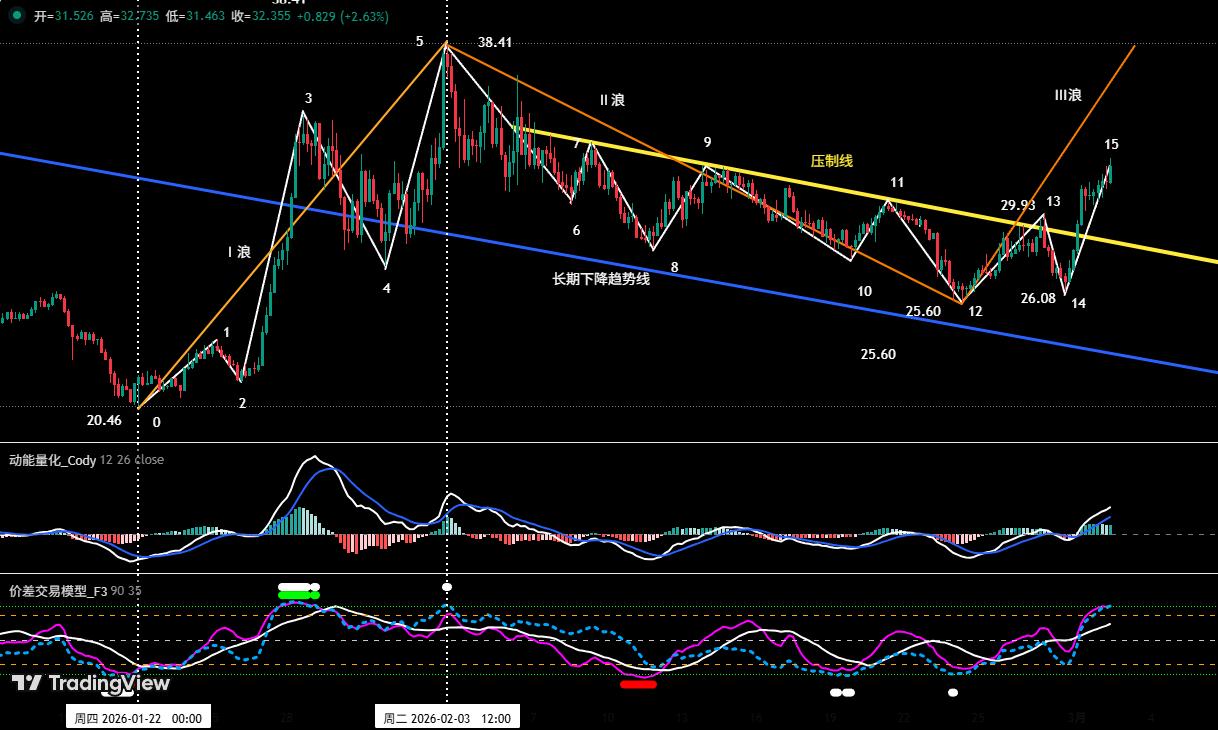
Figure 3
In Figure 3, we further refine the daily-level wave pattern described above.
• Wave I internal structure: It can be subdivided into 5 upward segments: 0-1, 1-2, 2-3, 3-4, and 4-5, forming a complete upward trend.
• Wave II internal structure: It can be subdivided into 7 adjustment segments: 5-6, 6-7, 7-8, 8-9, 9-10, 10-11, and 11-12, forming an orderly pullback trend.
• Wave III internal structure: In progress. It can be temporarily subdivided into three segments: 12-13, 13-14, and 14-15, among which the upward segment 14-15 has not yet ended.
II. Looking back at Bitcoin – mainly range-bound trading: (February 22 – March 1)
1. Review of short-term trading strategies : (See Table 2)
We strictly followed the trading signals generated by our self-developed spread trading model and momentum model , and combined them with our prediction of market trends. Last week, we completed a short-term (short) operation, which yielded a profit of 2.12% .
① Summary of Bitcoin short-term trading details: (leverage * 1x)

Table 2
② Short-term trading review: (See Figure 4)
• Opening a position: The price rebounded to the downtrend line but encountered resistance. At the same time, the spread trading model triggered a top warning signal (green dot in the chart). Combined with the short selling resonance signal from the two models , a 15% short position was established at $68,876 .
• Risk control: Initial stop loss for short positions is $72,000 .
• Close position: When the price falls to near the support level, combined with the bottom resonance signal of the model and the bottoming signal of the K-line combination, close all positions at $67,415 .
• Summary: This transaction yielded a profit of 2.12%.
Bitcoin 30-minute candlestick chart: (Momentum-based model + Spread trading model)
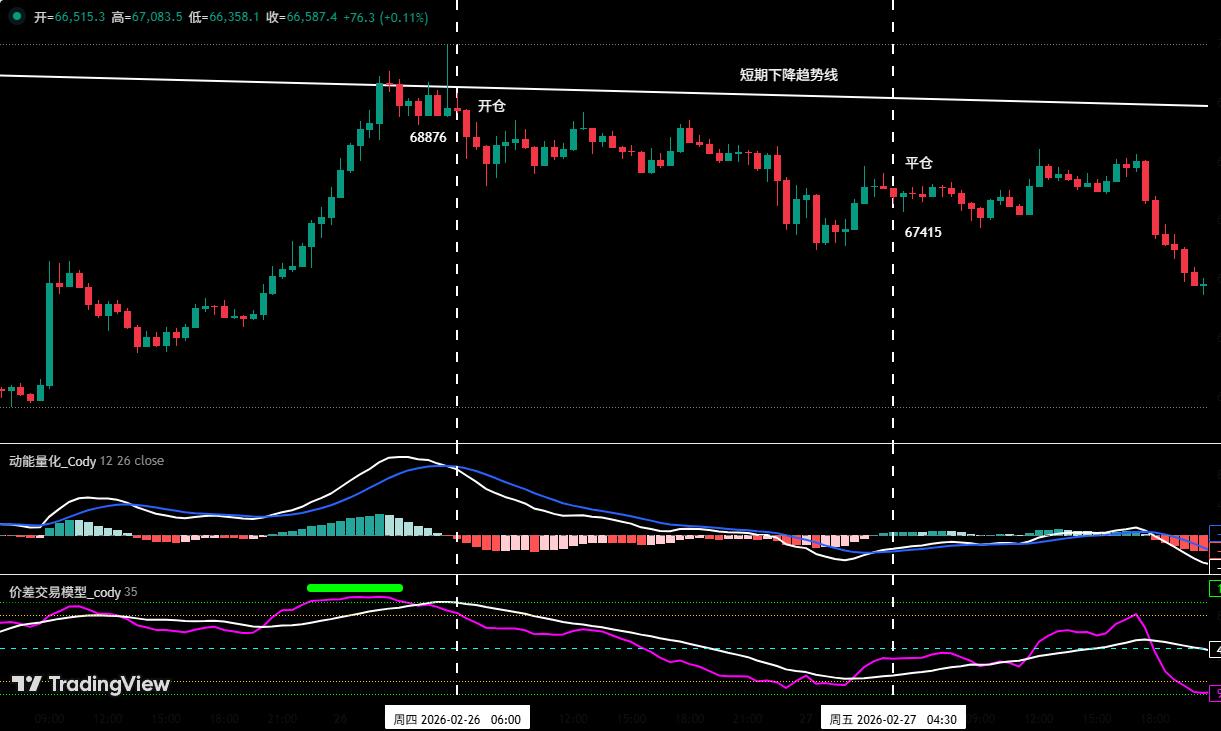
Figure 4 (Short-term trading illustration)
III. Bitcoin Indicator Analysis: Comprehensive Judgment of Weekly and Daily Charts
Weekly chart: The medium-term downtrend continues.
From a weekly chart perspective, the momentum line in the momentum quantification model continues to decline. Although the negative momentum bars have shown a temporary shortening, they have not yet formed a valid divergence signal, and the downtrend has not fundamentally changed. The sentiment quantification model indicates that the market has not yet entered a clear oversold panic zone, and the conditions for bottom sentiment repair are still insufficient; at the same time, the digital monitoring model has not given a bottom confirmation signal.
In terms of chart structure, last week's weekly candlestick chart showed a bearish candle with a drop of approximately 2.76% , breaking through the original triangle consolidation pattern. The center of gravity has clearly shifted downward, and the overall pattern is more in line with the characteristics of a downtrend continuation, indicating that the medium-term trend remains weak.
Daily chart: The oversold rebound continues, but momentum is limited.
From a daily chart perspective, the market is maintaining a sideways consolidation pattern in the short term. The momentum line formed a "golden cross" below the zero line and then rose slightly, indicating that short-term rebound momentum is being released. However, the positive momentum bars are disordered and lack sustainability, suggesting a weak rebound.
In terms of sentiment quantification models, although sentiment indicators are slowly moving away from the oversold range, capital participation remains limited, with both bulls and bears mainly taking a wait-and-see approach, making it difficult to drive the market to form a trend of upward movement.
Multi-cycle comprehensive judgment
Based on a combined weekly and daily chart analysis, Bitcoin is currently still operating within a downtrend dominated by bears. The daily rebound is more of a technical correction within the downtrend, and its magnitude and sustainability should be approached with caution until the weekly trend is effectively reversed.
The above data suggests that the daily downtrend has not changed, and the oversold rebound is continuing.
IV. Market Forecast: (March 2nd - March 8th)
1. Bitcoin's upward consolidation pattern (based on price action after the low on February 6th)
Bitcoin 4-hour candlestick chart
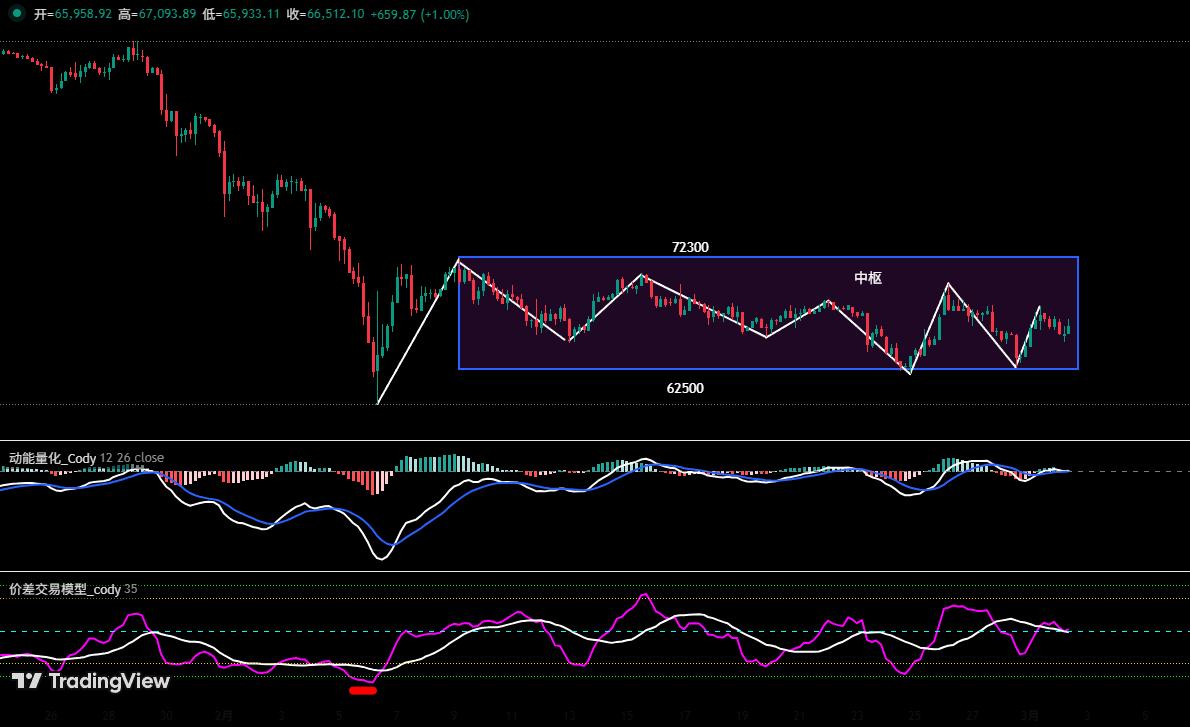
Figure 5
Using Bitcoin with a 4-hour trading cycle:
• Central Consolidation: The 4-hour chart suggests that the market is likely still in the process of building an "uptrend central consolidation" structure, with the highest resistance level around $72,300 and the lowest support level around $62,500 .
• Core operational contingency plan:
• Upward rebound: If the price breaks through the resistance level near $72,300 and breaks free from the current "central attraction" , it may continue the oversold rebound trend of segment C-2 , but the rebound space is expected to be limited.
• Downward Adjustment : The lowest support level of the current consolidation zone has shifted down to around $62,500 , close to the low of $60,000 on February 6th. If the price breaks below this support, the C-2 oversold rebound may have ended, or the C-3 correction may have begun.
Regardless of which of the above price movements occurs, investors are advised to adhere to a strategy of "selling on short" in short-term trading.
2. This week's core view: Maintain the range-bound trading pattern, pay attention to the struggle between bulls and bears near the edge of the range. Strategically, firmly adhere to the principle of "reducing positions (long positions) on rallies and controlling risk."
3. Core resistance level:
• First resistance zone: $68,500-$70,000 area (previous area of dense trading volume).
• Second resistance zone: $72,300-$74,500 area (near the low point in April last year)
4. Core support level:
• First support level: Around $65,000 (a key previous support area)
• Second support level: $60,000–$62,500 area (near the low of February 6)
• Third support level: around $ 57,400 (near the 210-week moving average)
V. Strategies for Plans A and B (excluding the impact of unexpected news): (March 2nd to March 8th)
1. Medium-term strategy: Maintain 60% short positions . If the rebound effectively breaks through $74,500 , the position can be reduced to 40% .
2. Short-term strategy: Use 30% of your position, set a stop-loss point, and look for opportunities to profit from price differences based on support and resistance levels. (Use 30-minute/60-minute charts as the trading timeframe).
3. Given the medium-term downtrend in the market, short-term Bitcoin trading should follow the principle of "following the trend and selling on short." To dynamically respond to complex market developments and incorporate signals from our self-built trading model , we have formulated two short-term trading plans , A and B :
• Option A : If the price rebounds to the resistance zone of around $70,000 to $72,300 :
• Opening a position: When the price rebounds to the resistance area and triggers a resistance signal, combined with the top signal of the model, a 15% short position can be established.
• Risk control: The initial stop loss for short positions is set above $75,500 .
• Closing positions: When the price falls to near a key support level and combined with model signals, positions can be gradually liquidated to realize profits.
• Option B: If the price rebounds to around $74,500 :
• Add to position: When the price continues to rebound to this area and encounters resistance, combined with the top signal of the model, you can increase your short position by 15% .
• Risk control: The initial stop loss for short positions is set above $75,500 .
• Closing positions: When the price falls to the support level and combined with model signals, positions can be gradually liquidated to realize profits.
VI. Special Note:
1. When opening a position: immediately set the initial stop loss level.
2. When the profit reaches 1% , move the stop loss to the opening cost price (break-even point) to ensure the safety of the principal.
3. When the profit reaches 2%, move the stop loss to the position where the profit is 1%.
4. Continuous monitoring: For every additional 1% profit in the coin price thereafter, the stop loss level will be moved by 1% accordingly, dynamically protecting and locking the loss.
Financial markets are constantly changing, and all market analysis and trading strategies must be dynamically adjusted. All views, analytical models, and operational strategies presented in this article are derived from personal technical analysis and are for personal trading journal use only. They do not constitute any investment advice or basis for action. The market is risky; invest with caution. Please do not make decisions based on this information.