Six major geopolitical and economic actions under President Donald Trump since mid-2025 have one thing in common: They all took place on Friday evenings, after the stock market had closed and before the Futures Contract market became active again.
This is no coincidence. According to model analysis, this is the most consistent and practically significant element in Trump's confrontational strategy — and perhaps the most tradable timing signal in today's macroeconomic financial markets.
Trump's Friday night ambush pattern is the most tradable signal in the macro market right now.
Understanding why Trump often chooses Friday nights, and what happens to Bitcoin (BTC), stocks, oil, and bonds in the 60 hours that follow, can provide a structural advantage for traders and investors that most retail investors have overlooked.
“Clearly, Trump chose the weekend to conduct military operations in Venezuela and Iran. A clever move that buys time before Wall Street opens, limiting the shock to the market. But there’s a big change: In the past, the market took a break on weekends. That’s no longer the case,” Chia Gracy Chen, CEO of Bitget.
Six events that reveal Trump's unique strategy.
The list, compiled by the financial research firm The Kobeissi Letter, is as follows:
- On June 21, the US and Israeli coalition attacked Iranian nuclear facilities.
- On September 1st, the US military attacked drug trafficking ships in the Caribbean.
- On October 10th, threats of imposing a 100% tariff on Chinese goods were made after the markets closed.
- On November 29, Trump completely closed Venezuelan airspace.
- On December 25th, the military began operations in Nigeria.
- On February 28, 2026, the US military launched a direct attack on Iran.
All of these events take place on Friday evening or early Saturday morning.
This pattern also appears in campaigns to pressure businesses. On August 11, 2025, the Trump administration announced a deal with Intel after weeks of pressure on CEO Lip-Bu Tan, which was also scheduled to take place outside of trading hours.
Those who followed this development from the beginning have reaped profits of over 80% in less than two months.
The consistency between geopolitical maneuvers , tariff actions, and even the struggle against corporations is no accident. It stems from a proactive understanding of how financial markets react to unexpected shocks.
Why Friday night? The market sentiment behind this time.
When a major geopolitical event occurs while the market is active, price determination becomes chaotic. Liquidation immediately dries up . Automated trading algorithms amplify any price fluctuations.
Intraday volatility can cause confusion, leading to chaotic trading sessions that are difficult for both participants and governments to control or predict.
But when the information was released on Friday evening, everything changed completely. Investors, institutions, and governments had the entire weekend to analyze the information, consult with experts, and assess scenarios before the markets reopened.
The shock still occurred, but the reaction became calmer. The Futures Contract market experienced its first correction on Sunday evening at 6 p.m. ET, when liquidation was low, leading to volatile but usually short-lived price movements. The gap between panic and rational assessment was revealed very quickly, within just a few hours.
This is especially important to Trump's negotiating strategy. Based on his own descriptions and observations, Trump is very sensitive to developments in the financial markets.
A chaotic market reaction during trading hours would create both political and economic pressure, further complicating his objectives.
When the information is released on Friday evening, the market has time to calmly process the event, and Trump's team can also assess the reaction and adjust their next message before the market reopens on Monday.
As a result, each event that took place on Friday evening followed this pattern:
- Initial shock in the Futures Contract market on Sunday night.
- The session saw a slight recovery on Monday, then
- The second phase of volatility was more intense, extending in the direction of the first shock.
Is this three-phase chain repetitive enough to warrant trading based on it?
60-hour period: How did each asset class fluctuate?
The 60-hour timeframe from Friday's market close to Monday's opening has shown a chain across all six confirmed events.
When the Futures Contract market opens on Sunday evening, Bitcoin typically loses 5–12% as it is then XEM a risk asset, and its correlation with stocks sometimes exceeds 0.8. Ethereum (ETH ) and altcoins can plummet 15–25% from pre-event prices in the first 48 hours, as money flows out of the most volatile assets first.
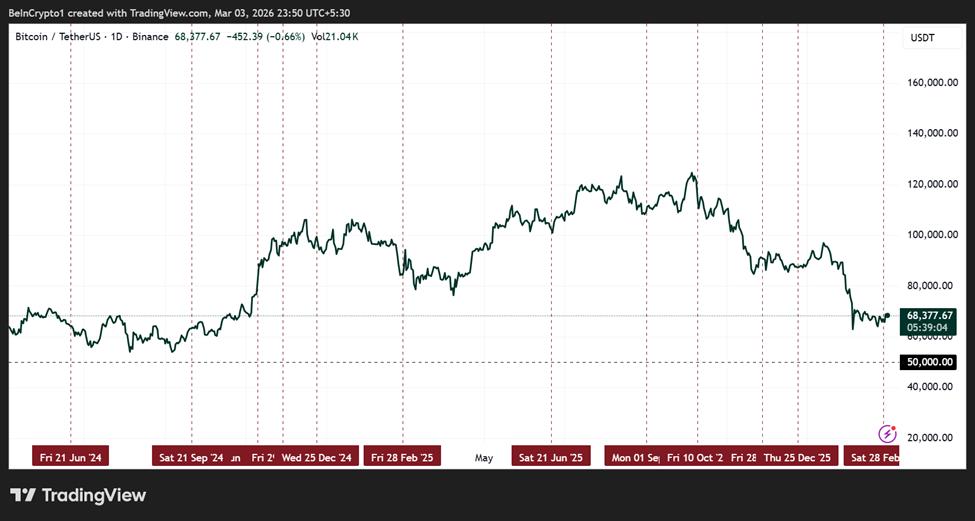 Bitcoin price performance chart. Source: TradingView
S&P 500 Futures Contract plunged 1.5–3%. Oil prices surged 5–10% depending on their proximity to energy facilities — events involving Iran typically generate the most volatility initially.
The US dollar strengthened significantly as a safe-haven asset. Yields on 10-year US Treasury bonds fell sharply as money flowed into the bond market seeking safety.
By Monday morning, the market began to recover partially. Participants were pricing in a short-term scenario, based on Trump's Capital to prioritize negotiation over prolonging conflict.
BTC has recovered 40–60% of Sunday's price drop. Oil prices have fallen back 30–50% from their initial gains. Stock Futures Contract have become more stable.
The rally on Monday was where most retail investors made a serious mistake.
This partial reversal is often misinterpreted as a signal that the market has resolved itself. In reality, it has not. In all previous cycles, the Monday stability has been unsustainable. A second, stronger, and longer-lasting decline (stocks continue to fall, oil continues to rise, crypto weakens) typically occurs within 48–72 hours as the market realizes the conflict will not be resolved anytime soon.
The best way to trade within this 60-hour timeframe is to avoid reacting immediately at the Sunday open, because:
- The price spread is too large.
- Trading algorithms were quick to seize every moment of price fluctuation.
- Market liquidation is currently insufficient to execute buy/sell orders effectively.
History shows that the opportune moment to enter trades in stocks and BTC usually appears 48–72 hours after the initial shock, not immediately.
The emerging bond market is a key indicator.
One element in Friday night's breakout pattern that most retail investors in the crypto and stock markets often overlook is the bond market's leading Vai in signaling "event resolution."
In the April 9, 2025, tariff suspension event, XEM the biggest factor in easing tensions during Trump's second term, it wasn't the weakening stock market but the bond market that drove this change.
The yield on 10-year Treasury bonds rose sharply in the days leading up to April 9th, creating pressure on the fixed-income market that the administration could not ignore. When yields change, Trump must change too.
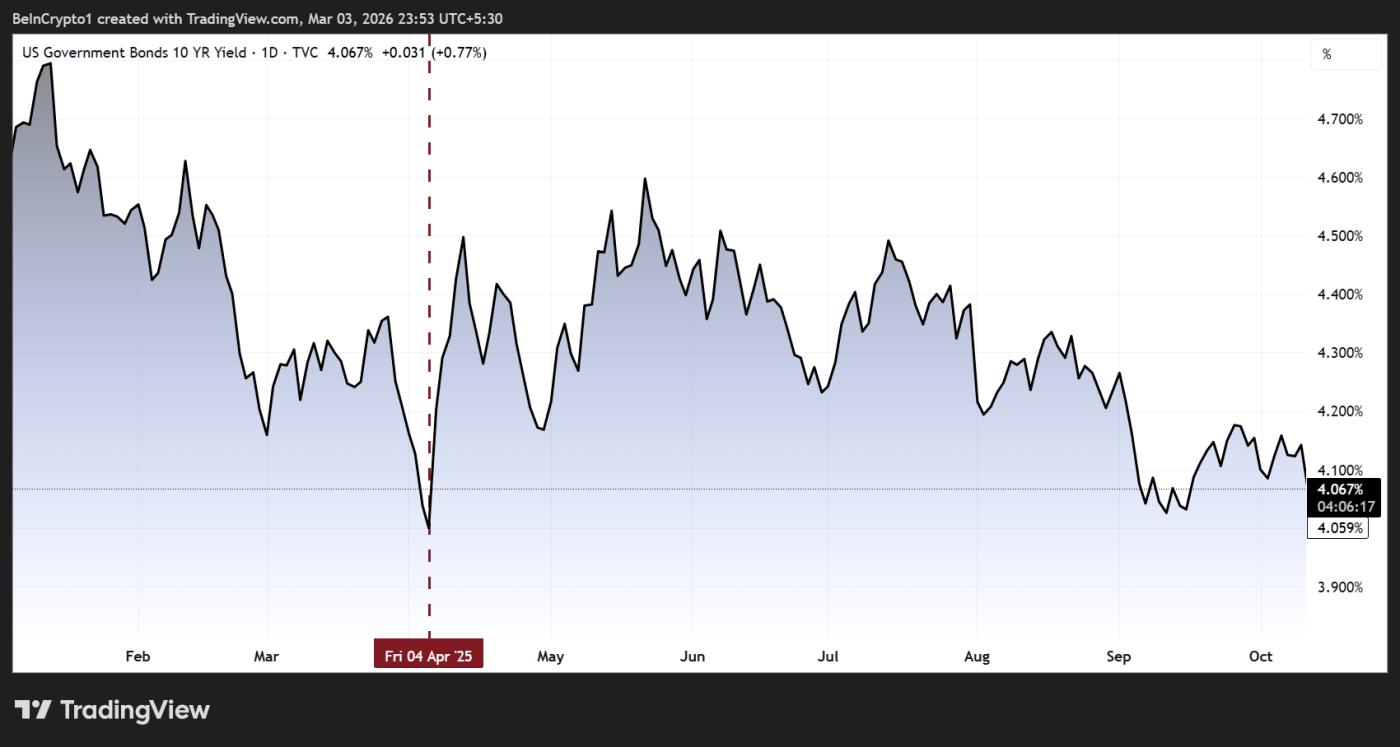 10-year Treasury bond yield before April 9, 2025. Source: TradingView
This cycle repeats itself repeatedly. The stock market weakens and then gets bought again, oil prices surge and then are XEM as a temporary phenomenon.
However, when the bond market is under excessive pressure (when volatility in 10-year bond yields signals systemic instability, rather than simply a shift toward safe-haven assets), the likelihood of de-escalation rhetoric increases significantly.
Therefore, retail investors trading on Friday night should watch the bond market as the most important indicator of Trump's potential next strategic shift, rather than relying on stock prices or crypto market sentiment.
What makes this model sustainable?
The pattern of attack on Friday night unfolded across six completely different events, encompassing military, commercial, business, and geopolitical spheres, and remained unbroken.
This sustainability stems from structural logic, not just short-term tactical measures. Trump's three main goals for his second term include:
- Cooling down inflation
- Bring gasoline prices down to $2 per gallon.
- Creating an image of a peaceful president in a midterm election year .
Each event on Friday night puts pressure on oil prices and raises inflation expectations in the short term. Choosing Friday night as the time may be a way for Trump to control this pressure.
Looking back at history, it's clear that Trump often lets the market absorb the shock by the end of the week before consumer-impacting data (like gas prices at gas stations) has a chance to spread politically.
This model is only broken when one of two conditions is met:
- Trump completely abandoned the negotiating style, shifting to a strategy of prolonging actual conflict, or
- The announcement on Friday evening no longer offered a timing advantage in the market because investors had already anticipated and anticipated the event.
During the 13 months of observation, neither of these two conditions occurred.
Until those two conditions change, the 60-hour chain following an event (Sunday's shock, partial recovery on Monday, trend confirmation on Tuesday) remains the most stable recurring trading pattern in current macro markets.
At the time of writing, March 3, 2026, with Brent crude oil prices above $85 per barrel and the Dow Jones index down approximately 1,100 points, the market is in a phase that history shows often paves the way for conditional cooling signals from Trump.
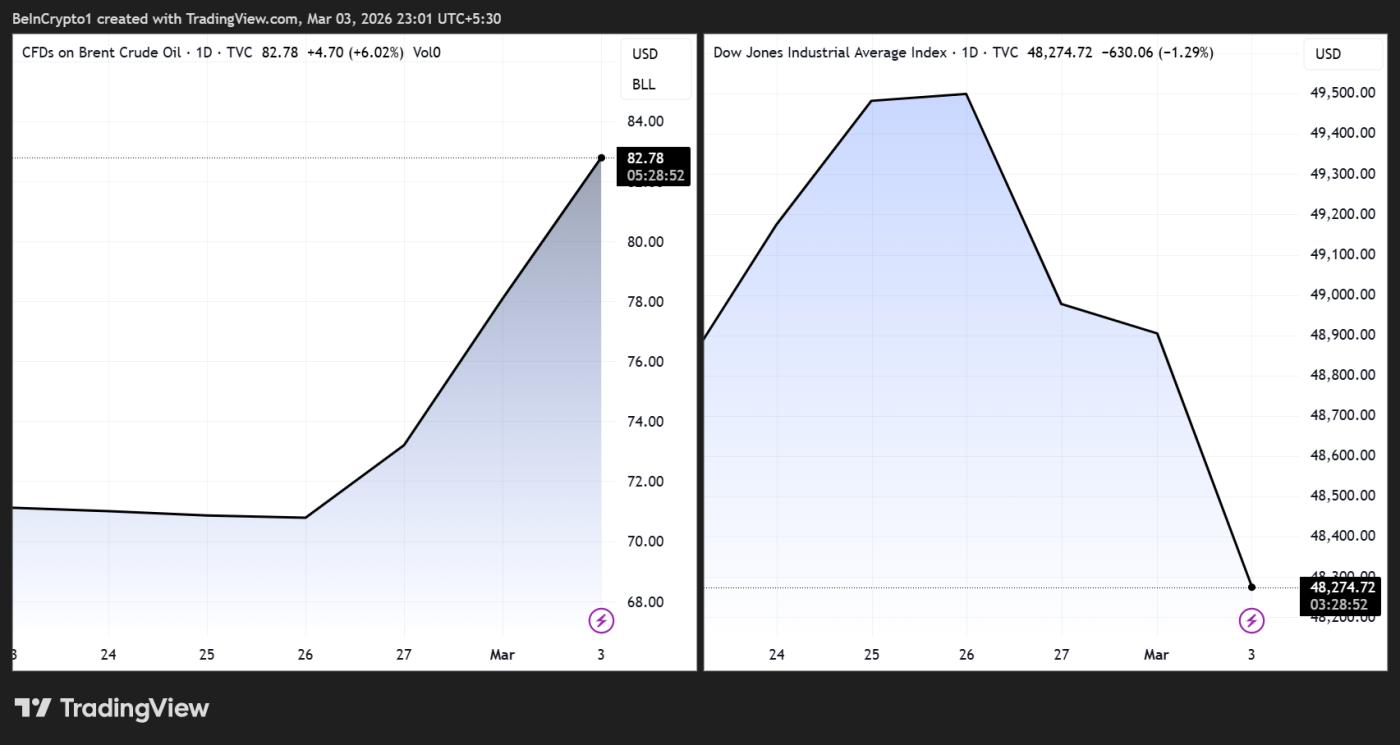 Fluctuations in Brent crude oil (UKOIL) and Dow Jones Index (DJI) prices. Source: TradingView
The situation created on Friday night is now a thing of the past. The question is whether retail investors are prepared for the subsequent volatility that this model predicts.
This article is for informational purposes only and is not financial or investment advice.
Follow us on X for the latest news updates. Subscribe to our YouTube channel for in-depth analysis from experts and reporters.