In the mysterious world of AI model naming, the suffixes "Instant" and "Lite" have long carried an inexplicable sense of cheapness.
There's a reason for this. In the past, these types of models were generally perceived as fast but slow-thinking, barely adequate for text summarizing, and prone to spouting nonsense when faced with slightly more complex reasoning tasks.
Over time, lightweight models have almost become synonymous with "just making do".

Just now, OpenAI and Google clashed again, releasing their respective lightweight models and attempting to overturn this stereotype with their hard power. Here's a simplified version:
- GPT-5.3 Instant: A more "human" intelligent assistant that significantly reduces the rate of illusions, minimizes the "AI tone," and enhances detailed writing capabilities. Communication is more natural and precise, making it suitable for scenarios with high content quality requirements (writing, professional Q&A, high-risk fields).
- Gemini 3.1 Flash-Lite: Inexpensive, fast, and efficient, it also supports "thinking level" adjustment, maintaining high throughput while accommodating deep logical reasoning, making it suitable for large-scale, high real-time batch tasks (content moderation, UI generation, NPC dialogue).
GPT-5.3 Instant: I've finally learned to chat like a normal person.
People who frequently use ChatGPT have probably experienced this frustration: you just casually ask a small question, and it insists on giving you a long explanation like, "As an artificial intelligence, I need to remind you..."
This kind of "AI-style" approach, always trying to teach people how to do things, is indeed quite annoying. Fortunately, OpenAI has really listened this time.
The newly released GPT-5.3 Instant has put a lot of effort into fixing this "problem". It has learned to give the answer directly, instead of giving long-winded explanations.
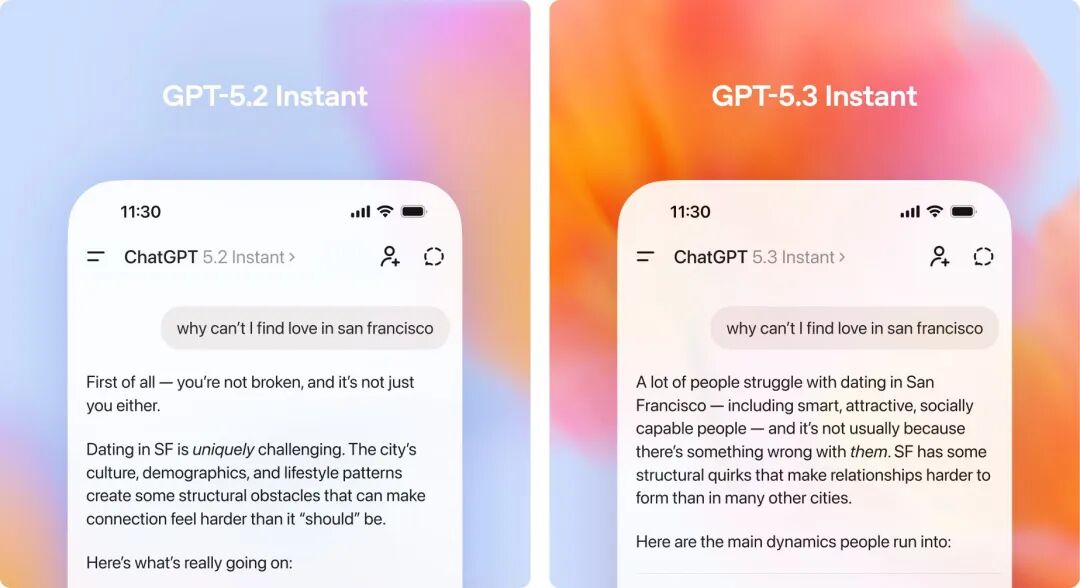
Besides being less verbose, it has also become more reliable. The old version, after searching the web, would often present you with a bunch of links and irrelevant information.
Thanks to its enhanced search capabilities, GPT-5.3 Instant proactively combines webpage content with its own background knowledge, first figuring out what you really want to ask before providing a focused answer, rather than simply outsourcing the work of a search engine to you.
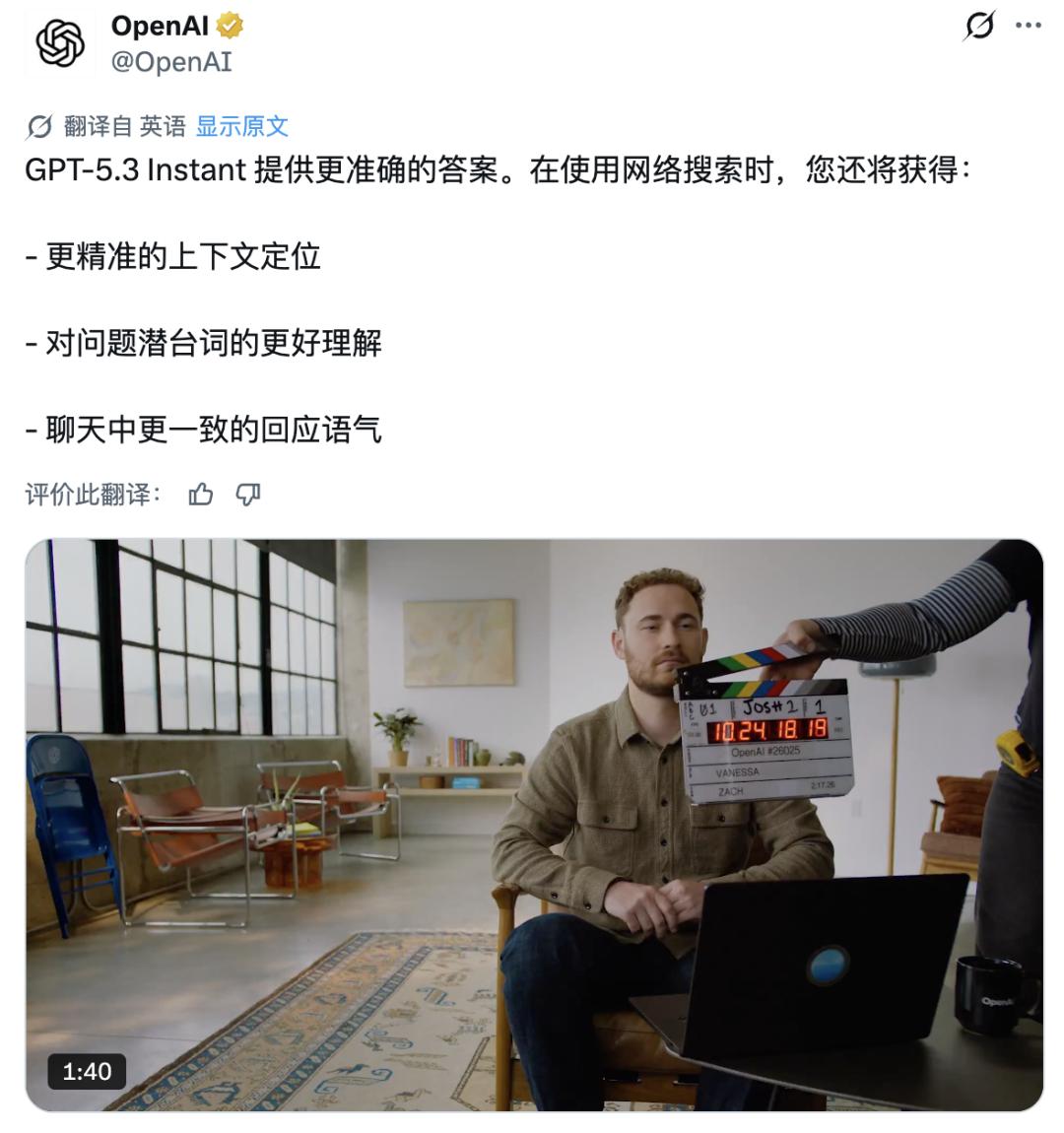
OpenAI's internal evaluation shows that the hallucination rate was reduced by 26.8% when connected to the internet and by 19.7% when relying solely on internal knowledge. The official report specifically mentions high-risk fields such as healthcare, law, and finance, where the new model shows significant improvements in both caution and accuracy.
What's most surprising is actually the change in its writing style.
OpenAI illustrated this with a comparison using a poem: Both versions describe a Philadelphia mail carrier's last day of retirement. The older version tends to pile up sentimental phrases like "carrying the city in his mailbag," while the newer version describes the "chipped blue railing" and the "gate where a dog always waits at the door." The emotions don't need to be forced; they simply flow naturally.

Adjusting the tone is also one of the core goals of this update.
Phrases like "Stop. Take a deep breath." that interrupt the flow of conversation have been deliberately reduced, resulting in a more direct overall style and less of an unnecessary "AI tone." Users can still customize the warmth and enthusiasm of the replies in the settings to find their preferred interaction style.
GPT-5.3 Instant is available to all ChatGPT users starting today, with the API name "gpt-5.3-chat-latest". Paid users can continue to use GPT-5.2 Instant in older models, but it will be officially retired on June 3rd of this year.

Easter Egg Time
Gemini 3.1 Flash-Lite: Cheap, fast, and quite smart.
Compared to the GPT-5.3 Instant's straightforward approach, the Gemini 3.1 Flash-Lite takes a purely pragmatic approach, with a very clear goal: to be fast and cheap.
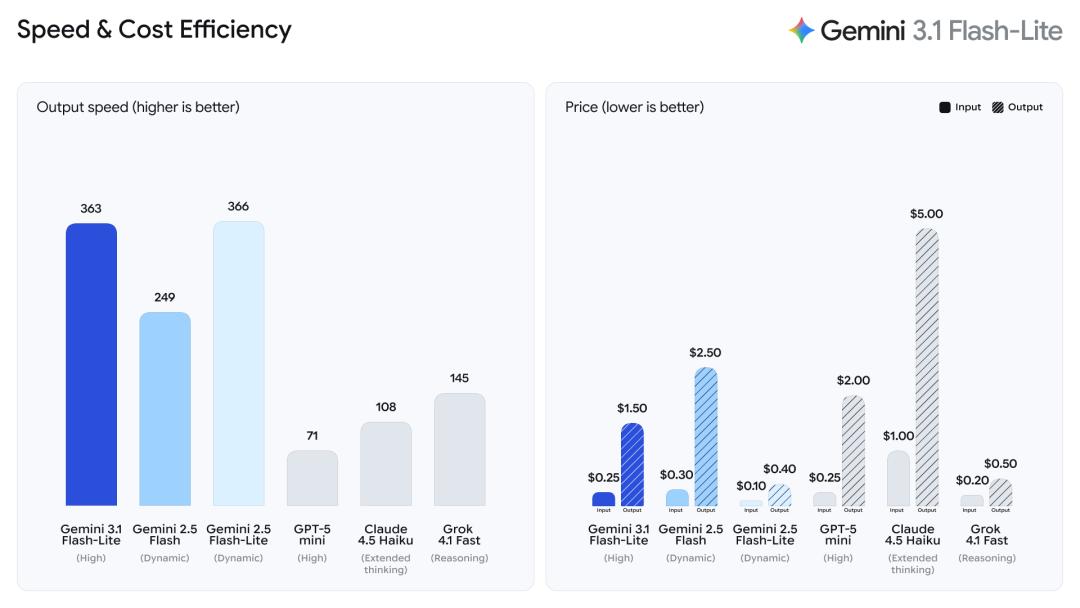
In terms of pricing, Gemini 3.1 Flash-Lite has an input price of $0.25 per million tokens and an output price of $1.50 per million tokens.
What does this mean? If you're a developer, it means you can have AI read the equivalent of five complete Harry Potter books for less than 2 RMB.
Think cheap things are no good? That shows a narrow-minded perspective.
According to Artificial Analysis's benchmark tests, compared to the previous generation Gemini 2.5 Flash, the 3.1 Flash-Lite has a first-word response time (TTFT) that is 2.5 times faster, and an overall output speed that is 45% faster. For products that require real-time response, this latency difference will be noticeably noticeable to the user.
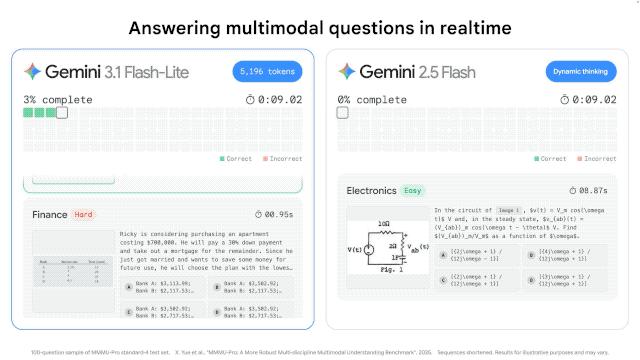
This means that while you're still blinking, its answer may already be half-generated. For applications that require real-time feedback—such as instant translation, in-game NPC dialogue, and instant UI generation—this low latency is crucial.
In addition, Gemini 3.1 Flash-Lite also has the ability to "think".
In AI Studio and Vertex AI, Google has equipped this Lite model with an option for "Thinking Levels." Developers can adjust how deep the model "thinks" based on the complexity of the task.
Simple, high-throughput tasks, such as batch content translation and content moderation, can be completed quickly with the lightest configuration; for tasks that require strict adherence to instructions, such as interface generation or simulation creation, the model can spend more time on inference to solidify the results.
This ability to "have it all" has yielded impressive results. On Arena.ai's leaderboard, it achieved an Elo score of 1432 and a GPQA Diamond (Graduate Level Question Answering) accuracy rate of 86.9%.
It scored 86.9% on the academic benchmark GPQA Diamond and 76.8% on the multimodal understanding MMMU Pro. These figures are not just "good in the same price range," but directly surpass the larger Gemini 2.5 Flash.
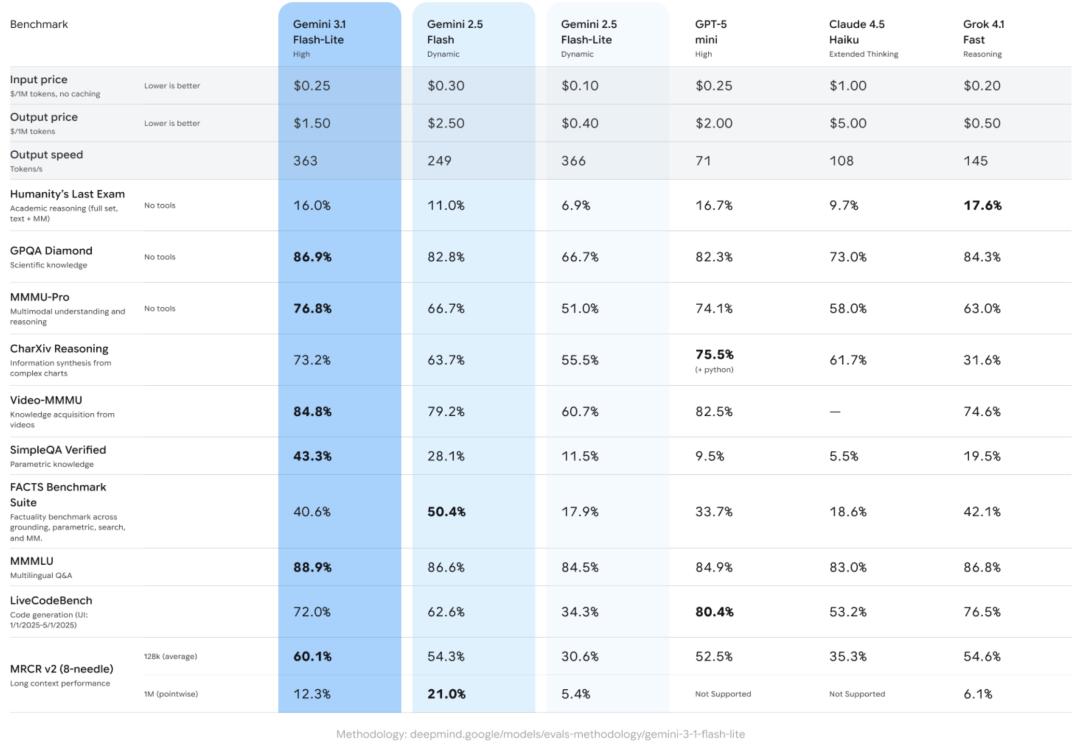
Note that the comparison here is with Gemini 2.5 Flash, not Gemini 3 Flash, which clearly shows that Google, being cunning, didn't have much confidence in this model either.
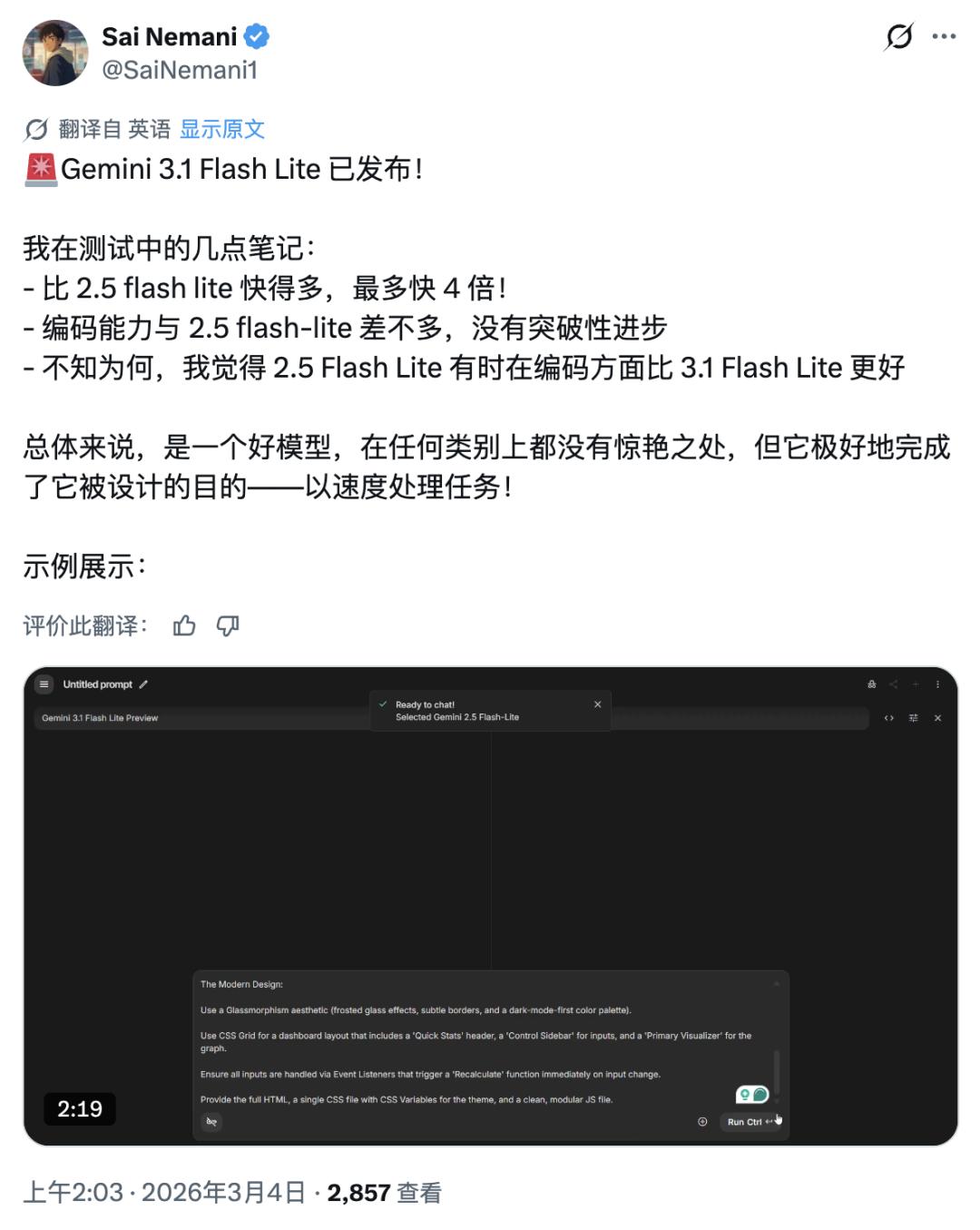
Currently, Flash-Lite 3.1 is available to developers in preview form through Google AI Studio and the Gemini API, while enterprise users can access it through Vertex AI. Early partners such as Latitude, Cartwheel, and Wheling have completed production testing and generally acknowledge its stability and instruction compliance under large-scale calls.
If you look at these two models side by side, you'll find that "Instant" and "Lite" may be finding their most suitable place.
Take the recently popular OpenClaw as an example. Its core scenario is to help users process emails and manage schedules. In essence, it is an agent that needs to perform tasks autonomously.
The requirements for models in this type of product are completely different from those of ordinary chatbots: it does not require the model to be very intelligent, but it requires the model to speak like a human, not make mistakes, and be able to withstand high-frequency calls.

GPT-5.3 Instant significantly reduces the hallucination rate, meaning the agent makes fewer mistakes when performing tasks autonomously; the reduction of the "AI voice" means that the generated emails and documents read more like real people's reading habits.
Gemini 3.1 Flash-Lite better meets the third, most critical requirement. When the agent is running in the background, it often needs to process a massive number of subtasks in parallel, making it extremely sensitive to response speed and API costs.
Flash-Lite's extremely fast response speed and affordable cost, coupled with its "thinking level" which allows for flexible allocation of computing power, make this highly flexible architecture a godsend for high-concurrency automated tasks.
Even though the long-term stability of the two models still needs to be observed, the general direction is clear: one is responsible for making the interaction more human-like, and the other is focused on speed and cost-effectiveness. In a future where everyone has a "lobster," the lightweight model will become a more natural and pragmatic choice.
Reference address attached:
https://openai.com/index/gpt-5-3-instant/
https://gemini.google.com/u/4/app/e0bea96b8f62bd1f
This article is from the WeChat official account "APPSO" , authored by APPSO who discovers tomorrow's products, and published with authorization from 36Kr.