Table of Contents
ToggleEditor's Note:
Amid the escalating situation in Iran and market volatility, investors are most prone to emotional interpretations of the news itself. However, from a longer timescale perspective, the numerous trade conflicts, geopolitical frictions, and policy games surrounding the Trump administration often exhibit a similar pattern: first, pressure is established through public rhetoric and deterrence; then, actions are gradually escalated; and finally, after sufficient risk and leverage have been accumulated, the parties return to the negotiating table.
This article attempts to analyze the Trump administration's decision-making pattern over the past year by examining this "conflict-escalation-pricing-negotiation" structure, and dissect it into an observable market rhythm. For financial markets, the real key is not just the events themselves, but how the market prices the worst-case scenario and how it quickly reverses course when uncertainty subsides.
Within this framework, oil prices, stock market fluctuations, and capital flows into safe-haven assets often reflect not only risk but also become part of political maneuvering. Understanding this logic may help to see the market mechanisms behind the news in a highly uncertain environment.
The following is the original text:
The war with Iran is escalating. Over the past 12 months, we have systematically analyzed all the geopolitical conflicts involving President Trump. What's next? This clear guide explains the potential future scenarios and what these changes mean for investors and financial markets.
Before you begin, please bookmark this article—it will be an important reference for your understanding of market trends over the next 2 to 4 weeks.
On January 17, 2026, we released our first "playbook," titled *Tariff Playbook*. At the time, President Trump was escalating tariff pressure on the EU while simultaneously pushing forward his strategic plans to acquire Greenland. This article ultimately predicted the outcome of Trump's latest round of tariffs with near-perfect date. So, how did we do it?
Since President Trump's inauguration on January 20, 2025, we have spent hundreds of hours systematically analyzing geopolitical and trade war news related to Trump. Through these studies, we have identified a very clear pattern: when Trump attempts to achieve a certain economic or military goal, he often employs a similar set of negotiation and pressure tactics when dealing with America's allies and adversaries.
Throughout 2025 and early 2026, we have consistently incorporated pattern recognition as a crucial component of our investment strategy. Today, we believe it is an opportune time to share this methodology with the X platform and the wider public. We hope this will provide a framework for reference amidst market volatility.
Step 1: The starting points of all conflicts are almost the same.
First, we need to review how the war with Iran began.
The conflict did not truly begin with the first strike against Iran on February 28 – in fact, its seeds had been sown two months earlier.
In the weeks leading up to the outbreak of war, President Trump repeatedly tweeted that "a massive armada is heading to Iran" and urged Iran to "make a deal."
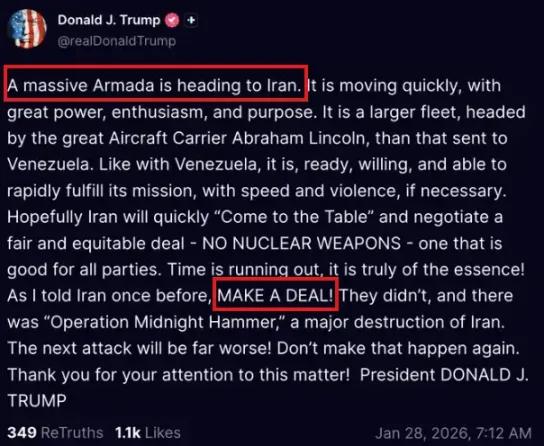
President Trump — Truth Social (January 28, 2026)
The war with Iran is the largest war President Trump has engaged in during his second term. But if you look back at the situation over the past six to eight weeks, you'll find that the strategies Trump has employed are logically almost identical to those he launched in the trade war, and even to his actions when he arrested Venezuelan President Maduro.
Why do I say that?
Of course, the two are not entirely the same in terms of the specific actions of the US military. However, in terms of the underlying strategies of negotiation and pressure, they follow the same historical pattern.
For example, consider this post from November 29, 2025: Trump announced the "complete closure of airspace over and around Venezuela." It's important to note that this announcement was made more than a month before the US ultimately arrested President Maduro. In other words, before any actual action was taken, Trump had already released strong pressure and deterrence through a series of public statements and military signals.
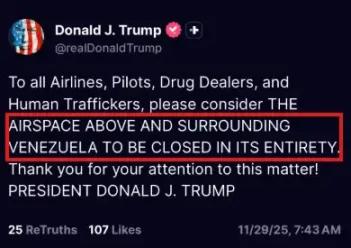
President Trump — Truth Social (November 29, 2025)
Next, let's look at this post that President Trump made on Truth Social. In fact, between January 1st and January 18th, we saw Trump post several similar messages.
In these posts, Trump stated, "It is time," and continued to pressure and threaten Denmark. Just days later, President Trump imposed widespread tariffs on the European Union.
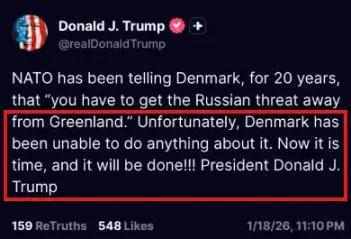
President Trump — Truth Social (January 18, 2026)
Clearly, the first step in Trump's "War Playbook" is to exert strong verbal pressure on targets through public statements in order to force them to "make a deal."
Step Two: Strategic Posture and Actual Deployment
The second step typically manifests as visible strategic preparation: strengthening deterrence and credibility through military or policy actions before actually launching full-scale operations.
On the Iran issue, this step includes: the redeployment of military forces; public coordination with allies; and Trump's so-called "Armada" fleet sent to the Middle East.
A similar pattern emerged in the Venezuelan crisis. There, the US first announced the closure of its airspace and deployed military forces in the region, while the actual action against President Maduro occurred much later.
In trade wars, this path is equally clear: investigations, administrative reviews, and public announcements often precede the actual implementation of tariff measures.
For example, consider a news report from August 11, 2025. President Trump met with Intel CEO Lip-Bu Tan. Just days earlier, Trump had posted on Truth Social that Tan had a "serious conflict of interest" and must resign immediately; there was no other solution.
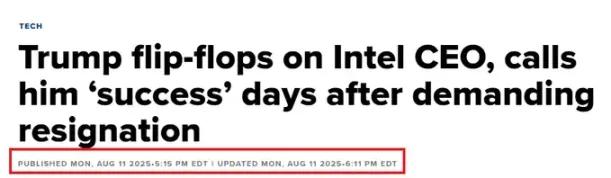
A few days later, the Trump administration announced that it had reached an "agreement" with Intel to acquire a 10% stake in the company. As shown below, this investment yielded a return of over 80% in less than two months.
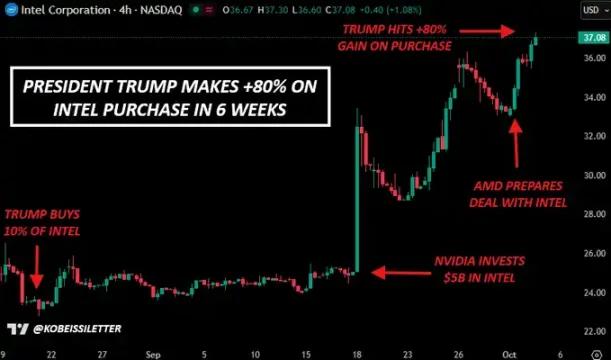
To reiterate, President Trump’s goal has almost always been to make a “deal”.
In some cases, the conflict ends in the second phase. After the initial threats and pressure have laid the groundwork, the two sides reach an agreement through negotiations, and the situation is resolved in this phase.
If the problem is not resolved, proceed to step three.
Step Three: The "Strike" on Friday Night
When Trump’s initial pressure fails to work, he typically escalates his actions further, turning to military force or economic warfare.
A very consistent tactical feature of Trump's escalation strategy is timing. Many major announcements, key strikes, or sudden policy changes tend to occur on Friday evenings—after the US stock market has closed and before liquidity has fully formed in the futures market.
Why choose this time? Because Trump is highly sensitive to sharp fluctuations in the financial markets.
Here are some important actions that took place on Friday night or Saturday morning:
* US and Israel launch joint airstrikes on Iranian nuclear facilities – June 21
* US military strikes Caribbean drug ships – September 1
* Threatening to impose 100% tariffs on China – October 10
* Venezuelan airspace closed - November 29
* Nigerian military operation – December 25
* US airstrikes on Iran – February 28
In fact, since 2025, many geopolitical or policy actions have occurred after the market closes on Fridays, a timing that is considered a deliberate strategy.
If a major geopolitical event occurs during trading hours, the market's price discovery mechanism often quickly becomes disordered: market liquidity immediately declines, quantitative trading algorithms amplify volatility, and sharp intraday fluctuations can easily trigger a chain reaction of panic.
In contrast, announcing the action on Friday evening would provide a buffer period.
Investors, institutions, and governments can use the entire weekend to digest information, assess risks, consult with advisors, and simulate various scenarios.
By the time the market reopened, all parties had a more comprehensive understanding of the situation.
For the Iran situation, this crucial moment is February 28th. Typically, on the Sunday of the same week (before the futures market opens), Trump often signals that a deal is "possible," providing the market with a sense of easing.
But this time it obviously didn't happen, so the situation moved into the fourth stage.
Step 4: Risk premium spreads across various assets
Following the third shock event, when the futures market opens at 6 p.m. (Eastern Time) on Sunday, prices of various assets typically experience sharp fluctuations.
However, the market often remains skeptical about whether the conflict will last in the long term.
The reason is simple: everyone knows that Trump ultimately wants to close a deal. Therefore, the initial sharp fluctuations in the stock, commodity, and bond markets often see a partial pullback before the market opens on Monday.
For example, consider the market performance on March 2 (the day before we wrote this article): the price of crude oil and the S&P 500 index at that time demonstrated this typical market reaction pattern.
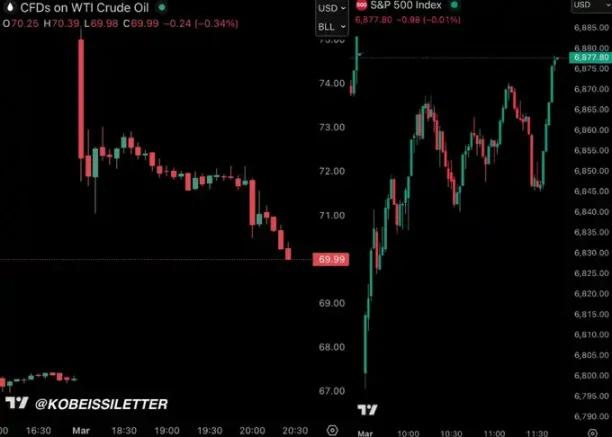
S&P 500 and WTI Crude Oil – March 2, 2026
WTI crude oil prices once gave back about 70% of their gains, while the S&P 500 even briefly turned positive yesterday. However, this trend was reversed again today – oil prices hit new highs, while the stock market refreshed its recent lows.
This shift occurred because President Trump understood that the markets also knew he always preferred to "make deals." Therefore, despite initial market bets that the conflict would end quickly, the reality was that it continued to escalate.
The situation has now entered the fifth stage.
Step 5: Trump hints the conflict could be "protracted".
When investors anticipate Trump will "back down" and rush to buy the dips, the market is often caught off guard by sudden changes. As news headlines worsen, many believe Trump will soon begin to ease pressure on his targets. However, the reality is often quite the opposite.
As his statement on March 2nd showed, Trump now says that "wars can go on forever" and that the United States has "an unlimited supply of mid-to-high-end weapons."
It's important to note that the word "forever" is in quotation marks. This is actually a tactical wording: Trump is using it to convey the message that he doesn't want the war to continue indefinitely, but that the United States is fully capable of doing so if necessary.
This is also a negotiation strategy.
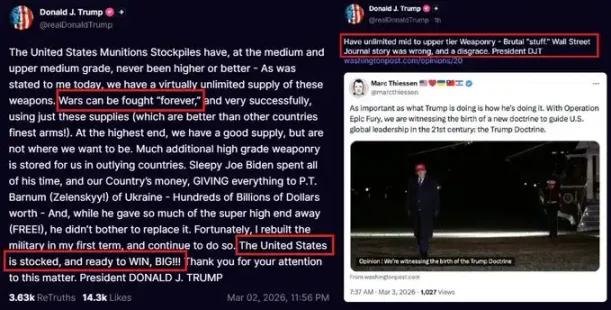
President Trump – March 2 & 3, 2026
Since the outbreak of the conflict between the US and Israel and Iran, and even before the war actually began, our assessment has been that President Trump would not benefit from a protracted war. Even with recent expressions of "forever war," we maintain this view.
Why? Because the Trump administration’s three most important policy goals include: becoming a “peace president”; suppressing inflation; and reducing U.S. gasoline prices to $2 per gallon.
Engaging in a protracted war with Iran would run counter to these core policy objectives. Especially in a crucial midterm election year, a short-term and sustained conflict would significantly impact these agendas.
Step 6: The market begins to price in long-term conflicts.
As of March 3, the sixth step in our "Action Manual" seems to be beginning to show results.
Take a look at the market performance below:
Brent crude oil prices rose above $85 a barrel for the first time in nearly two years;
U.S. stocks have given back all of their previous gains and hit a new weekly low.
Market risk aversion intensified rapidly, and funds accelerated their withdrawal from risky assets.
On that day, the Dow Jones Industrial Average fell by approximately 1,100 points in a single day.
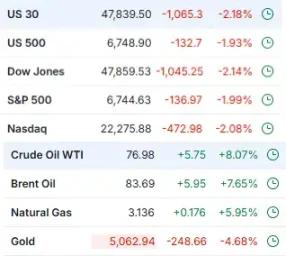
US Markets and Commodities – March 3, 2026
At this stage, the market no longer assumes that this is just a brief, symbolic military conflict.
The rise in oil prices to over $85 a barrel does not reflect a brief, weekend-level skirmish, but rather a pricing in supply chain risks, rising tanker insurance costs, and the potential partial closure of the Strait of Hormuz.
Meanwhile, the drop in U.S. stocks to new weekly lows was not merely an immediate reaction to a news headline, but rather a reassessment of the duration risk of the conflict.
This is precisely the psychological turning point that Trump's strategy is trying to create.
When the first dip occurs, investors often choose to buy the buy the dips because they believe an agreement will be reached soon. During the second dip, investors continue to buy because they believe the escalation is only temporary. It's only during the third dip that the market's positioning structure begins to truly adjust.
So-called "smart money" is often able to consistently identify moments when market sentiment is excessively biased in one direction, especially when retail investor participation is increasing.
In 2025, our investment strategy is largely based on this: how to anticipate the next market turning point by identifying historical patterns of Trump in economic conflicts.
As shown below, since 2020, our investment strategy has returned nearly five times the S&P 500 index. In 2025 alone, our S&P 500 trading strategy achieved a return of 21.8%, significantly outperforming the index itself. This is because we are able to identify key shifts in market sentiment and trends in advance.
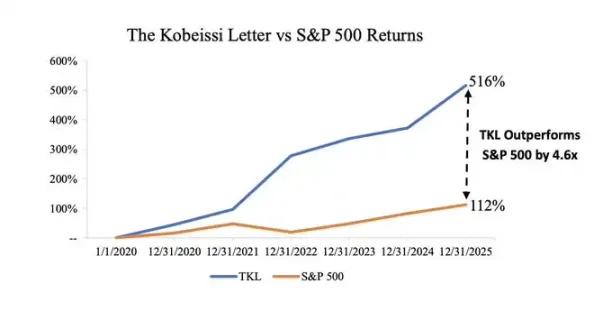
Performance of the "Kobeissi Letter" strategy (2020–2025)
This brings us to step seven.
Step 7: A "conditional downgrade signal" appears.
Before explaining this step, it's important to note that the timeframe between steps six and seven is highly uncertain. For example, during the trade war in early 2025, this phase lasted for several months before a tariff "pause" finally occurred on April 9th. This shift was largely driven by pressure from rapidly rising U.S. Treasury yields, as illustrated below.
Typically, some kind of catalyst emerges, prompting Trump to choose to back down or de-escalate the situation. This catalyst might be:
One party to the conflict takes the initiative to propose "reaching an agreement";
Or there may be some significant change or stress signal in the financial market.
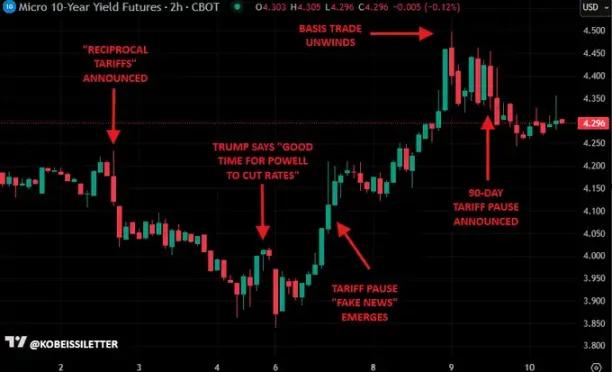
10-year US Treasury yield – April 9th tariff "pause"
When risk premiums widen significantly in the stock, commodity, and fixed-income markets, Trump often begins to release carefully crafted conciliatory signals. It's important to note that these statements typically do not imply genuine concessions.
In the context of a war with Iran, the situation could take two turns: either the Iranian government changes, or a major event occurs that has a structural impact on the US and global economies.
During this phase, official rhetoric will gradually shift towards a conditional solution. Statements will begin to emphasize that negotiations are possible if certain conditions are met; simultaneously, terms such as "talks," "consultations," or "framework agreement" will gradually appear in the narrative. The core objective of this phase is to test the reactions of the adversary and financial markets without relinquishing strategic initiative.
Recent examples include:
The tariff agreement reached between Trump and China in October 2025;
An agreement on Greenland reached with the European Union in January 2026;
A trade agreement was reached with India on February 9, 2026.
These agreements almost all followed a similar path: first a threat → then action → further escalation → eventually a gradual de-escalation.
Step 8: The Feedback Cycle Between Markets and Politics
One often overlooked factor in this strategy is that financial markets themselves gradually become part of the negotiating environment. Trump has repeatedly demonstrated that he pays close attention to stock market performance, energy prices, and inflation expectations, and considers these factors as part of a broader political narrative.
If the conflict lasts too long and causes a sharp rise in oil prices, it will directly impact the three core policy objectives he has repeatedly emphasized: to portray himself as a leader committed to peace; to curb inflationary pressures; and to lower gasoline prices.
Rising energy costs will quickly translate into consumer sentiment and inflation data, which in turn will have a significant impact on the political landscape during the midterm election cycle.
According to estimates by JP Morgan, if the Strait of Hormuz were closed, oil prices could rise to $120–$130 per barrel. This would mean that the US CPI inflation rate could rise to around 5%.
The last time the United States experienced 5% inflation was in March 2023, when the Federal Reserve was in the midst of an aggressive interest rate hike cycle.
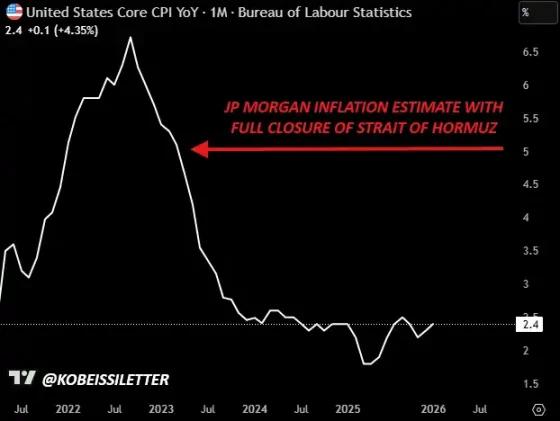
In the current environment, several key indicators deserve close attention: Brent crude oil prices remaining above $90 per barrel will significantly exacerbate market concerns about inflation; a stock market decline of 5% or more will noticeably alter investor sentiment; and a gasoline price increase of more than 10% will severely damage consumer confidence.
Once these thresholds are reached or approached, the probability of news about negotiations appearing in the market increases significantly.
Important note: This is precisely when "smart money" begins to position itself for buying – because at this point, retail investor sentiment has often completely collapsed.
Step Nine: Reaching an Agreement and Narrative Shaping
In the context of the Iran war, step nine is conditional.
If the Iranian government collapses, the US and Israel will likely declare the mission a success and the military objectives achieved. In this scenario, this "tariff action manual" strategy will end before the ninth step even begins.
If the above scenario does not occur, the next stage begins: within this framework, almost all major confrontations ultimately end in negotiation and are portrayed as a strategic victory. The specific agreement structure may vary depending on the situation, but the narrative logic tends to remain consistent: "maximum pressure" forces the other side to make concessions.
In past trade conflicts, agreements reached have often been described as proof of the economic advantages brought about by escalation strategies (such as trade agreements reached with China, the European Union, India, Vietnam, and Japan).
In corporate-level confrontations, the usual approach is to first exert public pressure, followed by equity investment or structural adjustments (such as the Intel-rare earth related agreement).
In geopolitical conflicts, ceasefire agreements or framework arrangements are interpreted as a way to force the opponent to compromise through a hardline stance (such as the many conflicts that Trump ended in 2025).
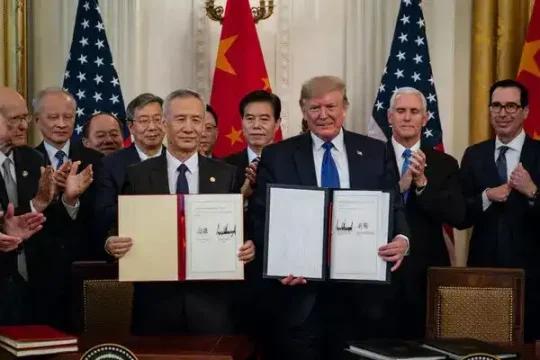
If the conflict in Iran continues along the existing pattern, a real solution will often only emerge after sufficient leverage and pressure have been demonstrated.
Such solutions could include: a ceasefire agreement linked to concessions on the nuclear issue; regional security arrangements with enforcement mechanisms; or sanctions adjustment schemes based on compliance conditions.
The specific structure of the agreement is not the most crucial factor; what truly matters is the timing of the agreement and the narrative style.
Step 10: Dramatic Asset Repricing and the Political "Victory Narrative"
The final stage of Trump's conflict strategy did not end with the announcement of the agreement. The real endpoint is the market's reaction to the agreement and the subsequent political narrative.
Historically, once a clear framework for a solution emerges, financial markets rarely experience a gradual adjustment; instead, they tend to undergo a rapid and dramatic repricing. This is primarily due to changes in market positioning.
When negotiations become truly credible, investors typically have already adopted a highly defensive portfolio: energy asset allocations have increased significantly; equity risk exposure has been significantly reduced; and market volatility is high due to high uncertainty.
When this uncertainty suddenly disappears, these positions will be quickly liquidated, triggering a sharp price reversal.
Similar situations occurred multiple times in April 2025, August 2025, October 2025, and January 2026, as shown below.
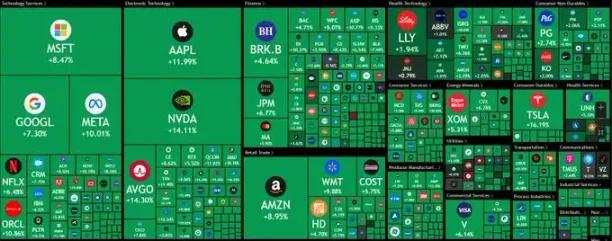
In past trade wars, stock markets have often surged once tariffs are suspended or a framework agreement is reached, even if deeper structural problems haven't actually been resolved. Similarly, during escalating geopolitical conflicts, oil prices typically fall rapidly once the market confirms that shipping lanes will reopen and the conflict will not escalate further regionally.
Such price revaluations often come very dramatically because what drives market changes is not a sudden improvement in fundamentals, but rather the rapid decline of risk premiums. Market rallies are not due to everything becoming perfect, but rather because the probability of the worst-case scenario has been significantly reduced.
To reiterate, even if it's just a temporary process of letting the market price in the "worst-case scenario," it's a very important part of Trump's negotiating strategy.
We maintain our assessment that if the US-Israeli military action against Iran does not lead to the collapse of the Iranian government in the coming days or weeks, then negotiations will eventually return to the table.
Trump does not want a “perpetual war,” as that would be inconsistent with any of his economic goals.
What might happen in the next 2–4 weeks?
Currently, the situation appears to be in a transitional phase between a peak in escalating rhetoric and the beginning of signals of conditional de-escalation. Compared to when the initial airstrikes occurred, the market is now pricing in a more protracted conflict.
Oil prices have broken upwards, the previous brief period of stability in the stock market has disappeared, and the inflow of defensive funds is accelerating significantly.
Historically, this is typically a phase where pessimism begins to solidify widely in market positions. However, at the same time, the probability of reaching an agreement also subtly increases beneath the surface, and "smart money" often begins to look for trading opportunities during this phase.
This is already reflected in the current price movements of silver and gold. Both metals have experienced significant declines, with silver falling by approximately 20% in the past 24 hours, even as the market as a whole continues to repric its risk premium.
This clearly indicates that there is a large-scale exit and wait-and-see behavior in the market, and holding cash is being regarded by more and more investors as the most direct hedging option.
"Smart money" often focuses on observing these capital flows.
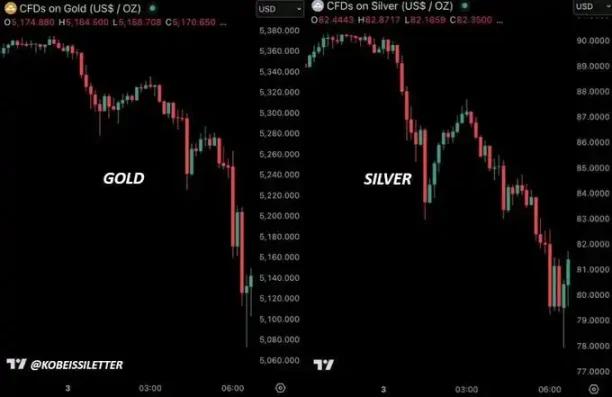
Gold and Silver – March 3, 2026
One last thing: Don't forget your true goal.
Over the next few weeks, there are roughly three main scenarios.
The first scenario is: the conflict briefly escalates, pushing oil prices higher and stock markets lower, followed by a sudden shift in rhetoric and the emergence of news about negotiations. In this case, due to the market's previously overly defensive positioning, asset prices could quickly reverse once signals of negotiations appear.
The second scenario is that the conflict unfolds in a controlled but sustained manner. Oil prices remain high but do not surge dramatically; the stock market fluctuates within a range, awaiting further clarity on the situation. In this case, a solution may not emerge until later this month, after sustained pressure.
The third scenario is a significant escalation of regional conflict, such as substantial disruptions to shipping routes or direct involvement of more countries. In this case, oil prices could rise to triple digits, forcing a deeper repricing of global risk assets. Considering historical experience and the fact that we are currently in a crucial midterm election year, we believe this outcome is relatively unlikely, but not entirely impossible.
Ultimately, let’s not forget one fact: in the nearly 13 months since Trump took office, almost every major conflict involving him has ended in a deal.
Trump is essentially a skilled negotiator and dealmaker. If you can identify and follow this pattern, you will often benefit from it.
About our strategy
In today's volatile market environment, investors who can remain objective and strictly adhere to systematic methods are finding one of the most attractive trading environments in recent years.
It is this objective and systematic investment approach that has enabled our strategy to consistently outperform market benchmarks. As shown below, since 2020, our investment strategy has achieved a cumulative return of nearly five times that of the S&P 500.