Author: Thejaswini MA
Original title: The Frozen Fortune
Compiled and edited by: BitpushNews
The house—your parents never saw it as an investment. They bought it because they needed a place to live, because the mortgage was manageable with a paycheck, because the schools in the neighborhood were great, and because it was the obvious choice at the time. They painted the living room twice, replaced the roof once, and argued for years about kitchen renovations but never actually started. They raised their children in the house and grew old in the house. In the process, unintentionally, they built the most valuable asset they ever owned.
Now they are worried about how to pay for medical expenses, while the house is now worth as much as $1.2 million.
Currently, one figure repeatedly appears in financial research : $124 trillion.
This is an estimated asset valuation that will flow from the older generation to the younger generation over the next 25 years. Analysts call it the "Great Wealth Transfer." In the media, it sounds like pure good news for the heirs.
But is that really the case?
The wealth transferred in this way is largely illiquid. Most of it is real estate. These houses were bought by the baby boomers when prices were reasonable, and after decades of repayments, they have witnessed the appreciation of property values, ultimately becoming the primary store of their wealth.
The generation inheriting these houses witnessed firsthand how similar housing prices made homeownership unaffordable for them. Now, these houses are about to be handed to them—houses with poor liquidity, emotional burdens, complex legal relationships, and increasingly difficult to use practically.
This is the problem that the "$124 trillion" headline failed to capture.
To understand why this is important, you must understand what has changed about housing since the 1960s. It has changed its category. Initially a refuge, a place to live, it has gradually become the primary financial instrument for the American middle class. For families outside the high-income bracket, a house is not just one of many assets; it is the only asset. Real estate equity constitutes the largest item on the median American household balance sheet, dwarfing the sum of retirement accounts, stocks, and all other assets.
Baby boomers amassed their wealth under conditions that no longer exist. When they bought homes, the price-to-income ratio was between 2 and 3.5. They paid off their loans over decades of real wage growth. By the first quarter of 2025, the real estate held by baby boomers had reached $19.5 trillion, a fraction of what it was in 1990.
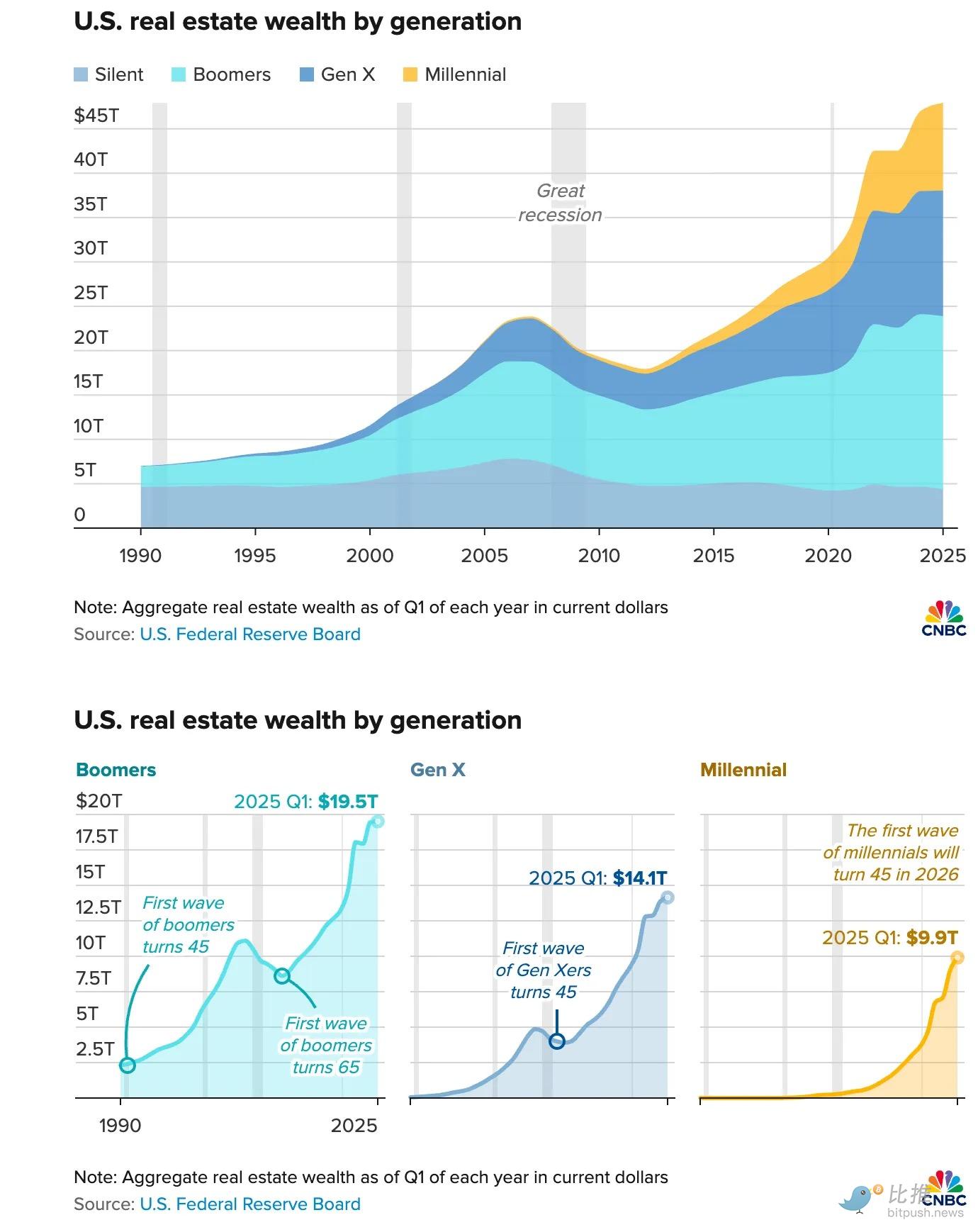
(Data from cnbc.com)
Today's millennials entering the market face price-to-income ratios more than double what their parents faced when they bought their homes. They carry student loan burdens their parents never experienced. They face mortgage rates that make monthly payments on median-priced homes nearly unaffordable for middle-income families. The down payment alone—in a market where home prices are rising faster than savings are accumulating—has become a trap.
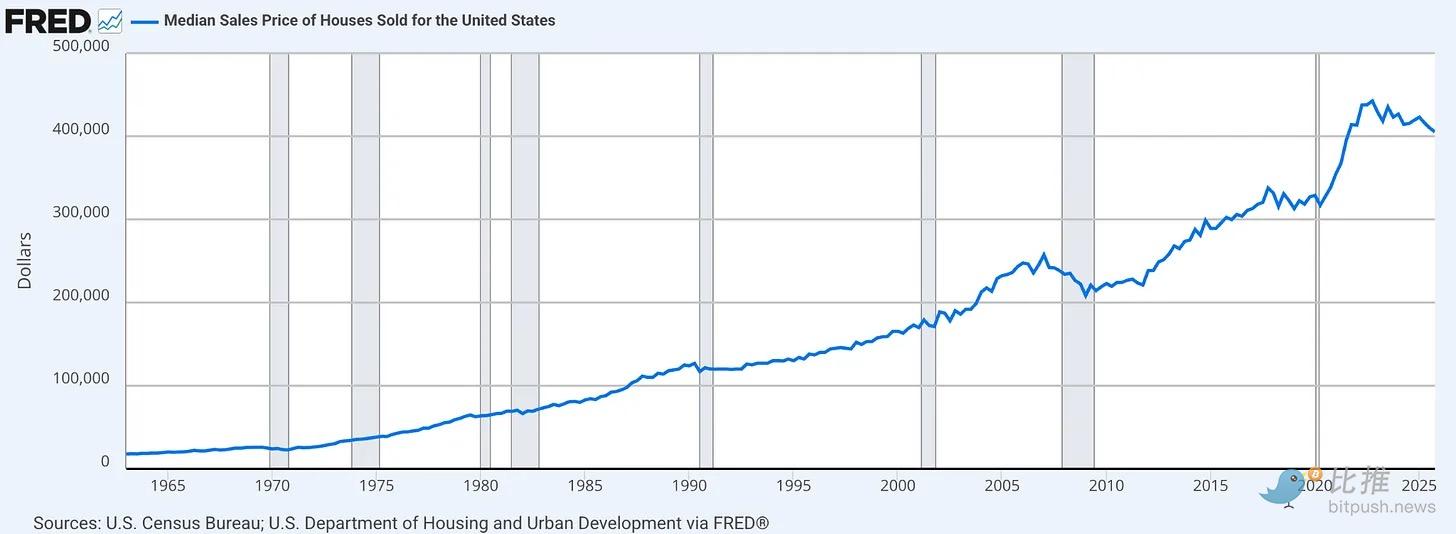
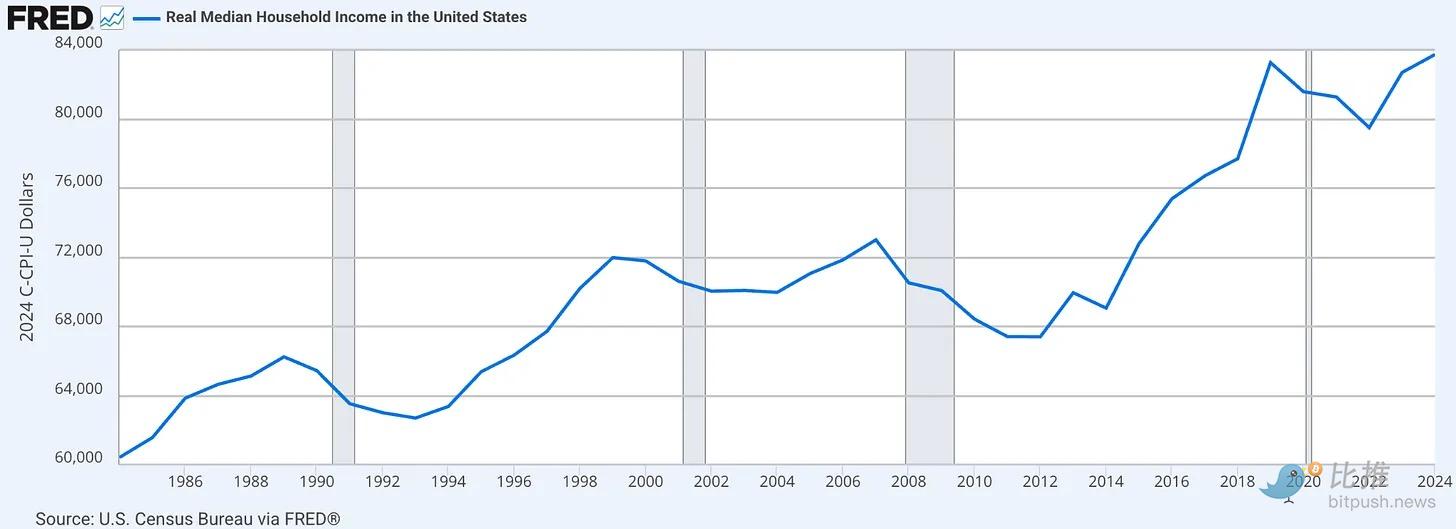 @fred.stlouisfed Data Charts
As a result, the generational divide is no longer cyclical. The generation that could afford a house has bought one, while the generation that couldn't is preparing to inherit what their predecessors left behind.
Real estate is one of the least liquid assets that people can hold.
You can't sell 10% of the house when you need cash. You can't move it when your job changes. You can't cleanly divide it among your four siblings unless you trigger a legal process that could take 18 months and deplete your estate funds. Inheriting a million-dollar house in a city you can't afford to live in isn't good news; it's a dilemma: sell it? Keep it and bear the maintenance costs? Rent it out and become a landlord? Or spend years negotiating with your siblings about which option to choose?
Baby boomers currently own about 40% of the nation's housing wealth. 61% say they would never sell their home. But when you understand the incentive structure, you realize it's not just stubbornness. Selling a home triggers hefty capital gains taxes on decades of appreciation; it resets a 3% mortgage rate to 7%; and in California, it could instantly increase property taxes tenfold. Moreover, there simply aren't any affordable homes on the market that would allow them to downsize.
So they chose to stay. The housing market ceased to circulate. Young buyers were shut out, awaiting inheritance—in many cities, the only realistic way to buy a home. When inheritance finally occurred, the liquidity problem didn't disappear; it simply shifted to the next generation.
Nansen co-founder Alex Svanevik described the upcoming situation as a "tsunami." He stated in January 2026 that approximately $100 trillion will be inherited over the next 20 years, and the forces driving this money into cryptocurrencies will be structural, not speculative. He estimated that if only 3% of these inherited assets flow into the crypto market, its market capitalization could double from its current size.
3% may not sound like much, but consider who's inheriting it: According to a recent OKX survey, Generation Z trusts cryptocurrency five times more than Baby Boomers. Millennials already hold more digital assets than their parents. We don't need to convince them that cryptocurrency is real; they've grown up using it much like previous generations used savings accounts. What they need is for inherited wealth to connect with them in a familiar way.
This is where the gap lies. And " tokenization " is the way to bridge this gap.
Tokenization of Real-World Assets (RWAs) means representing ownership of physical assets on the blockchain. Once implemented, ownership can be divided, transferred without intermediaries, stored in wallets, used as collateral, or traded without requiring agreement from all stakeholders. Previously cumbersome friction costs become manageable.
Specifically, when it comes to inheriting real estate, tokenization solves four currently unsolvable problems:
Liquidity: Tokenized properties can be partially sold. An heir urgently needing $50,000 but holding a $500,000 share of a property can sell 10% of their ownership instead of having to sell the entire house or receive nothing. This also simplifies mortgage lending significantly, as the underlying property can be liquidated, making underwriting easier for lenders.
Distribution: When four siblings inherit a property, tokenization allows each person to digitally hold their exact share, independently trading, selling, or retaining it without needing to reach a consensus on the disposal of the physical asset. When ownership is “programmable,” legal disputes that currently deplete inheritances will be greatly simplified.
Liquidity/Mobility: Tokenized real estate can be included in investment portfolios alongside assets such as stocks and cryptocurrencies. It can be managed remotely, transferred across borders, and ultimately used as collateral in DeFi (decentralized finance) protocols. The "geographical restrictions" of real estate are no longer a constraint on the financial flexibility of heirs.
Access: For heirs who cannot afford to buy a house but are destined to inherit property, tokenization allows them to participate in advance. For younger generations who receive a smaller inheritance share, fragmented ownership allows them to hold a physical asset without being forced to liquidate it immediately.
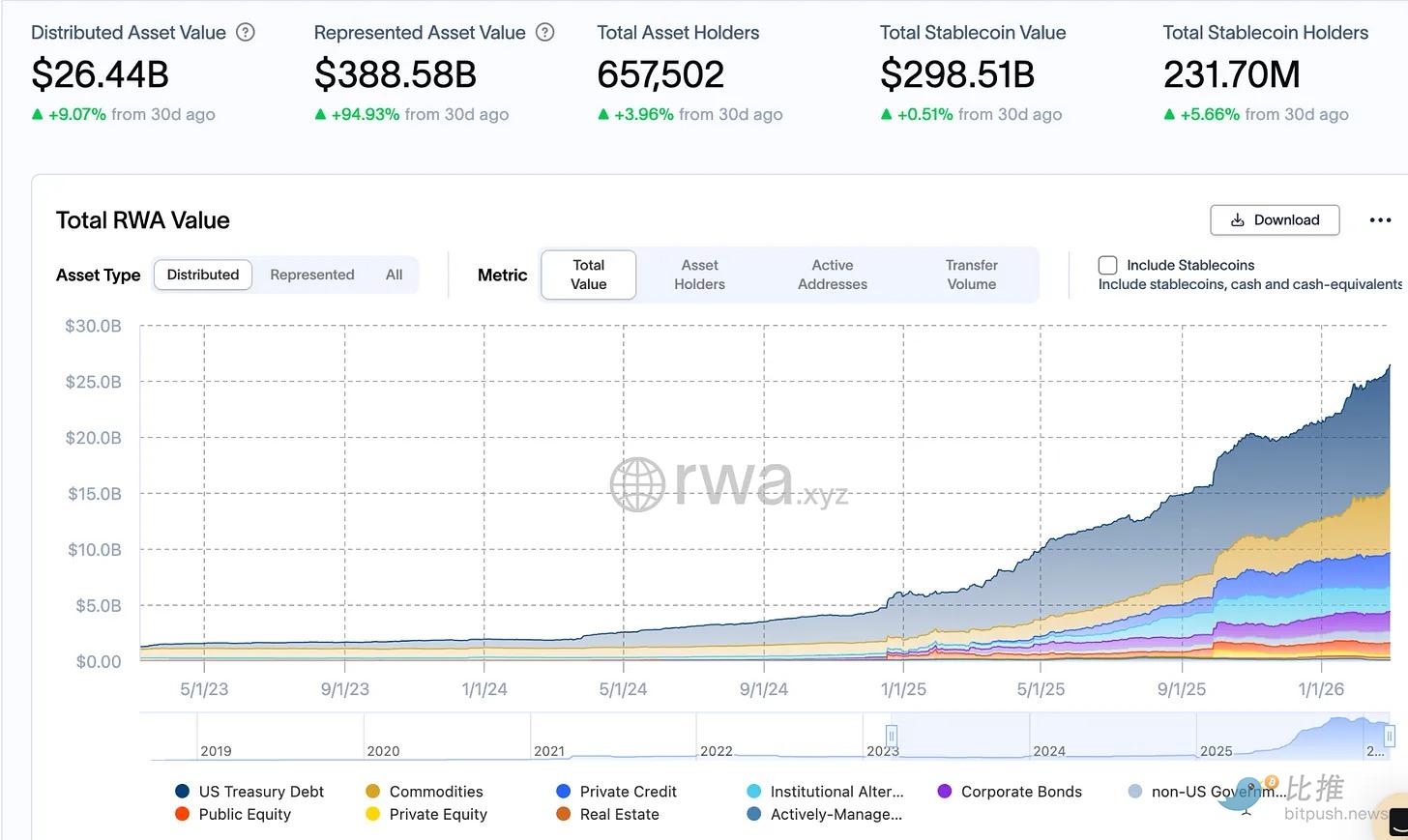
The market is already moving in this direction. As of early 2026, the total value of tokenized real-world assets had reached $26 billion in distributed assets and $388 billion in represented assets, showing strong growth momentum. While real estate currently only accounts for a small portion of this, the infrastructure being built—wallets, on-chain settlement, programmable ownership—is far more functional than it was two years ago. Svanevik points out that the products Nansen is developing today simply wouldn't have existed two years ago because the underlying infrastructure wasn't ready. Now, things have changed.
This does not mean that tokenization will solve the housing affordability crisis. House prices will not fall simply because ownership becomes more portable. The market's structural problems—limited supply, locked-in interest rates, and the long-term decoupling of house prices from wages—remain unchanged. Moreover, we are still unsure whether “financializing” the last illiquid asset owned by most households will improve their lives or merely make their troubles easier to trade.
Tokenization addresses a more specific and pressing issue. It concerns what happens when $25 trillion in real estate wealth shifts from a generation accustomed to storing everything in real estate to a generation that believes wealth should be fluid, digital, and not tied to a specific physical address.
Currently, tools for unlocking homeowner equity fail for most homeowners. Cash-out refinancing means giving up a 3% interest rate for a 7% one. Home equity loans (HELOCs) require income verification that retirees often cannot meet. Reverse mortgages carry a 30-year stigma and create complex inheritance issues. Selling the home triggers both tax traps and interest rate resets. Each option comes at a cost that homeowners can hardly afford.
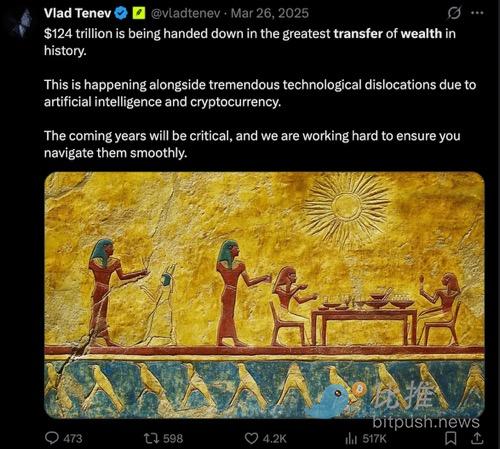
A wealth transfer is already underway, currently at a rate of approximately $1.5 trillion per year, and it's accelerating. The first wave of millennials will turn 45 in 2026. JPMorgan Chase , BlackRock , and Franklin Templeton have all ventured into tokenized assets over the past two years, building the infrastructure for this moment. Robinhood CEO Vlad Tenev wrote last year that this wealth transfer is occurring alongside technological innovation, making the coming years crucial.
For this generation of inheritors of wealth, financial assets are no longer just pieces of paper hidden in filing cabinets, but numbers living in their mobile phone wallets.
The real obstacle is that the current property transfer system still relies on paper documents and intermediaries—and they no longer think in that language.
Each generation accumulates wealth using the language they are familiar with. But for the next generation to inherit it, they must first translate it.
Twitter: https://twitter.com/BitpushNewsCN
BitPush Telegram Community Group: https://t.me/BitPushCommunity
Subscribe to Bitpush Telegram: https://t.me/bitpush