Author: CryptoNarratives (Viktor)
Compiled by: TechFlow TechFlow
TechFlow Summary: This monthly recap summarizes all the key trends in the crypto market in February: BTC's dramatic $60k rebound, the panic and rapid recovery following the attack on Iran, the anticipation and speculation surrounding the ZRO meeting, and the manipulative cryptocurrencies that have dominated the bear market. It's information-dense and serves as valuable background material for understanding the current market structure.
The full text is as follows:
BTC Timeline
Here is the main timeline for February:
Gold prices retreated sharply after peaking at the end of January, falling from $5,600 to $4,400. The bottom was reached on February 2nd, followed by a rapid rebound to $5,100 within two days. Silver also experienced a collapse from its highs, plummeting nearly 50% from $121 to $64 on February 6th.
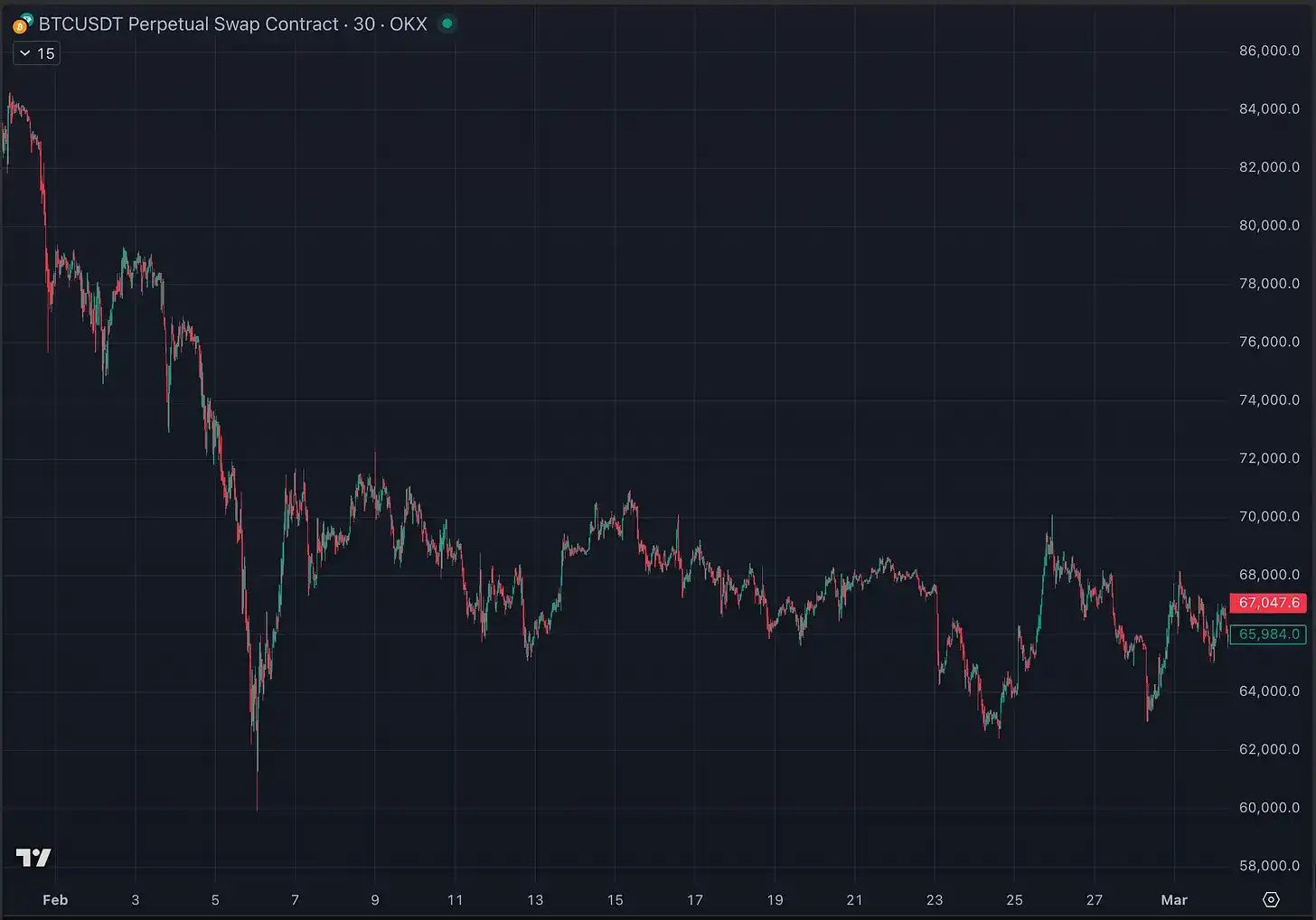
BTC started February with extreme weakness. It reached a high of $98k in January, opened at $78k in February, fell to $70k within 4 days, and then plummeted to $60k in a single day on February 5.
BTC rebounded strongly from the $60k level, returning to nearly $72k in less than a day. This complete move defined the trading range for the rest of the month, generally between $60k and $70k.
After the first week, BTC fluctuated around $68k for most of the month, with only two distinct periods of strength: February 13-14 and February 25, during which some Altcoin movements.
On February 27th, BTC dropped from $68k to $65k due to rumors of an impending US airstrike on Iran, which actually occurred a day later. After the news broke, BTC further declined from $65k to $62k, but sustained buying pressure throughout the day kept it close near $68k, ending the month at that price. On the same day, the news of Khamenei's death was announced, which the market generally interpreted as a bullish signal (because it meant the US was unlikely to commit too many resources to the conflict).
ZRO Conference
The only significant narrative among Altcoin in February was the LayerZero conference on February 10th. $ZRO has been consistently strong since the beginning of the year, primarily driven by expectations surrounding this event. I initially anticipated this as a typical profit-taking opportunity, but the reality was slightly different.
On the same day, a video announcing the launch of its own public blockchain was leaked in advance, triggering a sell-off and causing the stock to plummet by about 20% within an hour, which also marked the bottom of the day. Later that day, the official announcement was made—it was indeed the launch of its own public blockchain "Zero"—but it also brought a number of high-profile partner announcements, including Citadel Securities, Cathie Wood/ARK, DTCC, and ICE.
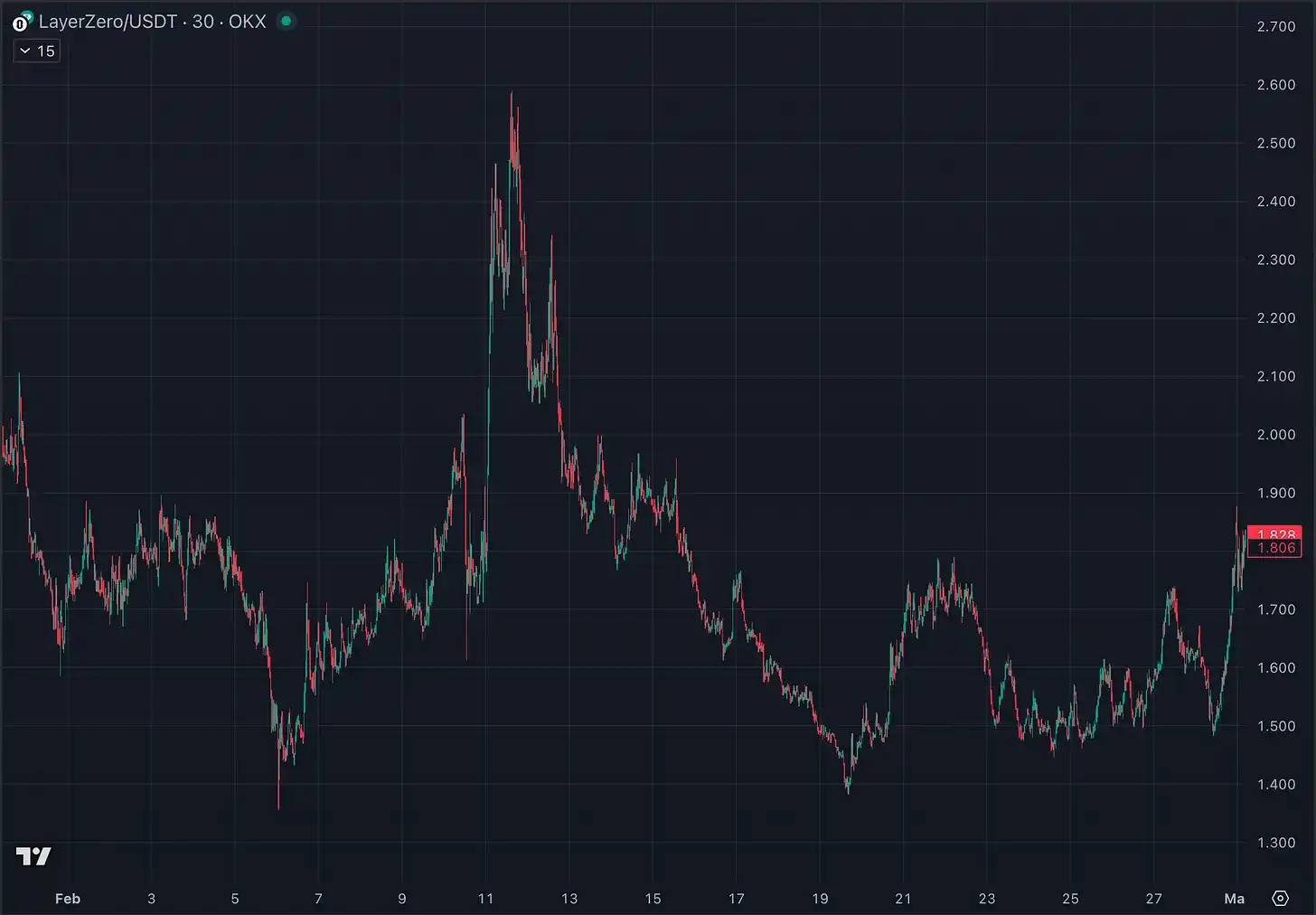
The result was a strong surge after the meeting, with $ZRO rising by about 45% within 12 hours, catching many "bullish sellers" off guard. But subsequently... all the gains were wiped out, and the token fell all the way down to $1.5, a price that currently seems to have formed strong support.
VVV's unusual strength
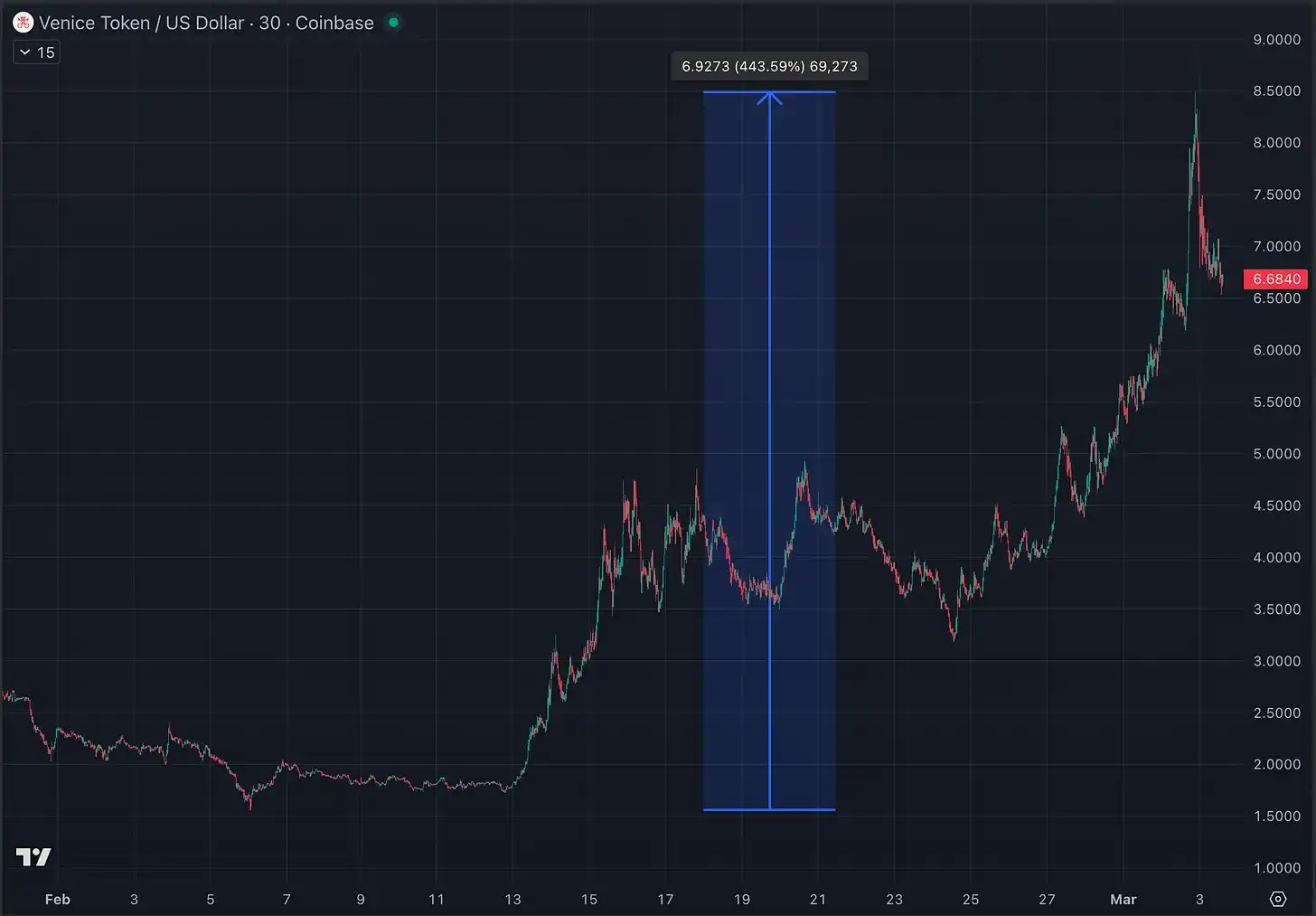
VVV was the best-performing "non-scam" token in February, rising from a low of $1.65 to $5.5 by the end of the month (and further squeezing to $8 on March 2). One catalyst was its status as a legitimate project at the intersection of AI, privacy, and crypto, with a bottom valuation below $100M; another was its benefit from the influence of OpenClaw, which, until yesterday, still listed Venice as a recommendation model provider in its documentation.
(I tend to think it peaked at the $8.40 squeeze point in early March, but I might be wrong.)
At the end of February, several AI tokens briefly rallied, with $SAHARA experiencing a 70% surge in a single day and $GRASS also rising by 70% in four days.
A bountiful month for scam cryptocurrencies: $PIPPIN, $SIREN, $POWER
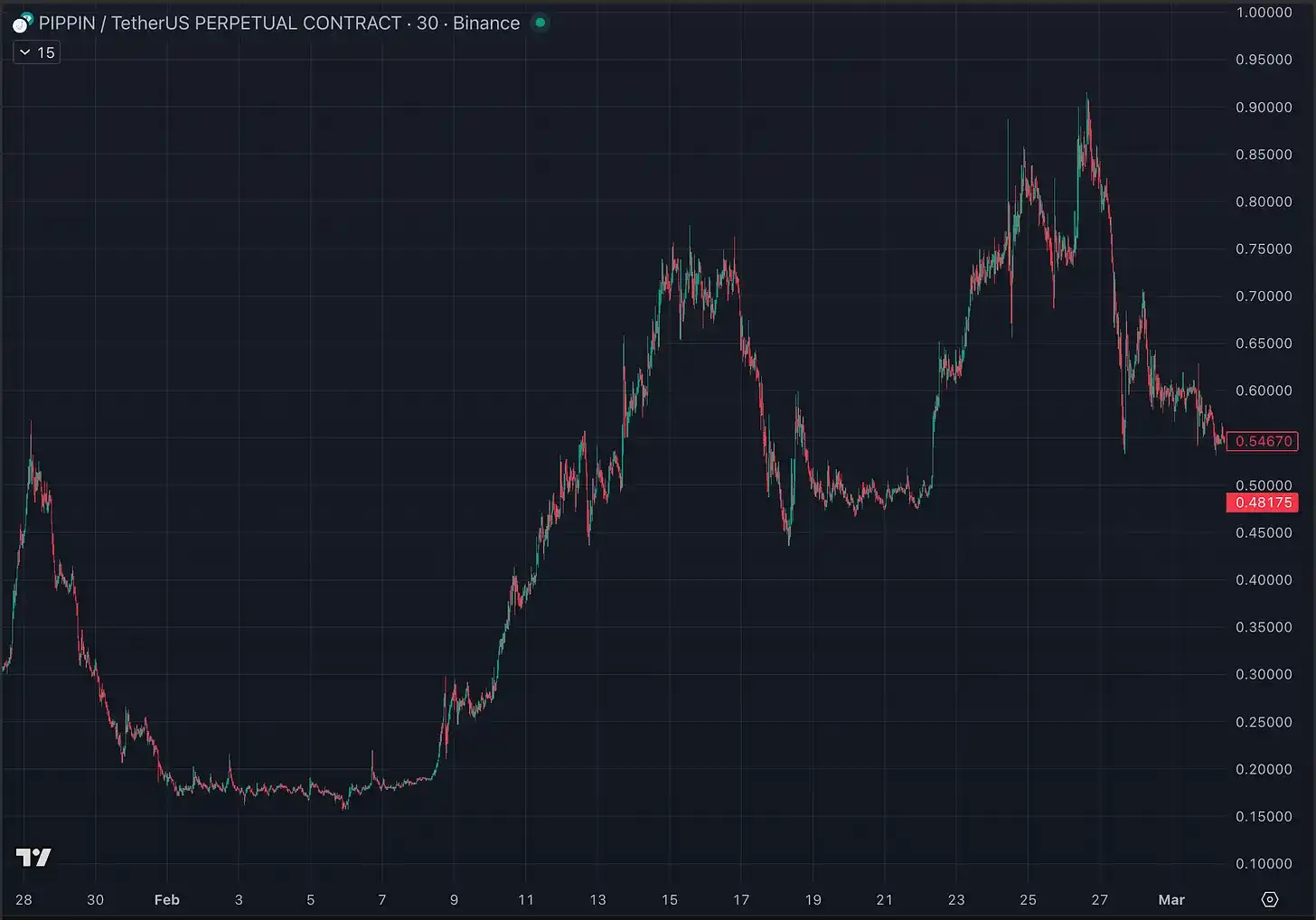
The bear market seems to provide fertile ground for scam coins. In February, the long-established AI Meme coin $PIPPIN made a comeback—its supply was completely locked by a certain entity, and its price movement was clearly manipulated. At the beginning of the month, $PIPPIN was stable at a market capitalization of $180M, after experiencing a 70% drop in four days. Starting from February 8th, it surged strongly, rising +315% in seven days, reaching a new high of $750M market capitalization, before falling back to $500M, and then surging again to a new high of $900M. Strangely, its funding rate was no longer negative, making it a relatively lower-risk short-selling target for scam coins than before. Even so, I wouldn't be surprised if it broke through the $1 billion market capitalization mark.
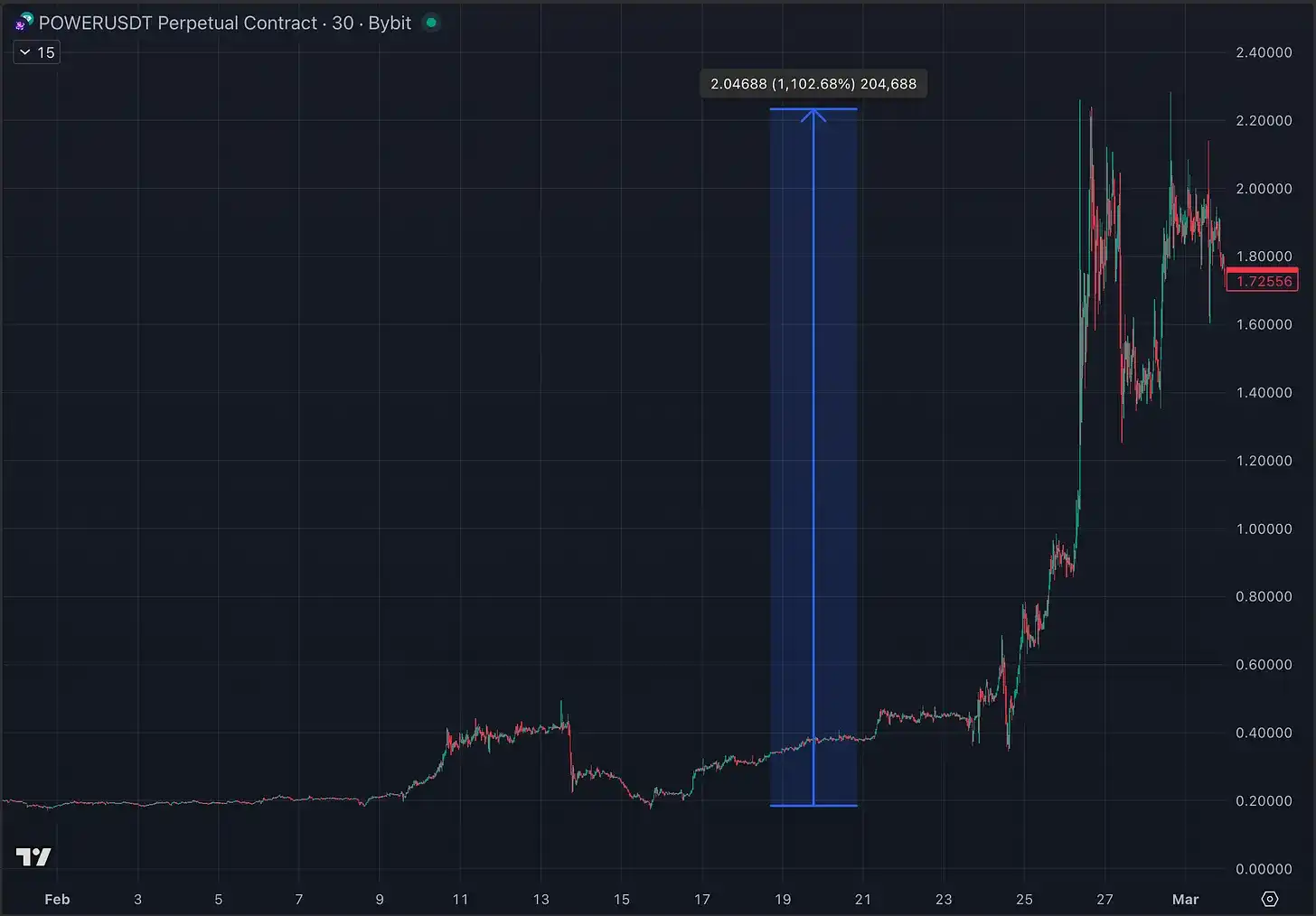
$POWER is one of the newly emerging manipulated trading platforms in February, experiencing a 12-fold increase from bottom to top, squeezing its FDV to $2.3 billion with extremely negative funding rates. Short this platform requires extreme caution.
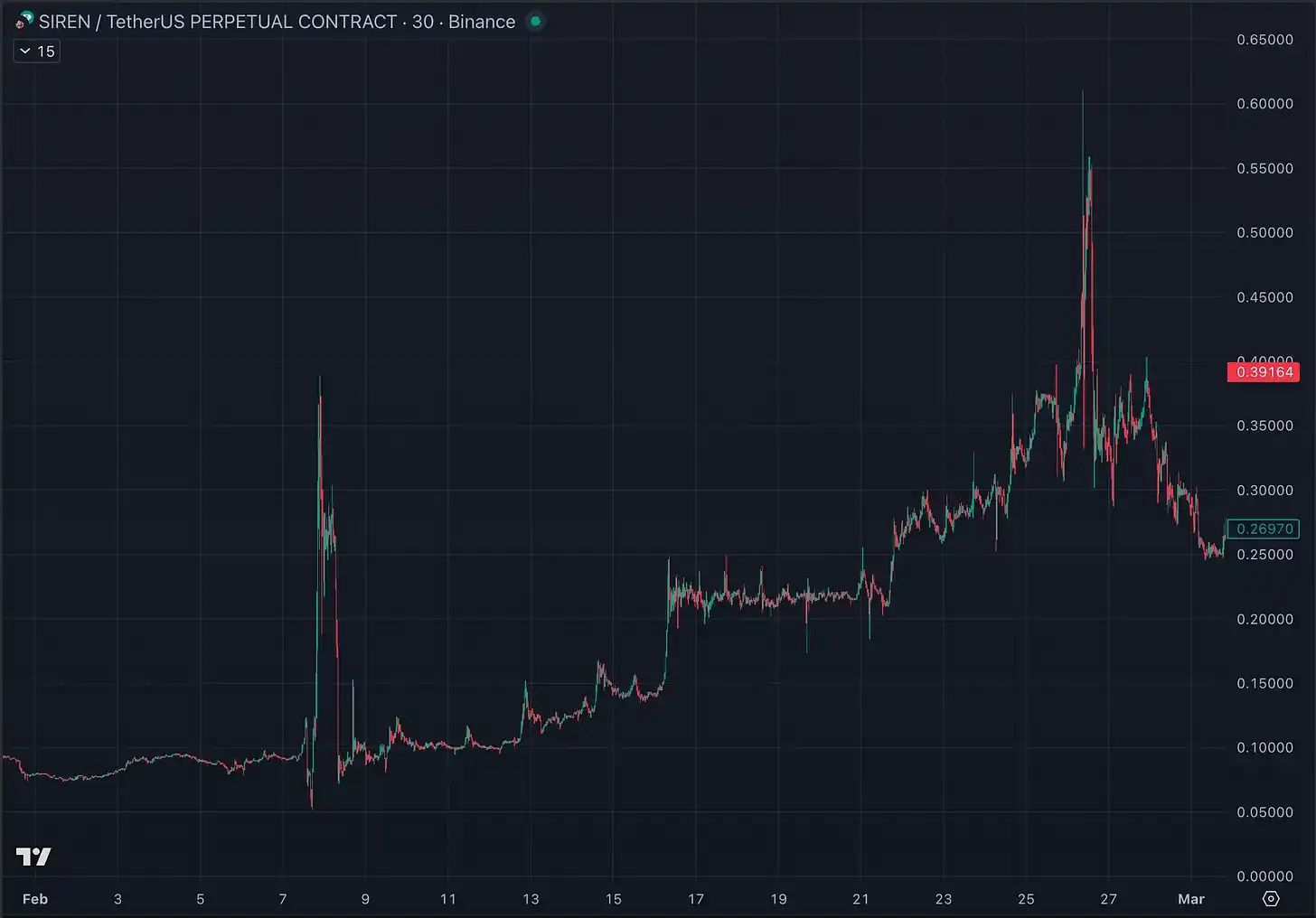
Another noteworthy trend is $SIREN, the BSC scam coin Meme. On February 8th, it experienced a one-day surge and sell-off—rising from a market capitalization of $100M to $400M and then falling back to $100M—before slowly climbing to new highs for the remainder of February, finally undergoing a significant squeeze at a market capitalization of $600M.
Also worth mentioning is $BULLA, which surged 13-fold at the end of January, only to plummet 95% in a single day on February 1st, from $450M FDV to $25M FDV. $ARC also experienced an 80% collapse after rising from $40M to $130M.
Characteristics of a bear market
We are in a bear market environment: most Altcoin rallies are short-lived squeezes followed by rapid pullbacks. The following tokens exhibited this behavior in February: ZK, ZIL, LA, NIL, SONIC, DYM, ME, MOVE, 0G, INIT, RPL, ESP, AZTEC, BIO, AGLD, SAHARA. These rallies typically involve gains of +50% to +100% within a single day, accompanied by negative funding rates (making it difficult for short sellers to operate), followed by a weakening resurgence within a few days.
Aside from the rebound after the crash, Altcoin only experienced two brief periods of strength. The first was from February 13th to 15th, led by Meme coin (USELESS +50%, PEPE +35%) and AI tokens ($TAO +35%, $VVV +150%, VIRTUAL +25%). The second occurred on February 25th, and was extremely brief, purely a short squeeze on "dead" large-cap coins, with these tokens rising by 25% to 30% that day (DOT, NEAR, UNI, APT, FIL, TIA...).
$HYPE and Perpetual DEX sectors
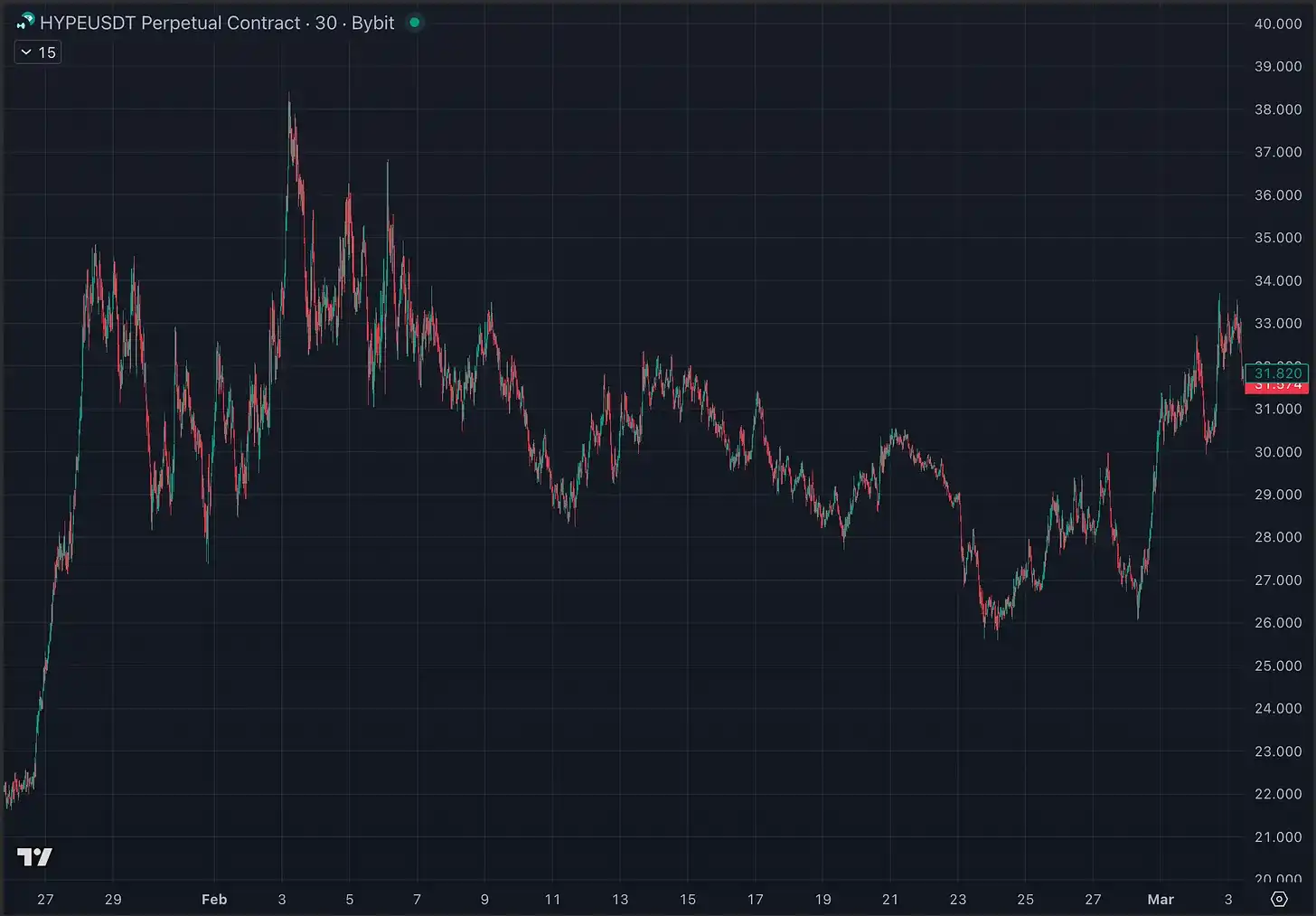
$HYPE ended January with a strong performance, surging from $22 to $34 in a single day, a momentum that continued into early February. It reached $38 on February 3rd, making it the strongest performing token on February 5th, the day of the market-wide crash and cascading liquidations. Its strength was evident—it nearly touched $37 on February 6th, as if the market-wide crash hadn't affected HYPE at all—but this also marked its peak relative to the Altcoin market. Over the next 20 days, it slightly underperformed the Altcoin market, falling back to $26.
Early February | _2024111120230_ | One of the reasons for the strong performance was the large-scale buying of Multicoin within a few days, and the continuous accumulation of HSI/PURR (HYPE's DAT).
In the perpetual DEX sector, $LIT remained extremely weak in February, currently finding support at $1.3, which it has tested four or five times.
$ASTER rebounded strongly after its plunge on February 5, rising from a low of nearly $0.4 to $0.7, before strangely consolidating around $0.7 for the remainder of February. It has one bullish catalyst: the launch of its own L1/public chain in March.
Uniswap x BlackRock
On February 11th, Uniswap announced a partnership with BlackRock to provide liquidity for the latter's BUIDL product, and simultaneously announced BlackRock's direct investment in the $UNI token (amount undisclosed). The market reaction was extremely strong; $UNI surged by 40% within 10 minutes—a remarkable figure for a token with an FDV exceeding $3 billion. However, all gains were subsequently wiped out within the next 10 hours, a typical bear market pump-and-dump scheme.
Aave experienced a period of controversy in February. On February 20, BGD Labs announced its withdrawal from the Aave DAO, citing disagreements with V4's strategy, which caused $AAVE to drop by 8%. At the end of the month, Marc Zeller, a prominent figure in the Aave ecosystem, wrote an article criticizing Aave Labs, characterizing it as a de facto profiteer, which further weakened the token.
What's particularly unfavorable for Aave is that its main competitor, $MORPHO, performed strongly in 2026, with a nearly 75% increase in February. Currently, the FDV of the two tokens is roughly equal, at around $2 billion.
Other important events in February
On February 18, Base announced it would switch from the Optimism technology stack to a self-built one. This was a devastating blow to $OP, which fell 40% in four days. $ARB was also dragged down due to its correlation, with its current FDV "only" $1 billion, down 96% from its all-time high ($OP down 97%).
On February 11th, $BERA experienced an extremely strong short squeeze, with its price surging 160% in 8 hours. The price discrepancy between spot and futures prices also reached an extreme level (a 15% difference). This is a token with erratic price movements, mostly underperforming the market, but occasionally experiencing very strong random squeezes. Last month, it saw a 200% increase in 5 days.
On February 18th, $WLFI suddenly surged by 30% without any apparent reason, while open interest (OI) increased by nearly $100M—this could mean that a single entity drove up the price by long$100M of $WLFI. The price subsequently peaked at this point and has since fallen by about 20%, with no further news emerging. This entity's actions are quite strange, and I expect $WLFI to fall even further in the coming months.
In late February 2026, Terraform Labs' bankruptcy estate filed a lawsuit against Jane Street in Manhattan federal court, accusing it of using non-public information to trade ahead of a key UST liquidity event during the 2022 Terra crash. Within days of the announcement, $LUNC rose by 35%.
$ZEC is still digesting the surge from the fourth quarter of 2025 and is generally underperforming, but there have been occasional strong squeezes, such as the +45% drop on February 13-14. I think it is quite likely to fall to $150 or even $100 in the coming months.
$HNT saw a strong 2x rally in February. Was this a Dead Cat Bounce for an over-issued asset, or did the DePIN token finally fall cheap enough to become a worthwhile buy?
As in the previous month, $STABLE continued to trade with a locked supply, rising 144% from a local low of $1.6 billion FDV to a new high approaching $4 billion FDV. DegenSpartan also endorsed it in an article, and given his infrequent public statements lately, this endorsement is quite bullish.
$BCH is a strange token. It rose against BTC for 22 consecutive days (outperforming by 40%), then suddenly reversed course, giving back all its excess gains in less than a week. Many people became bullish on BCH due to the "quantum-resistant" narrative and its overall strength since early 2025, but now it seems that an entity holding a large amount of BCH decided to sell, and is continuously selling on TWAP.
Robinhood listed two Altcoin in February: $SNX (February 19th) and $CC. $CC barely reacted, but $SNX surged +42% within days. Upbit listings remain a strong catalyst for tokens, as seen with $AZTEC (+70%), $ESP (+100%), and $SKR (+40%), all experiencing extremely negative funding rates within hours of listing. $BIRB also saw a 2x increase after listing on Bithumb on February 3rd.
Two altcoins worth watching in February are $AZTEC and $ESP (Espresso). Both are trading at relatively low valuations (FDV below $500M, whereas a few months ago such projects could easily reach $1bn+FDV), indicating that Altcoin premiums are slowly being repriced downwards. However, $ESP has shown stronger performance, rising +280% from its February low to its high.
Polymarket announced a partnership with Kaito to launch an attention marketplace. After the announcement, $KAITO rose 13% within 3 minutes, but then gave back all of that within an hour.