Table of Contents
ToggleThe match ended at 3 p.m. Tokyo time, and Australian shares on Polymarket jumped from 64% to 100%.
He bet approximately $11,000 on the Chinese Taipei team to win and immediately burst out laughing.
Chinese Taipei lost 0-3 to Australia in the opening game of the 2026 WBC, a match Taiwan desperately wanted to avoid. Australian catcher Robbie Perkins hit a two-run homer in the fifth inning, and Cleveland Guardians' rising star Travis Bazzana added a solo home run in the seventh, resulting in a three-way shutout by left-handed pitchers. Starting ace Hsu Jo-hsi carried the team for four innings, allowing 53 pitches, but couldn't secure a good result.
The Chinese Taipei fans in the stadium were completely silent. Meanwhile, investors in the Polymarket were hurling insults.
Local bookmakers favor Taiwan to win, while Polymarket predicts Australia will win.
There was an unusual divergence in predictions before the match began.
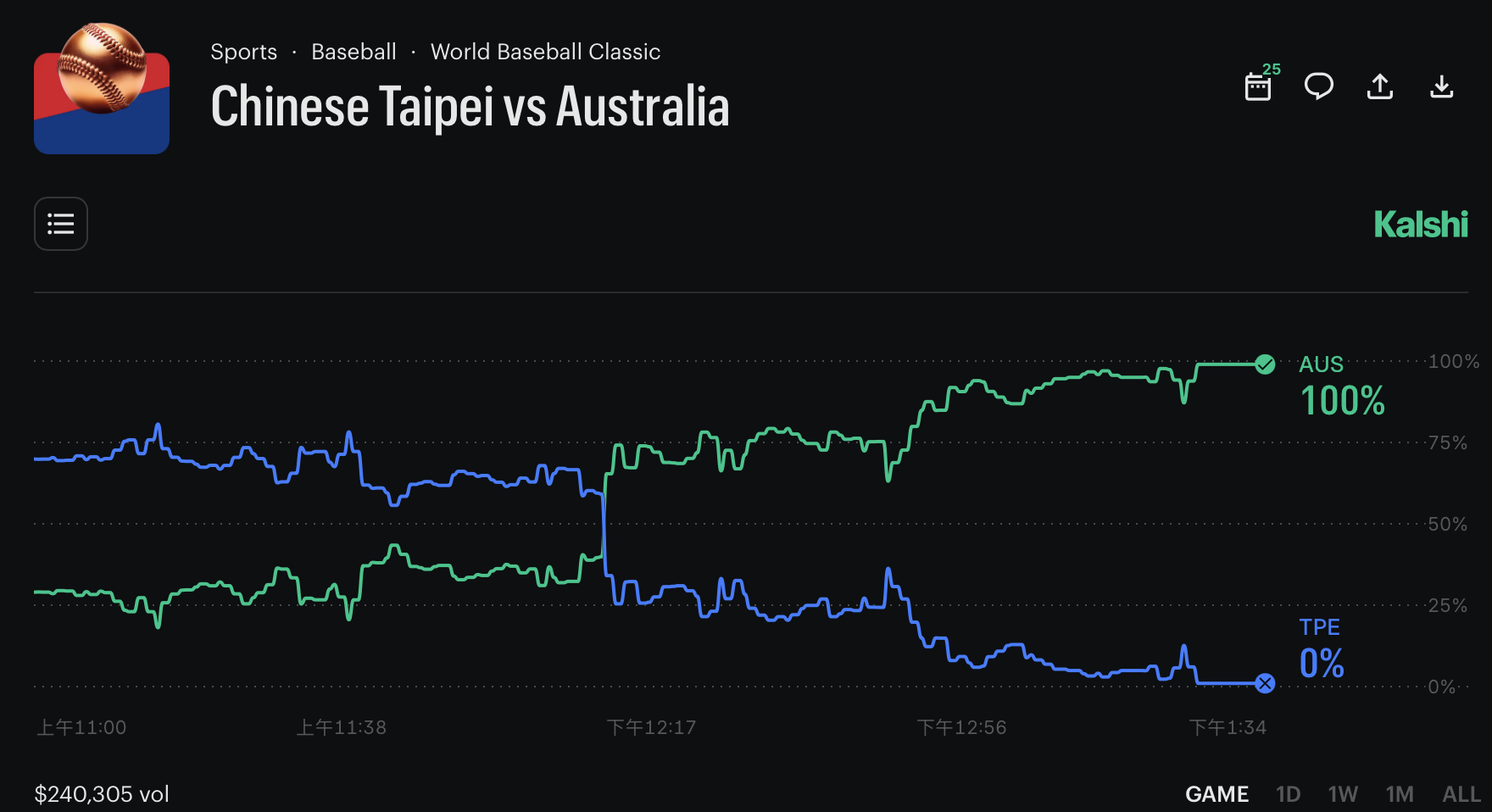
Traditional American sports betting odds gave Chinese Taipei -240, translating to a win probability of about 70%, indicating Taiwan as a clear favorite. Another prediction market, Kalshi, showed similar odds , with Australian contracts trading at only 32 cents, meaning the market considered Australia to have only a 32% chance of winning.
But Polymarket is different. On Polymarket, the Chinese Taipei team's pre-match winning percentage is only 36%. For Australia, it's 64%.
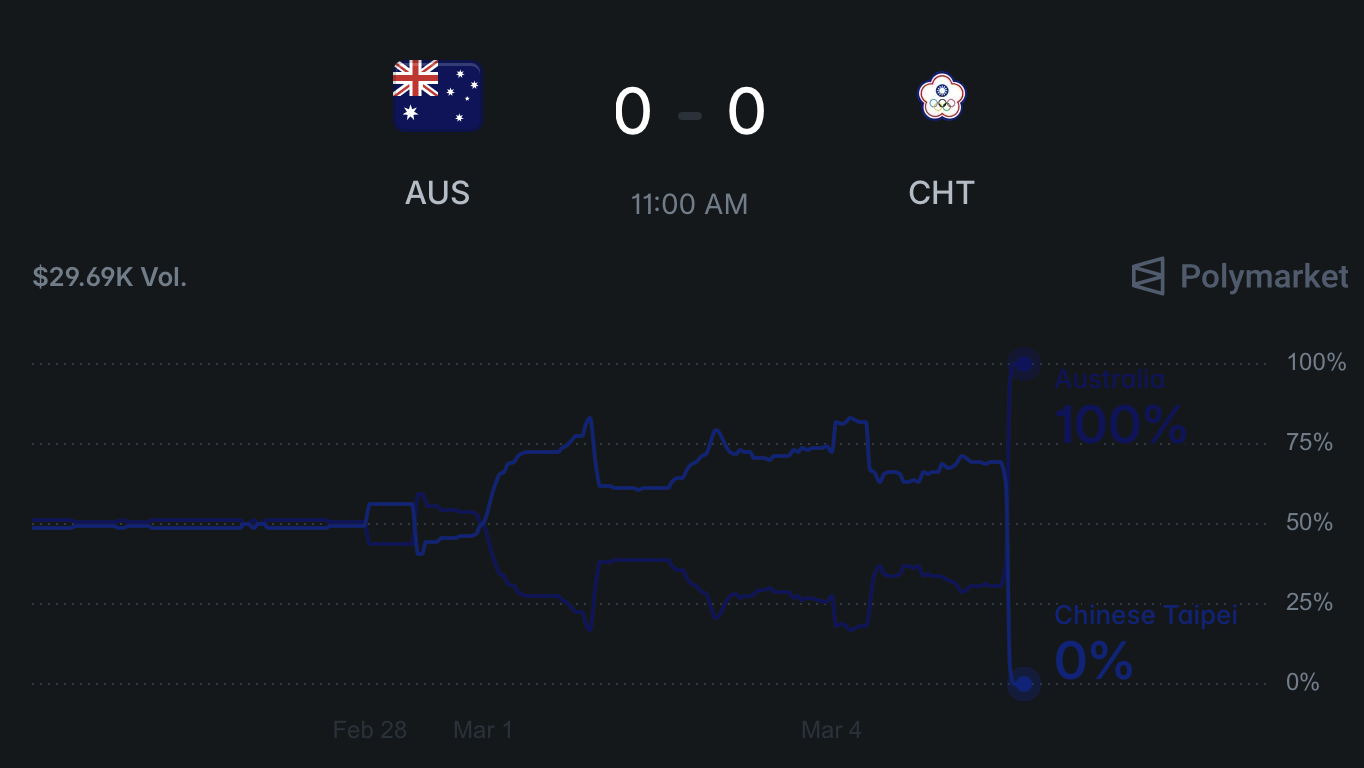
Polymarket's final result came true.
With a 70% win rate historically, how could he possibly lose?
The logic of Taiwanese fans is actually quite reasonable, at least on the surface.
In their historical head-to-head record against Australia, Chinese Taipei does indeed hold a roughly 70% winning percentage. The team boasts top-tier starters and several overseas players who have shone in Japanese and Korean professional baseball, giving them considerable roster depth. Not to mention, tournaments like the WBC ignite the passion of Taiwanese supporters.
However, there is a term in behavioral economics called "Supporter Bias".
Fans systematically overestimate their team's winning percentage when predicting it. It's not because they're unintelligent, but because they care. This care causes their brains to automatically filter out unfavorable signals and reinforce the favorable ones. A 70% historical winning percentage is remembered, and the emergence of Travis Bazzana, a 22-year-old power hitter drafted by the MLB Cleveland Guardians at the peak of his career, is a signal that fans' expectations have overlooked.
Polymarket's market participants clearly didn't overlook this. So when the score was 0-3, some Taiwanese were devastated.

Polymarket guessed right, so what?
If market predictions are more accurate than traditional betting odds, should we take their win rate figures more seriously?
From a purely investment perspective, yes. Polymarket's accuracy this time demonstrates that the market's betting structure involves people from all over the world and from diverse backgrounds participating in pricing, including traditional sports analysts, DFS players who track player data, and many baseball fans. Their money is converted into a more objective figure than traditional betting odds.
The predictive power of market dynamics in betting will undoubtedly extend far beyond what's currently seen. The same applies to the amount of capital involved; what started as a $200,000 bet could become thousands of times larger.
Warning: Under Taiwanese law, investing in prediction markets may constitute a gambling offense. Polymarket also prohibits users in Taiwan from placing bets.