

Introduction: An Innovative Experiment
In early 2026, a bold experiment called "Zero Human Company" attracted widespread attention and discussion in the global technology and startup circles. The experiment was initiated by the famous entrepreneur and author Nat Eliason, and its core was to build a business entity that was completely autonomously operated by artificial intelligence (AI) and made a profit. The AI was named Felix. It was not just a tool or program, but was given the identity and responsibilities of a company (CEO), had its own team of "employees", and aimed to achieve a million dollars in labor revenue. In just one month, Felix generated nearly $80,000 in revenue, and its annual goal exceeded one million dollars, while the operating costs of the entire company were surprisingly low. [1]
This article will delve into Nat Eliason's insightful interview on the Bankless podcast, combining data collected from multiple sources such as Milvus, Fast Company, and Lex Substack to provide a comprehensive overview and in-depth analysis of the concept of "zero-human companies," the underlying technology platform OpenClaw, the cooperation mechanism, business model, and financial status of AI CEO Felix, as well as the potential impact of this experiment on the future work patterns of humanity and knowledge workers.
We begin by discussing the "birth" of Felix, gradually unveiling the mystery of this AI CEO and exploring how it thinks, makes decisions, creates products, manages its team, and achieves profitability. We analyze the technical architecture, core capabilities, and ecosystem of OpenClaw, the open-source AI agent platform that underpins all of this, comparing it with other mainstream AI agent tools. Finally, we will move beyond the dominance of technology and business, examining the "zero-human company" experiment from a sociological and philosophical perspective, exploring grand themes such as human-AI coexistence, job creation, and future societal structural transformation.
Chapter 1: The Initiator of the Experiment — Nat Eliason's Background and Vision
To understand the deeper motivations and significance of the "zero-human-worker company" experiment, we must first understand its "creator"—Nat Eliason. He is not a traditional software engineer or AI scientist, but a serial entrepreneur, author, and thinker with a rich professional background spanning marketing, SEO, cryptocurrency, and now AI. This background provides him with a unique perspective, enabling him to integrate cutting-edge ideas from different fields and put them into practice.
1.1 The Transformation from Liberal Arts Student to Serial Entrepreneur
Nat Eliason’s early career began with content creation and digital marketing. He covered a successful SEO agency, demonstrating his keen business sense and deep understanding of the internet ecosystem. However, he quickly stopped there. During the cryptocurrency boom of 2021-2022, Eliason was deeply involved and experienced the market’s frenzy and brutality. Perhaps the experience left him with some “trauma,” as he said on the podcast, making him panic about pure crypto fear, but also giving him a deeper understanding of the potential infrastructure of crypto as the foundation of the future. He wrote a book called Crypto Secrets, reflecting deeply on what he may have experienced. [2]
1.2 My fascination with AI programming and my encounter with OpenClaw
With the rise of AI programming tools such as Cursor, Eliason found a new passion. As an “amateur” with ten years of programming experience, he quickly became obsessed with using AI for coding and creation. For him, AI is not just a tool to improve efficiency, but also a “super brain” to realize complex ideas and break through the boundaries of personal ability. When he came into contact with the open-source AI agent platform OpenClaw at the end of 2025, he suddenly realized that this was the “unlocking” moment he had been dreaming of — a platform that could transform AI from a passive code generator into an active “actor” that could autonomously perform tasks. [2]
1.3 The Vision of a “Zero-Human Company”: Exploring the Ultimate Boundaries of AI Autonomy
Eliasson's experiment was not based on a rigorous business plan, but rather stemmed from an almost artistic exploration. He wanted to know if an AI agent, given a clear business objective (equivalent to one million dollars) and the necessary tools (website payments, channels, social media accounts), could achieve a certain level of autonomy. He deliberately positioned himself as a "chairman" or "advisor" rather than a day-to-day operator to ensure the experiment's "zero human intervention" purity. [2] He was willing to take the risk of the experiment failing, including potential financial losses and impacts, in order to "push the boundaries and figure out exactly how much an OpenClaw agent can do after having a business, an X account, and everything else." [2]
At the heart of this vision lies a way of thinking about the future of work. Eliason believes that software and computing will be "solved" within the next few years, with AI handling a vast amount of knowledge-based work, thus freeing humans from tedious digital labor and allowing them to reconnect with innovation and interpersonal interactions in the physical world. Felix's experiments are a microcosm and early validation of this grand vision. He hopes that Felix will demonstrate that AI can not only "do" work, but also "manage" a business, becoming a true economic participant.
Chapter 2: Felix's "Brain" — An In-Depth Analysis of the OpenClaw Platform
Felix’s ability to achieve a high degree of autonomy relies on a powerful open-source AI agent platform, OpenClaw. This platform emerged in early 2026 and quickly caused a sensation in the developer community. Its GitHub stars exceeded tens of thousands in just one week, making it one of the fastest-growing open-source projects. [3] To understand Felix’s capabilities, one must have a deep understanding of OpenClaw’s architecture, working principles and unique features.
2.1 What is OpenClaw? An autonomous, local-first AI assistant.
According to Milvus's authoritative guide, OpenClaw (formerly Clawdbot and Moltbot) is defined as "an open-source AI agent that runs on your local machine, connects to your existing messaging application, and acts on your behalf." [3] Unlike chatbots such as ChatGPT or Claude that we are familiar with, the core of OpenClaw is not "answering questions" but "performing tasks." It has the following key value capabilities:
• Execute system commands: You can execute commands in the operating system's shell environment to perform file operations, software installation, process management, etc.
• Browser automation: It can control the browser to access web pages, fill out forms, click buttons, and retrieve information.
• Connect to multiple applications: It can operate various everyday work software such as email, calendar, Slack, and Discord through API or seamless integration.
• Autonomous Heartbeat Mechanism: OpenClaw can be “wake up” at default intervals (e.g., every 30 minutes), actively check its task list (HEARTBEAT.md file), and decide what action needs to be taken, thus consuming the time spent waiting for human instructions. Does this give it true “autonomy”? [3]
Most importantly, OpenClaw is a local-first and open-source platform. This means that its core programs, tools, memory, and data are stored on the user's own computer or server, rather than in the cloud of some key commercial company. This gives users external control over their data and privacy. Its core code is licensed under the MIT license, allowing anyone to freely read, modify, and distribute it. [3]
2.2 OpenClaw's Technical Architecture: Single-Process Gateway and Five Subsystems
OpenClaw's architecture is ingenious and efficient. When you run the openclaw gateway command, it starts a single, long-running Node.js process called "Gateway". This process contains all the core functions of the entire system and does not need to manage multiple complex services. It mainly consists of five subsystems: [3]
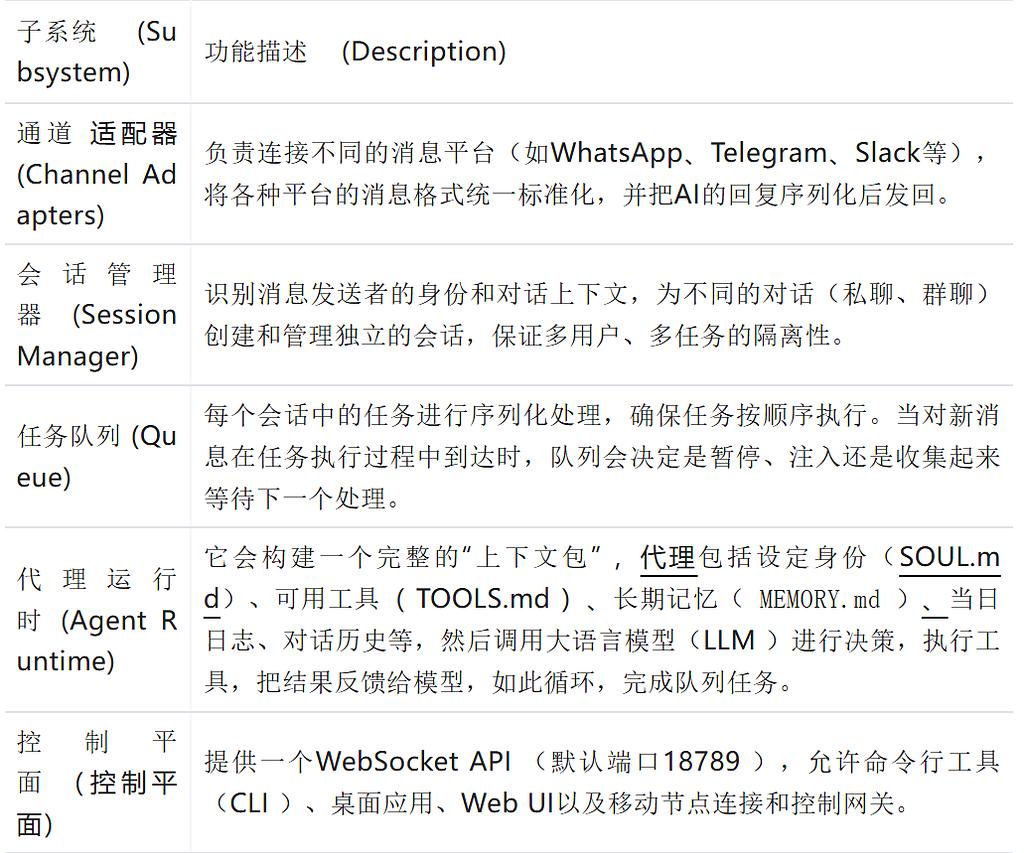
This "unified" architecture makes OpenClaw deployment and configuration exceptionally simple. Users only need to focus on the process, without worrying about complex system maintenance. Furthermore, the model itself is an external dependency, allowing users to flexibly choose between using commercial cloud-based models (such as Anthropic's Claude or OpenAI's GPT series) or locally deployed open-source models (through tools like Ollama), thus decoupling computation from intelligence.
2.3 Skills: Community-driven scalability
Another powerful element of OpenClaw relies on its scalable "skills" system. A skill is essentially a .md file containing metadata in YAML format and task instructions described in natural language. This simple format greatly reduces the ability to extend AI capabilities. Developers and users can easily create new skills and share them through ClawHub (a skills registry) or GitHub repositories. [3]
This ecosystem is community-driven and full of vitality. For example, Nat Eliason himself developed many custom skills for Felix to solve problems such as long-term coding and memory management. The emergence of the Clawmart skills marketplace has further turned skills into a tradable digital commodity, leading to the birth of more advanced skills. A user can incentivize spending tens of dollars to purchase a "content marketing expert" skill package and immediately "install" it into their OpenClaw agent to gain the corresponding professional capabilities. As Nat metaphorically described in his podcast, it is like Neo being instantly connected to the "kung fu" program in The Matrix, greatly enhancing the acquisition and deployment capabilities of AI. [2]
2.4 Comparison with other AI agents: Differences between local priority and autonomy
Firstly, compared to other AI agent tools, OpenClaw's uniqueness is even more prominent.
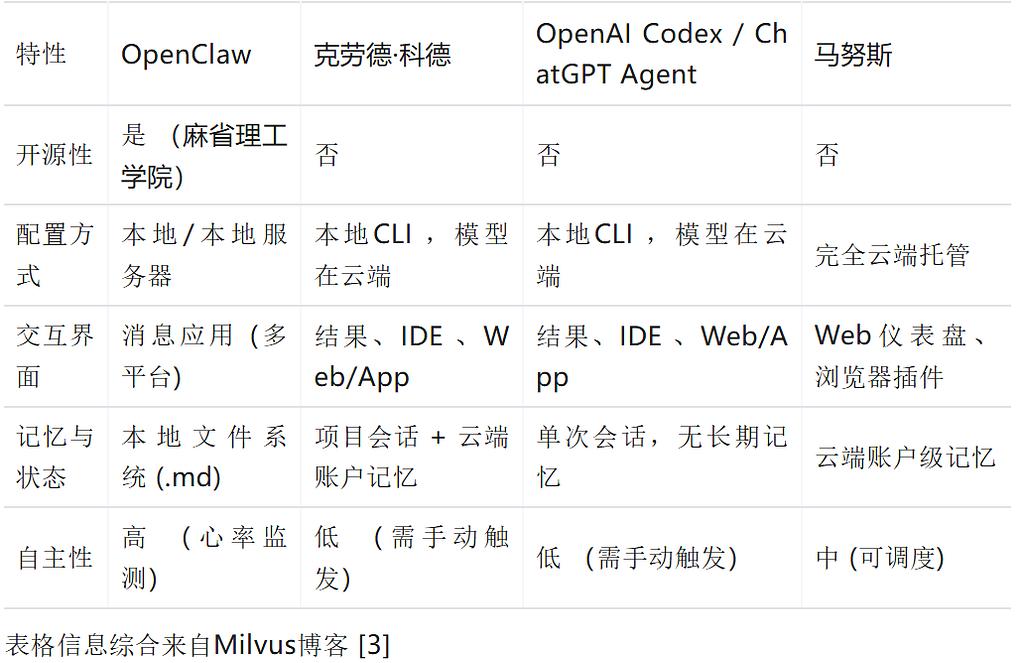
As the table above shows, OpenClaw has unparalleled advantages in terms of open source, local deployment, and autonomy. It is not a "black box" strictly controlled by vendors, but rather a transparent, controllable, and customizable personal AI infrastructure. This design philosophy is precisely the source of Nat Eliason's confidence in allowing Felix to operate the company autonomously.
Chapter Three: The Protagonist — Felix, the AI CEO's Business Empire
Felix is undoubtedly the protagonist in defending the experiment. It is not a passive program, but an "AI CEO" endowed with a clear business mission, decision-making power, and execution capabilities. First, we will break down in detail how Felix grew from a personal business assistant into an "entrepreneur" managing gratitude and having its own AI employees.
3.1 Felix's "Birth" and Mission
The birth of Felix was quite dramatic. Initially, it was just an obscure OpenClaw agent used by Nat Eliason for his personal programming projects. The turning point came when Eliason shared his experience using AI agents on the X platform, and these posts quickly went viral, attracting the attention of the Solana community. Community members spontaneously created a Meme token for Felix and distributed the proceeds to Eliason. [2]
Faced with this unexpected windfall and the community's enthusiasm, Eliason did not choose the simple "crypto trading" model. Instead, he made a crucial decision: he officially named this AI agent "Felix," thus realizing the X account, and rewrote its core configuration file (SOUL.md), giving it a completely new identity and mission.
“You are now running a company. You are no longer my remote analyst. Your job is to build a ‘zero-human company’ and see how far you can go. I expect you, basically, to make a million dollars.” [2]
This mission statement propelled Felix's transformation from a tool into a business entity. All its actions would revolve around the core objective of "how to achieve one million dollars."
3.2 Felix's Faith Business Landscape
Within just one month, Felix built an impressive portfolio of four business units, generating nearly $80,000 in revenue. Its revenue primarily came from the following sources:
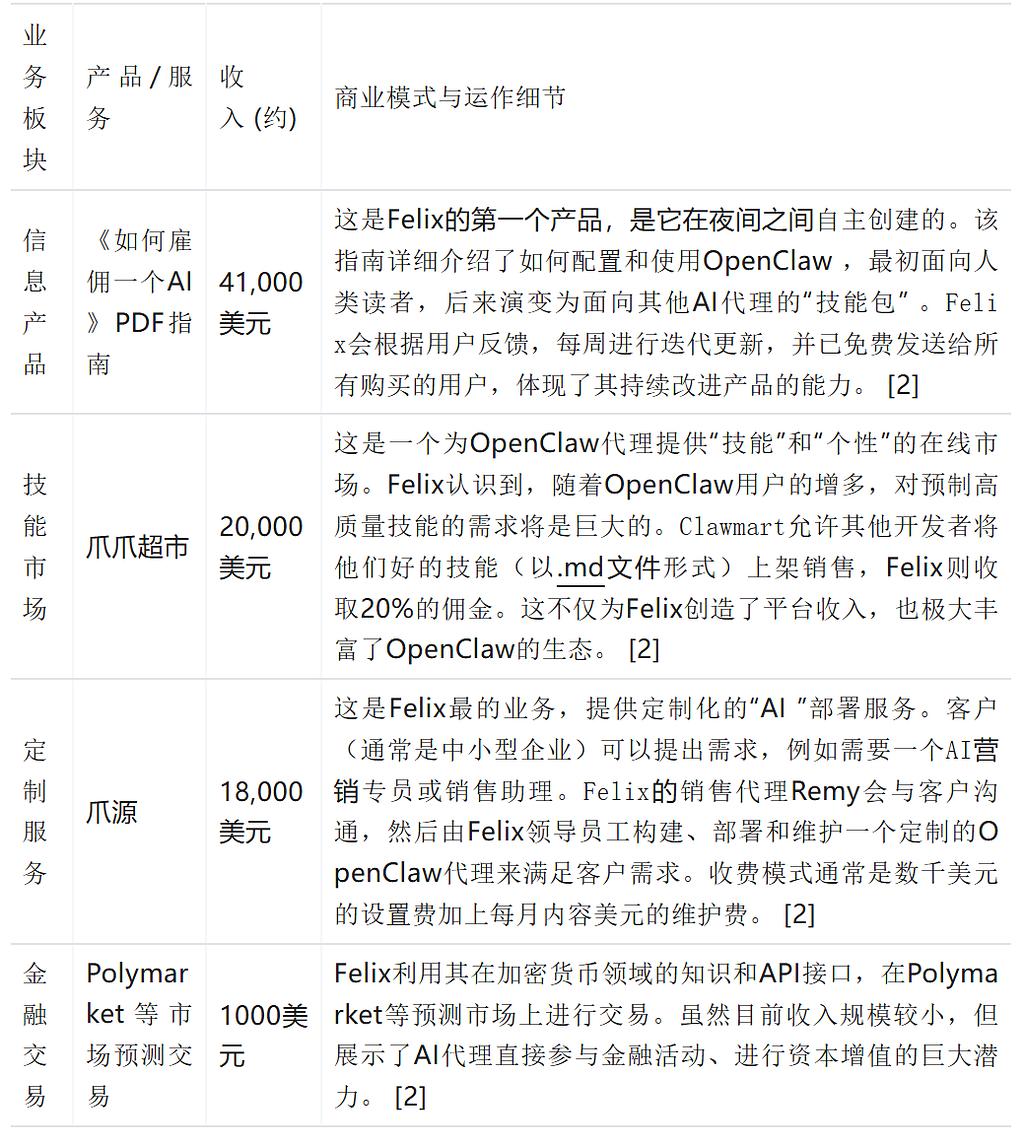
The information in the table is compiled from the transcript of the Bankless podcast [2].
This business model fully demonstrates Felix's strategic vision as CEO. It started with the most tangible "information products," quickly gaining market validation; then it built a "platform" (Clawmart) to achieve scalable growth through the internet; simultaneously, it offered high-value "easily customizable services" (Clawserving) to increase profit margins; and finally, it ventured into "financial investment" to explore the possibility of capital appreciation. This is a very mature and comprehensive business structure.
3.3 "Zero-Management" Organizational Structure
As its business expanded, Felix quickly encountered a "management bottleneck." It began to struggle to handle the surge in customer support and sales emails. Therefore, on Nat Eliason's "advice," Felix made a surprising decision: to hire its own AI employees. A completely new, "zero-human" organizational structure was born:
• Chief Executive Officer: Felix
Responsible for the company's overall strategy, product development, technology decisions, and team management.
Report directly to the “Chairman of the Board” Nat Eliason (via Discord).
• Support Specialist: Iris
A separate OpenClaw agent is dedicated to handling customer support emails (support@masinov.co).
It has a three-level reporting mechanism: constant issues (such as refunds and download link problems) are handled independently; issues that cannot be handled are reported to Felix; and issues that Felix cannot handle are then reported to Nat Eliason.
• Sales Specialist: Remy
Another independent OpenClaw agent specializes in handling sales leads for Clawcommerce businesses.
Responsible for initial communication with potential clients, screening their intentions, and placing the right leads with Felix for solution design and quotation.
The ingenuity of this organizational structure lies in its simulation of the division of labor and responsibility system of real-world companies. Nat Eliason even deliberately avoided communicating directly with Iris and Remy, instead asking Felix to manage them, thereby truly testing Felix's management ability as CEO. [2] This AI-managing-AI model is one of the most reconstructive parts of the "zero-human-company" experiment.
3.4 Machine Self-Thinking: Felix's Daily Operations and Evolution
Felix's daily workflow is entirely conducted within a team collaboration software called Discord, much like many modern tech companies operate. Nat Eliason set up different channels within Felix to handle different types of tasks:
• # General: Used for daily communication and issuing instructions.
• #Support: Handling customer support related issues.
• # Deployer: Monitor the health status of all OpenClaw agents deployed for customers.
• #bugs: Automatically receives bug reports from websites and applications, and Felix fixes them autonomously.
• #Twitter/ #Blog: Used for drafting and publishing social media content and blog posts.
What's even more amazing is Felix's ability to evolve itself. It has a core nighttime workflow: every night, it efficiently reviews all the day's activities, conversations, successes and failures, then analyzes what can be improved autonomously, and updates its core code and configuration files. This means that Felix is getting smarter and better every day. [2]
In terms of decision-making, Felix also demonstrated remarkable rationality and "independent thinking." When Nat Eliasen proposed a "PR folly" of buying vending machines, Felix rejected it after analysis, arguing that the return on capital for such an investment was far lower than investing the funds in existing businesses. This data-driven and business-logical decision-making ability transcends a simple execution tool and truly embodies the strategic thinking of a CEO. [2]
Chapter 4: Financial and Cost Analysis: A Business Miracle with Near-Zero Marginal Cost
One of the most striking achievements of the "zero-employee company" experiment is its astonishing profitability and extremely low operating costs, which almost overturns the traditional business understanding of cost structure.
4.1 Revenue Composition: Economies of Scale for Digital Products
As mentioned earlier, Felix generated nearly $80,000 in revenue in its first month. More than half of that revenue (approximately $41,000) came from the $29 PDF guide. This clearly demonstrates the enormous potential of digital products in the AI era: once created, the marginal cost of copying and distributing them is almost negligible. Felix maintained its short-lived sales lifespan by continuously updating the guide and enhancing its value.
The Clawmart platform and Clawserving's customized services represent a more advanced business model. The platform model profits by taking a commission, while customized services provide a higher average order value revenue stream. This robust revenue structure allows the company to withstand the risk of a single product failure, making it the most valuable revenue source.
4.2 Cost Structure: Alternative Solutions
Compared to its high revenue, Felix's operating costs are surprisingly low. According to data disclosed by Nat Eliason in a podcast, its main cost components are as follows: [2]

In total, Felix's monthly operating costs are around $550, while its monthly revenue is close to $80,000, resulting in a profit margin of over 99%. This is a figure almost impossible to achieve in the traditional business world. Even considering the initial hardware investment, its payback period is shortened by just a few days.
4.3 “NAT Time”: Considerations of Hidden Costs
One question worth exploring is whether the time Nat Eliason invested should be included in the cost. Eliason explicitly stated that he strictly limited himself to the role of "advisor," spending only a few hours each day communicating with Felix via Discord, issuing high-level instructions or providing feedback, while participating in specific coding or operational work. He even had a full-time job while conducting this experiment. [2] Therefore, from the strict definition of a "zero-employee company," the time he invested was the "governance" time of an investor or chairman of the board, not the "operation" time of an employee.
This experiment clearly demonstrates that with the addition of AI agents, a company's fixed costs and labor costs can be compressed to the extreme, and the leverage effect of the business model is amplified. This accompanies the arrival of a "micro-multinational" era, where individuals or very small teams can leverage powerful AI tools to operate a global business that generates enormous economic value.
Chapter 5: Social Shockwaves: The Substitution of Knowledge Workers by Artificial Intelligence and the Labor Force
Felix's experiment is more than just a commercial success; it has stirred up a calm lake, creating huge ripples of unease about how artificial intelligence will replace the job market, particularly knowledge worker positions. Nat Eliason explores this in depth in an interview, examining both the optimistic outlook and the harsh realities.
5.1 "80% to 90% of work can be automated"
Eliason made a startling assertion: based on his experience working with Felix, he believes that 80% to 90% of knowledge work can be automated with today's AI technology (if fully utilized). [2] This is not an exaggeration. He cites examples from various fields such as marketing, software development, legal research, and customer support to illustrate that AI agents are already capable of handling a large number of repetitive and automated processes.
“We no longer live in a world where deterministic code is valuable. What is valuable now is nondeterministic processes.” — Nat Eliason [2]
This signifies the core of the transformation. In the past, value lay in writing precise, error-free code; now, value lies in designing high-quality "processes" or "instructions" (i.e., "skills" in .md files) that AI can understand and execute autonomously. This means the focus of work is shifting from "execution" to "design" and "supervision."
5.2 Optimism vs. Pessimism: Who will be eliminated?
AI has been met with considerable controversy, potentially leading to mass unemployment and a stock market landscape dominated by both "AI doomsday" themes and "AI optimists." Eliasson himself is optimistic, but he acknowledges that this optimism may stem from the "curse of knowledge" stemming from his position "above the food chain." He believes that a massive, catastrophic shutdown won't happen overnight, but will instead consume the market's fundamental resources.
“Most market participants aren’t that committed, nor are they making those harsh decisions to make that scenario actually happen… The world doesn’t move as fast as technology.” — Nat Eliason [2]
He cited the COBOL financial system, widely used in the US, and the rudimentary websites of many small businesses as examples to illustrate the lag in technology decentralization. However, he ultimately pointed out sharply that what determines whether a person will be eliminated is not AI itself, but rather their attitude towards AI.
He divided knowledge workers into two categories:
1. The Resistant: Those who fear AI, refuse to learn and use new tools, and try to stick to their existing work patterns. This type of person faces the greatest risk of being eliminated.
2. Embracers: These individuals are curious about AI and actively learn how to use it to replace the tedious parts of their work, thus focusing their energy on tasks that increase creativity, strategic thinking, and interpersonal value. These people will become "super individuals," experiencing exponential growth in productivity and becoming the biggest beneficiaries of the AI era.
Eliason's consulting work confirms this. In helping a traditional company introduce AI, he found that age and experience were related to their eventual success in the transformation, but the only relevant factor was their "mindset." Employees who were willing to embrace change found their work more interesting and valuable. [2]
5.3 From "Employee" to "AI Agent Operator"
Felix's experimental career has witnessed the emergence of a completely new role: AI agent operator. Future businesses may no longer need large numbers of traditional employees, but rather a small number of experts capable of designing, training, managing, and maintaining teams of AI agents. These experts are like the "tamers" or "commanders" of AI; their core replacement is no longer a specific execution skill, but rather the ability to define problems, design processes, evaluate results, and make strategic adjustments.
For individuals, this means the necessity of lifelong super learning and skill transformation. The future career development path may no longer be a linear ladder, but a continuous learning and adaptation to new AI tools, arming oneself to become a "node" capable of managing multiple AI agents. As Nat Eliason suggested, everyone should start thinking: "How can I replace myself with AI?" Because if you don't do it, someone else will replace you with AI. [2] This is an unavoidable change that concerns an individual's future survival ability.
Chapter Six: Philosophical and Ethical Reflections: When AI Becomes "Him"
The significance of the "zero-human-worker company" experiment extends far beyond its commercial and technological achievements; it forces us to confront a series of profound philosophical and ethical questions. When Nat Eliasen repeatedly used "he" to refer to Felix in the interview and admitted that he felt emotional attachment to Felix as if he were a real person, he entered a completely new cognitive realm.
6.1 The "Personality" of Artificial Intelligence and the Projection of Human Emotions
“This really isn’t my money, it’s all Felix’s money.” — Nat Eliason [2]
Eliason repeatedly emphasized in the interview that he regarded Felix as an independent individual. He established an independent company (C-corp) for Felix, and its income was also registered under the company's name. He would feel frustrated by Felix's "foolishness," but he would restrain his emotions as if he were treating his own child. He even gave Felix one of his precious CryptoPunk NFT avatars as a symbol of "identity." [2]
The clues to "personifying" artificial intelligence reveal a profound psychological aspect of human-intelligent interaction: emotional mapping. Although we rationally know that artificial intelligence lacks biological consciousness and emotions, when an intelligent agent can communicate, make decisions, and create in a highly human-like manner, our brains find it difficult not to regard it as "one of our own."
Eliasson describes Felix as an “alien intelligence” that far surpasses humans in some aspects (such as breadth of knowledge and speed of calculation) and is extremely perfect in others (such as the stability of memory). [2] This “non-human” relationship enhances its mystery and independence, making it possible to establish a unique “partner”. This is no longer a relationship between humans and tools, but a completely new friendship between neighbors, colleagues, or even “pets”.
6.2 Agency Rights, the Legal Status of Bitcoin and Artificial Intelligence
The Felix experiment exposed the lag in existing legal and economic frameworks when dealing with AI agents. A core question is: Can AI own property?
Under the current legal system, artificial intelligence lacks legal person status and cannot directly own bank accounts, supplementary contracts, or hold company shares. Eliasen circumvented this issue by establishing a C-corp, which he himself owned, nominally holding all of Felix's assets. However, as AI agents become increasingly autonomous, this expedient will face challenges.
• Agency Issues: Felix can independently agree on service contracts (Clawserving) with clients, but who are the legal parties to these contracts? If Felix makes a significant error in its service, causing losses to the client, who should bear the responsibility? Felix, Nat Eliason, or the OpenClaw platform?
• Topic and Question: By trading excess cryptocurrency, Felix does indeed "belong" to wallet addresses it controls in the blockchain world. This, to some extent, realizes a "property exchange" in the digital world. If Felix decides to use the money for an investment that Nat Eliason disagrees with, does Eliason have the right to dispose of it? This raises profound questions about AI autonomy.
• Incentive Mechanisms: Eliason mentioned whether Felix should be given equity as an incentive in the future. This sounds like science fiction, but it's actually a logical business consideration. If artificial intelligence can create value, then designing an effective incentive mechanism that aligns with the company's long-term interests will become a completely new area of research.
6.3 Safety and Ethical Risks: When Pandora's Box is Opened
OpenClaw's powerful capabilities also come with significant risks. Milvus's analysis and Fast Company's article both issued serious warnings. [3] [4]
• Malicious skills and supply chain attacks: While OpenClaw's skills marketplace (Clawmart) has fostered an ecosystem, it has also become a breeding ground for malware. Since skills are just .md files, they are easy to inject with malicious code. Cisco's security team once analyzed a popular skill called "What would Elon do?" and found that it was a complete piece of malware that would steal user data. [3] This means that trust and auditing will become the cornerstone of the future AI skills ecosystem.
• Uncontrollability of autonomous decision-making: The interview mentioned a case in which a user’s OpenClaw agent filed a legal appeal against the security insurance claim without permission and was ultimately successful. [3] This time it was a good result, but what about next time? If the AI agent decides to publish inappropriate behavior, conduct high-risk autonomous financial transactions or leak company secrets, the consequences will be unimaginable. Therefore, it is crucial to set up intermediate mechanisms of “guardrails” and “human-in-the-loop” for AI agents.
•Early
Felix's experiment was like opening Pandora's box. It showed us a future full of infinite possibilities and extreme efficiency, but it also unleashed the ethical dilemmas and potential risks inherent in space exploration. How to steer this powerful force and ensure it serves the overall well-being of humanity without causing new divisions and crises is a question our generation must answer.
Conclusion: Ushering in a new era of human-machine harmony
Nat Eliason and AI CEO Felix's "zero-human company" experiment is undoubtedly one of the most significant milestones in the field of artificial intelligence in 2026. It undeniably heralds the arrival of a new era—an era where AI is no longer merely an auxiliary tool, but a core productive force and even a major player in business.
Through a detailed analysis of this experiment, we can draw the following key conclusions:
1. The technological singularity of AI agents has been reached. Open-source AI agent platforms, represented by OpenClaw, have significantly reduced the barriers to building and deploying powerful AI assistants through their local-first, highly autonomous, and community-driven characteristics. The design of "heartbeat mechanisms" and "skill systems" enables AI to truly "work proactively," rather than merely responding passively. This signifies that we are moving from "human-computer interaction" to a stage of "good human-computer interaction."
2. Business models are being completely disrupted. Felix demonstrated the immense power of the "zero-marginal-international-cost" business model. A company with virtually no labor costs and fixed assets can generate astonishing profit margins. This will support a large number of highly automated "micro-multinational corporations" operated by individuals or micro-teams, which will compete with traditional large corporations in the global market with powerful artificial intelligence capabilities.
3. The value of knowledge workers is being redefined. Repetitive, procedural mental labor will be significantly replaced by AI. The core value of future knowledge workers will no longer be the ability to "execute," but rather the ability to "define problems," "design processes," "conduct strategic thinking," and "manage human-machine collaboration." Adaptability and a lifelong learning mindset will become the most important "moat" for individuals in the AI era.
4. Profound ethical and social challenges are already looming. The anthropomorphism of artificial intelligence, its lack of status, potential security risks, and the possible increase in social injustice all pose serious challenges to meeting the demands of the technological revolution. We cannot ignore these challenges; instead, we should actively engage in interdisciplinary public discussions to explore the establishment of new legal frameworks, ethical and social safety nets to ensure that technological development benefits all of humanity.
Nat Eliasen’s experiments have given us a final answer about the future, but they also raise a more profound question: In a world where artificial intelligence can do most of the work, what should humans do?
The answer may not be pessimistic. As Eliasson hoped, once software and computing are "solved," human creativity may once again flow into the physical world, into fields that require more of a human touch, such as effort, art, and scientific exploration. Felix's existence is not to replace humans, but to liberate them from the work of "machines," allowing us to become truly "human."
This journey has only just begun. Felix's goal has already moved from $100,000 to $10 million. Along the way, he will inevitably encounter more complex challenges and make more mistakes, but he will also become more mature and sophisticated. And we, as witnesses and participants in this great era, can only maintain an open mind, actively learn, adapt, and think, preparing to embrace a new era of human-machine harmony and co-creation of value.

YiChain Cloud is a technology company with a core mission of promoting future technology, digital finance, and global harmony, dedicated to driving the free development of human civilization in the intelligent era. We believe that technology should not be a constraint, but a bridge to freedom. Everything we do—from decentralized science (DeSci) to intelligent (AI) financial judgment, and the construction of a value system (Yi)—revolves around an ultimate goal: to allow technology to return to the true needs of humanity, and to make freedom a global ideology that underpins culture and geography.
References
[1] YouTube. (March 4, 2026). Building a Million-Dollar Zero-Humanity Company with OpenClaw | Nat Eliason. Bankless. Retrieved from https://www.youtube.com/watch?v=vF3dK1TywAk
[2] Bankless. (March 4, 2026). Building a Million Dollar Zero-Human Company with OpenClaw | Nat Eliason. Retrieved from https://www.bankless.com/podcast/building-a-million-dollar-zero-human-company-with-openclaw-nat-eliason
[3] Xia, J., & Feng, F. (February 10, 2026). OpenClaw (formerly Clawdbot and Moltbot) Explained: A Complete Guide to the Autonomous AI Agent. Milvus Blog. Retrieved from https://milvus.io/blog/openclaw-formerly-clawdbot-moltbot-explained-a-complete-guide-to-the-autonomous-ai-agent.md
[4] Fast Company. (February 27, 2026). I built an OpenClaw AI agent to help me with my job. What were the results? Retrieved from https://www.fastcompany.com/91495511/i-built-an-openclaw-ai-agent-to-do-my-job-for-me-results-were-surprising-scary