Original title: The Idiot's Guide to Ethereum's 2029 Strawmap
Original author: James | Snapcrackle
Compiled by: Ken, Chaincatcher
Ethereum has just released its most detailed upgrade plan in history. Seven upgrades. Five goals. One massive rebuild.
Sketch: https://strawmap.org/
This metaphor deserves to be understood in depth.
The Ship of Theseus is a thought experiment from ancient Greece: if you replace every single plank of a ship one by one until every single plank is replaced, is it still the same ship?
This is exactly the plan that Strawmap proposed for Ethereum.
By 2029, every major part of the system will be replaced. However, there will be absolutely no plans for a "downtime rewrite." The goal is to achieve backward-compatible upgrades, keeping the blockchain running in real-time while replacing the "planks," although each upgrade will still require node operators to update their software, and certain edge cases may change. This is essentially a complete rebuild disguised as an incremental upgrade. Strictly speaking, while consensus and execution logic are being rebuilt, state (user balances, contract storage, and history) will be preserved at all forks. The "ship" is being rebuilt while still carrying cargo. Board!
"Why not start from scratch?" Because you can't restart Ethereum without losing its core value: the applications already running on it, the funds already flowing, and the trust already established. You have to replace the planks while the ship is sailing.
The name "Strawmap" is a combination of "strawman" and "roadmap." "Strrawman" refers to an initial proposal, known from the outset to be imperfect, its purpose being to elicit feedback and constructive criticism. Therefore, it's not a promise, but rather a starting point for discussion. However, this marks the first time Ethereum's builders have detailed a structured, time-bound upgrade path with clearly defined performance goals.
The world's leading cryptographers and computer scientists are involved in this work. And it's all open source. There are no licensing fees, no vendor contracts, and no enterprise sales teams. Any company, any developer, any country can build upon it. The upgrades that JPMorgan Chase can enjoy are exactly the same as those that a three-person startup in São Paulo can get.
Imagine if a global consortium of world-class engineers rebuilt the internet’s financial pipeline from scratch, and all you had to do was… connect directly.
How Ethereum Actually Works (60-Second Version)
Before we discuss its future direction, let's take a look at what it looks like today.
Ethereum is essentially a shared, global computer. It is not run by a single company with servers, but by thousands of independent operators around the world, each running a copy of the same software.
These operators independently verify transactions. A portion of them are called validators, who also stake their own funds (ETH) as collateral. If a validator attempts to cheat, they lose this collateral. Every 12 seconds, validators reach a consensus on which transactions occurred and their order. This 12-second window is called a "slot." Every 32 slots (approximately 6.4 minutes) constitute an "epoch."
True finality, the moment when a trade becomes irreversible, takes approximately 13 to 15 minutes, depending on where your trade lands in the validation cycle.
Ethereum processes approximately 15 to 30 transactions per second, depending on the complexity of each transaction. In contrast, the Visa network can process over 65,000 transactions per second. It is precisely because of this gap that most Ethereum applications today run on "Layer 2 networks." Layer 2 networks are independent systems that batch-process large numbers of transactions and then send the aggregated information back to the underlying Ethereum network for security.
A system that gets all operators to agree is called a "consensus mechanism." Ethereum's current consensus mechanism works well and has been proven over time, but it was designed for an earlier era and limited the network's functionality.
Strawmap aims to solve all these problems. One upgrade solves one problem at a time.
Strawmap's five core objectives
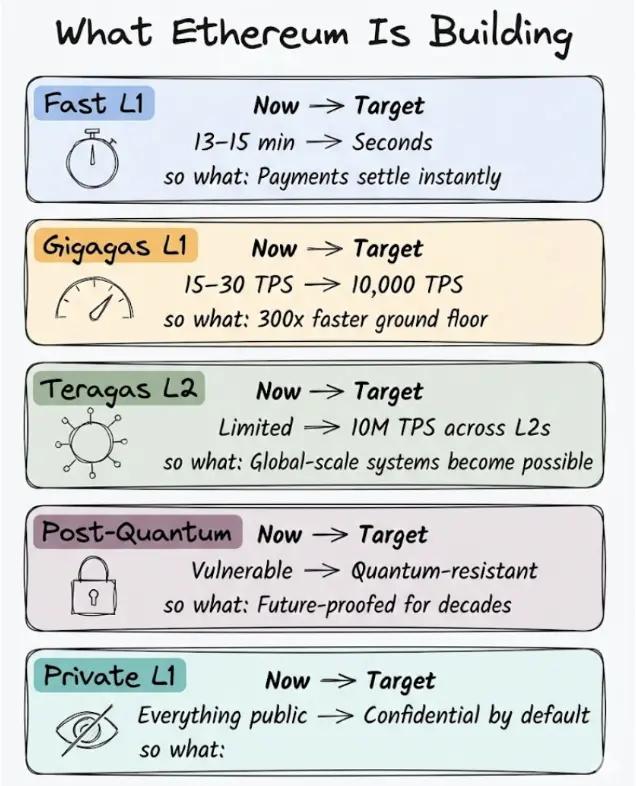
This roadmap revolves around five goals. Ethereum is already operational, with billions of dollars flowing through it daily. However, it has real limitations on what can be built on it. These five goals aim to remove those limitations.
1. Fast L1: Final Determinism in Seconds
Today, after sending a transaction on Ethereum, it takes approximately 13 to 15 minutes to achieve true finality, meaning the transaction is irreversible, completed, and cannot be withdrawn.
Solution : Replace the engine that allows all operators to reach consensus. The goal is to achieve finality through a single round of voting within each time slot. Minimmit is one of the leading candidates currently under research; it's a protocol designed for ultra-fast consensus, but its specific design is still being refined. The key objective is achieving finality within a single time slot. Furthermore, the time slot itself will be compressed: the proposed path is 12 seconds → 8 seconds → 6 seconds → 4 seconds → 3 seconds → 2 seconds.
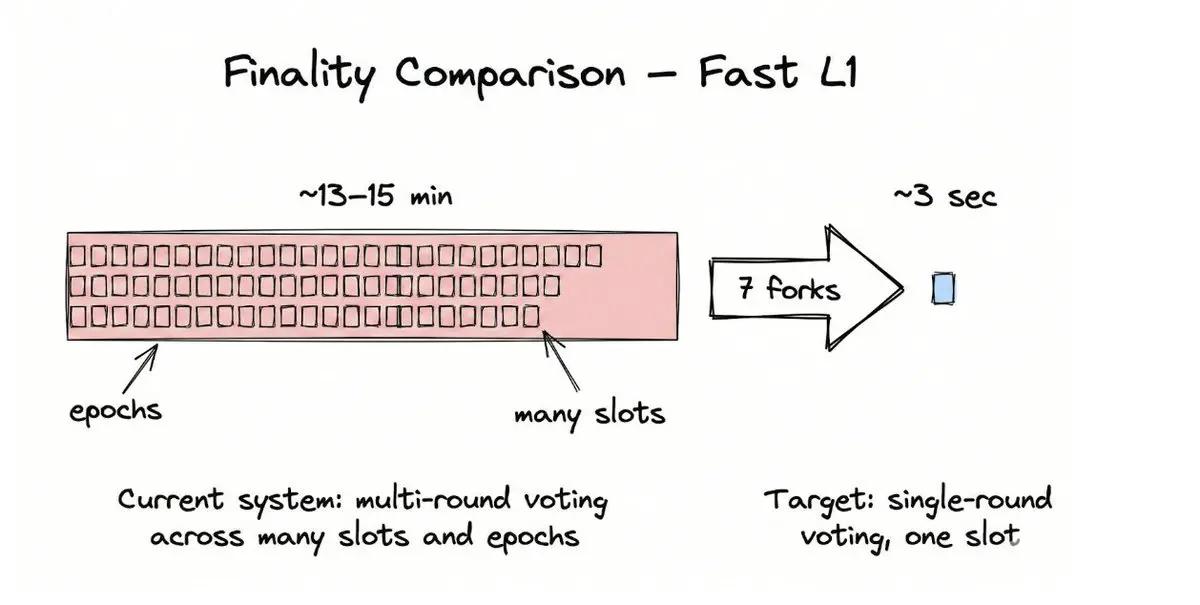
Final certainty is not just about speed, but also about certainty. Consider wire transfers; the time between "sending out" and "settlement" is the window of opportunity where problems may arise.
If you're transferring millions of dollars in payments, settling bond transactions, or completing a real estate transaction on the blockchain, the 13-minute uncertainty is a major problem. If you could reduce that to a few seconds, you would fundamentally change the network's capabilities. This applies not only to crypto-native applications but to anything involving value transfer.
2. Gigagas: 300 times larger
The Ethereum mainnet processes approximately 15-30 transactions per second. This is a bottleneck.
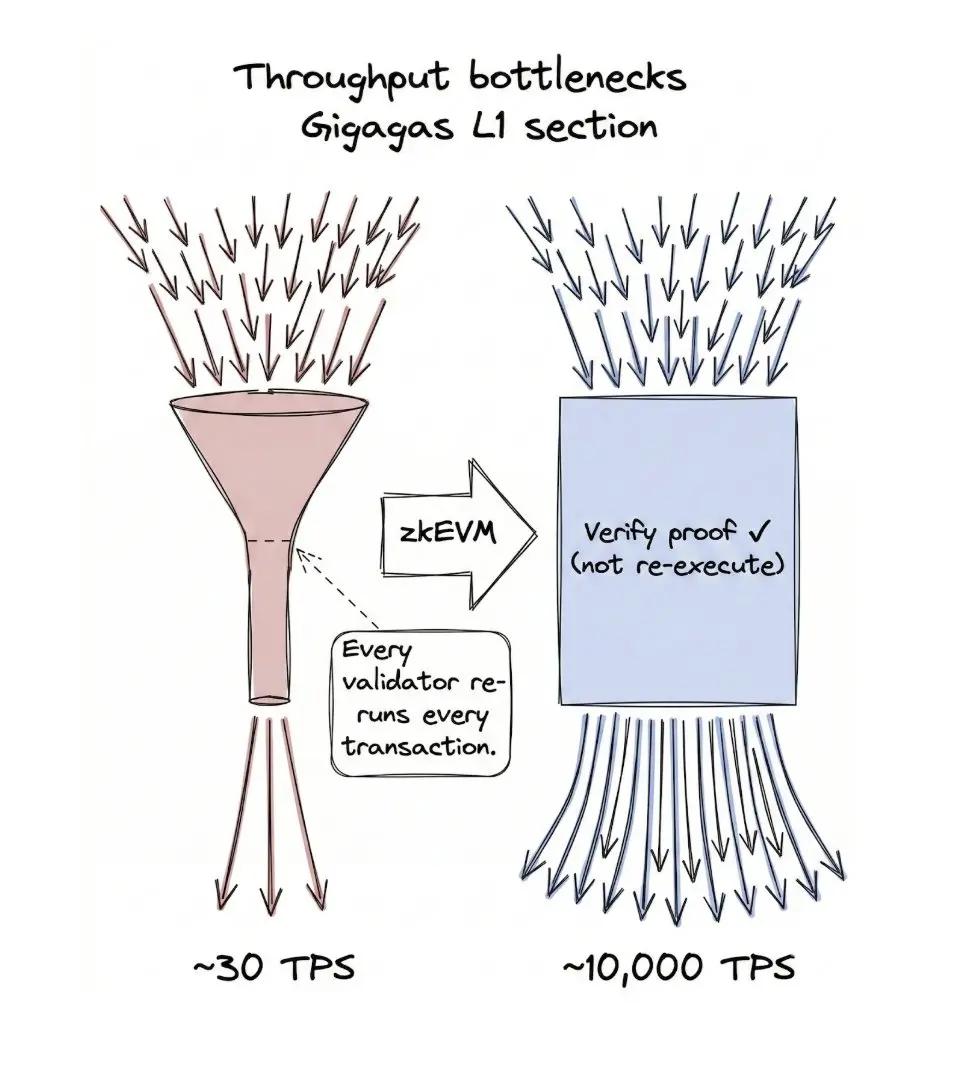
Solution : Strawmap aims to achieve an execution capacity of 1 gigagas (billions of gas) per second, which is roughly equivalent to 10,000 TPS for a typical transaction (the exact number depends on the complexity of each transaction, as different operations consume different amounts of gas). The core idea is a technique called "zero-knowledge proof".
The simplest way to understand this is: currently, every operator on the network must re-execute every single calculation to check its correctness. This is like every employee in a company having to independently recalculate the math problems of all their colleagues. Is it secure? Yes. Is it extremely inefficient? Yes.
ZK proofs allow you to verify a compact mathematical "receipt" that proves the calculation process is correct. The same level of trust, but with far less effort.
The software that generates these proofs is still too slow. Current versions take anywhere from several minutes to several hours to process complex tasks.
Reducing the time to within seconds (achieving approximately a 1000-fold improvement) is an active research challenge, not just an engineering one. Teams like RISC Zero and Succinct are making rapid progress, but it remains at the forefront of research.
A mainnet with fast finality and up to 10,000 TPS means a simpler system with fewer moving parts. The chance of problems occurring is also lower.
3. Teragas L2: Tens of millions of TPS spanning the "fast lane"
For truly massive transactions (and customization), you still need a Layer 2 network. Currently, L2 is limited by the amount of data the Ethereum mainnet can process.
Solution : A technique called "Data Availability Sampling" (DAS). Instead of requiring each operator to download all the data to verify its existence, they each check a random sample and use mathematical methods to verify that the complete dataset is intact. Imagine this as checking if a 500-page book is actually on the shelf by randomly flipping through 20 pages; if those 20 pages are present, statistically you can be certain that the rest are also present.
PeerDAS has been delivered in the Fusaka upgrade, laying the foundation for the infrastructure that Strawmap relies on. Expanding from here to the ultimate goal means iterative scaling: increasing data capacity with each fork and stress-testing network stability at every step.
A processing capacity of 10 million TPS across the L2 ecosystem will open doors that no current blockchain can achieve. Imagine a global supply chain where every product and item has a digital token; millions of connected devices generating verifiable data; or a micropayment system processing fractions of a cent. These workloads would be overwhelming for any existing network. But with a processing capacity of 10 million TPS, they can not only be easily accommodated, but handled with ease.
4. Post-Quantum L1: Preparing for Quantum Computers
Ethereum's security relies on mathematical problems that are extremely difficult for today's computers to solve. This applies to the entire system, including the signatures users use when sending transactions and the signatures used by validators to reach consensus. Once quantum computers become powerful enough, they could break both of these signatures, potentially allowing attackers to forge transactions or steal funds.
Solution : Migrate to a new cryptographic approach (a hash-based scheme) that is believed to be resistant to quantum attacks. This is a late-stage upgrade because it touches almost every part of the system, and the new method uses a much larger amount of data (kilobytes instead of bytes), which will change the economics of the entire network block size, bandwidth, and storage.
A quantum attack on today's cryptography may still be years or even decades away. But if you're building a long-lasting infrastructure—one that could be worth trillions of dollars—"later" is definitely not a real answer.
5. Privacy Level 1: Ensuring transaction confidentiality
All information on Ethereum is public by default. Unless you use a privacy application like Railgun, or a privacy-focused L2 platform like ZKsync or Aztec, every transaction, every amount, and every counterparty is visible to anyone.
Solution : Integrate confidential transaction functionality directly into the Ethereum core. The technical goal is to allow the network to verify the validity of a transaction, whether the sender has sufficient funds, and whether the mathematical calculations are correct without revealing the actual details. You can prove "this is a legitimate $50,000 payment" without disclosing who the sender is, who the recipient is, or what the purpose of the payment is.
Currently, there are some stopgap measures. EY and StarkWare announced Nightfall on Starknet in February 2026, bringing privacy-preserving transactions to a Layer 2 environment. However, these stopgap measures increase complexity and cost. Building privacy into the infrastructure can completely eliminate the need for middleware.
This is also where post-quantum work intersects: whatever privacy scheme is built, it must be resistant to quantum attacks. These are two problems that must be solved simultaneously. Once solved, a major obstacle to the widespread adoption of the technology will disappear.
Seven forks (upgrades)
Strawmap proposed seven upgrade plans, implemented at a pace of approximately six months, starting with Glamsterdam. Each upgrade was deliberately kept to a limited scope, changing only one or two major elements at a time, because if problems arose, it was crucial to pinpoint the exact cause.
The first upgrade following Fusaka (which has already been released and laid the foundation with PeerDAS and data tuning) is Glamsterdam, which refactors how transaction blocks are assembled.
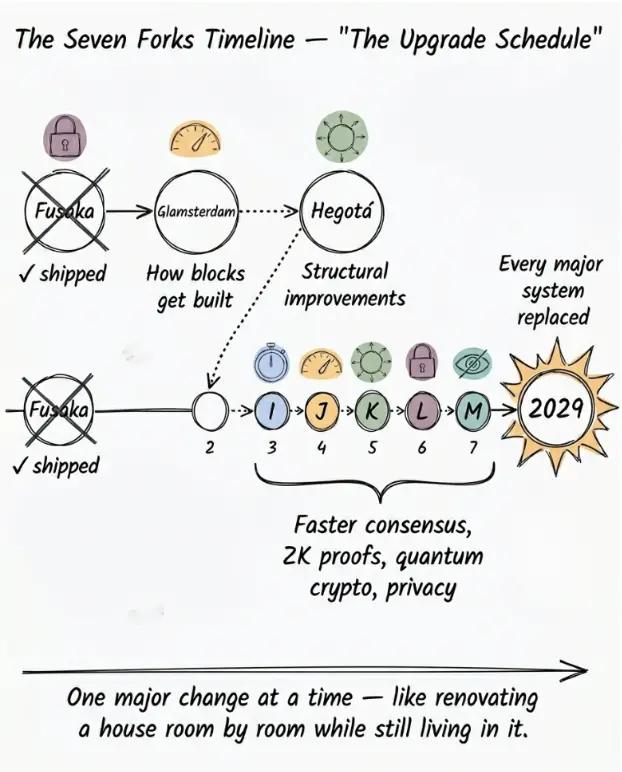
Hegotá follows, bringing further structural improvements. The remaining forks (from I* to M*) will continue until 2029, progressively introducing faster consensus mechanisms, zero-knowledge proofs, expanded data availability, quantum-resistant cryptography, and privacy features.
Why do we need to wait until 2029?
Because some of these problems have indeed not yet been resolved.
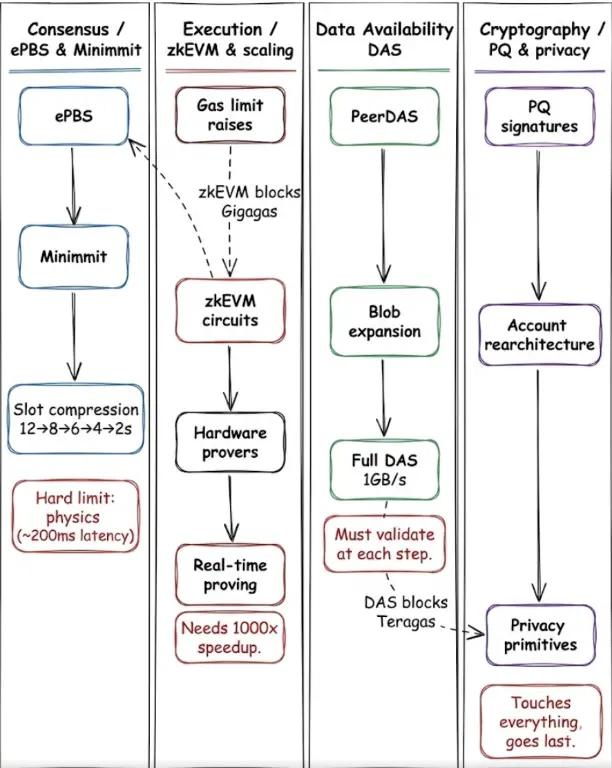
Replacing the consensus mechanism is the most difficult part. Imagine changing an engine mid-flight on a plane, with thousands of co-pilots needing to agree on every single change. Each change requires months of testing and formal verification. The effort to reduce the cycle time to under 4 seconds ultimately encounters a physical challenge: a signal takes approximately 200 milliseconds to travel across the Earth and back. In a sense, you're fighting against the speed of light.
Making the ZK prover fast enough is another cutting-edge challenge. The current speed (in minutes) is about 1000 times faster than the target speed (in seconds). This requires both mathematical breakthroughs and specially designed hardware.
Expanding data availability, while difficult, is relatively easier to manage. The mathematical logic makes sense. The challenge lies in how to operate cautiously on a real-time network carrying hundreds of billions of dollars in value.
Post-quantum migration is an operational nightmare because the new signature features are so large that they alter the economic model of all aspects.
Native privacy is not only technically challenging but also politically sensitive. Regulators worry that privacy tools could facilitate money laundering. Engineers must build systems that are private enough to ensure usability, transparent enough to meet compliance requirements, and resistant to quantum attacks.
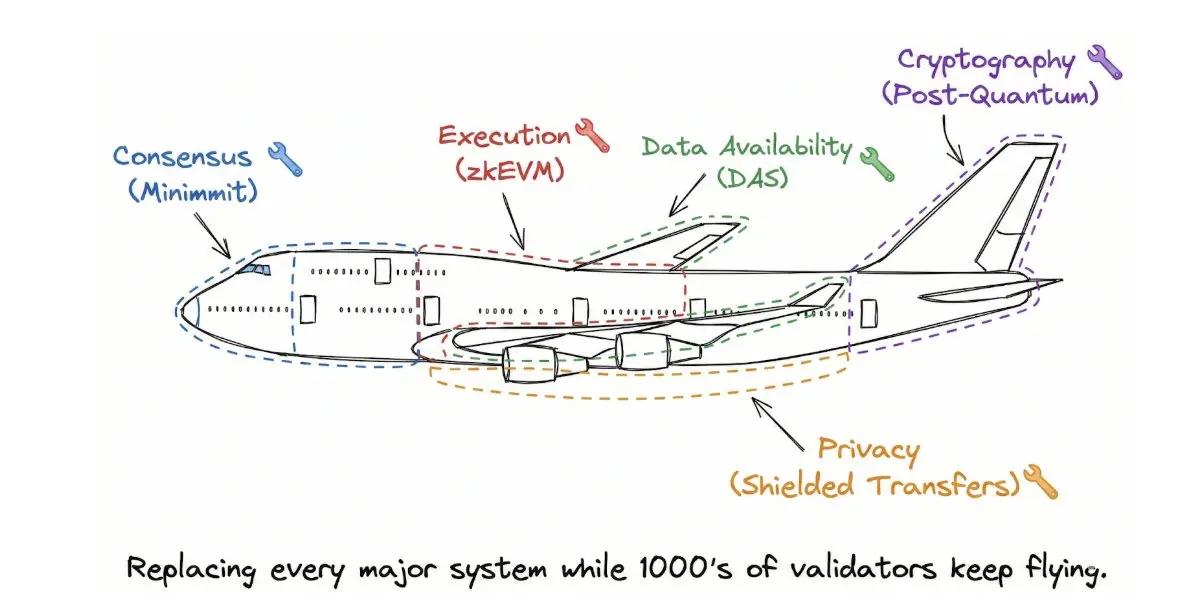
These upgrades cannot be performed simultaneously. Some upgrades depend on others. Without mature ZK proofs, scaling to 10,000 TPS is impossible. Without addressing data availability, L2 scaling is impossible. These dependencies determine the timeline.
Three and a half years is actually quite an aggressive timeframe for all of this.
2029?
First, there is a variable. Strawmap explicitly states: "The current draft assumes a human-led development model. AI-driven development and formal verification could significantly compress the timeline."
In February 2026, a developer named YQ made a bet with Vitalik Buterin that someone could use an AI agent to write a complete Ethereum system based on the 2030+ roadmap. Within weeks, he delivered ETH2030: an experimental Go execution client that claimed to have approximately 713,000 lines of code, implemented all 65 projects on Strawmap, and was marked as runnable on both the test network and mainnet.
Is it ready for production? No. As Vitalik pointed out, there are almost certainly fatal flaws throughout the code, and in some cases, these may just be stub implementations; the AI hasn't even attempted a full version. But Vitalik's response is worth reading carefully: "Six months ago, this was even complete fantasy, and what matters is the direction the trend is heading... People should be open to this possibility (just a possibility, not a certainty!): the Ethereum roadmap may be completed much faster than people expect, and the security standards will far exceed expectations."
Vitalik's core insight is that the correct way to use AI should not be solely for the pursuit of speed. Instead, half of the benefits of AI should be used to improve speed, and the other half to improve security: conducting more testing, more mathematical verification, and implementing the same functionality more independently.
The Lean Ethereum project is working on formal verification of parts of the cryptography and proof stack through machine checks. "Flawless code," long considered an ideal fantasy, may actually become a fundamental expectation.
Strawmap is a coordination document, not a commitment. Its goals are ambitious, its timeline visionary, and its execution relies on the participation of hundreds of independent contributors.
The real issue isn't whether every goal can be achieved on time. It's whether you want to build on a platform with this kind of development trajectory, or compete with it.
And all of this—including all the research, breakthroughs, and cryptographic migrations—was done in an open environment, free and accessible to everyone… This is the part of the story that truly deserves far more attention than it does now.