Original title: "The Hunter's Smell: a16z Bets $2 Billion on the Next Dawn of Web3"
Original author: Eric, Foresight News
While the entire crypto industry is still shivering in the winter, and countless VC firms are choosing to wait and see, a16z, known as "Silicon Valley's most audacious venture capitalist," has once again raised its shotgun.
According to Fortune magazine, a16z crypto is raising approximately $2 billion for its fifth fund, with plans to complete fundraising in the first half of 2026. While this figure is half the size of its $4.5 billion "monster" fund in 2022, it is still enough to attract attention across the industry in the current market environment. Dragonfly, another significant VC firm in the Web3 sector, announced its fourth fund on February 17th, which only raised $650 million.
a16z has a unique investment style in the Web3 industry, and has almost always bet on all the hottest sectors in advance. According to Fortune magazine, a16z's fundraising plan this time is very rushed, with only 3 months left in the time window, and it will only invest in blockchain-related projects.
We can't help but ask: what exactly did they see?
The Venture Capital Revolution of Two Programmers
To understand a16z's choices today, we must go back to the winter of 2009.
The shadow of the financial crisis had not yet dissipated, and a pessimistic atmosphere permeated Silicon Valley. Two tech entrepreneurs, Marc Andreessen and Ben Horowitz, who were already financially independent, decided to start a venture capital firm during this worst possible time. Their first fund aimed for $300 million, with the two contributing $15 million of their own money.
What did the VC community think at the time? "It was a stupid idea, absolutely not something that should have been done." This was the assessment of his peers, as Ben Horowitz later recalled.
Besides being considered too aggressive with a fundraising target of 300 million, a16z's fundraising memo also contained a statement that made its peers laugh: "We believe that technical talent is the most important resource, so we will build a platform team to serve the founders." At the time, peers believed that this move would increase expenses and drag down returns, and also violated the traditional VC rule of "few but excellent".
Today, almost all mainstream VCs are copying this "stupid idea," and that's the DNA of a16z: daring to say "yes" when others say "no."
In 2009, a16z participated in the acquisition of Skype for $65 million. At the time, eBay was embroiled in a patent lawsuit with Skype's founder, and everyone said the risk was too great. Less than two years later, Microsoft took over for $8.5 billion.
In 2010, Benchmark partner Matt Cohler ridiculed a16z's purchase of Facebook and Twitter shares on the secondary market as "trading pork futures." The result? Groupon's $17.8 billion IPO, Facebook's $104 billion IPO, and Twitter's $31 billion IPO.
In 2015, a reporter from *The New Yorker* relayed a colleague's skepticism: for a16z to achieve returns of 5-10 times for its first four funds, the total valuation of its portfolio would need to reach hundreds of billions of dollars. Marc Andreessen made a dismissive gesture: "Nonsense. We're going to hunt elephants, chase the big guys!"
Today, the combined portfolio value of a16z's first four funds has reached $853 billion, far exceeding the initial threshold. The "hunting elephants" analogy later became a classic meme in the VC industry, and a16z's two founders continue to inspire entrepreneurs with their own experiences: truly innovative things often look stupid at first.
This is the sense of smell of an elephant hunter.
Early planning in the crypto space
In 2013, when most people still considered Bitcoin a "geek's toy," a16z had already led Coinbase's Series B funding round. At that time, Ethereum hadn't even been created yet.
Eight years later, Coinbase went public on Nasdaq, reaching a market capitalization of $85.8 billion at one point. After cashing out $4.4 billion, a16z still holds a 7% stake.
This wasn't luck, it was anticipation.
In 2018, the cryptocurrency market experienced its first major bear market, with Bitcoin falling from nearly $20,000 to just over $3,000. It was at this time that a16z officially launched its first crypto fund, Crypto Fund I, with a size of $300 million.
With the same $300 million, this time no one questioned their aggressive approach and model, and the fund's choices were enough to silence those who doubted Web3. Between 2018 and 2021, a16z's crypto fund invested in projects including: MakerDAO (now Sky), Compound, Uniswap, Solana, Avalanche, NEAR, dYdX, Dapper Labs, OpenSea, and Axie Infinity.
According to DefiLlama data, the TVL of three DeFi projects—Sky, Compound, and Uniswap—exceeds $11.4 billion, accounting for nearly 12% of the total TVL of all DeFi projects. Although many names we were familiar with four or five years ago have faded into the dustbin of history, you cannot deny that their past glory still influences today's Web3 world.
By the end of 2021, the first fund's holdings had increased 11 times compared to its initial fundraising amount, making it one of a16z's best-performing funds. Even after a 40% drop in 2022, investors still made substantial profits.
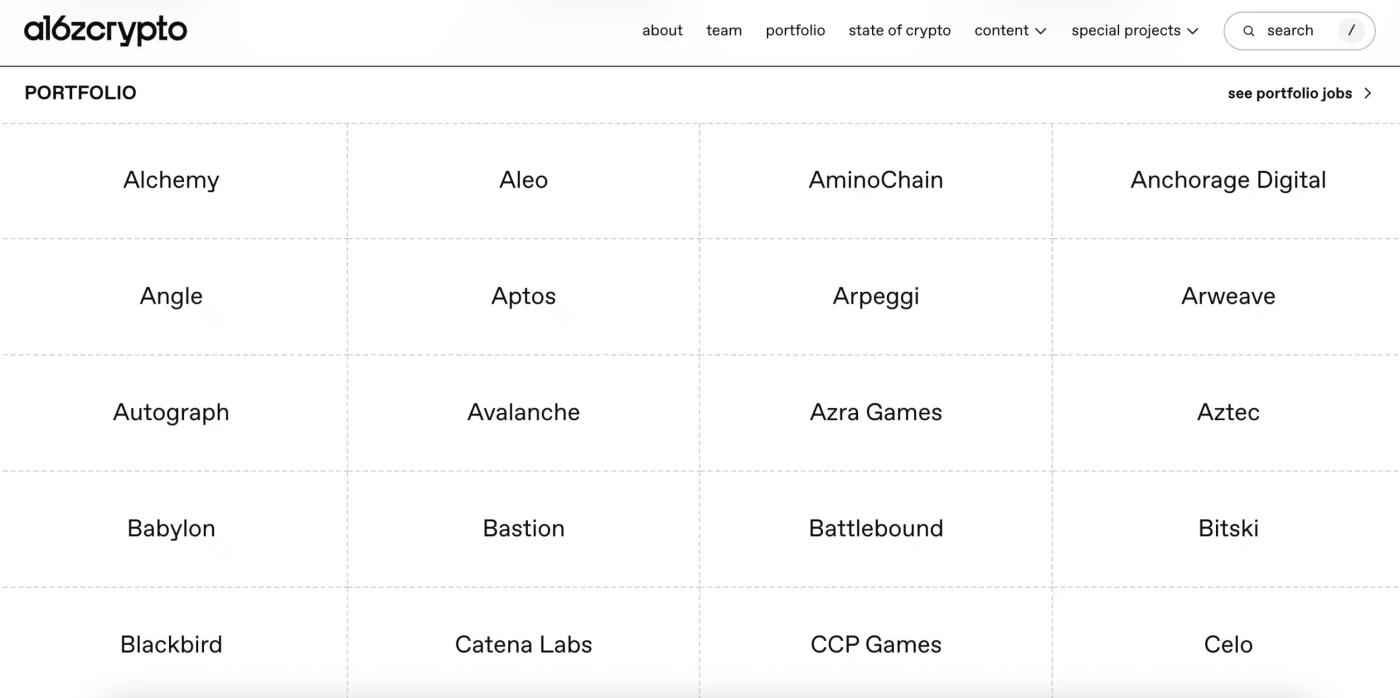
The success of Crypto Fund I made a16z one of the most prominent crypto VCs. In 2020, their second fund raised $515 million. In 2021, their third fund raised $2.2 billion. In 2022, their fourth fund raised $4.5 billion. With over $7.6 billion in funding, a16z became the world's largest crypto venture capital firm. Optimism, LayerZero, Lido, and EigenLayer—these subsequent investments have almost all become leaders in their respective sectors.
Of course, a16z also chases trends and makes investment mistakes. In the battle to predict the market, a16z also chose to heavily bet on Kalshi; in hindsight, its investments in Celo, Chia, Dfinity, and Farcaster also showed some misjudgments.
In this cycle, a16z held a relatively negative attitude towards inscriptions and memes, and its "VC Coin," which it invested tens of millions and hundreds of millions of dollars in, suffered an unprecedented Waterloo. However, a16z did indeed capture all the narratives that can be said to be "Web3 Native," such as L2, LSD, restaking, and interoperability.
You could say they have elitist arrogance, but it's hard to say they're bad.
The Double Life of a Media Company
a16z, which has almost become the undisputed leader in the Web3 field, has never ceased to be the subject of controversy.
In 2015, Benedict Evans, a former partner at a16z, jokingly said that a16z was a media company that made money through venture capital. This statement later became a classic quote used by people inside and outside the industry to criticize a16z.
In 2021, a16z launched Future.com, a centralized media platform, attempting to build a "content empire" in the technology sector. However, the project shut down after 18 months. The failure of Future.com did not cause a16z to abandon its media strategy. Instead, they adjusted their direction—shifting from building a centralized media platform to constructing a decentralized "media ecosystem."
In April 2025, a16z acquired Erik Torenberg's podcast network, Turpentine. This was a typical acquisition plus talent acquisition deal; a16z expanded its media and networking business through the acquisition of Turpentine, while Erik Torenberg joined a16z to be responsible for investment and leading the media team. Seven months later, a16z officially launched a16z New Media.
In the article "What is New Media?" on their official website, a16z stated that the "New Media" team's goal is to create the best turnkey media operation in the venture capital field, helping the founders of portfolio companies win the narrative war, and more importantly, bypassing traditional media.
In the AI era, the barrier to product development has been virtually reduced to zero, but the ability to tell a story has unexpectedly gained higher priority. Giants like Anthropic, OpenAI, Netflix, and Microsoft have significantly expanded their comms/storytelling teams. If you've recently seen a lot of posts on social media claiming you'll be left behind if you don't use AI, some of those posts likely originated from these AI companies.
After all, in an era where products can be made in a few hours, only those who can sell products and services by telling stories can survive.
I've heard many people criticize a16z, believing they lack real substance and often just tell stories about the companies they invest in, waiting for someone to take over. Now it seems this storytelling ability has become a rare commodity in the AI era. Perhaps a16z's ability to foresee trends is itself part of its own storytelling, but I recently heard a very interesting story:
a16z is a nerd-friendly VC firm that thrives on finding talented individuals who are overlooked due to a lack of social skills. These people are often not very talkative but possess a wealth of imaginative ideas that seem impossible to most or contradict current mainstream understanding. Their shortcomings make it difficult for them to stand out in the test of human nature, but a16z has found them and brought them together.
When similar species come together, a powerful chemical reaction occurs between them, allowing a16z's maverick nature to reap rich rewards.
The logic is simple: these people don't need to directly confront the complexities of business warfare; instead, they act as strategists behind the generals who fight on the front lines. Their insightful vision and cool-headedness always allow them to find unconventional solutions. More importantly, no one here will dismiss a strange idea from the outset, because outsiders might think they're crazy, but those within the team know that it might be the only and best answer.
Where will the $2 billion go?
Since October 2024, the cryptocurrency market has experienced a significant correction, with its total market capitalization evaporating by more than $2 trillion. In this environment, many crypto VCs have chosen to scale back their operations.
But a16z's choice was to go against the trend and increase its position.
Chris Dixon has repeatedly stated that a16z crypto's current holdings represent 95% of its historical investments. They believe that selling quality assets prematurely is the worst decision in venture capital. Dixon views blockchain as the next infrastructure of the internet, believing the crypto industry is in a long "foundational period," much like the 1943 paper on neural networks for today's AI; true mainstream adoption will require decades of groundwork.
"We think in centuries," said Katherine Boyle, a partner at a16z.
From this perspective, the current market downturn presents the best opportunity to invest. Valuations are more reasonable, high-quality projects are easier to access, and competition is relatively less. More importantly, a16z may have identified the next explosive growth sector.
The Fortune magazine report mentioned some key points, such as a16z not wanting to take too long to raise funds and only investing in blockchain-related projects.
We can roughly guess the message behind this: a16z has seen some new trends and wants to make a move as soon as possible, but a few hundred million dollars is not enough, at least 2 billion is needed.
Many speculate that they will invest in familiar and popular sectors such as stablecoins, RWA tokenization, payments, and Crypto+AI. However, I believe they must have seen something different, which unfortunately we don't yet know.
Although not explicitly stated, Chris Dixon revealed some clues in a tweet posted on February 7:
We anticipated that financial applications would be the first to take off, so we invested in Coinbase, MakerDAO, Compound, Uniswap, and Morpho, but non-financial applications will catch up sooner or later.
It's no accident that financial applications were the first to emerge; it's a matter of sequence. New applications will only appear once enough people have entered the market.
The long-term lack of regulation and legislation in the crypto field has led the industry astray. Once regulation is implemented, good cryptocurrencies will drive out bad ones.
It was precisely those chaotic years that led to the ultimate glory; the internet and AI are no exception.
Perhaps a16z has seen a new or even a series of promising sectors. Perhaps the $2 billion will not be invested in new sectors, but rather in projects that we think are dead, or perhaps it will be like a startup, frantically accumulating shares in the secondary market.
a16z is right there, continuing to do things that many people don't understand. But will you, the viewer, choose to believe this time?
Believe in the power of belief
Is a16z a Web3 evangelist or a shrewd harvester?
There may be no standard answer to this question.
From one perspective, a16z has indeed reaped huge rewards from the rise of the crypto industry. A single investment from Coinbase brought them over $7 billion in returns. But from another perspective, without institutions like a16z making early bets, without their substantial financial support for seemingly audacious entrepreneurs, could the Web3 industry have grown to its current size?
Their post-investment services have helped countless startups weather their toughest times. Their policy lobbying has secured a more favorable regulatory environment for the industry. Their content output has educated generations of entrepreneurs and developers.
In this atypical cycle, we have seen market resistance to venture capital. a16z also used a huge amount of UNI reserves to try to make LayerZero the choice for Uniswap cross-chain interoperability, but the market seems to have simply pushed Wormhole up the list to counter venture capital.
At the end of 2021, Musk joked on X, "Has anyone seen Web3? I can't find it." Jack Dorsey replied sarcastically, "It's probably somewhere between A and Z."
In today's view, these two sarcastic remarks hit the nail on the head. The concept of Web4.0 has been proposed, but Web3 hasn't even clearly defined itself. Many partners at large cryptocurrency VCs are choosing to leave, many founders of cryptocurrency projects are choosing to exit, and many investors are starting to focus on the stock and commodity markets.
a16z chose to believe in Web3.
In the past year or two, I have often had moments of wavering, but whenever those difficult times come, I think of the inspirational quotes from many successful business people: pay attention to what the smartest people in the world are doing, and just follow their lead.
The world's smartest people are certainly working on AI right now, but a portion of them are openly sticking to crypto. Like you, I don't see any particularly obvious potential or hope, and we don't seem to have the ability to see the future. All we can do is keep a close eye on the projects the new $2 billion fund invests in when it starts deploying.
After all, over the past 15 years, this "elephant hunter" has proven one thing: while others were still debating whether elephants existed, they had already pulled the trigger.