On March 9th, US time, what truly deserves attention in the crypto sector is not the daily increase of any particular stock, but rather the increasingly clear infrastructure-level changes emerging in the connection between traditional capital markets and on-chain asset markets. That day, the market provided clearer signals around three main themes: tokenized stocks, BTC treasury expansion, and ETH treasury monetization.
Traditional securities markets are beginning to embrace blockchain-based stock trading.
On the same day, Nasdaq announced a new equity token design and a partnership with Payward (Kraken's parent company) to develop infrastructure for tokenized stocks. Kraken simultaneously disclosed that the two companies will build an "equities transformation gateway" connecting regulated, permissioned markets with an open on-chain network through the xStocks framework, aiming for operation in the first half of 2027. Kraken also stated that xStocks has accumulated over $25 billion in trading volume since its launch, with over $4 billion settled on-chain, covering more than 85,000 individual holders.
For crypto-related stocks, this means that "on-chain stock trading" is gradually moving from offshore experiments to a new phase dominated by traditional exchanges, with issuer control and compliance frameworks at its core. The market's focus is also shifting from "whether there are stock tokens" to "who controls the issuance, trading, and clearing channels."
BTC Treasury is still reinforcing the logic of increasing holdings through financing.
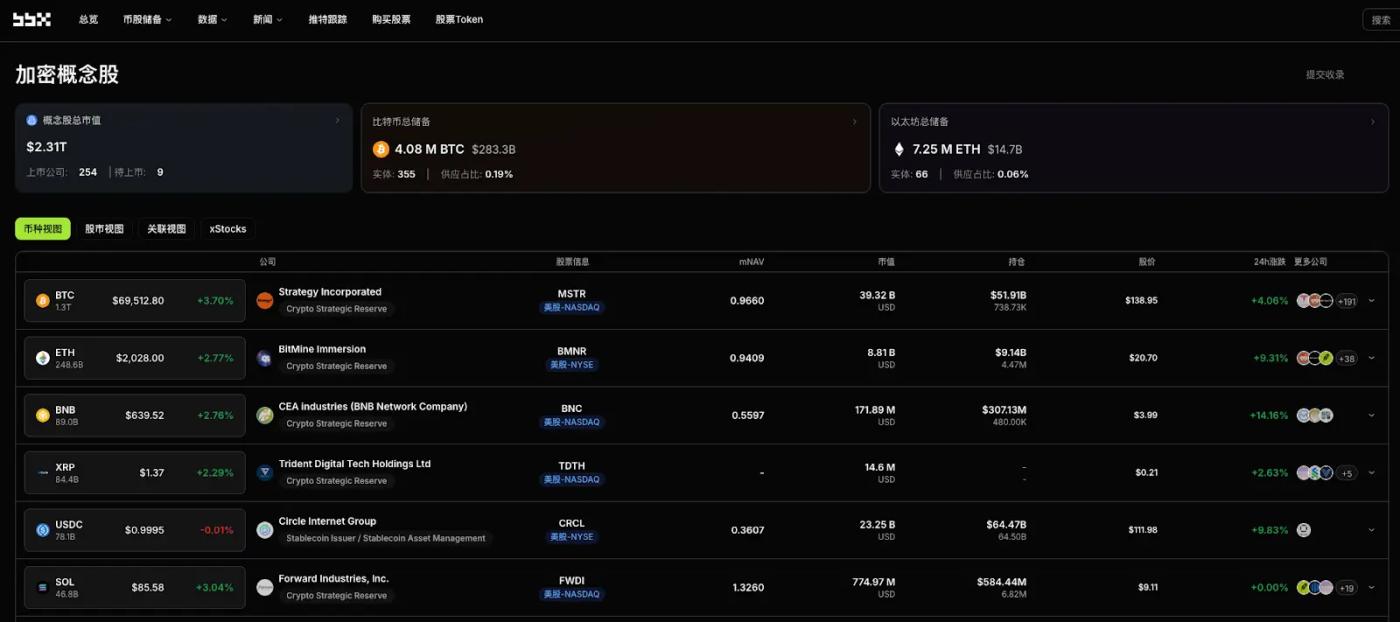
Meanwhile, the Bitcoin treasury theme has not cooled down. Strategy's 8-K filing on March 9 shows that the company added 17,994 Bitcoins between March 2 and March 8, investing a total of approximately $1.28 billion, with an average purchase price of $70,946. As of March 8, its total Bitcoin holdings had risen to 738,731, with a cumulative purchase cost of approximately $56.04 billion and an average holding cost of $75,862.
The document also shows that this round of additional investment funds continued to primarily come from the sale of stocks and preferred shares under its ATM mechanism. In other words, Strategy continues to leverage its public market financing capabilities to shape itself into a continuously expanding "Bitcoin capital container." The key to this model is no longer just a single purchase of cryptocurrency, but rather that it binds equity financing, preferred stock financing, and Bitcoin accumulation into a continuously executable capital market machine.
ETH Treasury Stocks Begin to Verify Income-Generating Balance Sheets
In contrast, ETH treasury company Sharplink presented a different path on March 9th. Sharplink released its full-year results that day, stating that it had completed its strategic transformation into an institutional-grade Ethereum treasury platform, raising approximately $3.2 billion in capital in 2025, with a cumulative ETH holding of 868,699; staking income in the fourth quarter of 2025 reached $15.3 million, continuing to grow from the previous quarter.
Sharplink's statement is straightforward: its goal is not simply to hold ETH, but to continuously increase the ETH exposure per share and improve the productivity of treasury assets through staking and yield management. Unlike BTC treasury stocks, which emphasize "scarce asset exposure," ETH treasury stocks are beginning to more clearly demonstrate to the market that on-chain native assets can be packaged into a listed company's balance sheet that combines reserve and yield attributes.
This logic is also spreading to a wider range of small and mid-cap companies. Genius Group, in its 2025 financial report released on March 9th, also emphasized that the company is a "Bitcoin-first" enterprise, holding 154 Bitcoins as of the end of 2025, and will continue to strengthen the integration of its AI education business with its Bitcoin-first treasury strategy. While it may not be the largest cryptocurrency stock by market capitalization, it illustrates a trend: the crypto treasury narrative is no longer limited to mining companies, exchanges, or a few star companies, but is gradually becoming part of the story of some growth-oriented listed companies reshaping their balance sheets and capital markets.
In summary, the signals from March 9th (US time) regarding crypto stocks were quite clear: crypto concept stocks are evolving from the early three-pronged approach of "exchange stocks, mining stocks, and holding stocks" to a new tiered structure of "on-chain capital market infrastructure + BTC treasury leverage vehicle + ETH yield-generating treasury platform." For ChainCatcher readers, the more important questions may no longer be who bought more coins, but rather who is controlling the entry point for tokenized securities, who is controlling the pace of fundraising for coin purchases, and who can be the first to transform on-chain assets into reusable listed company financial structures.
Data source: https://bbx.com/crypto concept stock information database, compiled based on yesterday's announcements from global listed companies and SEC/TSE disclosure documents.