Hey everyone! This is Liangmu. I just came across a major article published by Multicoin Capital yesterday (March 10th), titled "Internet Labor Markets." The author, Shayon Sengupta, put forward a bombshell viewpoint: In the next ten years, most people will enter the crypto world not by "buying coins," but by "earning coins"—by working and directly receiving crypto assets as wages.
This article gave me goosebumps because it strung together hot topics like DePIN, AI, and stablecoin payments into a clear narrative, giving the impression that the next big wave in the crypto is just around the corner. The article begins by stating the main point: in the past decade, 99% of people entered the market by "buying"—exchanging fiat currency for crypto assets or integrating crypto payments. However, the author predicts that this will reverse in the next decade, with most people choosing the path of "earning." This is because the vast majority of people globally live on wages, not through asset appreciation. When income directly translates into crypto account balances, those balances then become savings, and finally, participation in the internet capital markets, this is the true second-order effect.
Imagine an ordinary worker's monthly salary going directly into their wallet, automatically staking and yield farming—it's a fantastic prospect! Why is this happening? The core reason is that "programmable ownership" greatly improves collaboration efficiency. SpaceX's Starlink is already using stablecoins to collect payments from emerging market customers, while giants like Deel and Scale AI are using stablecoins plus USD to pay their global contractors and employees. In 2026, Deel partnered with MoonPay to allow employees to receive stablecoin salaries directly, starting in the UK and EU, followed by the US. This is already a reality, but even more significant is another group: those earning "native crypto capital assets" through their labor.
Projects like Helium and Hivemapper demonstrate that using crypto capital markets and cryptographic primitives can reverse capital expenditures—early adopters use tokens to bear the risk of a cold start, while project teams use tokens to reward physical proof-of-work.
DePIN establishes three prerequisites for on-chain collaboration: 1) fast, low-cost settlement; 2) verifiable output; and 3) trust and reputation guarantees on the supply side. Permissionless capital markets allow strangers to spontaneously form teams globally, drastically reducing the cost of risk aggregation. But these alone are not enough; DePIN must evolve to scale. In the past few years, they have changed dramatically:
First, the incentive design is much more sophisticated. Early versions of DePIN were often criticized for their erratic inflation and inability to prevent cheating. Now, after trial and error by leading projects, best practices have been established: work verification uses primitives like zkTLS, anti-spam uses a binding + penalty mechanism, and rewards are matched to continuous contributions rather than passive idleness. DePIN in 2026 is much more rigorous in these aspects.
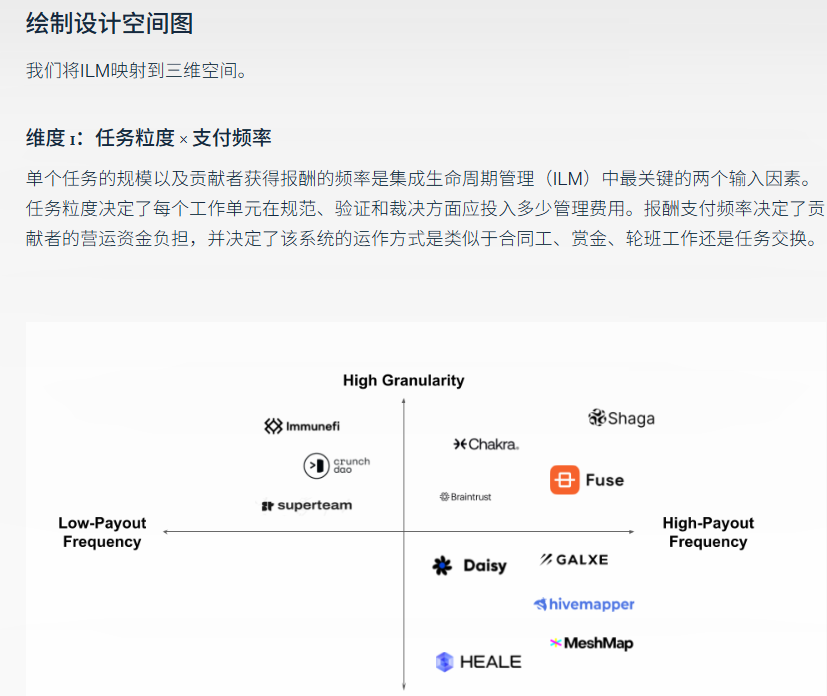
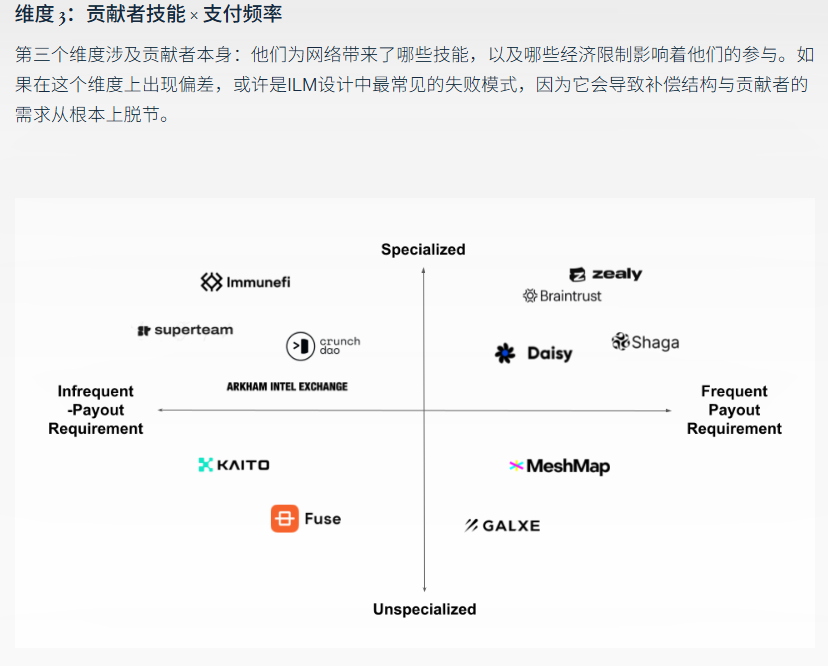
Secondly, "earning income through tokens" has become commonplace. Tens of millions of people are already doing social tasks on Galxe and Kaito, submitting bug bounties on ImmuneFi, and providing intelligence through Arkham bounty tasks. These platforms have made earning tokens a daily activity.
Third, the granularity of the work unit was chosen correctly. Why did those general-purpose DAOs fail in 2021? Because their contribution interfaces were too large and inefficient. DePin coordinating simple tasks (such as installing hotspots or taking pictures of roads while driving) is far more efficient than DAOs that heavily focus on designing capital allocation.
Now we're moving to the next stage: job descriptions are changing from "permanently install WiFi hotspots to earn tokens" to "deliver packages from A to B to earn a fixed reward," or "earn tokens that offset electricity bills by reducing electricity usage by 100kW between 7-10 PM." This granularity is smaller, and the matching is more precise. AI will accelerate this trend dramatically. AI is slashing software development costs and latency to rock bottom, allowing one person to handle product development, iteration, and promotion. Companies are becoming smaller, but still require non-software input: data labeling, evaluation, physical deployment, domain knowledge, and edge case handling.
We've already seen examples of single-person organizations achieving nine-figure value. This leads to the core concept: the Internet Labor Market. This is a contributor-owned market where the unit of work is a verifiable task, with instant settlement via encrypted tracks.
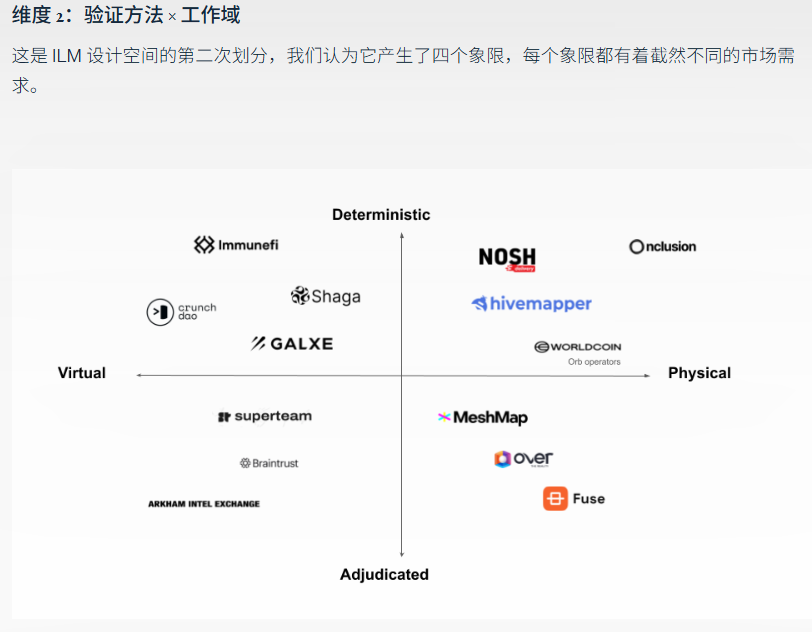
Two advantages over traditional DePIN: 1) Coordinating arbitrarily customized tasks; 2) Strong verification guarantees rewards based on individual contributions. Arbitrarily customized tasks: Work is defined using a small set of parameters (description, qualifications, verification method, pay function), broadcast globally, competed for/assigned upon completion, and paid out after cryptographic verification. Suitable for cutting-edge work, as such tasks rarely conform to traditional classifications. For example: "Collect 200 high-value edge cases for medical processes, qualified physicians, verify medical qualifications + XLM files, reward 100 tokens." Open only to high-accuracy contributors. The security marketplace publishes "Generate X-contract vulnerability patches, payment only upon passing the test suite."
The physical network sends out messages like "Go to location X to take a timestamped photo to verify business hours," combined with geofencing and verification. The underlying market doesn't need new categories; task definitions come with built-in workflows. Flexibility accumulates; the network adjusts procurement as bottlenecks occur, reusing the same batch of contributors, verification, and reputation systems. Strong verification guarantees: Traditional hiring processes (submission-invoice-approval-payment-delivery in a few days) are adequate for large, low-frequency transactions, but for high-frequency, adversarial tasks, the cost exceeds the task itself.
The internet labor market uses deterministic verification instead of conventional methods: Hivemapper checks the reasonableness of GPS tracks, ImmuneFi compares the test suite, and model evaluation scores based on baselines. Disputes are resolved using binding verification: the Livepeer model, where contributors stake deposits, reviewers are rewarded for accuracy and penalized for malicious actions. The two mechanisms are combined: deterministic verification improves efficiency, while binding verification handles edge cases.
The author concludes that this marks the beginning of the internet labor market. Programmable incentives on a cryptographic track are best suited to support this model. DePIN is shifting from speculation to sustainability, with revenue projected to double to over $100 million by 2026. Real demand is emerging for projects like Helium, Hivemapper, and Filecoin, and ARR is surging from millions to tens of millions.
The combination of AI and DePIN will completely reshape the future labor market. As a crypto blogger, I think this article is incredibly forward-thinking.
In 2026, we stand at a turning point: stablecoin payments are becoming mainstream, DePIN is shifting from hardware subsidies to real-world use, AI is atomizing work, and crypto provides a settlement and incentive layer. The way ordinary people earn cryptocurrency in the future may not be through speculation, but through contributing data, completing tasks, and performing physical work, directly depositing the funds into their wallets. Risks certainly exist: regulation, inflation design, and verification failures. But the trend is there; whoever gets on board first will reap the rewards.