Table of Contents
ToggleFrom tariff policies to the outcome of the US presidential election, Bitcoin's (BTC) sensitivity to major macroeconomic events is well-documented. With the US midterm elections approaching in 2026, Wall Street and cryptocurrency investors are closely watching how this political struggle will influence the price movement of the world's largest cryptocurrency.
Political uncertainty takes hold, risk assets face headwinds
According to a recent report by Binance Research, midterm election years are typically the weakest performing years for the S&P 500 during the four-year US presidential election cycle, primarily due to high political uncertainty dampening market risk appetite. Historical data shows that the S&P 500 experiences an average peak-to-trough retracement of approximately 16% during midterm election years.
For Bitcoin, which is highly correlated with US stocks, the impact of these macroeconomic headwinds is even more pronounced. The report points out that during past US midterm election years, Bitcoin's average decline was as high as 56%.
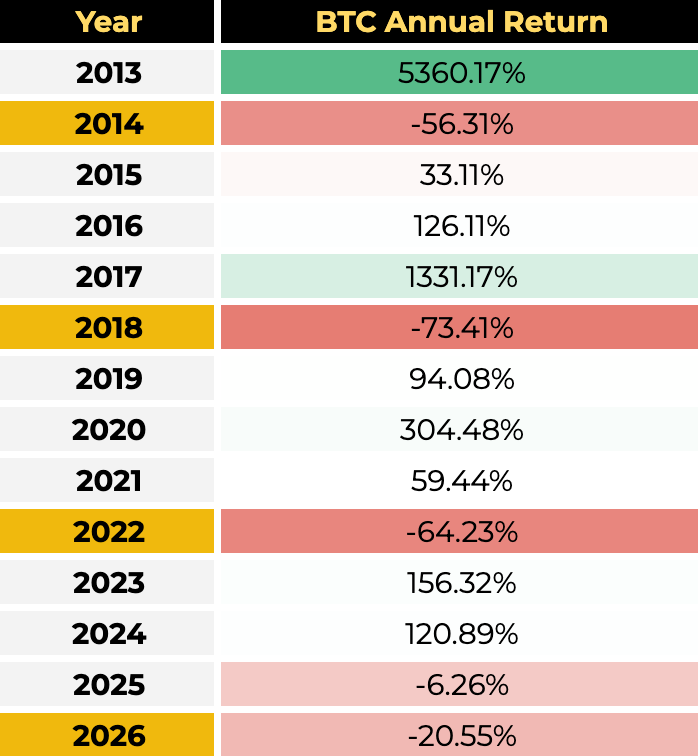
Will the election lead to a rebound? Analysts say the real test will be at the end of the year.
Despite the turbulent nature of midterm election years, historical patterns offer a glimmer of hope. Data shows that once the election results are finalized and uncertainty dissipates, funds tend to flow back into high-beta assets. In the 12 months following midterm elections, the S&P 500 index rose by an average of about 19%, while Bitcoin's recovery was even more remarkable, averaging a 54% increase.
Predictions from several well-known cryptocurrency analysts coincide with this trend. Some analysts have observed that the past three midterm election years (2014, 2018, and 2022) have "coincidentally" been bear market years for Bitcoin, with the market bottom almost always falling around or shortly after the November elections. For example, in 2022, the FTX exchange crashed during the week of the midterm elections, simultaneously establishing the absolute bottom of that bear market.
The second half of 2026 may become a watershed moment for the market.
Looking ahead to 2026, on-chain analysts, including Willy Woo, generally expect this potential bear market trend to end in the fourth quarter of this year. More aggressive predictions suggest that Bitcoin may dip to the $30,000 mark by the end of 2026 before starting a new multi-year bull market. According to CryptoQuant's analysis, the most likely timeframe for the market bottom is between September and November of this year.
In summary, Binance's historical data and various indicators point to the same conclusion: the second half of 2026, especially around the November midterm elections, may be a key turning point for Bitcoin's price. However, investors should be aware that market trends are not simply copied and pasted; variables such as global monetary policy and geopolitical risks could disrupt historical cycles at any time.

 Related reports
CZ denies rumors of "net worth over $110 billion": Bitcoin has fallen so much, how can he be rich?