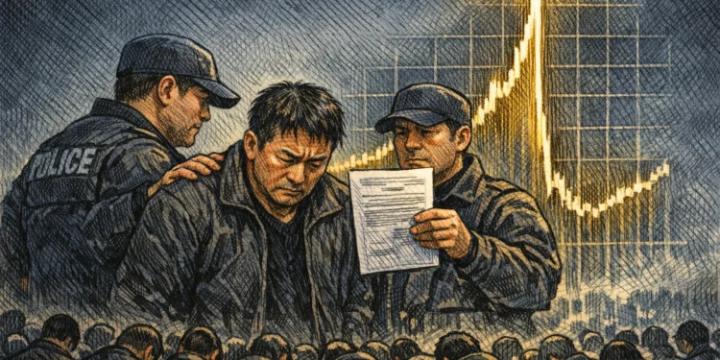
Satoshi Nakamoto, the most thoroughly anonymous person in human history, disappeared completely after creating a trillion-dollar economic system. There are no photos, no real names, and no traceable evidence.
Author: Bibi News
The views expressed in this article represent the author's personal opinion only and should not be used as the basis for investment decisions, nor do they constitute any investment advice. Readers are advised to strictly abide by local laws and regulations.
Jensen Huang is one of the most present tech figures of our time. Every year at GTC, he stands on a stage in front of thousands of people, wearing his signature black leather jacket, turning his two-hour speech into a sermon about the future.
Satoshi Nakamoto, the most thoroughly anonymous person in human history, disappeared completely after creating a trillion-dollar economic system. There are no photos, no real names, and no traceable evidence.
One integrated into the era, while the other disappeared from it. Their seemingly extreme and opposite behaviors revealed that they used the same way of thinking when facing their respective worlds.
First, they don't create things; they write the rules.
In October 2008, Satoshi Nakamoto sent a white paper to a cryptography mailing list, which had only a few hundred recipients.
The white paper is titled "Bitcoin: A Peer-to-Peer Electronic Cash System." However, it hardly defines Bitcoin; instead, it explains how Bitcoin is produced—the proof-of-work mechanism, node consensus, diminishing block rewards, and a total supply limit of 21 million coins.
Satoshi Nakamoto not only created Bitcoin, but also created a complete set of rules that enabled Bitcoin to be born: as long as you follow these rules, you can become a participant in this economy without trusting anyone or needing anyone's permission.
Satoshi Nakamoto once said a quote that has been cited by the Bitcoin community: "If you don't understand or believe, I don't have time to convince you." He was meticulous and strict in his control over the details of the code, but he never spent much time defending it, because the rules themselves only need to function, not explain.

Seventeen years later, in March 2026, Jensen Huang stood on the stage at the SAP Center in San Jose. NVIDIA launched a new product, but he barely talked about chip specifications or Groq LPU integration. Instead, he presented a graph: the Y-axis was throughput, the X-axis was the user-perceived token speed, and the graph was marked with five pricing tiers, from free to $150 per million tokens.
Addressing the CEOs and decision-makers in the audience, he broke down the data center's computing power allocation, explaining which model was suitable for which scenario and how much each scenario was worth. He wasn't selling GPUs, but rather explaining the reasons for their existence; he wasn't stating the status quo, but announcing the rules. "Tokens are a new commodity, and like all commodities, once they reach an inflection point and mature, they will be divided into different parts."
They share the same mindset: they never consider what to create, but rather the logic behind how the world works. Products are merely byproducts of the rules, not the end goal itself. They are extremely confident and focused because the rule-makers don't persuade others; they simply wait for the world to catch up.
Second, choose to continue when no one believes you.
Rules are not easily accepted from the outset; they often go through a long period of neglect before they truly take effect.
Satoshi Nakamoto did not choose a calm and peaceful time to release the white paper; instead, he chose a rather delicate moment.
In 2008, Lehman Brothers went bankrupt, and the global financial system teetered on the brink of collapse. In October of that year, he chose to release the white paper, and the Bitcoin Genesis Block—mined on January 3, 2009—contained a line of text embedded in the block data: The Times, January 3, 2009 headline: Chancellor of the Exchequer faces second bank bailout.
Without any comments or declarations, only this line of text was embedded in the code and permanently written into the blockchain. This was his only political statement, not an angry outcry, but an extremely restrained irony from someone who had lost faith in the old system.
For a long time, GPUs were primarily graphics cards for gamers. After the launch of CUDA, there were few developers, the market didn't understand it, and very few developers were willing to learn it. AI research was repeatedly declared a dead end in the industry; investors didn't understand it, Wall Street didn't buy it, and NVIDIA was on the verge of bankruptcy several times in its early stages.
In a later interview, Huang Renxun said that during that period he lived in constant fear that the company would die the next day, and even turned this state into a management philosophy: "The company is always 30 days away from bankruptcy." This was not pessimism, but rather his way of driving himself and the entire team by replacing complacency with a constant sense of crisis.
In this situation, most people would choose to shrink, adjust their direction, or even give up, but Satoshi Nakamoto continued to write code, fix bugs, and answer technical questions in forums, never talking about himself or explaining his motives; Jensen Huang continued to bet on parallel computing, standing at GTC year after year, telling the story of a future that most people have not yet seen.
Their answer was not language, but time.
This "lack of explanation" is not arrogance, but rather an almost obsessive trust in the laws themselves: as long as the rules are right, the world will eventually gravitate towards them.
Third, they all understand the importance of designing scarcity.
When the rules start to function, what truly gives them power is scarcity.
Satoshi Nakamoto never provided a detailed explanation for the number 21 million, but this design decision serves as the value anchor for the entire Bitcoin system. He understood the logic of currency better than anyone: something with an unlimited supply has no value.
He hardcoded the scarcity into the code, ensuring that no matter how many mining machines flood in or how many times the computing power increases, the total supply of Bitcoin will never exceed 21 million. This number is not an attribute of Bitcoin, but a prerequisite for its value.
Jensen Huang chose a different kind of scarcity. At GTC, he said, "You still have to build a 1GW data center. That 1GW facility, amortized over 15 years, is about $40 billion. Even if you don't put anything in it, it's still $40 billion. You have to make sure that the best computing systems are used on it."
A 1GW data center will never become 2GW. Land is limited, the power grid is limited, and cooling is limited. This isn't a constraint imposed by code, but simply a law of physics. Jensen Huang understands better than anyone that, under the constraint of physical scarcity, every watt of wasted computing power means a real loss.
Both individuals approach scarcity with an anchoring rather than possession. Scarcity gives tokens value; value gives rules weight; and weight gives the system credibility.
IV. After the starting point, the world operates on its own.
Satoshi Nakamoto designed the rules, handed over the code, and left gracefully. His last email contained only one sentence: "I've moved on to other things." After that, there was no further contact. His approximately 1.1 million bitcoins remained untouched; he accomplished decentralization itself through his disappearance.
After designing the rules, Huang Renxun stayed to continuously iterate, digging the moat deeper and deeper. Thirty years, five paradigm shifts, and he never left the stage.
Two people with completely opposite paths believe the same thing: rules are more reliable than people, and systems outlive individuals. Their deepest similarity lies not in what they did, but in how they view themselves and what they created.
Seventeen years ago, we saw because we believed; seventeen years later, we can see without believing. It is the next after Watt, Ampère, and Bit. And the writers of the rules only need to write at the starting point, and the whole world will operate according to their logic.
Disclaimer: As a blockchain information platform, the articles published on this site represent only the personal views of the authors and guests and do not reflect the position of Web3Caff. The information contained in the articles is for reference only and does not constitute any investment advice or offer. Please comply with the relevant laws and regulations of your country or region.
Welcome to the official Web3Caff community : Twitter account | Web3Caff Research Twitter account | WeChat reader group | WeChat official account