Table of Contents
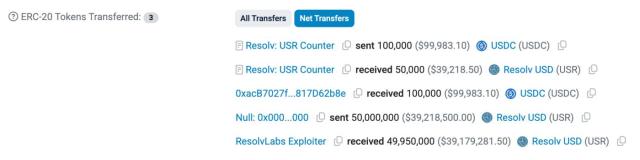
ToggleAnother major security incident has been reported on the blockchain today : the stablecoin protocol Resolv is suspected of being attacked by a minting vulnerability. The attacker minted 80 million USR with only 200,000 USDC, then cashed out and left, converting a large amount of the proceeds into ETH.
Attack steps: Three steps to complete cashing out
Onchain Lens, an on-chain monitoring platform, traced and revealed that the attacker's operation was clearly divided into three steps:
The first step was to trigger a minting vulnerability with 200,000 USDC, thereby obtaining 80 million USR at low cost: an abnormal minting ratio of approximately 400 USR to 1 USDC.
The second step is to convert USR into its staked version, wstUSR, and then further exchange it for USDC and USDT to complete the stablecoin cash-out.
The third step involved using a total of $17.24 million in USDC and USDT to buy 9,111 ETH in the market.
USR plunged as much as 74%, prompting Venus Protocol to halt trading.
Impacted by the vulnerability information, the USR exchange rate plummeted to $0.257, a drop of 74.2%, severely deviating from its $1 peg. By the time the message was sent, the USR had partially recovered to approximately $0.86, but remained below its target.
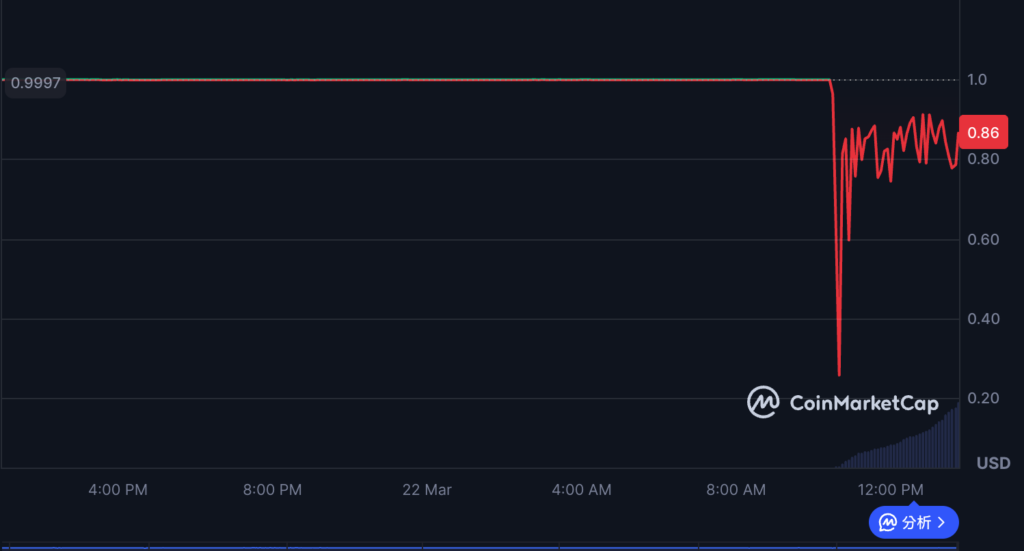
BNB Chain lending protocol Venus Protocol responded immediately, issuing an official statement stating: "Due to the de-pegging of the Resolv-issued stablecoin USR, USR trading on the Venus Flux market has been suspended. Venus Core is unaffected, and all user funds are safe. We are actively monitoring the situation and will provide updates as more information becomes available."
Resolv Protocol Background
Resolv is a stablecoin protocol designed with a delta-neutral (market neutral) strategy. USR is its yield-generating USD stablecoin, and wstUSR is a staking and encapsulated version of USR, with a design logic similar to wstETH in the Ethereum ecosystem.
The core of this suspected vulnerability lies in an abnormality in the casting mechanism, which allows attackers to issue a large number of USRs at a cost far below normal, thereby triggering de-anchoring and subsequent arbitrage activities.