Author: Radigan Carter
Compiled by: TechFlow TechFlow
TechFlow Introduction: The background of this analysis speaks for itself—the author wrote this four-stage market framework while evacuating his family and dealing with missile attacks in Oman.
Instead of trying to predict the outcome, he deduced the most likely middle path: six weeks is the critical point for inflation transmission, July-August is the buying window, and the Fed will be forced to cut rates in September.
This is one of the most information-dense and credible market analyses of the Iranian war to date.
The full text is as follows:
Over the past week, I've worked on this analysis intermittently while evacuating my wife and dealing with attacks in Oman. This is my current thinking on how this war will affect the markets over the next 6 to 12 months. I'm not making predictions, but rather outlining the most likely middle path so I can adjust accordingly as events unfold.
My goal has always been like Thucydides': to take my own risks, pursue understanding, and speak the truth clearly. When immense forces collide head-on again, and we all feel the weight of uncertainty, my sole focus is: as an individual investor, what can I do to protect my family?
I see four stages ahead.
Phase 1
Denial. That's where we are right now. What we're seeing is volatility surrounding the president's speeches—markets moving in tandem with whatever he says when the market opens. Everyone's desperately trying to believe this new Middle East war will be short-lived. Powell has been assuring everyone that this isn't stagflation, while he watches Israel bomb the South Pars gas field and looks like he could throw his phone away.
Phase Two
If the war continues, the six-week trigger point in mid-April will initiate this phase. In the sixth week, the oil price shock caused by the attack on energy infrastructure will seep into freight, food, and consumer goods. CPI data will begin to cause panic. Tech stocks will begin to suffer real pain as valuation multiples begin to shrink.
Tech stock valuations should fall—higher energy prices lead to hotter CPI data, which will kill any remaining expectations of a Fed rate cut. Powell has already begun to suppress those hopes, and the April and May data will finish that job. This situation won't change as long as Israel has a veto over our foreign policy. Israel is bombing South Pars, while the US is allowing Russia and Iran to sell oil on global markets in an attempt to stabilize energy prices.
When Powell completely dashes any remaining hopes for a rate cut this year, the market will erupt in fury. Unlike every sell-off in the past 15 years, I'm not sure I can simply buy the dip and wait for the Fed to prop me up. The inflation we'll see will be supply-side driven—from the bombing of gas fields and LNG terminals.
The Federal Reserve has a bunch of useless economics PhDs and a computer for printing money. They don't have a group of oil engineers, nor do they have LNG processing facilities in their basement. The Fed can't solve this problem with monetary policy. Therefore, tech stock valuations priced in on rate cuts will be repriced in on the assumption that rates will remain at current levels. Everyone will feel terrible before summer arrives when they realize there's no easy way out.
Phase Three
As summer approaches, targeting July and August, companies begin releasing their earnings reports, and the damage we've witnessed on the ground begins to manifest in the real numbers. Corporate profits are falling short of expectations. Unemployment is rising. Against the backdrop of this war, the process of AI replacing workers will only accelerate behind the scenes, as companies need to cut costs to cope with higher energy inputs. Politicians will begin to panic ahead of the November midterm elections.
The third stage presents the buying opportunity I've been anticipating.
The best items on my shopping list are expected to appear at meaningful discounts—by then everyone will be fed up with it all, angry about rising costs and declining job security, and demanding action before the fall and midterm elections. This will happen. We've gone from cost-cutting to massive stimulus like the war in Afghanistan. The war has been going on for less than three weeks, and costs have already skyrocketed with no signs of slowing down; hundreds of billions of dollars are just the beginning. The Fed will eventually compromise, politicians will increase fiscal support, and we'll add another trillion dollars or more in debt to pay for Israel's war. Just be patient.
Phase 4
Late 2026 to 2027. The Fed compromises, begins cutting rates, and everything bought in Phase Three starts to work. I believe that in Phase Four, as we emerge from this crisis, there will be a strong focus on energy independence and abundance. Both parties in Congress will be singing the same song. Nobody wants to be labeled "obstructing the resolution of this pain" because people have witnessed firsthand how disrupting energy markets in one region of the world leads to increased costs everywhere. And this gives them a reason and cover to cut rates, increase spending, and create jobs.
The Iran war will highlight the necessity of controlling input factors, which I expect will benefit assets within US jurisdiction or at least in the Western Hemisphere. Against this backdrop, AI will only accelerate. Companies facing profit margin pressures and rising energy and input costs will use AI to cut labor costs as much as possible. These aren't companies typically considered AI or tech companies, but the productivity gains will be reflected in their profit margins in 2027 and beyond. Emerging from this war, the AI story isn't just about the companies building AI, but about the companies using AI to survive. This is the structural shift I'm looking for this summer.
How did this war begin?
The war has been going on for nearly three weeks, and I still believe most people are underestimating the duration of this conflict. This is not because I am predicting the worst-case scenario—I am trying to focus on the most likely middle path—but because the theological framework driving Iranian decision-making does not respond to the kind of incentive mechanisms assumed by Western politicians and commentators.
The Shia tradition is built upon the story of Hussein ibn Ali, the third Shia Imam, who knew he would die in the Battle of Karbala in 680 AD. He faced death alongside 72 companions against an enemy force of thousands. In Shia theology, resisting injustice is a duty, even when victory is impossible in the conventional sense. Defeat and death are not defeats; surrendering to overwhelming injustice is.
The way Israel and the United States waged this war is almost a meticulous replica of the origin story of Shia Islam itself—diplomacy was used as a tool of deception, and they launched an attack while the Omani foreign minister announced a diplomatic breakthrough, assassinating Khamenei and his family. Just as Hussein was massacred after being promised safe passage.
That's why no matter how many targeted killings Israel conducts—of men in residential areas with their families and civilians—the Iranians won't kneel. The Israelis know this, and they don't care. Israel will bomb Tehran until it looks like Gaza, and set the whole Middle East ablaze. They don't care about the chaos. And the United States? I know I can't.
Shia theology reframes suffering as an affirmation of walking the path of justice. This dates back to the 7th century, when Arab tribes emerged from the Arabian Peninsula and began conquering parts of Roman and Persian territories. The Persians, an ancient civilization, viewed their conquest by the Arabs as unjust, and Shia theology found a natural place in this Persian identity.
The idea that Israel and the United States could assassinate their leaders, drop a few missiles on them, and then they would succumb to foreign powers—a history built precisely on millennia of resistance—is absurd. We remain tragically ignorant of the targets we want to wage war against, having learned nothing from our failures in the global war on terror and the war in Ukraine, yet handing over the veto power of foreign policy to psychopaths.
Current situation
Now it's day 20, and the conflict has crossed the threshold of the second phase: energy costs penetrating the supply chain.
Yesterday, Israel attacked Iran's South Pars gas field, the world's largest. Iran retaliated, severely damaging Qatar's Ras Lafan LNG facility, also one of the world's largest. Qatar Energy has declared force majeure on gas exports and shut down LNG production. Qatar accounts for approximately 20% of global LNG trade, with over 80% of its shipments going to Japan, South Korea, China, and Taiwan. These supplies are now offline and could take years to restore. Israel's Bazan refinery in Haifa—which supplies 65% of Israel's diesel and 59% of its gasoline—was also affected, along with other energy infrastructure in the Gulf region.
In Qatar, I worked for five years in the Ras Lafan Industrial City, doing pre-commissioning work on LNG facilities. Qatar Energy (when I worked there, it was called Qatar Gas) is vertically integrated. They own everything from offshore gas fields to LNG processing facilities, to export terminals, to an LNG tanker fleet.
These LNG processing facilities are colossal. Twenty years ago, when they were being built, 250,000 workers toiled in the heat of that industrial city every morning, the facilities under construction resembling a forest of cranes. Starting these facilities, especially after damage, repairs, inspections, and system restarts, is no quick process. These natural gas processing facilities are like small cities, costing tens of billions of dollars, with intricate systems, some components custom-made and with delivery times measured in years.
Once missiles and Shahid 136 suicide drones fly into these facilities, causing primary and secondary fragmentation damage, coupled with fire and blast shockwaves, you must meticulously inspect these systems before activating them in stages. Some systems operate under extremely high pressure, and missing a single point of failure could lead to catastrophic failure.
If a custom-made, long-lead-time component breaks down, you'll have to wait months or even longer—waiting for a new container to be manufactured in China or South Korea, shipped, unloaded at the dock, and then escorted to its destination by Mammoet's heavy lifting team.
I had hoped that the damage to Raslavan was not so severe that it could be repaired within a few months, rather than years. But unfortunately, that doesn't seem to be the case.
This will have an immediate ripple effect on other industries. Qatar's offshore natural gas has a high sulfur content. Qatar Energy, like a whole cow, separates liquid hot sulfur from the natural gas, making it into sulfur granules, which are then transported by bulk carriers for use in the production of fertilizers, chemical products, cement, and oil refining products. Once LNG comes online, it will begin to trigger other cascading effects; I am not entirely certain about its second- and third-order impacts at present. The only certainty is that if this situation continues long enough, the global economy will begin to experience problems in unexpected ways.
As Charles Gave stated, the economy is a transformation of energy. As the energy sources the world depends on go offline and remain offline, countries will scramble to import alternative energy sources. The shutdown of Middle Eastern energy producers has led to higher global energy prices. This may be good news for US energy exporters, but over time, higher energy costs will be passed on to consumers, and businesses unable to obtain energy at higher prices will shut down production and lay off workers.
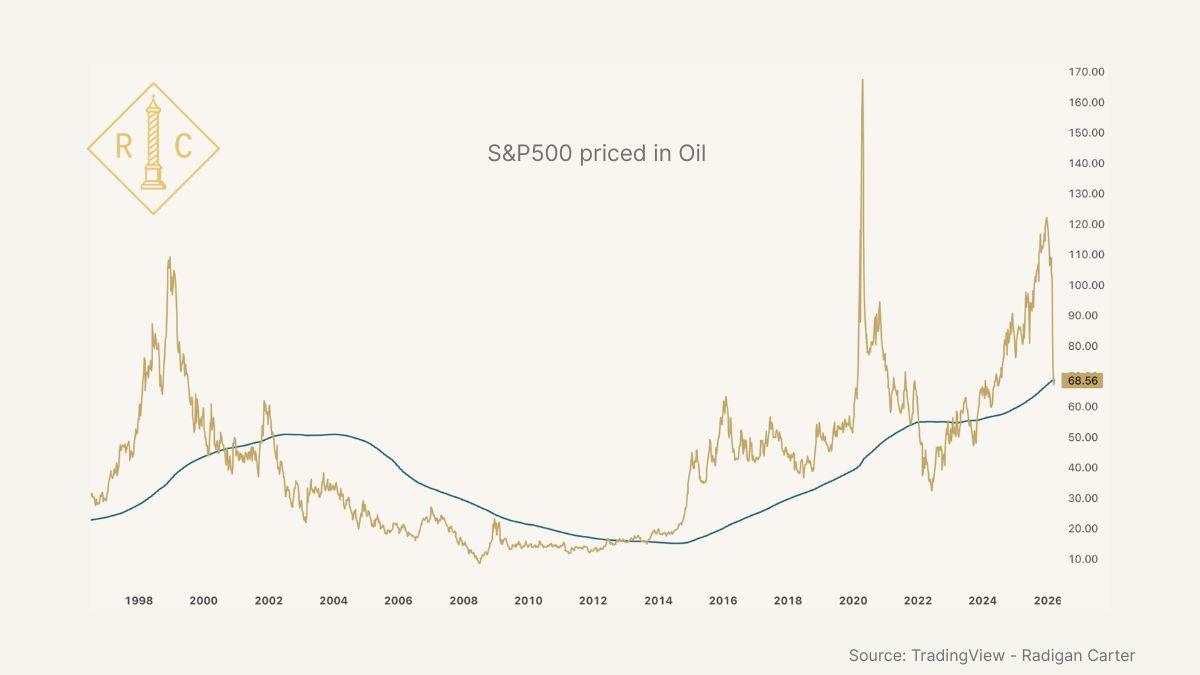
Chart: Heading towards an inflationary collapse
Hormuz crisis
Beyond attacks on energy infrastructure, the conflict continues to spread regionally. Israel is invading southern Lebanon, causing approximately 1,000 more deaths and displacing nearly a million people. Iraq's Popular Mobilization Forces—Iranian-backed Shiite militias that played a key role in the 2016 fight against ISIS—have now joined the conflict, attacking U.S. facilities in Iraq, Saudi Arabia, Kuwait, and Jordan. This has forced the U.S. to withdraw and redeploy personnel from the region, further weakening the U.S. military's ability to sustain regional operations.
I have sailed through the Strait of Hormuz many times, and I wrote an article about the strait before.
Since the start of the war, more than 20 ships have been attacked. The Islamic Revolutionary Guard Corps has launched 50 operations against US bases in the region. My understanding of this is that the entire region, from Adana in southern Turkey, south through Israel, and eastward, encompassing Lebanon, Syria, Iraq, the Arabian Peninsula, the Persian Gulf, and the Arabian Sea, is under Iranian firepower.
If we include the Houthi rebels in Yemen, then when they begin targeting Red Sea shipping, global maritime and energy trade will be split in two. Historical analogies include the Ottoman Empire's closure of the Silk Road, the global economic impact of the outbreak of World War I in the summer of 1914, and the Suez Crisis of 1956, which signaled the end of the British Empire. This is why I believe that after emerging from this crisis in Phase Four, investors will re-examine their holdings and seriously consider the issues revealed by this war. Many might say: profits are good, but are the assets safe, and in which jurisdiction are they located? Assets in jurisdictions considered safer, where they don't need to navigate treacherous chokepoints to reach the final market, may command a premium. The outcome of this conflict is crucial.
Climbing the upgrade ladder
Some have asked why the US doesn't begin targeting life support infrastructure when Iran has firepower over the Strait of Hormuz. Given the targeted killings, the regional spread of the conflict, and the current attacks on energy producers, further escalation is not something to be taken lightly, no matter how much White House interns try to portray this war as a video game and release distasteful propaganda videos.
Unfortunately, we are already targeting life support infrastructure. On the seventh day of the conflict, the United States attacked a desalination plant on Iran's Qeshm Island, a strategic location guarding the Strait of Hormuz. Iran's geological conditions have resulted in numerous natural caves on the island, and the Islamic Revolutionary Guard Corps has been improving and strengthening underground facilities there for decades.
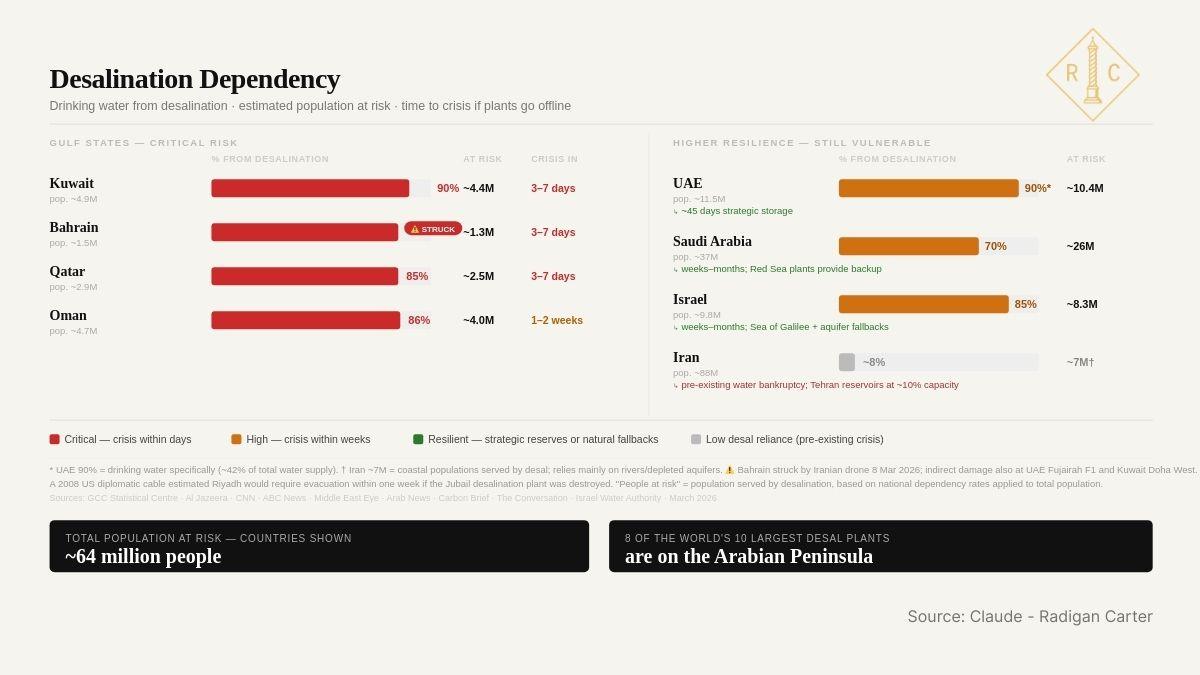
The following day, Iran retaliated in kind, launching a drone strike against a desalination plant in Bahrain. Kuwait and the UAE also reported missile-related damage to their desalination plants. The loss of desalination plants poses a life-or-death threat to the Gulf states and Israel. With temperatures reaching 46 degrees Celsius in the summer, the disruption of drinking water and electricity could trigger a humanitarian crisis, resulting in deaths—a real risk.
In the Gulf region, over 90% of desalinated water comes from just 56 plants. In Kuwait and Bahrain, desalinated water accounts for approximately 90% of the national water supply. In Oman, where I am, this figure is 86%, in Israel it's 80%, in Saudi Arabia it's 70%, and in the UAE it's 42%.
If the US and Israel continue to target life support infrastructure, Iran will retaliate, and with its air defenses waning, striking these facilities will become increasingly easy—a vulnerability asymmetrically exploited by the Gulf states and Israel. Approximately 64 million people in the region could be affected. This would trigger a humanitarian and refugee crisis dwarfing the Syrian civil war, with profound repercussions for Europe and Turkey.
Oil built the modern Middle East, but desalinated water sustains it. In this war, Iran holds the upper hand in escalating both. The United States needs a continuous flow of energy from the Persian Gulf to maintain global market stability, and the region cannot afford to lose its desalination plants. Israel can continue to climb the escalation ladder, but will eventually reach the top, at which point Iran will strike their desalination plants.
Phase Two: The Logic of the Six-Week Trigger Point
Everything that has happened so far belongs to the first phase—where we are now, why neither side is willing to back down, and why the conflict is likely to continue. But Trump may announce a glorious victory at Truth Social tomorrow, that the war is over, and he has reached a remarkable agreement—even if the details aren't true.
Whether the Strait of Hormuz remains under Iranian control is irrelevant, and whether the US has experienced its own Suez Moment is irrelevant—that has longer-term implications, but that's another matter. In this context, what matters is whether higher energy costs can be passed on to other parts of the supply chain in time, rendering this entire analysis invalid.
While I was thinking, I asked myself a question: When did it become so that no matter what was said or what agreements were announced, higher energy prices were already flowing through the system and could not be stopped?
Six weeks—that's the trigger point I've determined. By week six, the denial period is over. Everything is no longer alright; this war is not a 20-minute adventure, and the inflation data in late April and May will reflect the real damage already done.

Image: Every neoconservative is talking about the Middle East
This is how I determined the six-week trigger point:
We've already seen refined product price adjustments in the first and second weeks. Gasoline and diesel prices at gas stations have been repriced. Shortages are beginning to appear in more vulnerable countries. Oil prices are about 40% higher than pre-war levels.
The third and fourth weeks, which is the stage we are currently in, are seeing freight and logistics costs begin to adjust as carriers repric according to new fuel costs. February's PPI was 0.7%, compared to an expected 0.3%, an early harbinger of this stage; April's inflation data will be even worse as costs continue to permeate the system.
In weeks five through eight, the increased freight and logistics costs from the first two weeks flowed into consumer goods as these costs were passed on to consumers. Food, building materials, and manufactured goods were all repriced as overall inflation in fuel and freight costs from the previous month reached consumers.
By the sixth week, higher costs had already passed on to consumers, and it didn't matter if the conflict ended; higher prices had already been established, especially after energy producers went offline—the next step was simply to patiently wait for the third and fourth phases to unfold in the summer and fall.
Six weeks ago, a ceasefire could mitigate most of the damage because contracts hadn't been fully rolled over, businesses could revert to previous pricing, the Fed could cut rates, and everything would be fine—at least in theory. However, with energy infrastructure crippled and supplies like Qatari gas expected to be offline for the foreseeable future, my assessment may have been flawed.
Six weeks later, even a ceasefire cannot undo what's already in the pipeline. Repricing has already occurred, and the CPI data for May and June will reflect the damage, regardless of what happens in Iran.
The CPI data will likely dash Powell's hopes for a rate cut this year—he currently says he's not worried about stagflation—and keep rates at current levels. This will lead to shrinking tech profit margins, and the market won't be happy. Nobody will be happy as this war drags on.
Phase Three: The Long Summer and AI
My plan for this summer is to go to the beach and the gym to keep myself patient, and then, towards the end of summer, start seriously assessing where the situation is. By August, we should see corporate earnings reports begin to report the damage we're currently seeing on the ground. Meanwhile, AI continues to accelerate behind the scenes as companies cut costs as much as possible under pressure to increase energy inputs.
The company has been deploying AI, not hiring, and now we're adding a stagflationary energy shock on top of that. Even a rocket scientist can see that when a company faces profit margin compression and needs to cut costs due to $95 oil prices, it will replace employees with AI tools whenever possible. This is no longer about innovation; it's about survival.
AI adoption will accelerate during the downturn as it becomes an obvious cost-reduction tool.
The cruel paradox is this: it works exceptionally well for individual companies while simultaneously destroying overall demand. It will eliminate income that workers would otherwise spend, and I'm unsure what the impact will be on creditors—those who previously thought they held a goldmine.
It's also uncertain how it will affect colleagues—who are no longer certain about their future and will cut back on non-essential spending, especially given the backdrop of energy inputs driving up commodity costs.
So I wouldn't be surprised if we see price increases from an energy shock, while employment deteriorates faster than any historical model predicted—as AI substitution is superimposing and amplifying the cyclical downturn.
This is what I consider the most important point regarding the timing.
The Fed's employment authorization will be triggered sooner than anyone expects. This is not only because of the war, but also because AI is structurally amplifying the underlying unemployment. This compresses the entire timeline, pointing to a September rate cut.
The Federal Reserve will face a dilemma: inflation they cannot combat, and a deteriorating job market. They will likely remain on hold throughout the summer, only to cut rates in September due to pressure from the midterm elections.
AI and tech stocks will likely fall in this environment due to price compression and slowing corporate revenue. But the narrative will actually become stronger. Companies that adopted AI are the ones that weather the downturn, while those that didn't are the ones that went bankrupt. So when stocks are cheapest, the long-term argument becomes most compelling. That's why I want to remain patient and buy into tech and research companies that will leverage AI to weather the crisis in Phase Three.
After the fourth phase, people will look back and say: I should have bought that copper mining company. It was crushed because no sulfur was flowing out of Hormuz, but they made 30-ton dump trucks self-driving and are now printing money because both parties in Congress believe in energy independence!
Midterm elections
The Federal Reserve, the White House, and Congress each have different mandates, but they all face the same date—November. No leader wants to face voters amidst stagflation and without a policy response. No Federal Reserve chairman wants to be seen as standing idly by and watching the economy deteriorate.
This consensus broke the deadlock. The Federal Reserve will signal at the Jackson Hole meeting in August that it will cut rates in September, and every politician can campaign by saying, "We took action."
The market reacts 4 to 6 weeks in advance, meaning July to August would be a time I seriously consider starting to build positions—if the six-week threshold is triggered and the conflict continues. The AI-driven deterioration in employment actually helps this timeline. It gives the Fed political cover to cut rates even with inflationary pressures, because it can frame it as an employment emergency rather than a policy capitulation.
2027 Outlook
The theme of energy independence emerging from this crisis will be massive and bipartisan, much like defense spending in the global war on terror, but focused on energy. After the higher energy prices and associated costs from this war impact consumers, energy independence will become the dominant political narrative, transcending partisan boundaries in 2026-2027.
The mutual bombing of South Pars, the Qatari LNG terminal, and Saudi refineries during this war has made vulnerability undeniable. Every politician is campaigning for "never again relying on the Middle East." Both parties in Congress will fight for more infrastructure spending, as well as expanded drilling, regulatory reforms, nuclear energy, and clean energy.
I keep reminding myself of the most important thing: I'm not trying to predict, I'm just adapting. If a genuine peace agreement emerges—not just Trump tweeting that it's over, but a real cessation of hostilities, the reopening of the Hormuz, the re-entry of the insurance market, and Iran having a negotiating partner capable of enforcing compliance—then I will turn to this.
But to be honest, with Larijani killed and Israel continuing to assassinate anyone we can negotiate with, that hope is fading every day.
This is my current framework for thinking. It's not a prediction, but a framework that can be adapted and adjusted as things develop.