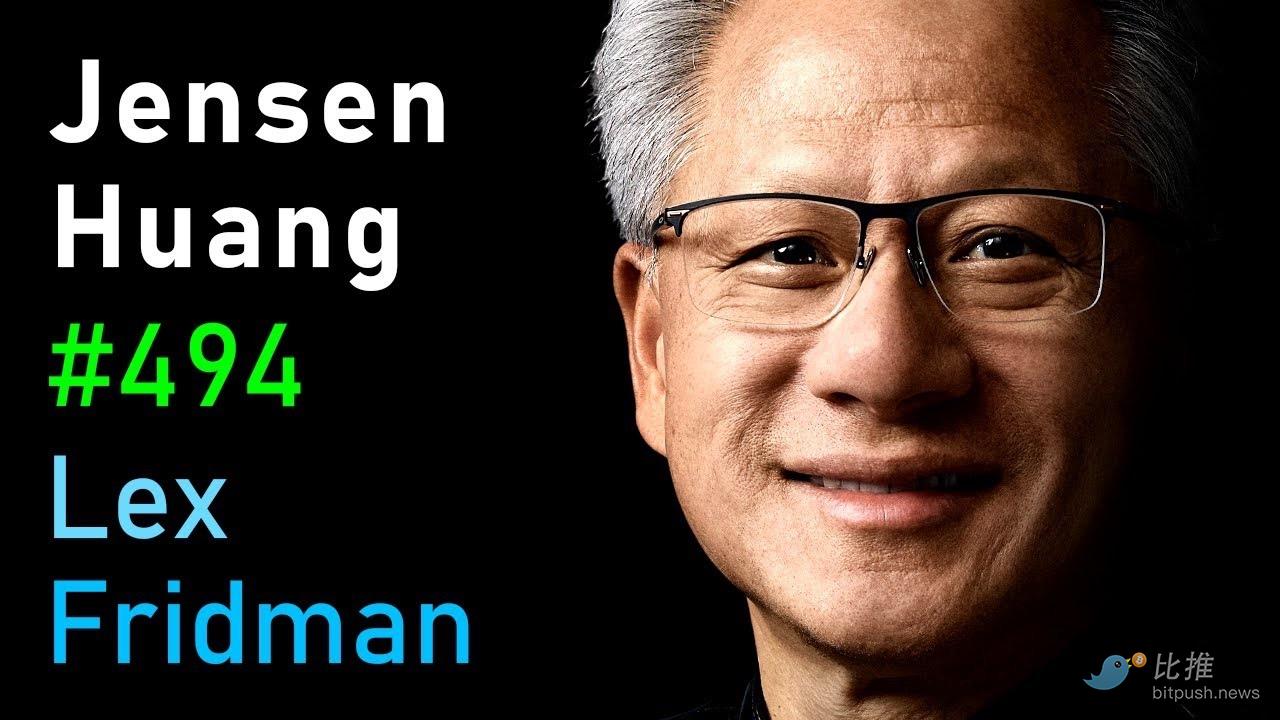
Podcast source: Lex Fridman Podcast
Interviewee: Jensen Huang, Founder and CEO of NVIDIA
Podcast compilation: BitpushNews
In this in-depth conversation lasting 2 hours and 26 minutes, Jensen Huang discussed AGI, the scaling law of AI , intelligent agents, NVIDIA 's competitive advantage, TSMC and its supply chain, the possibility of a $10 trillion market capitalization, how he runs NVIDIA, and his views on death and succession. The entire conversation was incredibly informative, with the most striking statement being his assertion regarding AGI: "I believe we have already achieved AGI."
To ensure a better reading experience, the following content has been reorganized while retaining the original meaning.
AGI Schedule
Lex Fridman:
The question of AGI timelines actually depends on how you define AGI. Let me use a perhaps absurd but very specific definition: If an AI system can already essentially do your job—start a company, build it up, scale it up, and run a successful tech company valued at over $1 billion—how far are we from such a system? 5 years, 10 years, 15 years, or 20 years?
I'm talking about systems that can accomplish very complex tasks: innovation, finding customers, sales, management, building a team of intelligent agents and humans, and so on.
Huang Renxun:
Is it a good company, or just a company?
Lex Fridman:
It's not just about "starting a company" in the ordinary sense; it has to be worth over $1 billion. You know how difficult it is to make all of these aspects work.
Huang Renxun:
I believe, right now. I believe we have achieved AGI.
Lex Fridman:
Do you really think it's possible for an AI system to run such a company right now?
Huang Renxun:
Possibly. The reason is that you said it's "worth $1 billion," but you didn't say it has to exist forever.
For example, a system like Claude could easily create a web service or a fun little application that suddenly has billions of people willing to pay 50 cents to use, only to disappear shortly afterward. We've seen many such companies in the internet age, and many of those websites weren't actually much more complex than what systems like OpenClaw can create today.
Lex Fridman:
In other words, it relies on viral spread to cause a rapid outbreak, and then monetizes that traffic.
Huang Renxun:
Yes. I just didn't know exactly what it would be. I couldn't predict which companies it would be back then either.
The law of AI expansion: "Intelligence will continue to expand."
Lex Fridman:
You've always been a staunch supporter of the extension law. Do you still believe it now?
Huang Renxun:
Of course I believe it. In fact, we now have not just one extended law, but many more extended laws.
Lex Fridman:
You've mentioned four types: pre-training, post-training, test-time scaling, and agent scaling. What's your biggest concern regarding this obstacle?
Huang Renxun:
Let's look back. Initially, the concern was that pre-training expansion would hit a data ceiling. High-quality data is limited, and even the largest models will eventually run into obstacles. Ilya even said something like "pre-training is over," which caused panic throughout the industry, with many feeling that AI had reached its limit.
But this is clearly not true. Training data will continue to expand in the future, with a significant portion coming from synthetic data. Many people are confused by "synthetic data," but much of the information humans pass on, modify, enhance, and then disseminate is inherently "synthetic." AI can now generate massive amounts of augmented data based on real-world information, so future training will no longer be primarily limited by data, but will increasingly be limited by computing power.
Huang Renxun:
The second law of scaling is test-time scaling. Many people used to tell me that training is difficult, but inference will be easy; that future inference chips will be small, cheap, and easily commercialized. But this has always seemed illogical to me, because inference is thinking, and thinking is much more difficult than reading.
Pre-training is more like memorization, generalization, and pattern finding; while test-time reasoning is about breaking down, planning, searching, and trying different paths when facing a new problem. Since this is thinking, how can it be lightweight computation? As it turns out, we were right: test-time scaling is extremely computationally intensive.
Huang Renxun:
Next comes agent expansion. Now we have an agent with a large language model, but during testing, this agent will do research, query databases, use tools, and most importantly, it will spawn many more sub-agents.
This is similar to scaling NVIDIA: scaling myself is difficult, but scaling NVIDIA can be done by adding employees. The same applies to AI; the next scaling law is to multiply AI.
These agents will continue to generate more data and experience, some of which will be retained and re-entered into pre-training, post-training, and testing for further expansion, forming a continuous cycle. Ultimately, intelligence will continue to expand, and its upper limit will ultimately be determined by computing power.
What will AI become in the future: a digital employee, a tool user, and a "reinvented computer"?
Lex Fridman:
But the real challenge is that you must predict in advance which direction AI will develop in the future, because the iteration cycle of hardware architecture is much slower than that of models.
Huang Renxun:
Yes. AI model architecture changes roughly every six months, while system and hardware architectures change only about once every three years. Therefore, you must anticipate the direction two to three years in advance.
Part of our success comes from our own research; the other part comes from collaboration with the entire industry. We are probably the only company in the world that collaborates with almost every AI company, so we can constantly hear the real "whispers" of the industry.
Lex Fridman:
So you're predicting the future?
Huang Renxun:
It's actually simpler: you just need to reason.
If a large language model is to eventually become a "digital employee," what must it possess?
It must access the real evidence, which is the file system;
It must be able to conduct research, because I cannot wait until it knows everything about the past, present, and future before making it useful;
It also requires the ability to use tools.
Huang Renxun:
Some people say that AI will completely destroy software, making tools unnecessary. I find that absurd.
Let's conduct a thought experiment: If we do create a very powerful humanoid robot in the next ten years, after it comes to my home, is it more likely to use the tools I already have to complete its tasks, or will it transform its hands into a 10-pound hammer one moment and a scalpel the next, and even emit microwaves from its fingers to boil water? Obviously, it's more likely to just use the microwave oven.
It's okay if you don't know how to use it the first time. Just look up the instructions online and you'll know how in no time.
Therefore, the key to the future of AI is not to get rid of tools, but to learn how to use tools, access files, conduct research, and form I/O with external systems. Following this logic, you will find that we have actually reinvented the computer.
Huang Renxun:
If you look back at the architectural diagram of the agentic systems I drew at GTC two years ago, you'll find that it's almost exactly the same as OpenClaw today.
The reason this issue has surfaced now is because the model capabilities have reached a certain level, and the ecosystem projects have matured. I believe that OpenClaw is as significant to intelligent agent systems as ChatGPT is to generative AI.
How to operate NVIDIA?
Lex Fridman:
Today, NVIDIA is a platform company spanning chips, systems, networking, data centers, software, and the ecosystem. How do you run this company?
Huang Renxun:
When you design a computer, you need a "computer operating system"; when you design a company, you should first figure out what this company is going to produce.
I've seen many company organizational charts, and they're all pretty much the same, but that doesn't make any sense to me. A company's structure should reflect its environment and serve the product it ultimately produces.
Huang Renxun:
I report directly to about 60 people, actually more than that. Almost everyone has at least one foot in engineering: some work on memory, some on CPUs, some on optics, some on GPUs, and some on architecture, algorithms, and design.
I don't do one-on-one. Because it's simply impossible. If you really have 60 direct reports and want to get the job done, you can't rely on one-on-one management.
Lex Fridman:
So when you're discussing a specific issue, everyone else is also present?
Huang Renxun:
Yes. Even when the discussion revolves around heat dissipation or networking, everyone is listening. Because a localized problem will inevitably affect other parts: it will impact power supply, memory, and network.
At NVIDIA, no problem is solved by one person alone. We present the problem, and then everyone tackles it together. Because we do extreme collaborative design, and in a sense, the entire company has always been doing extreme collaborative design.
CUDA: Nvidia's most dangerous and crucial step
Lex Fridman:
Looking back, NVIDIA's most crucial step was probably CUDA. It was almost a life-or-death decision.
Huang Renxun:
That's right. I would say it was the closest we ever came to a life-or-death strategic decision.
At the time, we invented CUDA, which greatly expanded the range of applications that GPUs could accelerate. But the problem was: how to attract developers? Because everything about computing platforms revolves around developers, and what developers value most is not just how interesting the technology is, but whether the installed base is large enough.
Huang Renxun:
I have always believed that the number of installed systems defines the architecture.
Look at x86; it wasn't the most elegant architecture, yet it has become the defining architecture today. Conversely, many extremely elegant RISC architectures have failed. The reason is that what truly defines an architecture is not aesthetics, but installed base.
Huang Renxun:
So we made a very difficult decision: to put CUDA into GeForce, into every PC, regardless of whether the user used it immediately. At the same time, we went to universities, wrote books, and taught courses to bring CUDA to researchers, scientists, and students.
The problem was that CUDA caused the cost of consumer-grade GPUs to skyrocket, almost eating up all of the company's gross profit. The company's market value once plummeted from six or seven billion US dollars to around 1.5 billion US dollars. But we still insisted on including CUDA in GeForce.
I've always said: NVIDIA is the house built by GeForce, because it was GeForce that brought CUDA to everyone.
What is Nvidia's moat?
Lex Fridman:
So what exactly is NVIDIA's biggest competitive advantage?
Huang Renxun:
One of our most important attributes is the number of installations on our computing platform. Today, our most important asset is the number of CUDA installations.
Huang Renxun:
Twenty years ago, there were certainly no installations. Even if someone had developed GUDA or TUDA back then, it wouldn't have automatically changed anything. Because this has never been just about technology. Technology is certainly important, but what truly made CUDA successful wasn't just three people, nor just a good idea, but the company's continuous investment and expansion of its capabilities. It wasn't three people who made CUDA successful, but 43,000 employees and millions of developers working together to make it successful.
Huang Renxun:
The first layer of moat is the installed capacity.
The second layer is execution speed. Given today's level of complexity, no company in history has ever built such a system, let alone built it once a year.
From a developer's perspective, if I support CUDA, it will become 10 times more powerful on average in six months; if I build open-source packages on CUDA first, I can immediately reach hundreds of millions of computers, all major clouds, all major computer companies, all industries, and all countries.
Moreover, developers believe that NVIDIA will continue to maintain CUDA, optimize the libraries, and invest in it. This trust is part of the barrier to entry.
Huang Renxun:
Our second core advantage is our ecosystem.
We vertically integrated an extremely complex system, but at the same time, we horizontally connected it to everyone's computers: Google Cloud, Amazon, Azure, new cloud companies, supercomputers, enterprise systems, edge computing, cars, robots, satellites, and even space.
A single architecture that covers almost every industry worldwide. The breadth of this ecosystem is itself a huge barrier to entry.
TSMC, HBM, ASML and the entire supply chain
Lex Fridman:
Does the supply chain keep you up at night? For example, ASML, TSMC's advanced packaging, and SK Hynix's HBM.
Huang Renxun:
We've been thinking about it all along, and we've been doing it all along. No other company has ever experienced such rapid growth while continuing to accelerate its pace.
Our market share continues to rise in the entire world of AI computing. Therefore, the supply chain, both upstream and downstream, is extremely important to us.
Huang Renxun:
I spend a lot of time telling our partners' CEOs: what's happening now, what the short-term growth drivers are, what's next, and where we're headed.
In some ways, what I do for the supply chain CEO is the same as what I do for NVIDIA employees: inform, shape, and inspire.
Huang Renxun:
For example, a few years ago, I convinced some DRAM industry CEOs that although HBM was a rare type of memory at the time, mainly used only in supercomputing, it would become the mainstream memory in data centers in the future.
At first, it sounded absurd, but a few of them believed it and began investing in building HBM production capacity. We also pushed to adapt low-power memory, originally designed for mobile phones, for data center and supercomputing scenarios. Many people initially thought it was strange, but these directions eventually materialized.
Lex Fridman:
So you're not just shaping NVIDIA, but also TSMC, ASML, memory, packaging, and even the broader industry chain.
Huang Renxun:
Both upstream and downstream.
Lex Fridman:
Are you worried about hitting a bottleneck?
Huang Renxun:
I'm not worried. I've already told them what I need, they understand, and they've told me what they're prepared to do, and I believe they will.
Lex Fridman:
There's a story circulating that TSMC once invited you to succeed them, but you declined. Is this true?
Huang Renxun:
It's true. It was an incredibly honorable invitation. TSMC is one of the most decisive companies in history, and Morris Chang is one of the entrepreneurs and friends I respect most in my life.
But I declined, not because the offer wasn't prestigious enough, but because I was acutely aware that the work I was doing at NVIDIA was equally important. I already envisioned what NVIDIA would become and what impact it would have. And making that happen was my responsibility.
Lex Fridman:
So now you can help both companies at the same time in another way.
Huang Renxun:
Yes, now I can help both companies.
Will Nvidia reach a market capitalization of $10 trillion?
Lex Fridman:
Do you think NVIDIA will be worth $10 trillion in the future? Or to put it another way: if this really happened, what kind of world would it be?
Huang Renxun:
I believe that NVIDIA's growth is very likely to continue, and in my opinion, it is even inevitable.
Huang Renxun:
Why? There are two fundamental technical reasons.
First, computing has shifted from retrieval-based computing to generative computing. Past computers were essentially more like document retrieval systems: humans pre-write, record, and draw content, store it in networks and files, and then retrieve it for you through recommendations and searches.
But now, AI computers are context-aware; they must process and generate tokens in real time. In other words, we've moved from a world centered on storage and retrieval to one centered on real-time computation and generation. The old world needed more storage; the new world needs massive amounts of computing power.
Huang Renxun:
Second, computers used to be more like warehouses, but now they are more like factories.
Warehouses themselves don't directly generate revenue, but factories do. Today's computers are no longer just for storing and retrieving things; they are directly generating valuable output.
Moreover, these outputs—that is, tokens—are forming their own economic hierarchy: there are free tokens, premium tokens, and different levels of token services. It will become a real economic system.
Electricity and AI in the Factory: One of the Biggest Obstacles to the Future
Lex Fridman:
If agents are ubiquitous, what will be the main bottleneck going forward?
Huang Renxun:
Electricity is an issue, but it's not the only one. That's why we place such emphasis on extreme collaborative design, so that the number of tokens produced per watt per second can continue to increase by orders of magnitude.
Over the past 10 years, according to Moore's Law, computing power has increased approximately 100-fold; while we have increased system size and capability by a million-fold. We will continue to do so.
Huang Renxun:
One thing I've always wanted to push for is to make more people understand that the power grid actually has a lot of idle electricity most of the time.
The problem today is that data center contracts often require extreme "six nines" stability, resulting in the entire power grid being configured for the most extreme scenarios. My idea is, could we enable data centers to proactively reduce power, migrate loads, and gracefully degrade during rare periods of stress, thereby making fuller use of idle power during normal times?
Once the requirements are clearly defined, this is a problem that can be solved through engineering.
About the future of programming
Lex Fridman:
Will AI make programming disappear?
Huang Renxun:
No. It would change programming.
The future of programming will be more like a continuous spectrum: sometimes you'll write very precise specifications because you want a very clear result; sometimes you'll deliberately define less, letting AI explore with you and push your ideas further.
Therefore, programming will not disappear; it's just that "writing specifications" itself will become more and more like programming.
On consciousness, humanity, and the "commodification of intelligence"
Lex Fridman:
Do you think chips will eventually have the same consciousness as humans?
Huang Renxun:
I don't know if there will be a real shortage of chips.
AI can certainly recognize tension, understand anxiety, and comprehend various emotions, but I'm not sure if it can actually "feel" these things.
Therefore, I have always felt that we need to separate "intelligence" from "humanity." Intelligence includes abilities such as perception, understanding, reasoning, and planning, but it is not equivalent to complete humanity.
Huang Renxun:
I've even said that intelligence is a commodity.
The people around me are all smarter, better educated, and more knowledgeable than me in their respective fields. But I still sit in the middle, coordinating them.
This illustrates that what is truly important in life is not just the word "intelligence." A person's capacity to endure pain, determination, willpower, compassion, and generosity cannot be encompassed by "intelligence."
Don't let the democratization and commodification of intelligence make you anxious. You should be inspired by it.
On death, succession and inheritance
Lex Fridman:
NVIDIA's success, and the lives of countless people, depend on you to some extent. But ultimately, you are just a person, and you will die. Do you think about your own death? Are you afraid of dying?
Huang Renxun:
I really don't want to die.
I have a great life, a great family, and a very important job.
What I'm experiencing now isn't just a "once-in-a-lifetime" experience, but a kind of "one-time human-level experience." NVIDIA is one of the most influential technology companies in history, and what we do is very important; I take it very seriously.
Lex Fridman:
So what are your thoughts on succeeding him?
Huang Renxun:
One of my famous quotes is: I don't believe in succession planning.
This isn't because I think I won't die, but because: if you're really worried about the company's future after you leave, the most important thing today isn't writing a succession plan, but continuously passing on knowledge, information, insights, skills, and experience.
Huang Renxun:
That's why I always do on-the-spot reasoning in front of the team.
Every meeting is a reasoning meeting;
Every minute I spend inside and outside the company is essentially spent trying to pass on knowledge to others as quickly as possible.
Nothing I learn stays on my desk for more than a moment. Before I've even fully grasped it, I'm already pointing it out to others: Go learn this, it's so important.
Twitter: https://twitter.com/BitpushNewsCN
BitPush Telegram Community Group: https://t.me/BitPushCommunity
Subscribe to Bitpush Telegram: https://t.me/bitpush