Last night's strong bullish candle reversed market sentiment, shifting from panic to cautious optimism. Spot trading remains the best investment opportunity in the past two years. Trading volume doubled overnight, and tokenized assets like gold and silver now account for nearly 40% of the trading volume on leading platforms. Over the next one to three years, they will dominate most of the liquidity, thus squeezing the space for BTC and ETH.
Spot trading is for securing your assets and protecting your resources, while futures contracts are for accelerating value appreciation. Once you understand this allocation logic, it's only a matter of time before your assets outperform inflation.
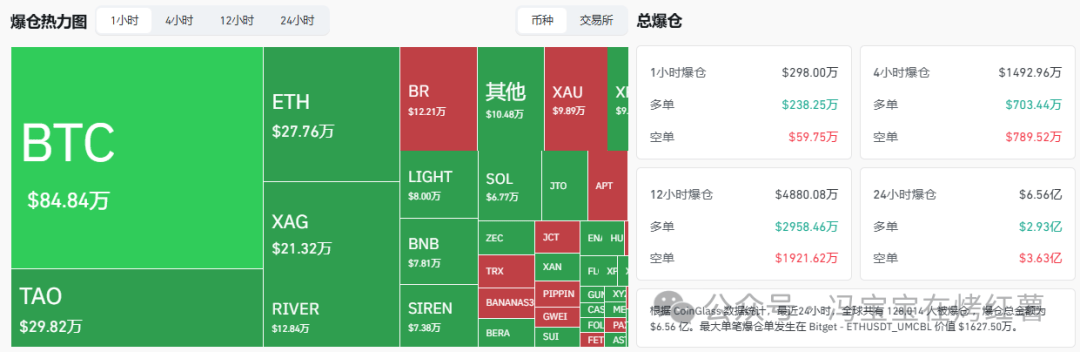
In the past 24 hours, a total of 128,014 people across the internet have had their positions liquidated, with a total liquidation amount of $656 million. Long positions were liquidated for $293 million and short positions for $363 million.
BTC
Bitcoin has seen a large green candle on the daily chart, breaking above the Bollinger Middle Band. The KDJ and RSI indicators are both trending upwards, while the MACD bearish momentum is contracting. Be wary of a potential short squeeze triggered by news-driven price action. On the 4-hour chart, a break below 69500 is needed to confirm the end of this rebound, followed by further declines towards 68000 and 65000. Currently, the price is around 70600, neither rising nor short significantly, making it unwise to chase the price up or down. It's best to remain on the sidelines for now.
If you want to short, pay attention to the resistance levels at 72,500 and 73,500. Wait until they are reached before considering entering the market. Alternatively, wait for a decisive break below 69,000 before considering shorting, with targets at 68,000, 67,000, and 65,000.
If you want to buy on dips, pay attention to the support levels at 69500 and 69700. If the price retraces but doesn't break these levels, you can consider a short-term long position with targets at 71500, 72500, and 73500.

ETH
For Ethereum, the initial resistance levels are 2250 and 2300. If the price rebounds to these levels and fails to rise further, consider short. The support level is around the 4-hour moving average, approximately 2110. If the price retraces to this level and holds, consider a rebound trade targeting 2200, 2250, and 2300.
If 2110 cannot be held, then the rebound is over, and it's time to short. The next support levels to watch are the psychological levels of 2050 and 2000.
Recently, it's mostly been contract trading.
$siren has made a good start again, although many people are criticizing it, it's better than stagnant water. Getting liquidated after a significant price increase ultimately comes down to your own fault; you have to learn to admit defeat. There are also $aria, $tria, $ain, $dexe, $cys, and many others; many of them have seen rapid price increases, basically just looking for counterparties to liquidate or profiting from funding fees.
The major shareholders kept changing hands, and after 1011, many shell companies were re-handed over and accumulated chips. This kind of coin can only be traded in waves when it is rising; trying to buy the buy the dips when it is falling will result in huge losses. It is best to wait for the support level before buying when it is rising.
Let's talk about $bp again. I previously said that 150M was a no-brainer to buy, for a simple reason: it's an established project with a solid foundation, and the price seemed undervalued. The initial price was indeed 200M, a bit expensive, but there's still room for growth. Personally, I think 300M is the limit in the short term; without other positive factors, it'll likely be close to that.
Recently, I've been watching the following cryptocurrencies: $aria, $tria, $ain, $dexe, $enso, $kite, and $vvv. Specific price ranges will be discussed in the group. Everyone says the market is difficult, but there are actually quite a few trading opportunities. The key is to manage your position size well.
And in every bear market, after a major drop, the coin that rebounds the most is always MEME.
So for those of you trading spot, if you want to profit from a rebound in a bear market, just choose coins in the MEME sector during each major drop, such as $PEPE, $DOGE, and $PENGU.
The reason is simple: MEME coin has no fundamentals and its price is driven entirely by sentiment.
If you're going to buy DeFi coins, like AAVE and UNI, their fundamentals will definitely be weak in a bear market, so their rebound will be limited. As for MEME, you don't need to research anything; it's all just hype, just speculate.

On-chain
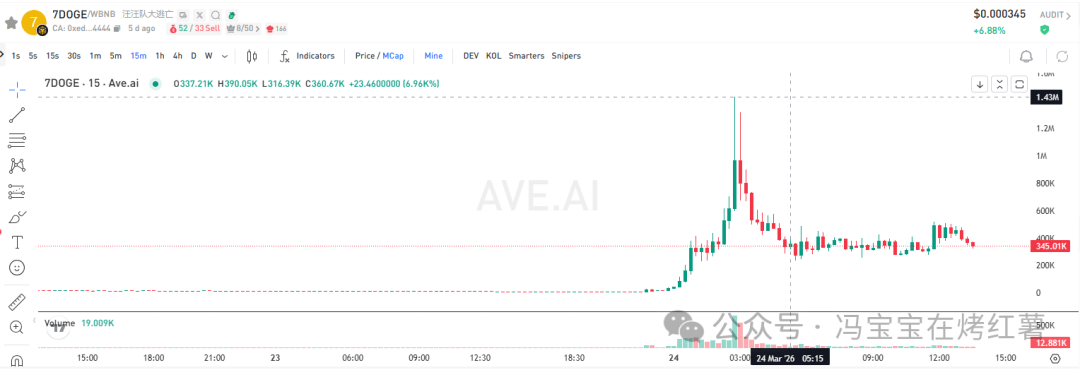
Following the last time my sword and shield were crushed, this time even seven dogs were defeated. Although BSC's $7DOGE had the first-mover advantage, SOL's $7 last night was clearly more powerful.

Not only did $7 reach a peak market capitalization of 4 million, but it also bounced back after being halved to just over 1 million. In contrast, BSC's market capitalization stagnated after reaching 1.4 million.
It's not that SOL's on-chain meme capitalization is high; it's that people can even make your concepts stand out. If you can't compete with foreign concepts, you can blame it on information asymmetry. But if you can't even compete with domestic concepts, that's truly unacceptable. The hype surrounding Seven Dogs has died down in China for days, but these people are already making a killing with it.
If you can't play it, someone else will; if you don't want to play it, someone else will. It just goes to show that without celebrity endorsements, online memes have more conviction in foreign communities, and SOL's (a popular online marketplace) operators have a more sophisticated approach. They don't try to create a quick, one-off trend, even if it's just a fleeting moment. That alone shows their strength.