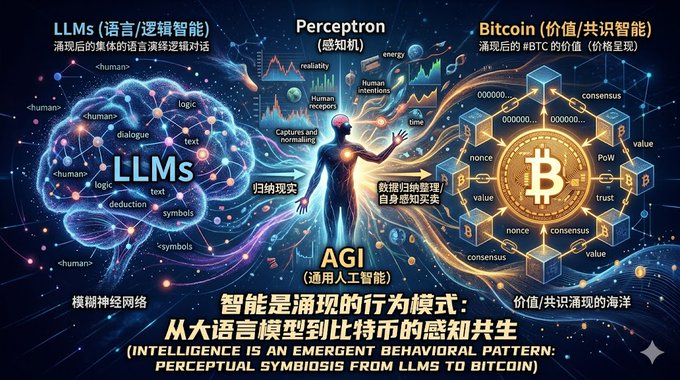
The Topology and Emergence of Intelligence: The Evolution from Large Language Models to Bitcoin's AGI Path I. Intelligence: An Emergent Feature of Complex Systems Intelligence is not a single entity, but rather an **emergence** behavior based on underlying rules at a specific level of complexity. From a systems theory perspective, emergence describes the phenomenon where, after a phase transition point, a system collectively exhibits global characteristics not possessed by its individuals. In today's technological paradigm, the emergence of intelligence presents two distinct yet complementary paths: one is language/logic intelligence represented by Large Language Models (LLMs), and the other is value/consensus intelligence represented by Bitcoin. II. A Structured Comparison of the Two Emergent Paradigms 1. Large Language Models: Semantic Enhancement of Symbol Sequences Before emergence, Large Language Models consist of isolated, high-dimensional vector spaces containing human vocabulary (tokens). Through self-supervised learning with massive amounts of data, after reaching a critical point in parameter scale, the model achieves a leap from probabilistic prediction to logical deduction. This intelligence is essentially a "lossy compression" and "logical reorganization" of the existing knowledge of human civilization, giving rise to collective language expression capabilities within a fuzzy, neural network-like structure. 2. Bitcoin: Value Collapse in Individual Game Before its emergence, Bitcoin consisted of countless holders with individual wills. Through the Nakamoto Consensus, these discrete individuals, constrained by the "longest chain principle," transformed the energy (computing power) and time of the physical world into an immutable ledger. The result of this intelligence is value (price presentation), which collapses uncertain individual beliefs into deterministic network-wide consensus. If LLM is an induction of language, then Bitcoin is a structured induction of "trust." III. The "Perceptron" of Inductive Logic: Why Can't AI Do Without Humans? The core advantage of computer science lies in deterministic deductive logic, that is, executing computable tasks through predetermined algorithms. However, the uncertain inductive logic—that is, extracting meaning and patterns from the chaotic real world—is a natural weakness of computers because silicon-based life currently lacks direct perception of physical reality. In this evolutionary logic, humans act as the "perceptive machine" for machine intelligence: Data Anchoring: The progress of LLM relies on human summarization and cleaning of massive amounts of data. Humans transform sensory experiences of the real world into language, which is then used to train machines. Without continuously generated, reality-oriented data from humans, AI will fall into a self-perpetuating cycle of "model collapse." Injection of Consensus: The value of Bitcoin does not come from the code itself, but from the buying and selling behavior of global participants after perceiving reality and assessing risks. This volatile ocean of "human perception" is what allows this code symbol to emerge with a consensus of belief. IV. The Ultimate Vision of AGI: Combinatorial Entropy Reduction of Intelligent Protocols The path to Artificial General Intelligence (AGI) is not a linear increase of a single algorithm, but a deep integration of multiple intelligence emergence modes. Humans themselves are natural AGIs integrating multiple intelligences: possessing both neural networks for processing fuzzy information (sensory and intuitive) and the ability to establish consensus in social organizations through peer relationships (morality and cooperation). The future AGI architecture should be a digital isomorphism of this complexity: Neural Network Layer (LLM Paradigm): Providing fuzzy feedback and an efficient language interaction interface, acting as the system's "cognitive left brain." Decentralized Organization Layer (Bitcoin Paradigm): Providing decentralized adaptive organizational rules and value liquidation mechanisms, acting as the system's "social right brain" and trust skeleton. Human Feedback Loop: As the sole point of contact between the system and the physical world, providing continuous inductive motivation and perceptual signals. V. Conclusion: Symbiosis, Not Replacement The development of AI is destined to be inseparable from humans. Once it loses human perceptual guidance, AI will lose its "source of meaning" for inductive summarization, and thus lose its evolutionary motivation. Similarly, in the era of information entropy explosion, humans will increasingly rely on AI to handle the order of complex systems. This relationship is more like a symbiotic agreement: humans provide "perception" and "meaning," while AI provides "computation" and "scale." True AGI will only truly arrive when emergent intelligence from different paths—whether it's decentralized consensus or the expression of deep learning—works collaboratively under the same protocol.
This article is machine translated
Show original

Lux(λ) |光灵|GEB
@gguoss
03-27
人类的智能 是 人类个体涌现出来的无数种 智能。
#BTC 给我们带来了 无中心化的 个体 如何通过对等的组织关系涌现出 信仰的共识 方法。
而 大模型 给我们带来了 可以通过输入 数据到 模糊的 类神经网络 算法 涌现出 集体的 语言表达。
这两种 都属于 人类智能的一种,将来会有更多的 x.com/gguoss/status/…
Sector:

From Twitter
Disclaimer: The content above is only the author's opinion which does not represent any position of Followin, and is not intended as, and shall not be understood or construed as, investment advice from Followin.
Like
Add to Favorites
Comments
Share
Relevant content