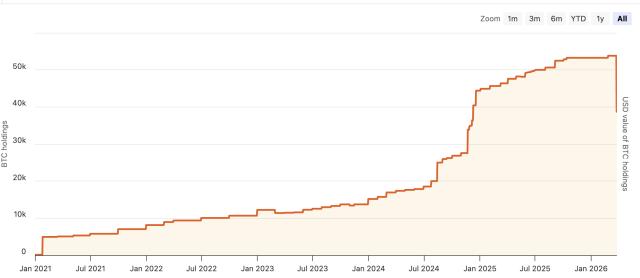
Chainlink (LINK) reserves increased by 131,905 LINK (over $1.1 million), bringing total holdings to 2.79 million LINK, but the price remains trapped below the $10 resistance level.
The transfer of Token into the reserve reduces the circulating supply in the market, thereby limiting immediate selling pressure. However, the fact that the price has not yet broken through indicates that demand has not yet caught up with the tightening supply.
- LINK reserves increased by 131,905 LINK, bringing total holdings to 2.79 million LINK, indicating a tendency for circulating supply to shrink.
- LINK remains blocked below $10 and the price pattern leans toward a continued decline, with $5.77 being the next risk zone if support is broken.
- Net flow on the exchange fell by 15.31%, easing selling pressure, but the overwhelming liquidation of Longing positions kept Derivative sentiment negative.
Chainlink reserves increased to 2.79 million LINK, but the price has not yet broken through.
Chainlink 's reserve added 131,905 LINK (over $1.1 million), bringing its total holdings to 2.79 million LINK, but the price remains sideways/downward below key resistance levels.
The move to increase reserves reflects a strategic accumulation trend rather than a short-term position. As Token are placed in custody, the amount of LINK available on active markets decreases, thereby thinning the supply that can be immediately sold.
However, the lack of a strong price reaction suggests that demand is not yet sufficient to turn the "supply squeeze" into an upward trend. The market is absorbing the supply change without triggering an upward expansion phase.
LINK is stuck below $10 and under technical pressure.
LINK continues to trade below the $10 resistance level and is forming a bearish "pennant" pattern, indicating that the main trend remains under selling pressure.
The price recently dropped to $7.84 before stabilizing around $8.89, reflecting a period of consolidation following a sharp decline. This pattern shows progressively lower peaks pressing against a horizontal resistance zone, limiting recovery efforts.
Support is currently relatively fragile as the structure leans toward continuation rather than reversal. A break to the downside could see the $5.77 area become the next target. Small rallies are often rejected near the upper boundary of the pattern, indicating consistent defensive resistance from sellers.
The RSI at 46.37 reflects weakening momentum in recent sessions. Instead of gradually rising to create upward pressure, the RSI reversed, consistent with the price compression in the pattern, implying that buyers have not yet regained control despite signs of short-term stabilization.
Net flow on the floor decreased by 15.31%, helping to ease selling pressure, but demand remains weak.
Exchange Netflows decreased by 15.31%, indicating less LINK being deposited onto the exchange, meaning immediate selling pressure tends to decrease due to increased withdrawals.
When Token are delisted from exchanges, the liquidation available for rapid distribution decreases, which usually helps limit the risk of sudden sell-offs. However, the price has not yet expanded upwards, indicating that buying pressure remains cautious and there has not yet been a "massive" accumulation from buyers.
In this context, supply may tighten without triggering a price surge. A more noticeable positive impact would be slowing the decline, rather than a decisive reversal of the trend.
The overwhelming liquidation of Longing positions increases the risk of further weakness.
Liquidation data shows that Longing orders suffered greater losses than Short orders, reinforcing the unfavorable Derivative picture for buyers and reducing the likelihood of a quick recovery.
Recent data shows approximately $55,800 in Longing liquidated compared to $24,590 in Short liquidated. This large difference indicates that bullish traders are being forced to exit their positions under pressure.
When Longing positions are largely "swept away," the leverage from the buyers weakens, making it easier for the downtrend to continue. At the same time, the insignificant liquidation of Short implies that sellers are less pressured to close their positions, reducing the likelihood of a Short squeeze.
The outlook for LINK remains bearish unless it breaks above $10.
Although the accumulation and supply on the exchange are decreasing, indicating a tightening fundamental, the current price structure and Derivative positions still favor a bearish scenario as long as LINK remains below $10.
As long as the $10 resistance remains unconquered and Longing positions remain dominant, the market tends to maintain a bearish trend. In the event of a confirmed bearish continuation pattern, the $5.77 area remains the structural target, unless buyers regain control with a clear breakout above the resistance.
Frequently Asked Questions
What does it mean that Chainlink reserves have increased to 2.79 million LINK?
This indicates strategic accumulation activity that could reduce the amount of LINK circulating in the market, thereby limiting the supply readily available for immediate sale. However, this only supports the price when demand increases correspondingly.
Why is LINK still weak despite a 15.31% drop in Exchange Netflows?
A decrease in net flow usually means that selling pressure has eased temporarily, but prices may still not rise if buying demand is not strong enough. In this case, the market absorbs the supply squeeze without triggering an upward momentum.
How important are the $10 and $5.77 price levels to LINK?
The $10 level is a resistance zone holding back the price; breaking above this level could improve the trend. Conversely, if the price pattern breaks downwards, $5.77 is XEM the next downside target according to the technical structure in the original text.
What does it mean when the number of Longing positions exceeds the Short ?
This indicates that buyers using leverage are being forced out of positions more than sellers, weakening price support. When Short are not significantly liquidated, the likelihood of a Short squeeze is also lower.