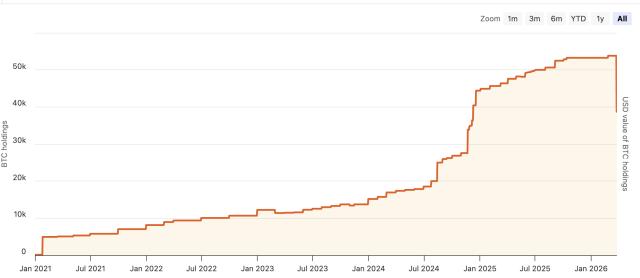
The extreme pessimism of retail investors towards Bitcoin is often a counter-signal, and Strategy (MSTR) could become the catalyst for this reversal as retail money flows into STRC, boosting BTC buying activity.
Retail investors often trade based on emotions, news, and social media discussions, so even a small change in macroeconomic "FUD" can amplify volatility. In this context, monitoring retail cash flow indicators linked to Strategy can help identify accumulation opportunities.
- A report from Santiment indicates that retail investors are increasingly pessimistic about Bitcoin due to macroeconomic FUD , but extreme pessimism is often a buy signal in the opposite direction.
- Bitcoin experienced a nearly 3.6% correction in under 48 hours and fell below the $70,000 mark for the first time that week, reflecting resistance at the $75,000 level.
- STRC has a high retail ownership rate and an 11% yield, which could become a channel for retail cash flow influencing Strategy's Bitcoin purchases.
Retail investors often trade based on emotion rather than fundamental analysis.
Retail investors often rely on news and market sentiment, so when sentiment shifts, crypto price volatility can be amplified beyond the actual changes in the underlying market.
Unlike institutional investors, retail investors' portfolios are typically smaller and heavily reliant on public information, news headlines, or social chatter. Therefore, even a small shift in crowd sentiment can trigger significant market movements.
A report from Santiment indicates that the retail sector is showing increasing pessimism regarding Bitcoin (BTC), influenced by macroeconomic FUD such as ongoing tensions in the Middle East. In such a context, confidence-boosting anchors could play a crucial Vai in reversing sentiment.
Extreme pessimism in retail sales is often a buy signal that is the opposite of Bitcoin.
When negative price rhetoric begins to circulate, history shows that Bitcoin often goes against the crowd, making extreme retail pessimism a potential accumulation signal.
Bitcoin has often moved against the prevailing "narrative." Therefore, when retail investor pessimism is high, this is often interpreted as a strong buy signal. A common observation is that when keywords like "dip," "pullback," "rejection," "crash," or "bloodbath" become trending, it's often a period where accumulation opportunities become clearer.
Bitcoin's downward momentum suggests fear is holding back its upward trend.
At the time mentioned, Bitcoin was in a downward correction, having dropped nearly 3.6% in under 48 hours and weakened below $70,000 on a weekly basis.
According to the original data, BTC dropped nearly 3.6% in less than 48 hours, falling below $70,000 for the first time this week. This development indicates that buyers are still struggling to break through the $75,000 resistance level. In the short term, the "fear" factor is described as limiting upward momentum and creating a ceiling for any rebounds.
Strategy (MSTR) could be the catalyst driving retail money into Bitcoin accumulation.
Strategy's STRC has a high percentage of retail investor ownership and an 11% yield, creating a mechanism that helps retail cash flow link more directly with Strategy's Bitcoin purchases.
To attract Bitcoin inflows from retail investors, the market typically needs sufficiently clear "smart money confidence" to sustain FOMO and encourage participation. In this context, the Strategy's Stretch (STRC) Index was noted to have traded above $100, a level described as potentially allowing MSTR to deploy Capital into Bitcoin purchases, thereby adding 114 BTC to its holdings.
Strategy CEO Phong Le is quoted as saying that 80% of STRC shares are held by retail investors, double the retail ownership of MSTR shares. This structure underscores the role of the retail group in the STRC “setup,” and is further supported by an 11% yield for STRC shareholders .
In summary, the high retail ownership ratio and strong yields give STRC a large retail investor base. Therefore, Strategy's Bitcoin buying activities may be directly influenced by this investor group, making STRC a key indicator to watch when assessing retail inflows into BTC.
When placed alongside the retail FUD picture according to Santiment, the "retail-heavy" profile, yields, and alignment with the "smart money" sentiment make STRC not only a psychological indicator but also a potential catalyst for Bitcoin accumulation in this cycle.
Frequently Asked Questions
Why are small retail investors more likely to cause significant volatility in the crypto market?
Because they often rely on public news and crowd emotions rather than fundamentals, even small shifts in sentiment can trigger mass buying and selling, amplifying price fluctuations.
What does the Santiment report say about retail sentiment toward Bitcoin?
The report indicates that retail investors are increasingly pessimistic about Bitcoin, influenced by macroeconomic FUD such as tensions in the Middle East.
Why is extreme pessimism sometimes a buy signal for Bitcoin?
Because Bitcoin often tends to go against the crowd's narrative, when negative keywords spread and retail sentiment becomes extreme, that's often a period of stronger accumulation opportunities.
What does STRC have to do with Strategy's purchase of Bitcoin?
STRC is described as potentially facilitating MSTR's deployment of Capital to purchase Bitcoin. Given STRC's large retail investor base, the flow of funds and expectations from this group could influence Strategy's BTC buying pace.
What are the key facts about STRC mentioned in the original text?
STRC is mentioned for trading above $100, with 80% of its shares held by retail investors and a yield of 11%, and Strategy is stated to have added 114 BTC in that context.