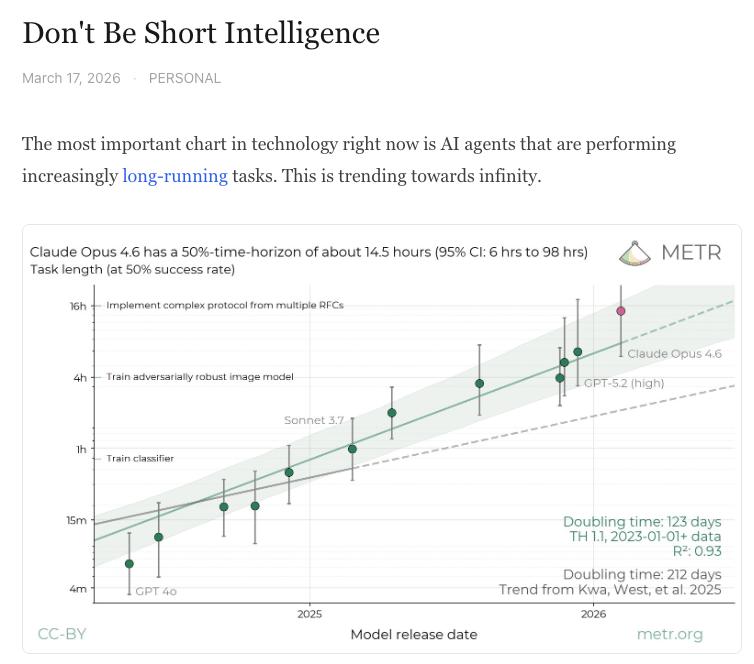
Kyle Samani's Don't Be Short Intelligence I recommend reading it yourself. The Evolution of AI Agents: Beyond simple chatbots, AI capable of working for long hours autonomously has emerged. The cost of implementing standard Software as a Service (SaaS) approaches 'zero'. Short White-collar outsourcing services easily replaceable by AI, and traditional SaaS companies that charge based on the number of users. Long Financial Services: The key is brand and user trust. Financial services are inherently ledger-based. Even if the cost of creating high-quality consumer experiences plummets, there is no way to keep ledgers '10 times better' than mainstream finance. Crypto: As long as asset prices fluctuate, crypto rails have a use, generating significant revenue at a cost close to zero. Market Makers: As long as there is asset price volatility, markets exist. The Physical World (Hardware): Real-world infrastructure where AI actually exerts influence outside the screen. Healthcare: Due to regulatory friction and physical requirements, AI cannot disrupt healthcare as extensively as it disrupted call centers. Opportunities Will Exist for AI-Native Full-Stack Healthcare Providers Marketplaces: Intelligence cannot alter the network effects forming around marketplace businesses. Brand and Information Aggregators: Products where human habits and external link graphs serve as a moat. The brand value embedded in millions of human-generated links and citations, as well as YouTube or TikTok videos, cannot be easily replaced by intelligence. Investment Strategy Considering risk and liquidity, it will be easier to make money in the public market than in the private (venture) market over the next few years. AI will change the world faster than any other technology in human history. This is because it can be immediately adopted by everyone thanks to the mobile and cloud infrastructure built over the past 20 years. In this context, making a 10-year venture bet is far riskier than in the past. Amazon, Google, and Tesla (and Microsoft, Apple, and Meta) are on a straight path toward a market capitalization of $10 trillion, and even $30 trillion. The driving forces include proprietary chip development, explosive token demand, and, in Amazon's case, the ability to replace millions of warehouse workers with robots. In particular, Tesla is targeting the world's two largest physical markets through FSD and Optimus.
This article is machine translated
Show original
Sector:

Telegram
Disclaimer: The content above is only the author's opinion which does not represent any position of Followin, and is not intended as, and shall not be understood or construed as, investment advice from Followin.
Like
Add to Favorites
Comments
Share
Relevant content