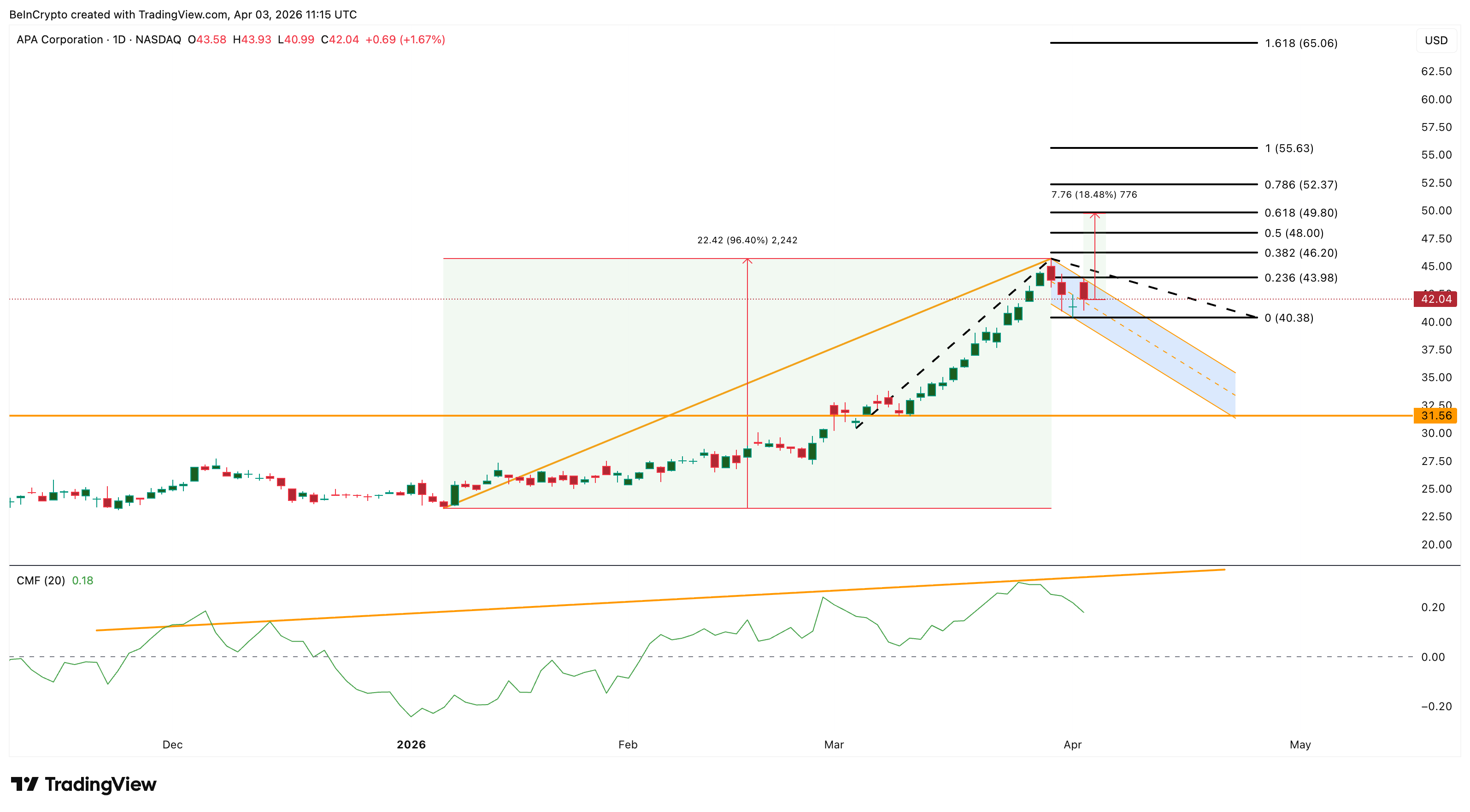
April is almost here, and market liquidity is currently very poor. Simply put, there are many sellers and very few buyers. This is evident in tokenized crude oil, where buying interest is weak. The same situation exists in the crypto and the US stock market. Asset prices are high, and institutions want to sell but find no buyers, so they can only attract funds by offering discounts, ultimately hoping to get retail investors to take over.
If a large investor urgently needs funds to dump shares, the market could easily panic and plummet. To secure higher levels and mitigate the risk of a US stock market crash in May or June, April presents the most suitable window for a rally. While this is the core reason for the potential rise in April's market, it's currently likely to remain stagnant. Regardless of whether you're trading contracts long or short, always strictly set stop-loss orders and never hold onto losing positions.
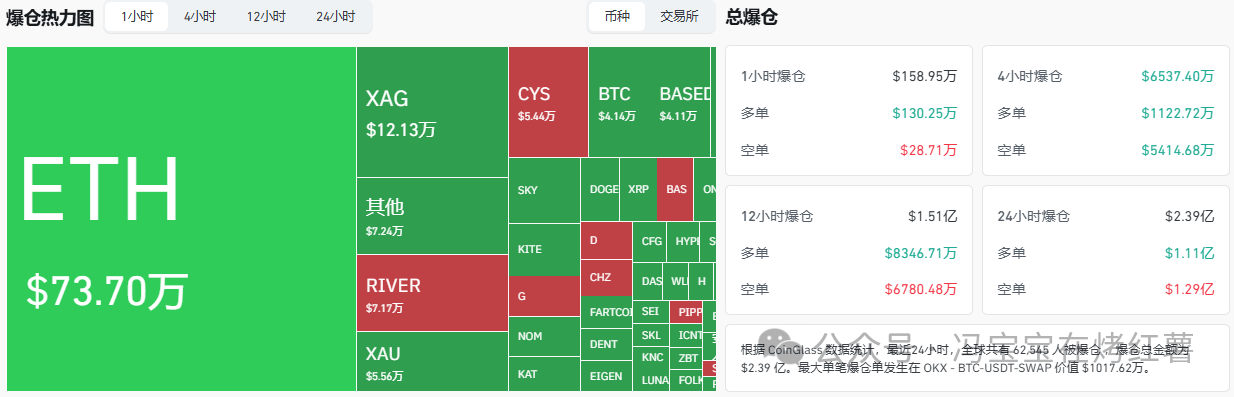
In the past 24 hours, a total of 62,545 people across the internet have had their positions liquidated, with a total liquidation amount of $239 million. Long positions were liquidated for $111 million and short positions for $129 million.
BTC
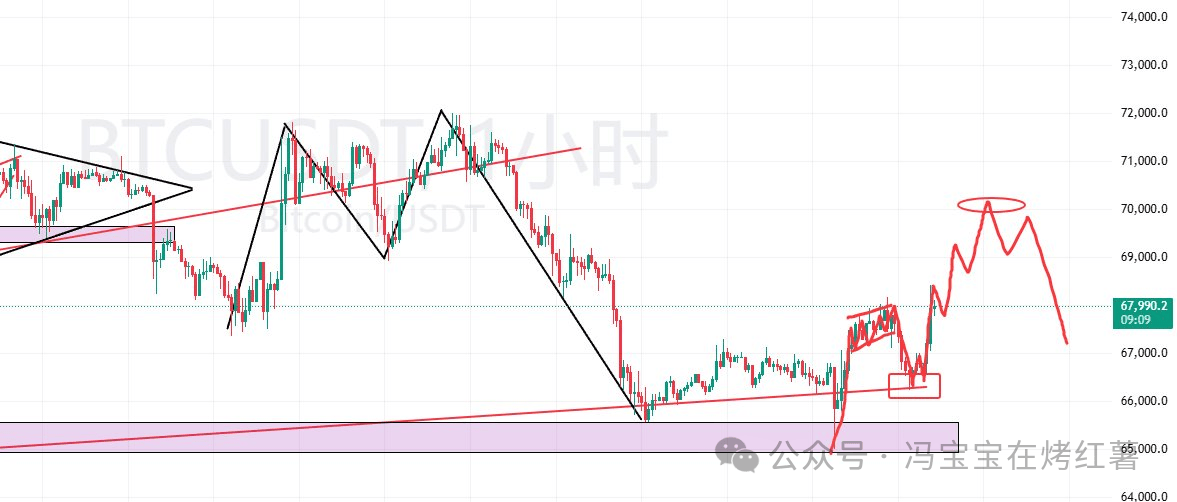
Bitcoin's short-term price movement was roughly as I predicted. The first wave rebounded to 68,000, then encountered selling pressure and fell back, retracing to 66,200 to complete a double bottom at the 0.618 Fibonacci retracement level. I originally wanted to go long below 66,000, but I missed the low by about 200 points. Since I didn't get in, I won't chase the price higher unless it retraces to a more favorable level before considering long again.
As long as it doesn't fall below 66,000, there should be a short-term rebound, with a target of around 70,000. If it's strong, it might even reach 70,000 directly. At that point, I plan to close my long positions and switch to short positions. Once it reaches that level, I'll consider short.
ETH
Ethereum's price action largely followed expectations. It rebounded to the minor resistance level of 2086 before falling back, retracing to around 2010 to complete a double bottom, reaching only the 0.5 Fibonacci retracement level. I was hoping to buy at 0.618, but almost missed out. Currently, the rebound is relatively strong; although it broke the previous high, it hasn't held firm. It's estimated that it needs to digest some selling pressure before moving higher.
Based on the double bottom pattern, the rebound high should be in the 2130-2150 range, which is the 1.618 Fibonacci short level. That's the optimal point to close long positions and go short. Whether it's a direct green candle to that level or a gradual, sideways climb, I'll enter short once it reaches this range.

Here's a summary of the on-chain data and fundamental changes in mainstream DeFi protocols:
UNI
MetaMask has directly integrated with Uniswap's API, connecting v2/v3/v4 and UniswapX, causing entry-level traffic to begin shifting towards Uniswap. BlackRock's BUIDL (US Treasury bonds) is also trading on UniswapX, indicating that RWA has officially integrated with a mainstream DEX.
In short: DEXs are starting to reap the dual benefits of "institutional assets + wallet access".
AAVE
On March 10th, an oracle incident occurred, resulting in the erroneous liquidation of approximately $26 million, exposing the risks. v4 is currently 52.58% approved and will be launched after the audit is completed.
Key takeaway: Established lending platforms are upgrading, but security issues remain critical.
$ONDO
Franklin Templeton put ETFs on the blockchain, enabling 24/7 trading. Felix has improved liquidity, allowing spot trading of more than 260 tokenized stocks, accounting for 58% of the tokenized stock market and exceeding $1 billion in size.
The core message is that it's no longer just a DeFi project; it's more like an on-chain brokerage and asset management platform.
MORPHO
The Ethereum Foundation added 3,400 ETH, a crucial endorsement. Apollo Global invested $112.5 million in governance tokens, directly aligning their interests. Bitwise and Lombard are managing BTC accounts, while Morpho handles liquidity. The core message: institutions are not just using the tokens, but starting to control the market and integrate them into the ecosystem.
ENA
40.63 million tokens were unlocked in March, and whale withdrew $4 million from exchanges. First-quarter revenue declined by 32%, and user numbers are also decreasing.
Key takeaway: The data is weakening, and the fundamentals are under pressure; caution is advised.
JUP
53.47 million tokens were unlocked, of which approximately 8.15 million entered the market. Jupiter Lend deposits surpassed 100 million, and multi-chain deposit and cashback features were launched.
The key takeaway is that the Solana group is supplementing its financial infrastructure and moving towards a "complete DeFi" model.
The three main themes for the future of DeFi protocols are becoming increasingly clear: first, RWA (US Treasury bonds, ETFs, and stocks) will be fully on-chain; second, institutions will directly participate, buying tokens, providing liquidity, and controlling protocols; and third, wallets, protocols, and assets will begin to be integrated.