With the fear index soaring, yet bottoming signals appearing, is Bitcoin nearing its bottom?
Written by: Cointelegraph
Compiled by: AididiaoJP, Foresight News
The cryptocurrency fear and greed index is currently showing "extreme fear" with a reading of 11, a state that has persisted for twelve days. Although there was a brief rebound between March 17 and 18, the index has remained in the "extreme fear" zone since January 28.
Traders use this index as a contrarian indicator to monitor investor sentiment, and its components include market volatility, trading volume, social media trends, and market momentum data.
From this perspective, in past bull and bear markets, traders have typically viewed "extreme fear" readings as an opportunity to buy on dips. However, given the persistently low market sentiment since January, the effectiveness of this signal is questionable.
On the X platform, cryptocurrency commentary firm Rand Group pointed out a misalignment between current investor sentiment and Bitcoin prices. Their article stated that market fear remains high due to news related to the conflict between the US and Israel with Iran, as well as expectations of rising US interest rates. However, it's noteworthy that despite the still bearish market environment, selling pressure on Bitcoin has not increased accordingly.
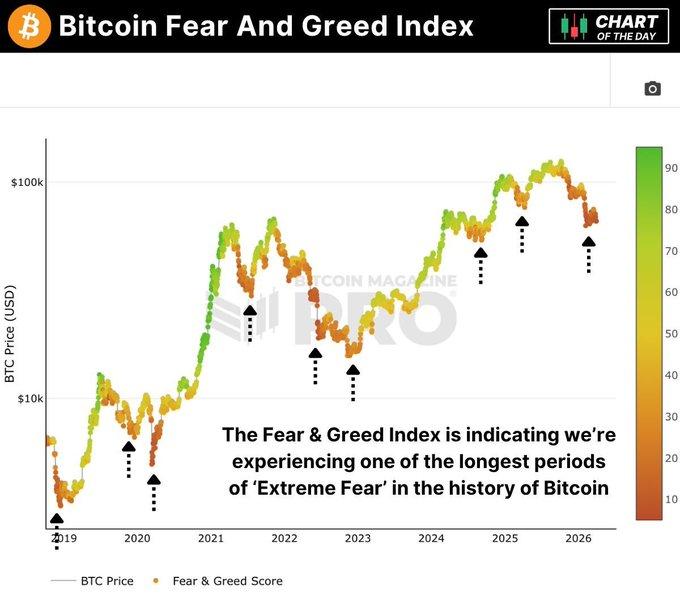
Bitcoin Fear & Greed Index. Source: Rand Group/X
On-chain data also indicates that the market is stabilizing. Cryptocurrency analyst MAC_D points out that the proportion of short-term holders (especially those holding for a week to a month) has dropped to 3.98%. In past market cycles, periods when this proportion was below 4% typically corresponded to periods when the market was near its bottom.
The decrease in short-term activity suggests a reduction in short-term trading and a corresponding decrease in speculative demand from day traders. Long-term holders currently control a larger proportion of the supply, indicating that the market is in a hoarding phase.
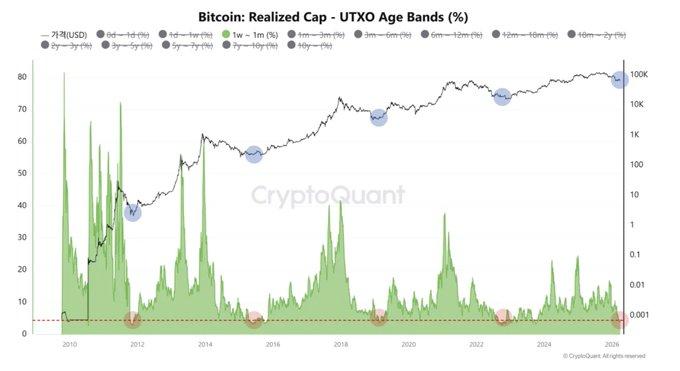
Bitcoin's realized market capitalization: UTXO holding time distribution. Source: CryptoQuant
Large Bitcoin holders continue to dominate fund flows. Cryptocurrency analyst CW8900 points out that the "whale" ratio on Bitcoin exchanges has climbed to over 60%, the highest level in a decade. Meanwhile, retail investor participation has fallen to its lowest level in a year. The analyst further states:
"Typically, market bottoms often occur when the 'whale' ratio reaches its peak. Currently, the proportion of retail investors is at its lowest point in the past decade."
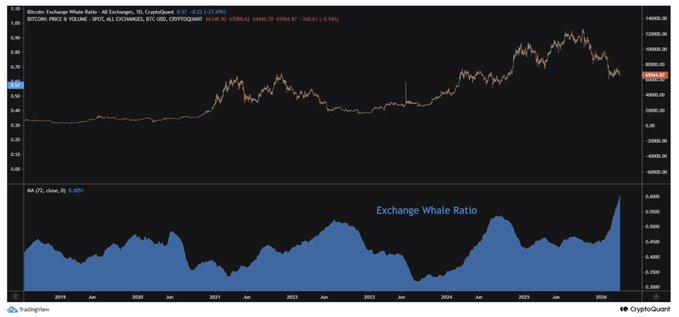
Bitcoin exchange whale ratio. Source: CryptoQuant
Analysts point out that Bitcoin has lost its advantage relative to the stock market.
Bitcoin researcher Axel Adler Jr. points out that the short-term correlation between Bitcoin and the S&P 500 has weakened, with the 13-week correlation falling into negative territory.
Entering 2026, the ratio of Bitcoin to the S&P 500 index trended downwards, reflecting Bitcoin's continued underperformance compared to the stock market. Despite persistently high market volatility, Bitcoin's price corrections were significantly larger than those of the stock market.
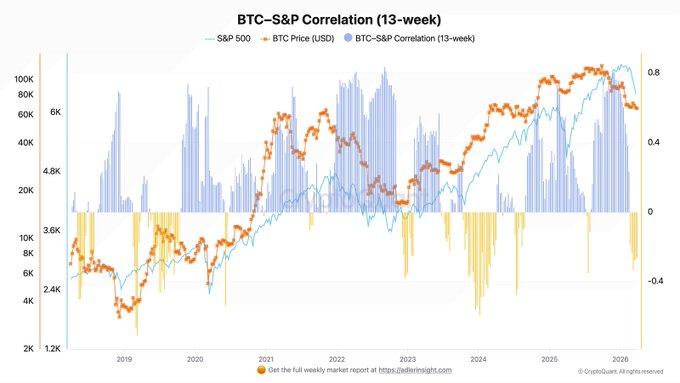
Bitcoin/S&P 500 ratio. Source: Axel Adler Jr.
Bitcoin briefly surged to $76,000 on March 17, but this rally failed to gain momentum. This ratio suggests that Bitcoin is currently viewed as a riskier asset compared to traditional markets, given the low participation rate of small and medium-sized investors.
This disconnect from traditional markets, coupled with the current "extreme fear" in the market, may provide potential buying opportunities for Bitcoin investors.
While Bitcoin has underperformed the S&P 500, underlying data paints a different picture. Selling pressure on Bitcoin has not intensified due to negative market events, and the dominance of "whale" investors continues to strengthen as retail investors exit the market.
The above signals suggest that Bitcoin may be quietly entering an accumulation phase.