Nice to meet you, I'm 0xMach (@0xMach). In this article, I will introduce you to the NFT market in Japan.
1 Differences between Japanese and international NFT markets 2 Attractiveness of cheap MINT and HOLD cultural fields 2.1 Attractiveness of cheap MINT 2.2 Comparison with overseas collections 2.3 About Hongdeli Cultural Circle 2.4 Advantages of creating Hongdeli Cultural Circle 2.5 How to create one HOLD cultural circle? 3 Will Japanese NFT blue chips appear in the future?
Differences Between Japanese and International NFT Markets
Recently, the NFT market in Japan in particular has started to attract attention from abroad. However, the characteristics of the Japanese and overseas NFT markets are very different, so it is difficult to understand the reasons for the prosperity of the Japanese market from an overseas perspective.
From the perspective of overseas researchers, what does the NFT market in Japan look like? For example, the following tweets accurately capture the Japanese NFT market, but for the most part, they seem to be confused by the gap with overseas markets.
About the attractiveness of cheap MINT and HOLD cultural fields
So, from that point on, here are the tweets, notes and audio content from ikehaya (@IHayato), who is involved in CNP as a marketer and understands the NFT market in Japan, which will be used to explain the appeal of cheap MINT and HOLD cultural fields respectively .
The appeal of cheap MINT.
ikehaya mentioned the following four points as the advantages of cheap MINT
Easier to lower listing rates since there is no initial "take your base money back" sale
Low risk, so it is easier to attract investors
Easier to build community momentum and increase market capitalization due to the ability to take on a higher number of issuances
Can attract "friends" instead of "clients".
Let’s first take a look at the listing rates of three representative cheap MINT projects (CNP, LLAC, APP) that ikehaya participated in. These are all representative of NFT collections in Japan.
【Reference: NFTMarketCap.jp 】
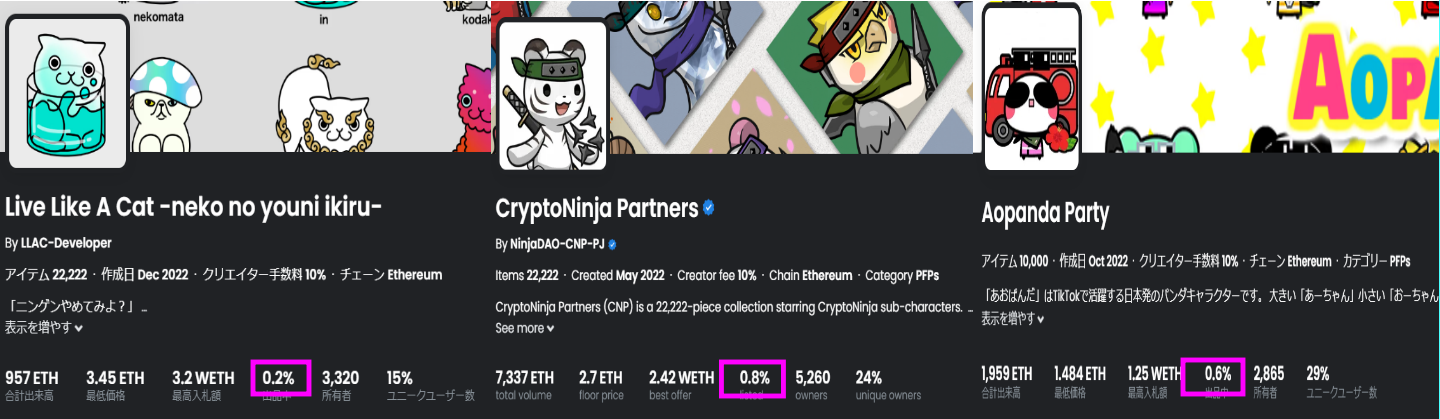
Both listing rates are below 1%. This low listing rate may be due to cheap MINT not generating selling pressure to recoup associated capital.
Additionally, all of these projects have an initial MINT price of 0.001 ETH, which means very little risk for investors. Of course, the fact that investors don't lose money makes it easier to attract investors. We've looked at two of these advantages so far, and they seem to be on point.
The third advantage is that ikehaya has always emphasized the importance of NFT and the community. According to ikehaya, the value of NFT depends partly on the size of the community, and by making it a cheap MINT, it can become a large collection with many participants.
Non-cheap MINT projects often adjust the circulation to about 3,000 due to the risk of not being sold, while cheap MINT projects often operate with a circulation of 10,000-20,000 due to the low risk.

A major advantage is that by making it cheap MINT, the number of points of distribution can be increased, so the community can start as a massive collection.
A fourth advantage is that there is less pressure to sell cheap MINTs, and by starting off as a large community, it is easy to create a sense of "friendliness".
Comparison with International Collections
So far, we have introduced the low listing rate and the large size of the community (high number of unique users) as advantages of cheap MINT vs Japanese NFT. Now, we want to compare them with overseas collections, so-called blue-chip brands. As representative examples, we will discuss BAYC, AZUKI, and Doodles.
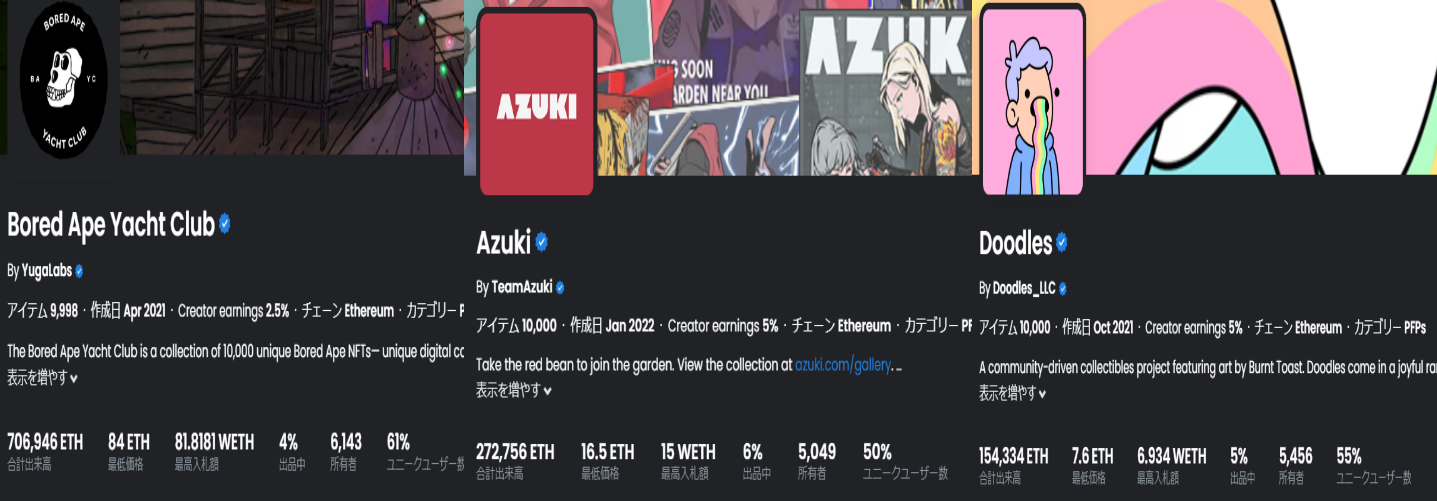
The number of items issued is similar to the general number of items issued by cheap MINTs, 10 000 in each case. Then, the list rate is between 4-6%, and this difference can be seen when compared to the three cheap MINT programs (CNP, LLAC and APP).
Followed by independent users, it is 50-60%, and the three cheap MINT projects (CNP, LLAC and APP) are 15-30%, so in comparison, the community scale of the international blue chip issue is larger.
About Hongdeli Cultural District
Another feature of Japanese NFT is the HOLD cultural circle, which is then explained with reference to ikehaya's NOTE.
[Reference: Conception of "ガチホ Cultural Circle". 】
https://note.com/ihayato/n/nd0dad02c85ec
What is the HOLD Cultural District? First, look at the picture below.
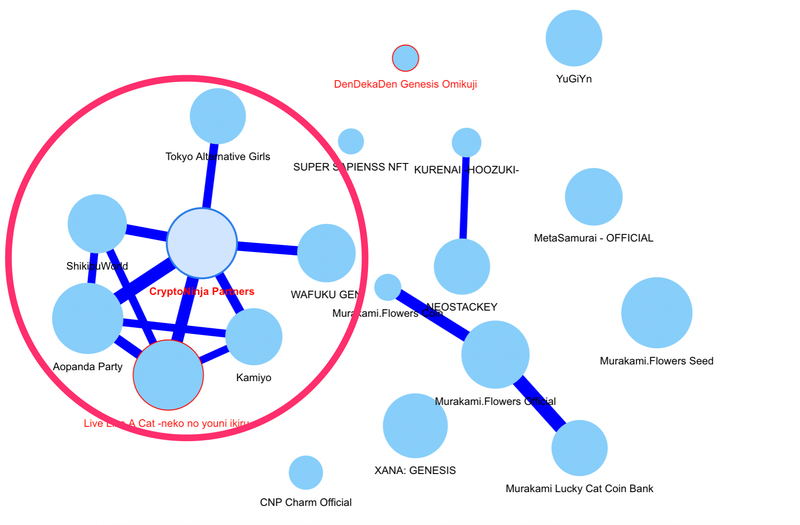
We've identified (CNP, LLAC, and APP), but there are also projects that are highly related to these (overlapping holders). Wafuku, KAMIYO, Shikibuchan, and TAG all fall into this category and should be checked one by one.
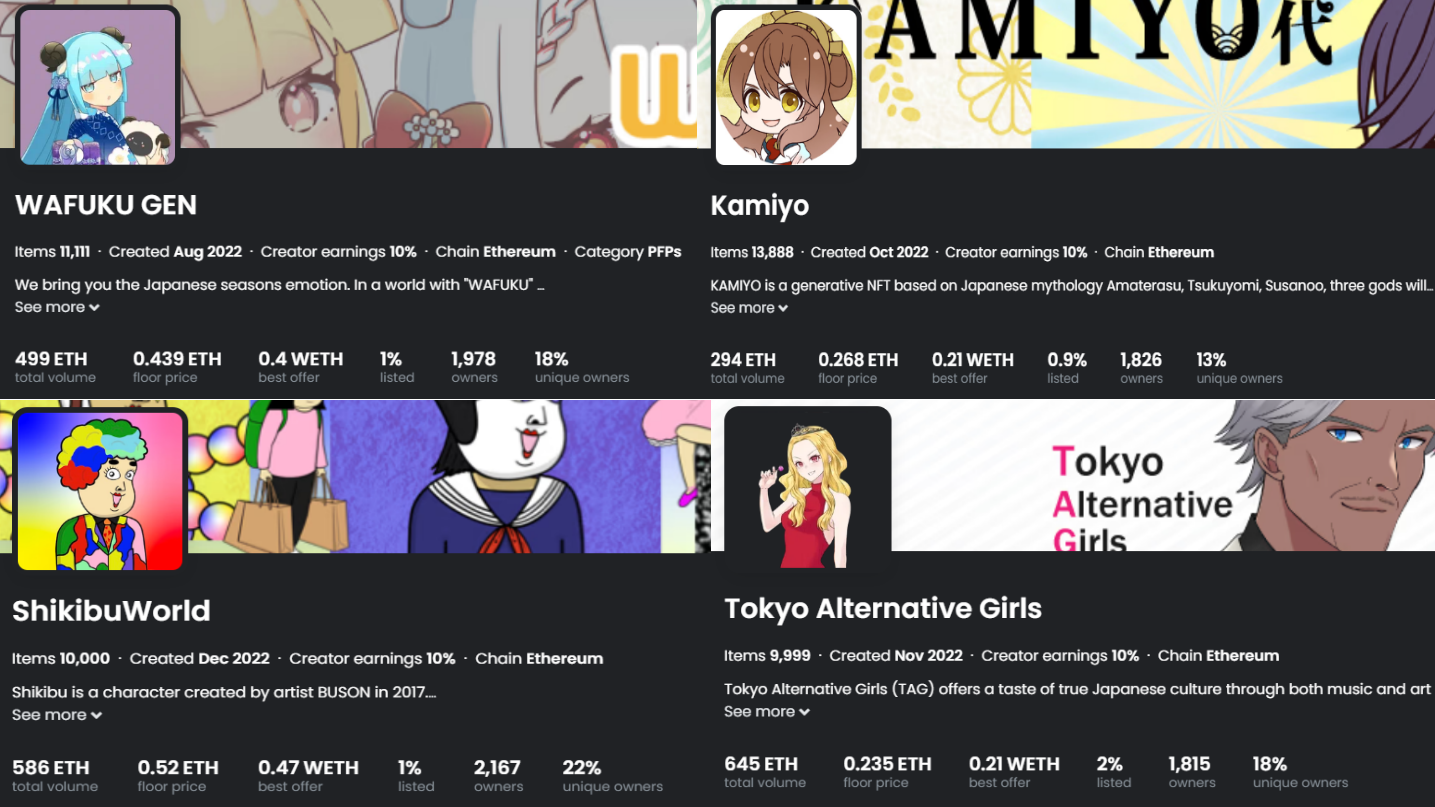
Compile the data once.
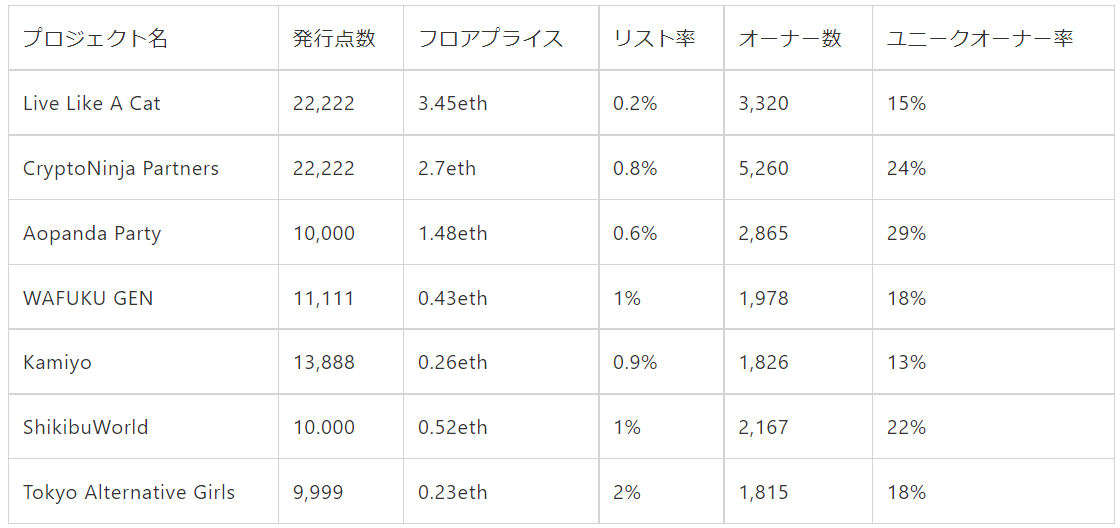
All of these collectibles are cheap MINTs featuring low list prices. Another feature is the overlap of the holders, as shown in the related figure. ikehaya seems to aim to further add to these collections and create a HOLD culture circle.
The benefits of creating Hongdeli cultural circle
Why is ikehaya so focused on creating a HOLD cultural circle? He cites the following advantages.
When the HOLD rate is high, the community is strong and it is easy to look forward to long-term growth
A high hold rate (low listing rate) always makes it easier to expect price increases because the sales slate is thin
Increased likelihood of gains due to localized volatility
A high hold rate means a low listing rate on the flip side, so this is where cheap MINT projects connect.
How do we create a HOLD culture circle?
Now that we know the benefits, how exactly do you create a HOLD cultural zone? Setting up a cheap MINT is certainly important, but it seems impossible to achieve sub 1% listing rates on its own.
That's why ikehaya takes the approach of providing AL to "those who hold existing projects". In the audio content, he said: "I will never give the hard work of the creator to those who sell it in a day or a week. The project party has this responsibility." Behavior, their activities in the community and data on the chain, thoroughly analyze and select those who will not be sold immediately. He said.
He also commented on overseas markets and the NFT industry in this way.
Overseas markets are dominated by short-term traders, with practices such as MINT and immediate selling being rampant. This does not promote the development of an industry.
Short-term traders are important at times, especially in a bubble market, but in this current down market, they are no good. This is because if they sell too much in the early stages, the project will be over before it can grow. As I've said many times, that doesn't make an industry great.
When the market grows more, you can do more and more transactions, but right now the market is still too small. If we don't create a market where investors can make good profits, there will be no growth.
There is a tendency to say bad things about the HOLD culture, but I don't think that's right. This year, we want to expand the HOLD cultural area. I think this is a good thing for the entire NFT industry.
In 2023, ikehaya predicts that investment funds and a certain amount of speculative funds will be attracted to "HOLD stocks" with high yields.
Will Japan's NFTs have blue chip issuance in the future?
We have already introduced the benefits of cheap MINT and HOLD cultural circles in Japan. So, will we see blue chips from Japanese NFTs in the future? Looking at the reactions overseas, this point has attracted the attention of many people, so I would like to give some opinions at the end of this article.
First, as a basic point, the NFT market itself is still small and highly dependent on macroeconomic and market conditions, not just in Japan. Therefore, management's strategy will be different for projects created during bubbles and recessions.
Beyond that, I believe cheap MINT and the Japanese HOLD cultural scene will continue to attract attention, at least as long as the lull lasts. And I believe, it will become more difficult to get AL in the future.
If you are interested in NFTs in Japan, the first step is to follow ikehaya (@IHayato) and follow the projects around you. I don't know if there will be new blue chips in Japanese NFT in the future, but I think it will be more exciting than it is now.
Also, while I'm focusing on the benefits, I have a concern that there is overlap in the holders of the HOLD culture, making it difficult for the community to grow. While a high level of camaraderie is an advantage, there are certain people who dislike this tendency because it shows prejudice against holders of different viewpoints.
Thanks for reading this far. We hope that you have understood the characteristics of Japanese NFT, and hope this is helpful for your research.