Table of Contents
ToggleGlobal gold and foreign exchange reserves crossed a threshold not crossed in 30 years by the end of 2025. According to the Economic Times, the total market value of gold reserves held by central banks has reached approximately $4 trillion, surpassing foreign holdings of U.S. Treasury bonds ($3.9 trillion) for the first time, becoming the world's largest single foreign exchange reserve asset class (the first time since 1996).
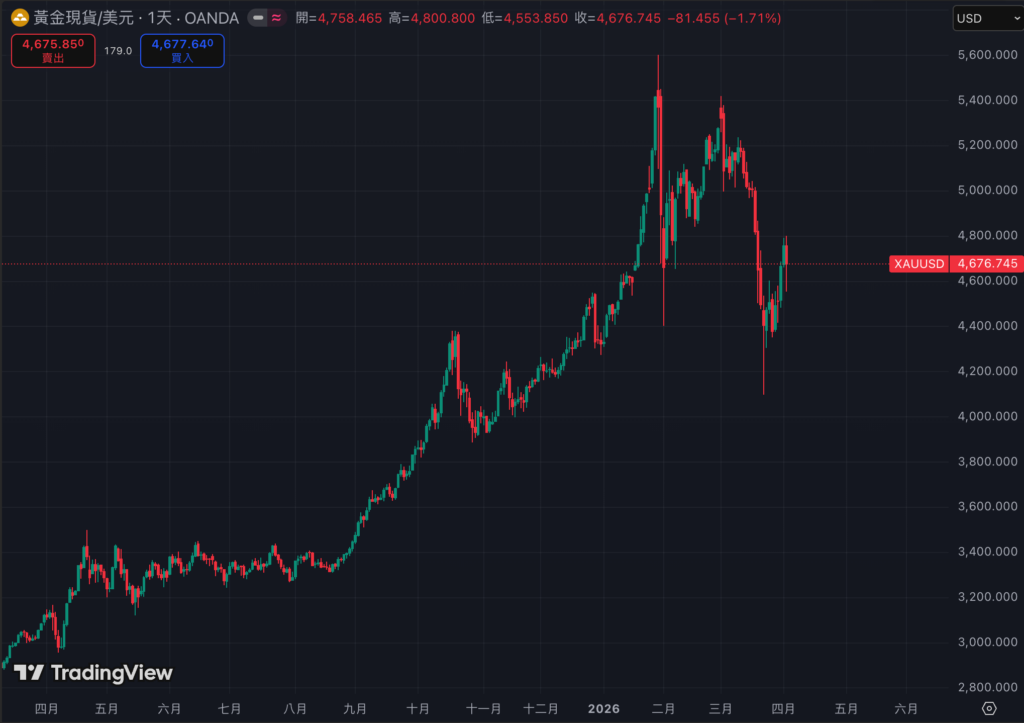
Gold prices rose more than 70% throughout 2025, briefly breaking through $4,500 per ounce at the end of December, and reaching an all-time high of approximately $5,595 to $5,608 on January 29, 2026. As of April 2026, gold prices have fallen about 15% from their peak, currently trading at around $4,676.
Turning point: Russia's reserves freeze in 2022
The Economic Times points out that most analysts agree on the same starting point for this structural shift: February 2022.
Following Russia's invasion of Ukraine, Western countries froze approximately $300 billion of Russia's foreign exchange reserves, most of which were denominated in US dollars and euros. This action sent a clear signal to central banks worldwide:
Sovereign foreign exchange reserves are not absolutely safe, and holding assets denominated in other countries' currencies carries "counterparty risk".
Gold's core advantage lies precisely in this: it cannot be defaulted on, cannot be frozen by sanctions, and is not dependent on any issuing institution. This characteristic translates from a theoretical advantage into practical demand in an environment of rising geopolitical tensions.
Central bank gold purchases: more than double the historical average
In 2025, global central banks will have purchased more than 1,100 to 1,200 tons of gold, far exceeding the historical annual average of about 473 tons.
Major buyers include: China (225 tons), Poland (102 tons), India (100 tons), and Turkey (95 tons). Currently, global central banks collectively hold approximately 36,000 to 37,000 tons of gold, representing about 25% to 27% of global official reserves, a record high.
A World Gold Council survey shows that 95% of central bank reserve managers expect their gold reserves to continue to increase by the end of 2026; 68% of central banks plan to actively increase their holdings in 2026, up from 62% in 2025.
The structural targets for increased holdings are also clear: many emerging market central banks currently have gold reserves accounting for less than 10% of their total reserves, while some institutions have set targets close to 25%. This means that if this round of reallocation continues, potential capital inflows could last for several years.
The dollar's share continues to shrink, and the attractiveness of US Treasuries is declining.
The rise of gold is accompanied by a continuous decline in the US dollar's share of global foreign exchange reserves.
According to IMF data, the US dollar's share of global foreign exchange reserves will fall from 71% in 2000 to 59% in the fourth quarter of 2025. Meanwhile, the outstanding balance of US Treasury bonds has exceeded $38 trillion, and concerns about fiscal sustainability have prompted some central banks to reassess the rationale for holding US Treasury bonds for the long term.
De-dollarization does not mean the dollar is being replaced, but rather that the process of diversifying reserves is accelerating. In this process, gold is moving from a backup holding to a core asset.
Bitcoin's "Digital Gold" Narrative
The structural rise in gold prices has also led the market to re-examine the relationship between Bitcoin and gold.
Since 2026, the price correlation between the two has been close to zero, and even turned negative at times. In contrast, the correlation between Bitcoin and the Nasdaq 100 index remains high at 0.75 to 0.85, indicating that the market still views BTC as a risk asset rather than a substitute for sovereign reserves in the short term.
However, it's worth noting that the U.S. Treasury currently records its gold reserves at a book value of $42 per ounce, a figure that has remained unchanged since the collapse of the Bretton Woods system in the 1970s. If the U.S. were to consider revaluing its gold reserves at market prices, the published book asset size would be substantial. Some market participants believe this could, in turn, provide policy speculation on the possibility of Bitcoin becoming a national reserve asset.