Passive configuration is the true path to widespread encryption adoption.
Written by: Thejaswini MA
Compiled by: Chopper, Foresight News
Any default option will eventually become the choice of the majority. This is known as the "default effect" in behavioral economics.
The history of the entire U.S. pension system is essentially a history of default options. In the 1980s, the default option shifted from traditional pensions to 401(k) plans, which most employees accepted without fully understanding what they were giving up. In the early 21st century, target-date funds became the default option for the vast majority of pension plans, with tens of millions of people holding these funds without ever actively choosing them.
Each change to the default options involved the transfer of huge sums of money and ultimately altered how a generation retired. Most of those affected didn't realize it until later, when they checked their bank statements.
In the coming years, a new default option is on the horizon. It doesn't quite look like a default option yet, but rather a draft rule proposed by the Department of Labor, currently undergoing a 60-day public comment period. It's carefully worded, emphasizing fiduciary duty and compliance with the Employee Retirement Income Security Act (ERISA). These often appear as options, gradually gaining popularity and eventually becoming the default choice.
On March 30, the U.S. Department of Labor issued a rule that, for the first time, opened the door to cryptocurrencies in the $12 trillion U.S. 401(k) pension market. Indiana passed legislation in March requiring state pension plans to offer at least one cryptocurrency investment option by July 2027; Wisconsin's pension system already holds $321 million in Bitcoin ETFs; and Michigan has allocated $45 million to Bitcoin and Ethereum ETFs. Florida and New Jersey are also moving towards similar policies.
Let's first look at how cryptocurrencies were previously kept out.
The wall blocking cryptocurrency
Prior to this rule, cryptocurrencies were not explicitly prohibited from being included in 401(k) plans by law. The real obstacle is more effective than a ban.
Under the Employee Retirement Income Security Act (ERISA), which regulates pension plans, trustees are personally liable for investment decisions that result in losses. The responsibility lies not with the company or fund, but with the individual who made the decision.
Since 2016, there have been over 500 lawsuits alleging violations of ERISA; since 2020, related settlements have exceeded $1 billion. Pension plan managers have witnessed their peers being sued for excessively high fees, improper selection of index funds, and issues with mutual fund share classes. These lawsuits are numerous, circumstantial, and directly target individuals.
Consider the incentive this creates: You manage a pension plan, buy Bitcoin, and then Bitcoin crashes by 50%. The plaintiff's lawyer sends you a letter stating that you must spend three years gathering evidence to defend yourself.
Conversely, if you don't join Bitcoin, even if Bitcoin rises to $200,000, no one will sue you for it.
The rational choice is always to stay away from cryptocurrencies. And almost everyone does just that.
In 2022, the Labor Department under the Biden administration explicitly stated that trustees must exercise "extra caution" before handling digital assets. This guidance has now been withdrawn, replaced by the six-factor safe harbor rule: as long as a trustee completes a written review covering performance, fees, liquidity, valuation, benchmarks, and complexity, they are deemed to have fulfilled their due diligence obligations under ERISA. As long as the process is compliant, they are protected from individual lawsuits even if asset prices fall.
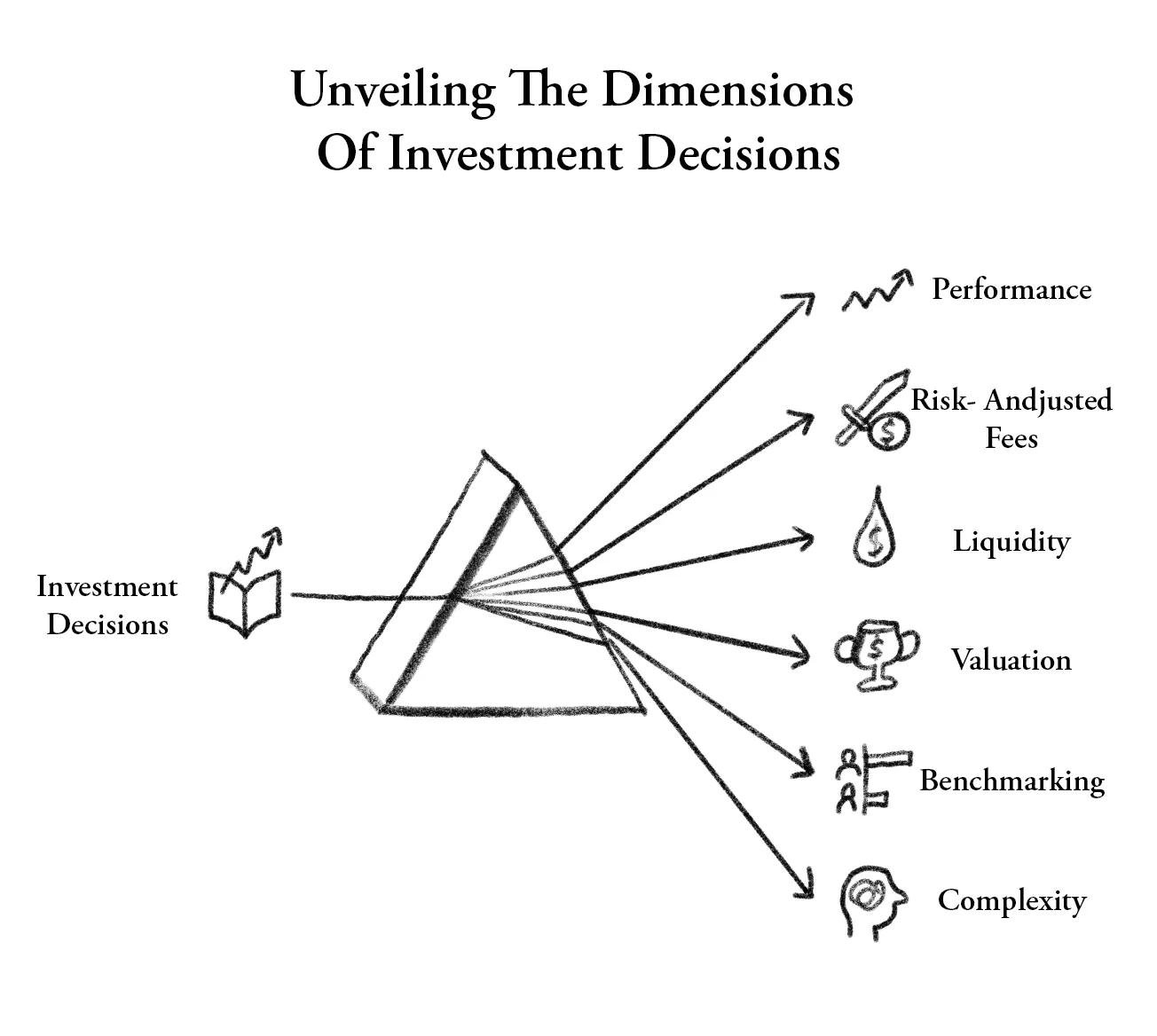
Don't mistake rule changes for shifts in market fundamentals. For ordinary investors, the volatility of crypto assets remains unchanged. What this rule truly protects are fund managers. It corrects the unbalanced legal risks that marginalized cryptocurrencies for a decade, finally allowing trustees to confidently give their consent.
Transmission mechanism: Target date fund
The Department of Labor itself anticipates that the primary access channel will be target-date funds. This has a crucial impact on the actual lives of ordinary depositors.
When most people start a new job, they automatically choose a target-date fund. You only need to select a fund that is closest to your expected retirement year, such as a 2045 fund. It will automatically adjust its stock and bond allocation as you age, becoming more conservative as the maturity date approaches. The vast majority of people who hold this type of fund never look at it again.
If crypto assets are allocated through target-date funds, investors won't actively buy Bitcoin at all. Their retirement portfolios will automatically allocate 1%–3% to Bitcoin, managed and automatically rebalanced by professional institutions.
Just like many people who hold gold in their 401(k) accounts but know nothing about it. That's how gold entered the pension system in the first place—the same vehicle, the same logic—and no one ever asked the true owner of that money.
Fidelity took the lead in 2022, offering pension plan sponsors the option to include Bitcoin in their portfolios before the Biden administration issued guidance. At that time, Fidelity allowed plan sponsors to incorporate digital asset investments into their portfolios, with participants able to invest up to 20% of their account balance in Bitcoin. Historically, plan sponsors have lacked adequate legal protection to confidently allocate Bitcoin without incurring personal liability. Currently, relevant legal safeguards are being developed.
$12 trillion
The US 401(k) program is worth approximately $12 trillion. Even a mere 1% allocation would result in about $120 billion flowing into digital assets, exceeding the total value locked in DeFi. Even just 0.1% would amount to $12 billion, equivalent to the size of the top five Bitcoin ETFs.
Previous waves of institutional adoption of cryptocurrencies have all stemmed from proactive decision-making: ETF buyers actively purchased, MicroStrategies actively held, and banks actively built custody products. These decisions can all be reversed: a CFO can sell Treasury holdings, and ETF investors can redeem their shares.
The 401(k) channel is structurally completely different, something the industry has been waiting for since the launch of spot ETFs. Pension funds are passive funds, held for up to 30 years. They won't panic sell during market crashes, won't be affected by the fear and greed index, and won't care about last week's oil price fluctuations.
Morgan Stanley's Amy Oldenburg points out that currently, 80% of crypto ETF trading comes from independent investors, not advisor-recommended allocations. The 401(k) market, on the other hand, is almost entirely driven by professional advisors. The new U.S. Department of Labor rule opens a channel previously difficult to access due to structural reasons, as those who control these channels bear too much personal responsibility and are hesitant to open the door easily.
This is a point that cryptocurrencies have emphasized for years: the real wave of adoption won't come from traders or early adopters of the technology, but rather from the infrastructure of ordinary people's savings systems automatically shifting towards cryptocurrencies. Target-date funds are precisely this infrastructure.
Risks and hidden dangers
A 50% drop in a trading account might just be considered a bad quarter. But a 50% drop in a 55-year-old teacher's retirement account is a completely different matter.
Bitcoin has retraced more than 80% in past bear markets, and this cycle is about 50%, which some interpret as "maturity." But losing half of your retirement savings doesn't make it any easier just because it's called "progress."
Jaret Seiberg of TD Cowen writes that he remains skeptical that trustees will not act rashly until a court confirms that the safe harbor clause truly protects against litigation. ERISA is a process-based law, but the final interpretation rests with the courts.
The safe harbor may hold true on paper, but whether a target-date fund that has invested in crypto assets can withstand a 40% drop in a bear market, triggering the first round of lawsuits, remains to be seen.
The public comment period for the rules will end on June 1st. The Department of Labor can amend the rules, withdraw them, or proceed with their implementation directly. Even if the final version remains unchanged, the process from the proposed rules to the actual funds entering pension accounts will involve compliance teams, investment committees, system integration with record-keeping service providers, and trustee reviews, which can take months, and possibly years.
Indiana's July 2027 deadline is a hard directive, while the federal rule is only a soft permit; the implementation pace of the two will be drastically different.
In the 1980s, stocks entered pension accounts through mutual funds; in the early 21st century, international stocks entered through target-date funds; followed by REITs, inflation-protected bonds, and commodities. None of these developments were driven by the active demands of retired savers.
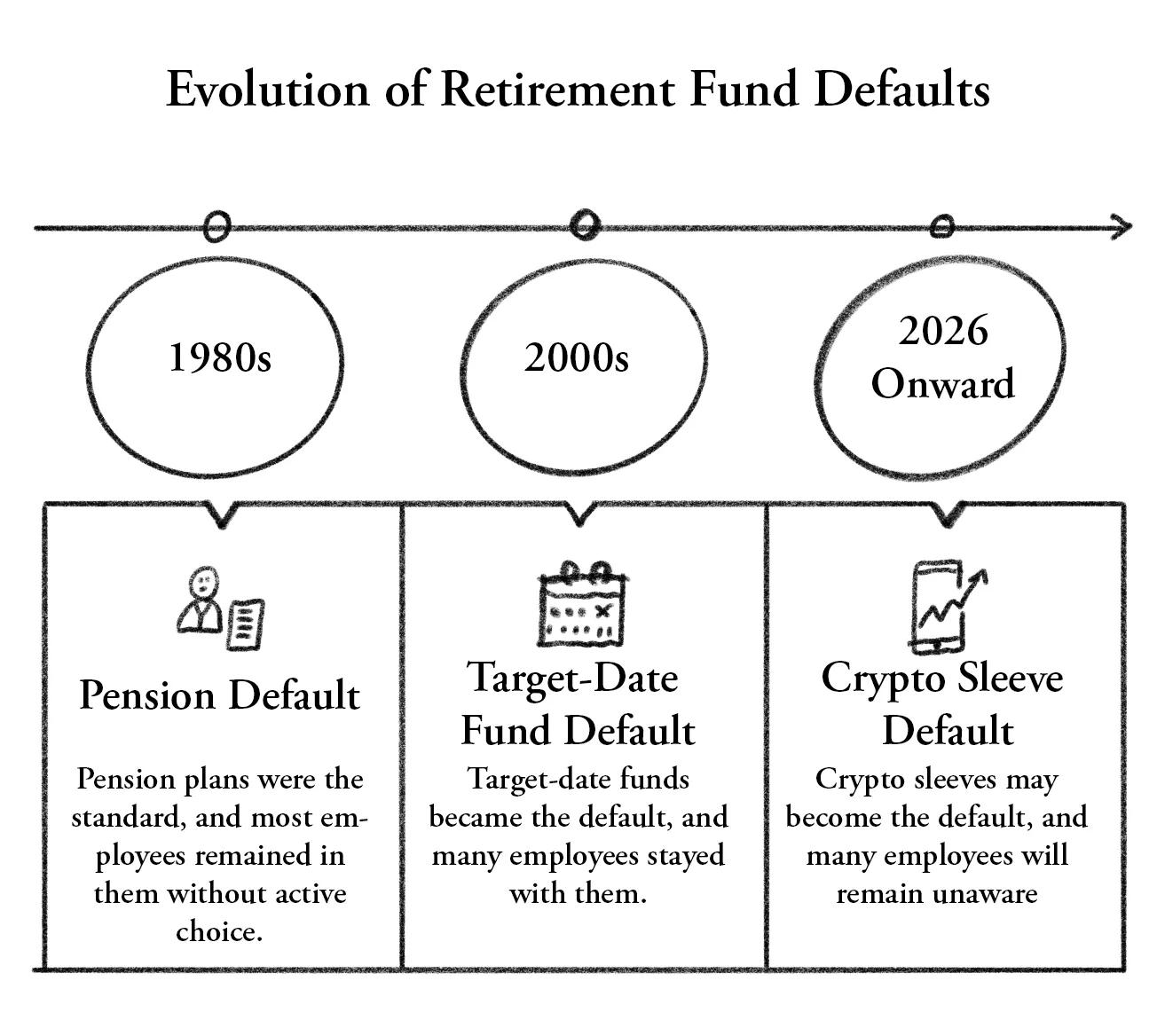
Cryptocurrencies are currently at this inflection point. Spot ETFs are the products, the new Labor Department regulations are the regulatory support, Fidelity, Charles Schwab, and Morgan Stanley are the distribution channels, and the Clarity Act enshrines the classification of crypto assets into law, providing a legal basis for trustees to conduct prudent due diligence.
All the puzzle pieces are in place, only the last one is missing.
If, someday in the future, a pension plan manager adds Bitcoin to a target-date fund, and Bitcoin subsequently crashes by 60%, causing a retiree to lose a significant portion of their savings, a lawyer may file a lawsuit.
At that point, the only important question will be: whether the judge will agree that the safe harbor protected the person who made the decision.
Currently, no one knows the answer. The Department of Labor thinks it's possible, while TD Cowen believes it could take several years to reach a conclusion.
Before the first case was heard and decided, all pension plan managers in the United States were required to trust a piece of paper that had never been tested in court.