The 500-day cycle surrounding Bitcoin's Halving is being talked about a lot… but the question isn't "will it repeat itself?", but "how effective is it?".
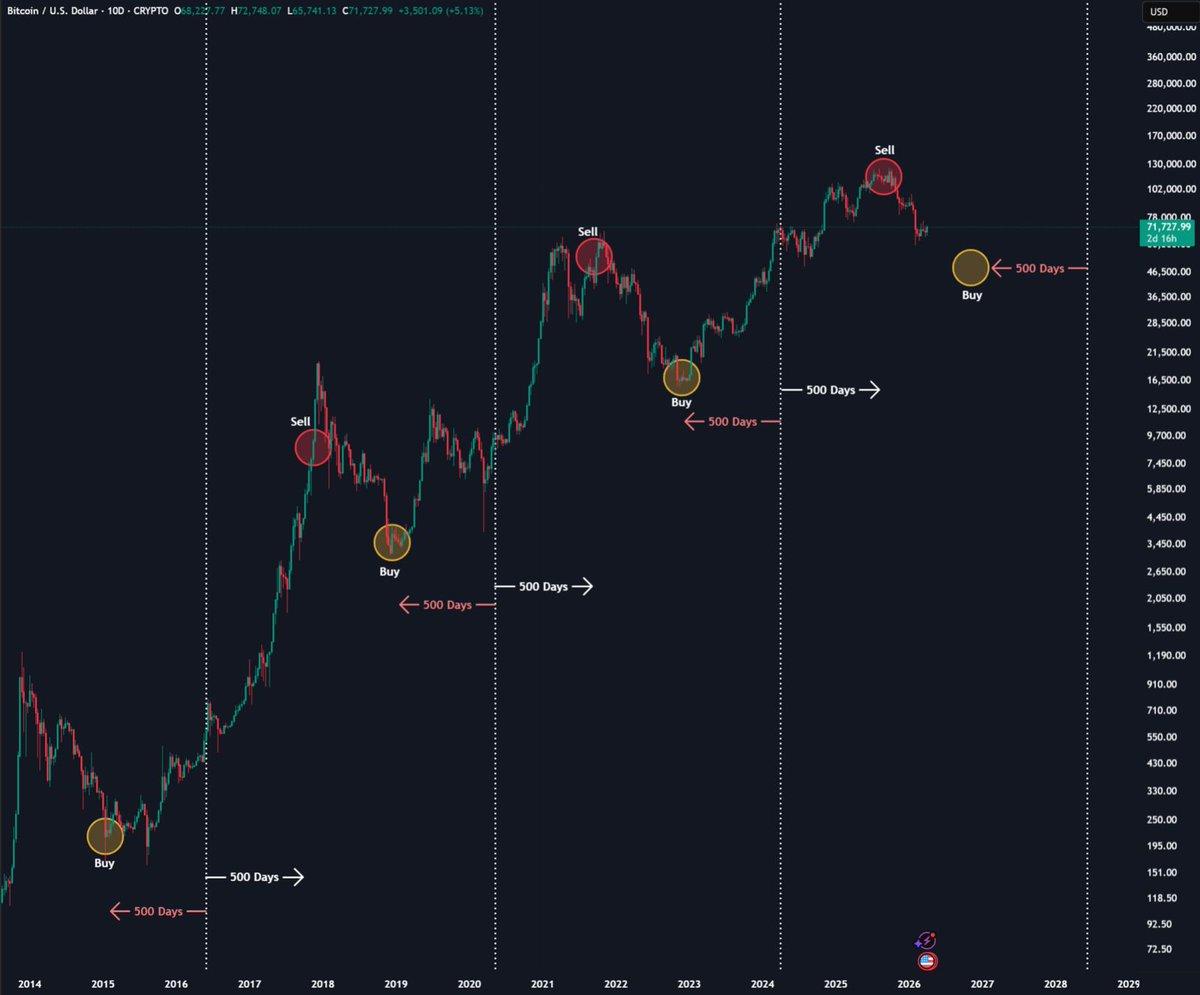
In previous cycles, the market typically formed as follows:
- Accumulation zone approximately 400–600 days before Halving
- The peak occurs approximately 12–18 months after the Halving.
The "Buy 500 days before – Sell 500 days after" model is essentially a simplified representation of a larger behavior: money flows in early when supply is tight and exits when expectations have been reflected in the price.
But the current cycle has a major difference: ETFs have brought in institutional money earlier, liquidation is no longer entirely dependent on retail, and the narrative "halving = Bull run" has become common knowledge. This leads to one possibility: The cycle still exists… but it’s compressed and shifted forward.
If that's the case, "500 days before the Halving" might no longer be the optimal timeframe. And "500 days after the Halving" could also be delayed compared to market realities.
Another noteworthy perspective: Instead of asking "when to buy," the current market is shifting to the question: when will large amounts of money flow in? If institutional money continues to dominate, fixed timeframes will gradually become less meaningful compared to:
- liquidation
- interest rate
- and the macro context
Q4/2026 could be a period worth watching. But not because "the cycle says so"... but because at that time, many variables could converge. The question is no longer whether the cycle will repeat itself. Rather, it's: are you following the cycle... or are you following the money flow?