Author: Curry, TechFlow TechFlow

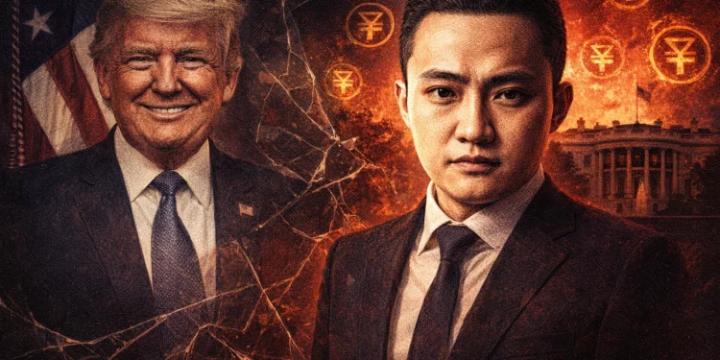
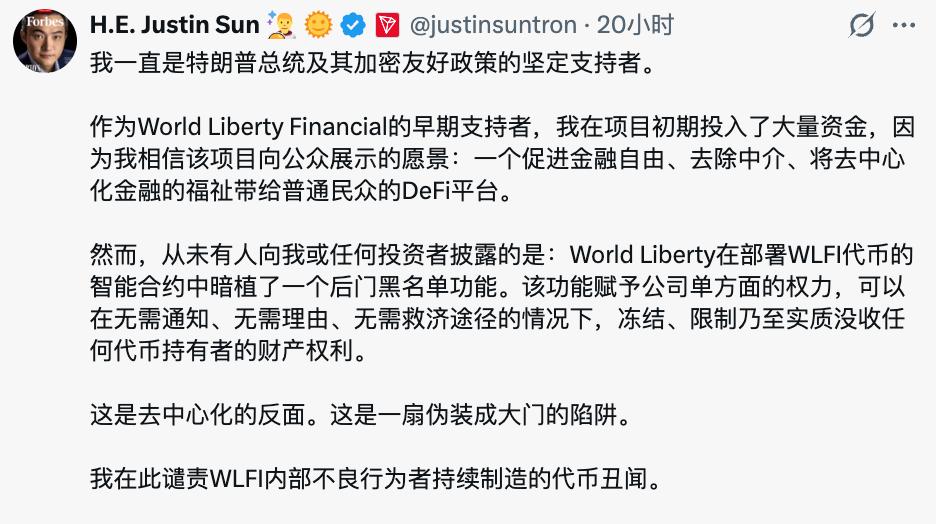
Yesterday, Tron founder Justin Sun published a long article on X, accusing World Liberty Financial, a DeFi project under the Trump family, of hiding a backdoor for freezing funds in its token contracts and treating investors as "personal ATMs."
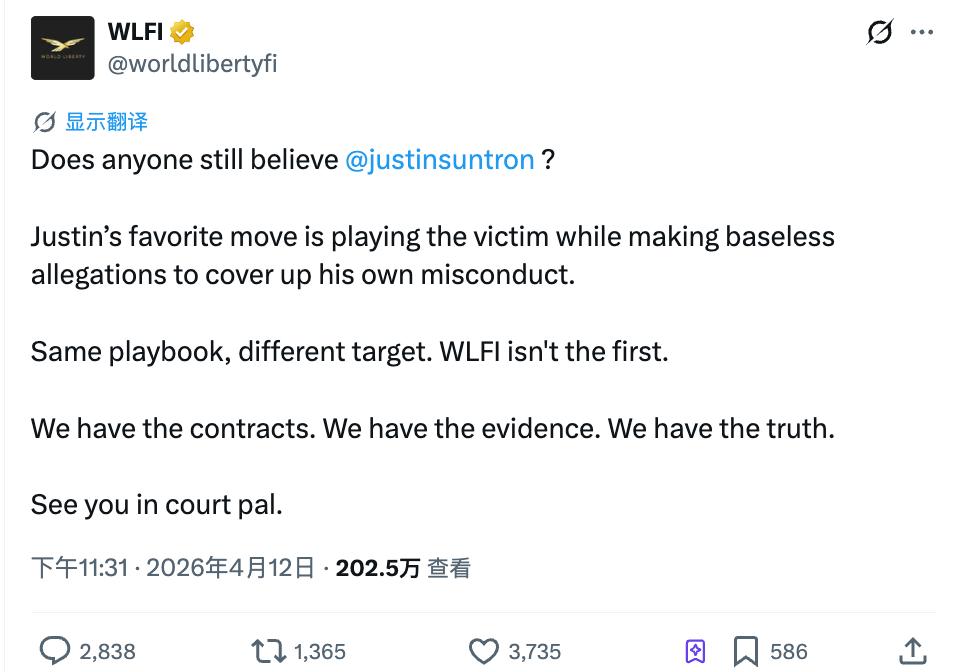
A few hours later, WLFI replied with three words: See you in court.
Sun is WLFI's largest external investor, having invested $75 million. Last September, his wallet was blacklisted by the project team when the tokens first started trading, and tokens worth over $100 million have been frozen ever since.
Last week, WLFI borrowed $75 million by pledging 5 billion of its own tokens, making it difficult for ordinary users to withdraw their deposits. Some say this operation is very similar to FTX.
WLFI is also saying that Sun has problems, and the dispute between the two sides remains unresolved. However, the WLFI token has already fallen by more than 76% from its peak last year.
The scale and intensity of this battle are considerable, but the most widespread view in the community is that Justin Sun dared to confront it head-on because he went to space last August.
On August 3rd of last year, he completed a suborbital flight aboard a Blue Origin rocket, having paid $28 million and waited four years for that seat. The spacecraft crossed the Kármán line, experienced weightlessness for a few minutes, and then landed.
The entire process takes 10 minutes and 14 seconds.
After landing, he said to the camera, "From space, Earth looks very small; it's our home. We must do everything we can to protect it."
Some people on social media have seriously said that going to space changes a person's mindset and perspective, which is why they dare to challenge projects with powerful backers. People who have been to space see things differently.
Can space really change a person?
Overview effect
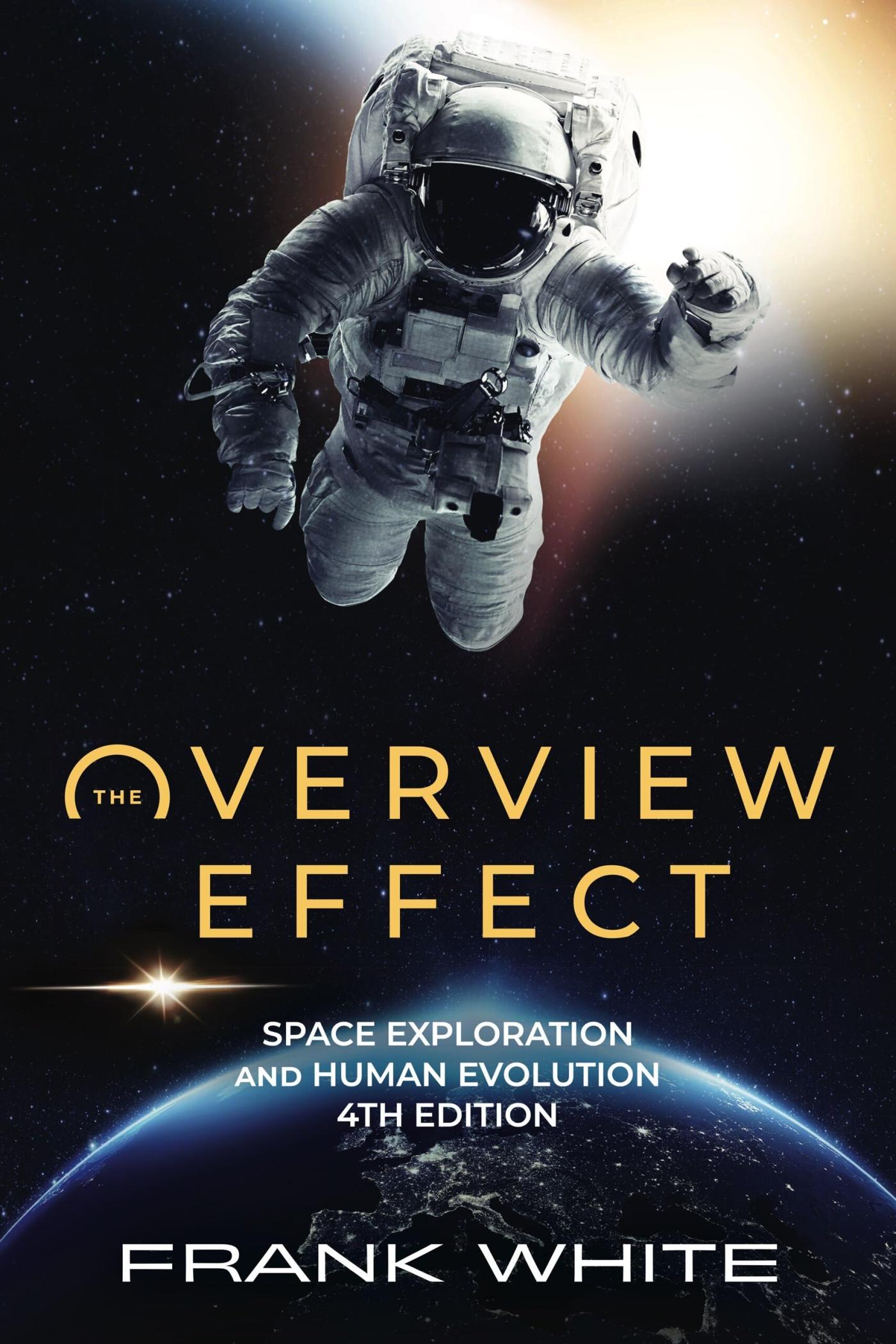
In 1987, a researcher named Frank White named this phenomenon after interviewing dozens of astronauts .
It means that when you look back at Earth from space and see that thin atmosphere, like a layer of varnish, and the continents without borders, something in your mind will be permanently changed.
A 2018 survey of 39 astronauts found that their perception of Earth had changed significantly, and that this change was highly correlated with whether they engaged in environmental protection efforts after returning home.
There's a NASA astronaut named Mike Foreman who went to space. He once said something very famous: "If you're not an environmentalist before you go to space, you'll at least be half an one when you come back."
However, there's a distinction hidden here that few people mention. Those reporting on this profound shift in understanding are primarily professional astronauts who have spent several months or even half a year on the International Space Station. They float to the observation window every day, witnessing hundreds of sunrises and sunsets, giving them ample time to absorb that feeling.
For paying passengers taking a 10-minute suborbital ride, the experience can be completely different.
The most genuine emotional reaction from a commercial space tourist came from William Shatner, the actor who played Captain Kirk in Star Trek. In 2021, at the age of 90, he took a trip on Blue Origin. He cried upon landing. Later, in his book, he wrote that it took him several hours to understand why he cried.
He said, "I am mourning for the Earth."
But the old man only stayed in the sky for 10 minutes. After returning to Earth, he appeared on a few talk shows, and then his life went back to normal.
The overview effect may not be a myth. During those few minutes of weightlessness, seeing that blue marble suspended in the darkness, you might indeed experience something you wouldn't normally feel.
But a momentary emotional impact and a permanent rewriting of cognition are not necessarily the same thing. You may be moved, you may post a sincere reflection, and you may even feel insignificant about everything in the first few days after you return.
Then you'll go back to your own life and continue being the person you've always been.
Space cannot affect the balance sheet.
Let's return to Justin Sun battle.
The community says he's come to terms with things, his perspective has changed, and people who've been to space are different. This statement is perfect for a romantic repost to grab some traffic, but it likely doesn't touch on any core interests.
He invested tens of millions of dollars in WLFI, his wallet was frozen for over half a year, and the frozen tokens plummeted in value. He experienced firsthand the feeling of being frequently fleeced by retail investors. If your investment went down the drain, wouldn't you want to seek redress?
In his statement, Sun carefully excluded Trump himself, only attacking "bad guys in the WLFI team," indicating that he was well aware of the scale of the enemy he was dealing with.
Rather than calling him an idealist who was inspired by space and acted recklessly, it's more accurate to say that in this matter, he was a large-scale gullible investor who invested money and then sought redress.
But some might say he doesn't need the money.
Hurun estimated his net worth at 10 billion RMB this year. With a presidential family listed across the street, silence seems the safer option. Why would someone widely considered shrewd choose a path that appears less so?
When he invested in WLFI, he wasn't just buying tokens; he was buying a ticket to join the Trump crypto ecosystem. However, from WLFI's perspective, this ticket has a different version.
Last September, shortly after the token was listed on exchanges, reports indicated that Justin Sun transferred approximately $9 million worth of tokens to HTX from his wallet. HTX happens to be the exchange where Justin Sun serves as an advisor, and at the same time, it was offering a 20% annualized return on WLFI deposits.
In the community's eyes, this series of moves looks exactly like someone claiming they won't sell while secretly trying to get their stock out through back channels. WLFI's rebuttal yesterday was also aimed at this point, saying that he is "most adept at playing the victim."
Justin Sun stated that it was merely a recharge test, and on-chain data showed his transfer occurred after the price drop, not before. However, this did not quell the controversy.
Regardless of the truth, once things have escalated to this point and the wallet is frozen, the value of this relationship has essentially been wiped out.
This calculation can be made clear even without going to space to create an "overview effect".
The project team might say freezing your account is a security measure, treating it alongside phishing scams. You're the biggest investor, but now you're on the blacklist alongside fraudsters.
Therefore, I believe that silence will not get you a ticket back.
Publicly appealing to gain community sympathy and exerting public pressure on the other side, thus securing a narrative advantage for potential legal battles later on. Every step appears calculated. A shrewd person wouldn't become reckless because of 10 minutes of weightlessness.
When the cost-effectiveness of silence drops below zero, it's normal to change your strategy.
Changing someone's behavior doesn't necessarily require going to space; just getting them to realize the consequences is enough.