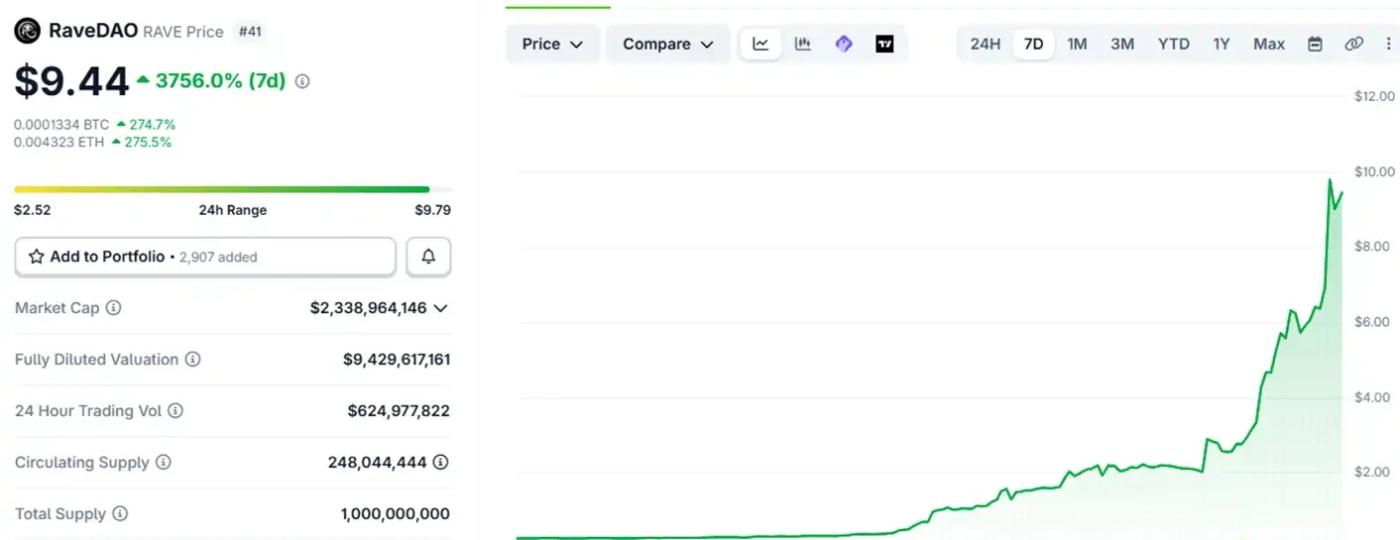
This year, one unavoidable concept in the cryptocurrency world is "monster coins." In the past week, the price of $RAVE has been steadily rising, reaching a peak increase of approximately 40 times compared to a week ago. Currently, $RAVE's market capitalization ranks 41st in the market.
From the recent $SIREN and $STO to the earlier $PIPPIN, $RIVER, $BEAT, and $MYX, no matter how sluggish the market, and although "monster coins" represent an information asymmetry game between retail investors and market makers, there are always players who, while chasing volatility, diligently analyze and try to grasp the logic behind these "monster coins" and find a winning strategy.
In fact, a complete field of study called "Demon Currency Studies" has gradually emerged in the Chinese-speaking world.
What are "demon coins"?
If the definition of "monster coins" is simply "rising quickly and sharply," then the study of "monster coins" would cease to exist. For retail investors, playing with "monster coins" is essentially a direct battle with the big players, a struggle to extract profit from their manipulation.
Based on this essence, KOL CryptoWeituo (@thecryptoskanda) has provided a detailed definition of "monster coins," clarifying the foundation of "monster coin studies":
- The spot market control rate is generally above 96%.
- With a Binance contract, whether or not there's actual physical stock is less important.
- Typically, through off-exchange margin financing, massive liquidity and counterparties are gathered in a short period of time by violently manipulating price swings.
- Market makers profit by triggering liquidation of long and short positions and taking advantage of the counterparty's fees, ultimately completing the spot distribution and the entire harvesting process.
How to identify "monster coins"?
On this issue, different players have offered excellent suggestions from different perspectives.
The anomaly in open interest can manifest itself from multiple angles. Firstly, it suggests "data manipulation." On April 11th, @Arya_web3 discovered that the 24-hour open interest data for $RAVE on Binance, Bitget, BingX, OKX, and Bybit were $60 million, $60 million, $60 million, $26 million, and $26 million respectively. Based on this data and comparing it with the overall open interest data of various exchanges, she speculated that the data from BingX and Bitget showed anomalies upon comparison, suggesting the possibility of data manipulation in their open interest figures.
Furthermore, $RAVE's 24-hour trading volume was $6.9 billion, with open interest at $300 million. Market manipulators drove the price up tenfold from the bottom, yet there weren't any large liquidation orders, further increasing the possibility of contract data manipulation. She also mentioned that observing which exchanges saw a concentration of liquidated contracts could serve as a basis for determining whether open interest data was being manipulated on certain exchanges.
@thecryptoskanda summarized and supplemented the above observations:
- The lower the median percentage of open interest on Binance, the higher the degree of market manipulation.
A high ratio of traded volume to open interest suggests a higher likelihood that the open interest data has been manipulated.
This means that any strategy that simply monitors contract trading volume or open interest is inappropriate, because it is very likely that market makers are deliberately stopping the manipulation of open interest data to lure retail investors into buying in.
You might say that this is a "monster coin" identified through analysis of data that has already occurred or is currently occurring. Is there a way to analyze it before it even starts to move?
No. In the words of @thecryptoskanda:
"A 'demon coin' isn't defined by meeting certain criteria. Rather, it's because it inherently is a 'demon coin,' which is why it exhibits those characteristics. Demon coins never follow the market's logic; they only depend on one thing—whether there's a major player involved."
How to tell if a "demon coin" is about to collapse?
The first perspective, proposed by @wuk_Bitcoin, is the "divergence between price and open interest," which can be used to determine if a "volatile" cryptocurrency is nearing a collapse. @wuk_Bitcoin stated that a price increase coupled with a continuous decline in open interest is a sign of an impending crash.
"The major players close out all their long positions at high levels, then support the price and continue to find counterparties, allowing retail investors or electronic traders to enter the market to long positions. Once they have counterparties, they can quietly accumulate short positions. After the short positions are established, they withdraw the price support orders and drive the price down, continuing to accumulate short positions as they sell, until the market finally collapses completely."
He also emphasized that it is necessary to look at the data at the 1-hour level, otherwise the level is too small to determine the intentions of the main players.
This perspective also has certain limitations, as mentioned earlier regarding "data manipulation." However, if we narrow down the observation period for open interest, another perspective emerges: "massive liquidation and a sharp drop in open interest led to the exit of major players."
This perspective was proposed by @CryptoRounder and further refined and supplemented by @thecryptoskanda:
"A price at a certain level triggered a large number of liquidations, causing a sharp drop in open interest. Short positions disappeared, and the major players lost their willingness to maintain high prices, leading to a decline. This is a more definite top signal."
While the two perspectives above emphasize "how to escape before the collapse of a volatile cryptocurrency," this represents the most rational decision a retail investor can make in the highly information-asymmetric world of such a coin: find the point at which the major players decide to abandon their positions and design trades around that point. After all, before a volatile cryptocurrency collapses, major players can repeatedly liquidate both long and short positions, but once they truly exit and cease supporting the price, the downward trend of the volatile cryptocurrency becomes irreversible.
Conclusion
While various experts have been striving to find a stable way to profit from these "monster coins," and have offered us many insightful perspectives, it's crucial to always remember that these "monster coins" are so named because of their control over the market, which can reach 95% or even more.
Although we can discover clues of manipulation by big players from many dimensions, and even win the game of "demon coins" through data analysis, it is difficult to summarize the situation of each "demon coin" through analysis and replicate it in every game.
The manipulators behind these "demon coins" are the ones who control the script. They can manipulate data to mislead retail investors and also have various ways to profit from them.
According to @Arya_web3's speculation, the cost for market makers to manipulate open interest data is not high. Based on a 24-hour contract trading volume of $7 billion, with a fee rate of 0.005%, the cost for 24 hours would only be $350,000.
If the core of compounding potential in trading "demon coins" lies in "predicting the actions of the big players," then the difficulty is akin to betting against someone with a script on the next scene. This level of difficulty is akin to having supernatural insight, and can be considered "superhuman."