China's imports of chip manufacturing equipment from Malaysia and Singapore are projected to surge in 2025, surpassing direct imports from the US – which have fallen to their lowest level in eight years, according to Nikkei Asia .
Although the Netherlands and Japan remain the two main foreign suppliers of semiconductor manufacturing equipment by export destination, imports from two Southeast Asian countries have reached record levels: Singapore reached $5.7 billion (up more than 17% year-on-year), while Malaysia reached $3.4 billion (more than double the 2024 figure).
Conversely, direct imports from the US fell by more than 34%, to around $2 billion – the lowest level since 2017, according to Chinese customs data.
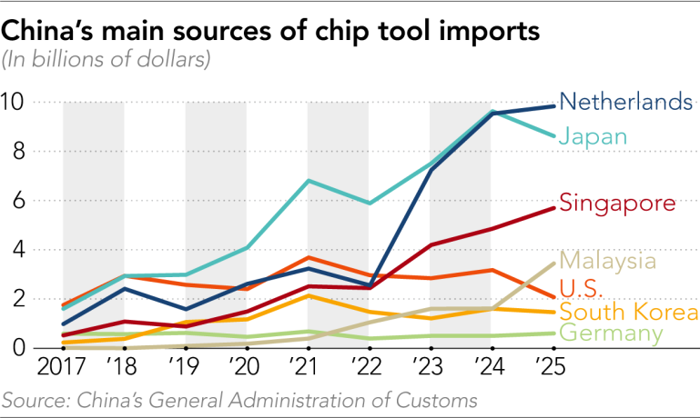
Source of chip equipment imports into China (Source: Nikkei Asia)
The decline occurred after the Trump administration increased tariffs and imposed new export controls aimed at slowing China's progress in chip manufacturing technology for defense, aerospace, and artificial intelligence.
Despite a decline in direct imports, the Chinese market remained a key revenue source for leading US chip manufacturers last year. Applied Materials, Lam Research, and KLA all projected that more than 30% of their total revenue would come from China in fiscal year 2025.
The three leading US chip manufacturers generated nearly $19 billion in revenue from China in fiscal year 2025 – significantly higher than customs figures based on export location, demonstrating the effectiveness of their manufacturing diversification strategies.
For ASML of the Netherlands, China is projected to account for 29.1% of revenue in 2025, while for Tokyo Electron of Japan, this figure exceeds 40% in fiscal year 2025.
Between 2020 and 2025, China's total imports of chip equipment from Japan exceeded $42 billion, followed by the Netherlands with $35 billion. Japan is home to many major equipment manufacturers such as Tokyo Electron, Screen Semiconductor Solutions, and Ebara, while the Netherlands is home to ASML – the world's largest chip equipment manufacturer – along with key suppliers such as ASM and Besi.
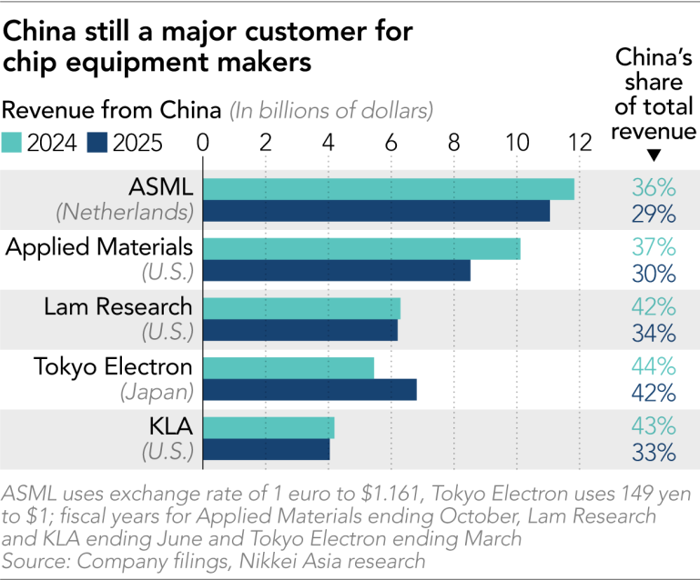
Revenue from China for chip manufacturers in 2024–2025 (Source: Nikkei Asia)
Conversely, domestic Chinese chip manufacturers are experiencing explosive growth, thanks to policies promoting domestic technology development to reduce dependence on foreign countries. Companies such as Naura, AMEC, ACM Research, and Piotech all recorded record revenues and profits in 2025.
Naura's revenue – XEM the "Chinese version" of Applied Materials – increased from 6.05 billion yuan (US$887 million) in 2020 to 27.14 billion yuan in just the first three quarters of 2025. AMEC's revenue increased by more than 400% during the same period, while Piotech recorded a 13-fold increase from 2020 to 2025.
Amid increasing competition from Chinese suppliers, U.S. policymakers are seeking to tighten loopholes in export controls.
In April, bipartisan lawmakers proposed the MATCH Act, calling for closer coordination among allies in synchronizing and tightening export restrictions on key segments of the chip manufacturing industry. These measures would target critical technology bottlenecks as well as shipments to Chinese chipmakers such as CXMT, YMTC, SMIC, and Hua Hong.
Kevin Kurland, a former U.S. Commerce Department official, said that Chinese companies on the "Entity List" cannot access U.S. components, but can still substitute them with sources from Europe and Japan.
"If the controls aren't coordinated multilaterally, they could undermine the competitiveness of American businesses while still allowing Chinese businesses to continue operating – a 'lose-lose' scenario," he said.
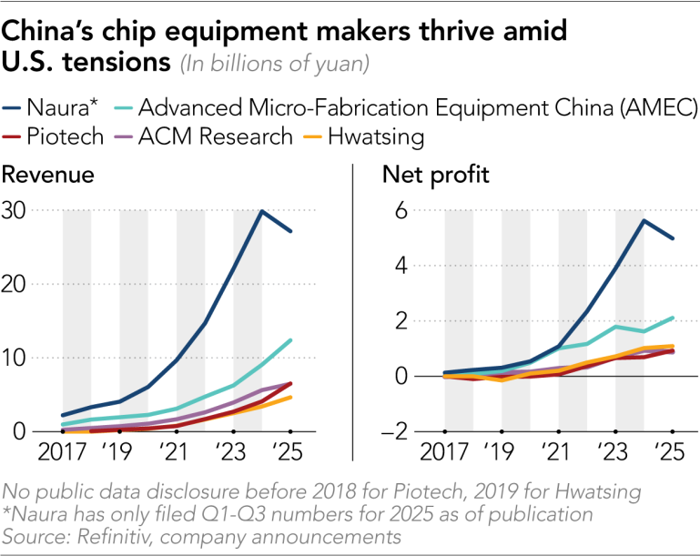
Revenue and profits of Chinese semiconductor companies 2017–2025 (Source: Nikkei Asa)
Alex Rubin, a former CIA China analyst, argues that controlling the export of components is reasonable. He draws a comparison to the aviation industry: China assembles the C919 aircraft but still relies on components from the US and Europe, while competing directly with Boeing and Airbus.
Despite still relying heavily on foreign equipment, China's ultimate goal is complete self-sufficiency. An industry leader stated that, while quality and reliability may not yet be on par, "almost every piece of equipment, material, or component used in chip manufacturing now has a domestic version."
According to Nikkei Asia, citing sources, China is pursuing a "two-pronged" strategy: developing domestic equipment while continuing to purchase foreign equipment whenever possible. Imported tools remain popular due to their higher efficiency, and even consumable components are reused to repair other machinery.
The rapid expansion of Chinese chip manufacturers has also created opportunities for domestic suppliers to become more deeply involved in the supply chain .
Companies like SMIC, Hua Hong, and manufacturers affiliated with Huawei are accelerating the expansion of advanced chip production, aiming for 7nm and even 5nm technology, to support the development of the domestic AI chip industry.
Meanwhile, memory manufacturers like CXMT and YMTC are also deploying their largest expansion plans ever to meet the global shortages caused by the AI wave.
Although the Netherlands and Japan have implemented regulations that align with US export controls, Washington argues that these measures are still not strict enough.
If passed, the MATCH Act could further restrict China's ability to obtain critical technology, including older but still strategically important generations of machinery.
However, the bill is still in the legislative process, and it remains unclear how allies like the Netherlands or Japan will react to pressure from the US – especially since only a few companies like ASML (Netherlands) or Canon and Nikon (Japan) are capable of producing commercial lithography machines, an area where China still faces significant challenges.
Source: Nikkei Asia