Author: TechFlow TechFlow
While market attention is being drawn to US stocks, AI, and gold in turn, Sui recently announced a new move:
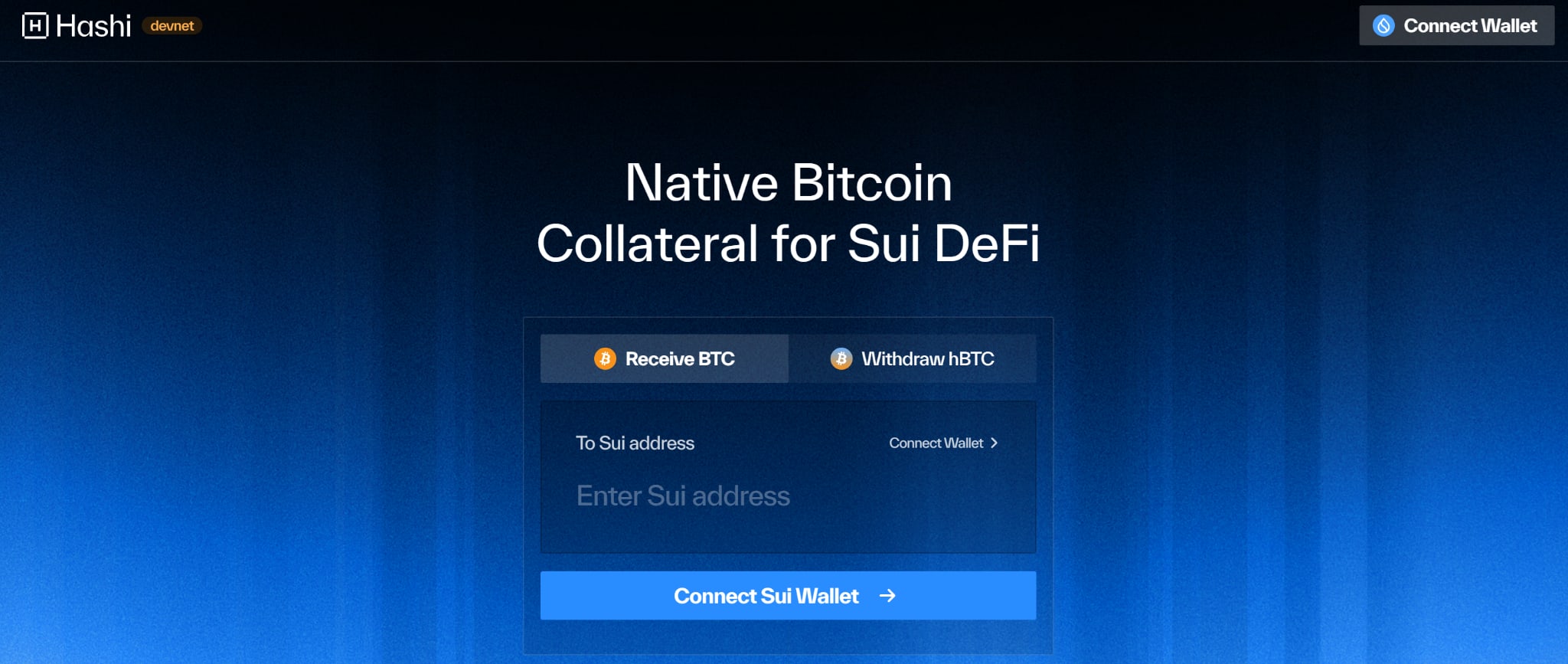
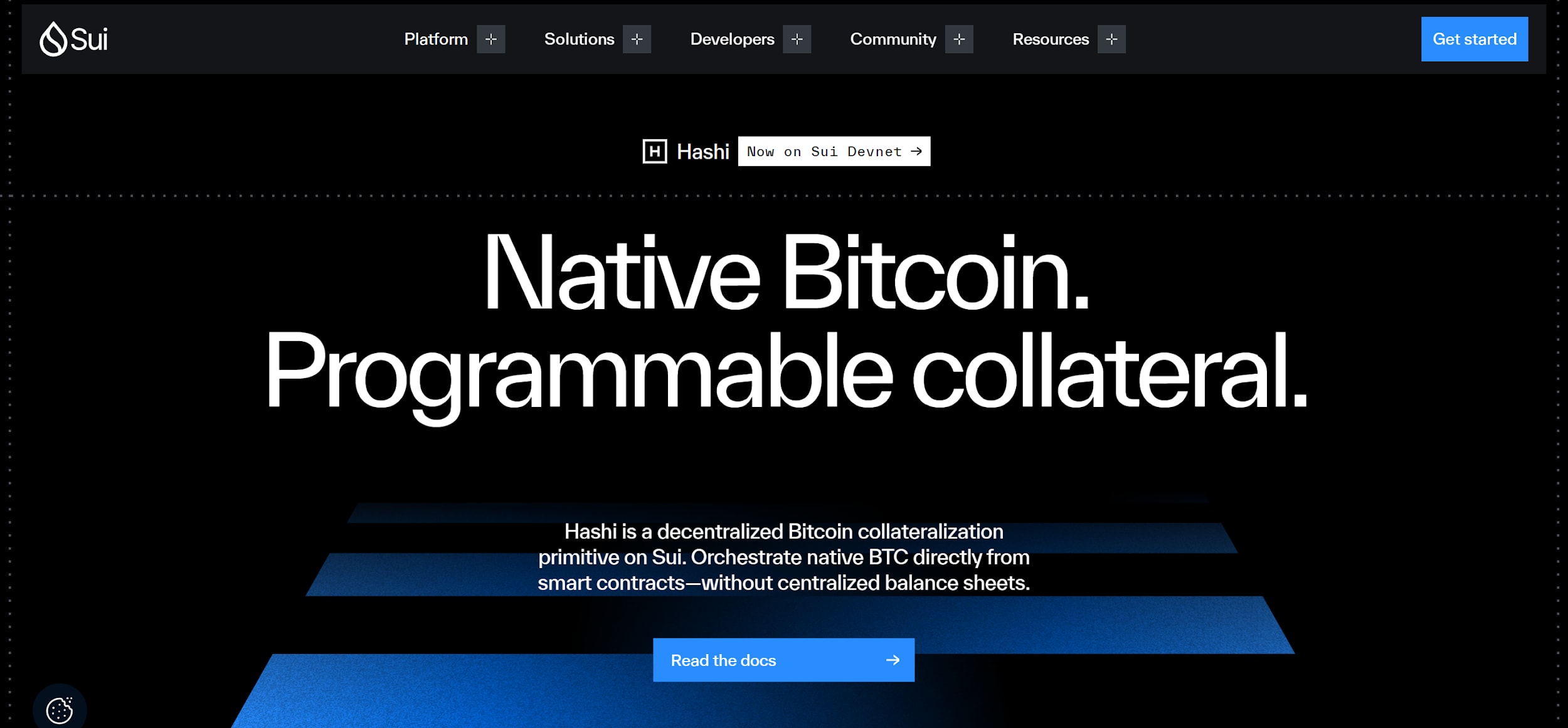
Hashi, a Bitcoin staking primitive based on Sui, is about to be launched and has garnered support from a number of top institutions.
Bitcoin finance, a topic that has been discussed countless times, yet remains unresolved:
As the largest on-chain asset pool with a market capitalization of over 1.4 trillion, Bitcoin is currently used for less than 0.22% of DeFi.
The core reason for the lack of clarity lies not in insufficient functionality, but in the flawed premise of trust. In numerous past attempts, users have often been misled; you think your Bitcoin is in your hands, but it's actually on someone else's ledger. The collapses of projects like Celsius, Voyager, and Genesis have repeatedly sounded the alarm about the logic of "sacrificing trust for efficiency."
In particular, synthetic Bitcoin, despite attracting a considerable number of retail investors, has failed to convert large amounts of Bitcoin into DeFi funds and has not attracted institutions and large asset holders who require stronger security.
This was the crucial turning point for the birth of Sui's new developer primitive, Hashi:
Reconstructing the most crucial foundation of trust in Bitcoin finance.
This allows the native BTC staking process to be organized more transparently within Sui's smart contract environment, without packaging, synthesis, or handing over the keys to any centralized entity, and transforms this capability directly into a reusable interface.
Hashi's design philosophy can be summarized in one sentence:
Assets reside on the Bitcoin network, while rights reside on the Sui network; both are established simultaneously and do not interfere with each other.
If you have one Bitcoin and you want to use it as collateral to borrow USDC.
In most past schemes:
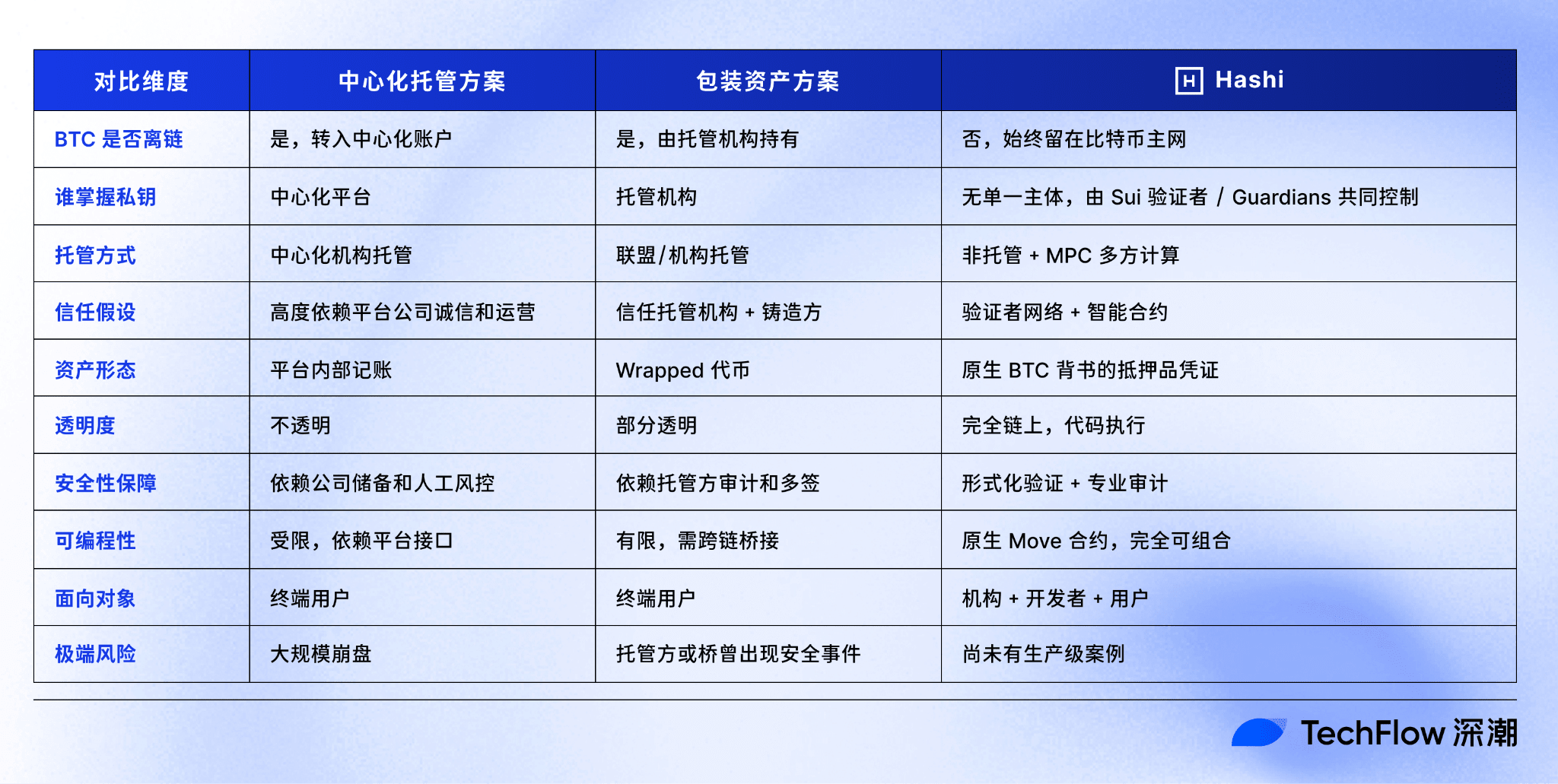
You either deposit your BTC into a centralized platform in exchange for a loan, or you accept wrapped BTC. At some point, your Bitcoin must be handed over to someone else; essentially, it's exchanging "trust in an entity" for "programmability."
In Hashi:
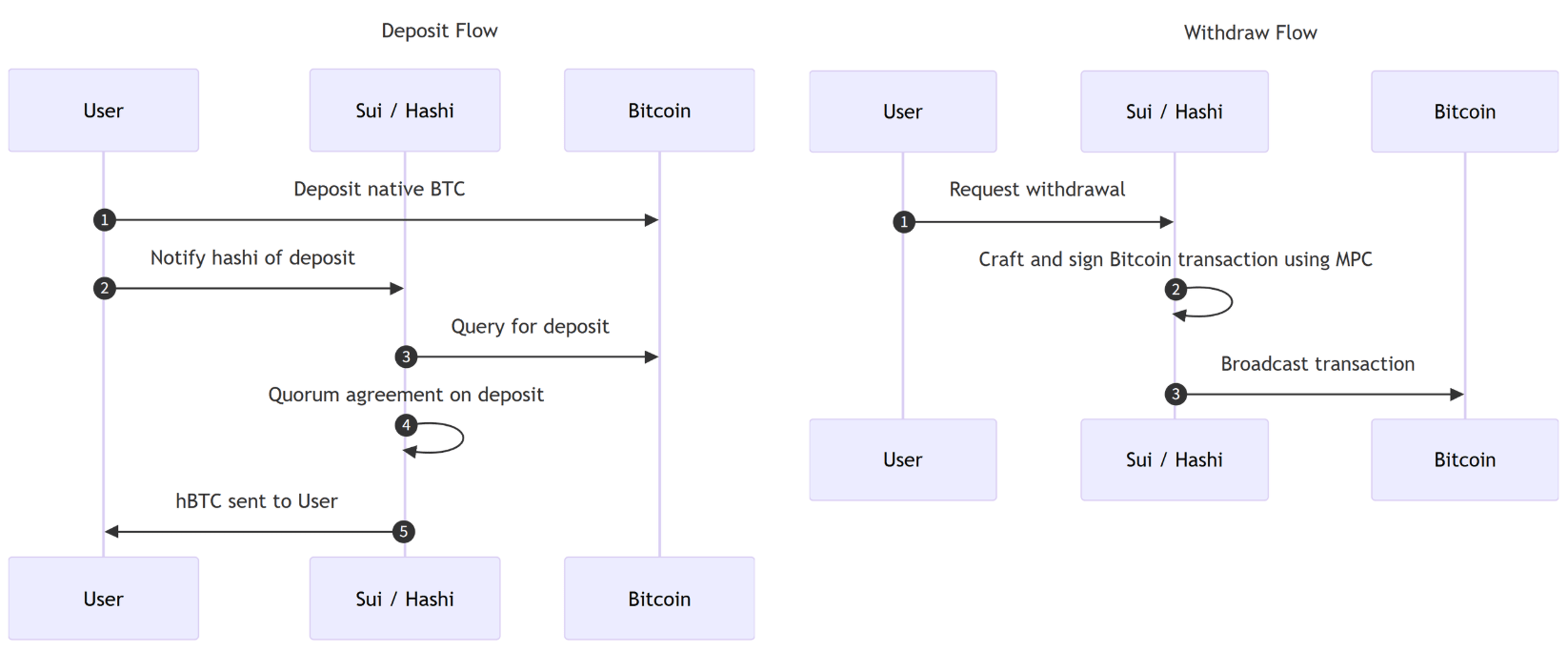
Deposit: Users deposit BTC into a dedicated address (a unique Bitcoin deposit address generated by Hashi for its Sui address). The private key of this address does not belong to any one person, but is jointly managed by validators on the Sui network. The BTC can only be used when a sufficient number of validators reach a consensus. This means that no single entity can take your money unless they can simultaneously control more than one-third of the entire Sui validator network.
Certificate Generation: Validators simultaneously monitor the Bitcoin network. Once they confirm that your BTC has indeed been locked, they generate a corresponding collateral certificate on the Sui chain. This certificate is not a newly issued token, nor is it a packaged asset; it is simply an on-chain proof that a real BTC has been locked, and that you are its owner.
As collateral: With this certificate, you can borrow money, participate in DeFi, and set up yield strategies within Sui's smart contracts. All rules are written in the code and executed automatically, so no one can tamper with them.
Repayment and Withdrawal: After repayment, validators automatically release the native BTC on the Bitcoin mainnet through MPC threshold signing and can withdraw it to any Bitcoin address without any manual intervention.
Guardian Layer: To prevent extreme situations (such as validator collusion), Hashi introduces an additional Guardian Layer as a secondary check and backup protection, which mainly monitors large withdrawals or abnormal thresholds to prevent potential systemic risks.
Throughout the entire life cycle:
BTC remains on the Bitcoin mainnet, rather than being moved into an internal account on some platform;
No single centralized entity has exclusive control over the private keys;
Sui circulates collateral rights backed by real BTC, and the programmability of native BTC is reopened;
Furthermore, the only entities users need to trust are the validator network and smart contracts.
In short, Hashi is dedicated to enabling on-chain financial systems to directly identify native BTC staking relationships without entrusting trust to centralized entities as much as possible.
When the market is stable, users may not perceive this difference much, but in extreme situations such as platform collapses or liquidity crises, it can be the difference between whether your BTC is still there or not.
From a design perspective, Hashi is a more decentralized, trust-less, and more secure and transparent Bitcoin financial solution.
However, if we only understand Hashi from the perspective of a single "solution", we may miss its most promising aspects.
It's important to understand that for a long time, Sui has been working towards moving from "a single chain" to "a complete set of developer infrastructure." Whether it's launching Walrus, Seal, or Nautilus, the goal is to achieve full-stack native support from execution, storage, and access control to off-chain computing, providing convenience for developers and building the necessary foundation for a thriving ecosystem.
This time, the situation with Bitcoin finance is no exception.
According to the official definition:
Hashi is the first decentralized Bitcoin staking primitive developed by Mysten Labs, which allows developers to actively process Bitcoin network UTXOs within the Sui native smart contract language.
The key word is "original language".
In the context of blockchain and DeFi, primitives often refer to basic building blocks or underlying infrastructure components, much like a "standard brick" in a Lego set:
It is not a terminal product for ordinary users to use directly, but a basic module for developers to build products.
Just as TCP/IP is not an app, but all apps run on it; Hashi is not a product, but lending platforms, profit strategies, and structured products can all be built on it.
In other words, Hashi does not provide a closed financial service, but rather an underlying capability that allows native BTC to be used as collateral directly by Sui smart contracts.
As for what the collateral is used for, how it is used, and under what rules it is used, Hashi doesn't care; it's up to the contract, the developers, and the market.
Before Hashi, developers who wanted to build a protocol with BTC as collateral faced numerous challenges: they either had to accept the trust risks associated with centralized custody or implement the entire complex logic of native BTC collateral from scratch.
Hashi, as a primitive, transforms this difficult problem into a directly reusable interface.
Now, when developers build specific products, they can directly call the mechanism provided by Hashi to make their built protocols have native BTC collateralization capabilities without having to solve underlying problems again, which greatly reduces the development threshold and time cost.
For the first time, users, whether institutional or ordinary, will gain the ability to earn yield with Bitcoin through products built on Hashi, without relinquishing control over it. Initially, lending will be Hashi's primary use case, enabling BTC to be lent out or used as collateral to borrow stablecoins. In the future, Hashi's applications will gradually expand to include vaults, insurance, structured products, credit derivatives, and RWA yield strategies, among other diverse scenarios.
Bitcoin is the most widely accepted and most liquid asset in the world, but in the past, this wealth was almost invisible to the on-chain financial world: it is huge but not programmable; it is valuable but cannot be directly perceived and accessed by smart contracts.
Therefore, when Hashi turns the native BTC staking capability into an interface that any developer can directly call, the upper-layer application space it can leverage is far more than just a specific product or protocol.
The answer to whether this judgment is right or wrong has already been provided by the extensive institutional support that Hashi has garnered.
Currently, Hashi is available on Sui Devnet, primarily for developer testing and auditing, and has not yet entered the production environment, but has received clear support commitments from several leading industry organizations.
In terms of custody and infrastructure: major institutions including BitGo, Blockdaemon, Cobo, and Ledger have directly opened up channels for institutional BTC to move from cold storage to on-chain staking scenarios.
In terms of trading and liquidity: major institutions such as FalconX, Bullish, and CF Benchmarks provide Hashi with reliable price and liquidity outlets and institutional-grade counterparty support.
Regarding security and compliance: Several teams, including security auditing firm OtterSec, smart contract formal verification security company Certora, and cryptography and zero-knowledge proof research and engineering team Asymptotic, have chosen to support Hashi and will conduct smart contract audits, formal verifications, cryptography and zero-knowledge proof research before the Hashi mainnet goes live.
Meanwhile, projects including Suilend, Scallop, NAVI Protocol, Matrixdock, and Bluefin have announced that they will integrate Hashi to unlock the potential of on-chain finance and enable retail and institutional users to quickly access BTC collateralized lending.
In addition, Soter Insure, a solutions provider specializing in institutional insurance, announced a partnership with Hashi to bring built-in institutional insurance mechanisms as a risk protection layer.
These institutions represent hundreds of billions of dollars in nominal Bitcoin value and a mature compliance infrastructure. Their decision to commit to integration during the Hashi Devnet phase means that once Hashi is officially launched, a large number of institutional Bitcoin assets will be realistically ready to enter on-chain scenarios.
At the same time, looking at these 20-plus institutions together reveals something interesting: they cover almost every aspect of a complete Bitcoin financial ecosystem.
From secure custody of Bitcoin, on-chain collateral, price pricing, liquidity support, lending protocols, yield strategies, RWA integration, to security auditing and user access, the end-to-end chain is beginning to take shape.
In other words, behind this list of supporters, a complete Bitcoin financial ecosystem map centered around the Hashi primitive will be ready from the first day of the Hashi mainnet launch.
Of course, Hashi is still in the Devnet stage. It hasn't yet undergone the long-term testing of the mainnet environment, real asset scale, and extreme market volatility, and its production-level performance still needs time to be verified. The path of Bitcoin finance will never become smooth immediately just because a new primitive appears.
However, the fact that Day One has secured integration commitments from over 20 leading institutions in areas such as custody, liquidity, security, and protocol layer services clearly demonstrates the market's strong acceptance of this approach.
The story of Bitcoin finance has been told for many years, but the real breakthrough has never been about "what can be done", but about "why believe in it".
Past solutions, whether centralized custody or asset packaging, essentially required users to make the same choice: either give up control in exchange for returns, or keep the key but be isolated from on-chain finance.
Hashi is attempting to rewrite the problem itself: to make the native BTC collateralization capability a low-level interface that developers can directly call, allowing Bitcoin, this dormant trillion-dollar vault, to be truly "seen" by the smart contract world for the first time in a non-custodial, verifiable, and composable manner.
Rebuilding trust is often more difficult than adding features.
If the ultimate goal of Bitcoin finance is to make Bitcoin a true native collateral for on-chain finance, then what Hashi is doing may be laying the first pile for that bridge.
TechFlow is a community-driven in-depth content platform dedicated to providing valuable information and insightful thinking.
Community:
WeChat Official Account: TechFlow TechFlow
Subscribe to our channel: https://t.me/TechFlowDaily
Telegram: https://t.me/TechFlowPost
Twitter: @TechFlowPost
Add the assistant's WeChat ID to join the WeChat group: blocktheworld
Donate to TechFlow TechFlow and receive blessings and a permanent record.
ETH: 0x0E58bB9795a9D0F065e3a8Cc2aed2A63D6977d8A
BSC: 0x0E58bB9795a9D0F065e3a8Cc2aed2A63D6977d8A