This article is machine translated
Show original
Last month, a friend asked me what I thought about crypto terminals. To be honest, I didn't know much about them before. Do they even exist in the crypto?
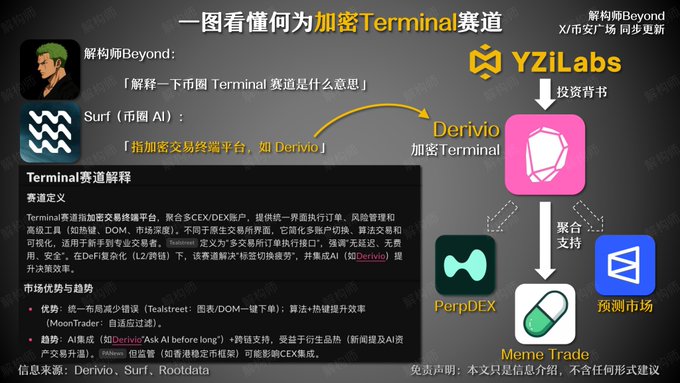
Before entering the crypto, I had only seen similar devices in college and during my internships, but they were usually extremely expensive. For example, the famous "Bloomberg Terminal" costs 200,000 RMB per year for a subscription, and the computer with it installed is called a Bloomberg machine. Usually, a college only has one or two such machines. Although expensive, its functions are exceptionally powerful because it integrates real-time data, news, analysis tools, and trading functions from almost all global financial markets into one system. No free tool can replace it. Returning to the crypto, after a friend's suggestion, I used tools like SURF to research and learn about this sector. It turns out that similar narratives do exist in the crypto. This article will use the SURF-recommended project Derivio (@derivio_xyz) to deconstruct the current situation. Nowadays, crypto trading systems have long since moved beyond the primitive era. Not only are the trading instruments diverse, but the trading entry points are also varied.
- CEX secondary spot and contract markets
- On-chain trading pairs of PerpDEX or Swap
- On-chain Meme Trading, using Pumpfun as an example
Prediction markets like Polymarkets typically operate on a "prediction tool" model, where different platforms handle different scenarios: one uses a tool for trading speculative stocks, while another uses CEXs or PerpDEXs for contract trading. There's no single platform that integrates all these functions. This is what terminals like Derivio do: they integrate price lookup, order execution, position management, and fund exchange into a single platform, significantly reducing the cost for users switching between different apps. Furthermore, with the development of AI, automated arbitrage and hedging are inevitable trends, and these operations often occur across multiple platforms.
For example, during the US-Iran conflict, simultaneously buying a long position in BTC and a "YES" prediction of political turmoil caused by Trump is a very low-cost hedging strategy. However, in the past, unless operated manually, it was difficult for AI to automate such cross-platform operations. Now, with Terminal, everything becomes natural; AI can easily perform such operations. In short, Terminal is indeed a future trend, especially with the explosive growth of AI today. As a complementary necessity, its market prospects are vast. I believe the end game for Terminal-like products should be deep integration with various on-chain exchanges and information flows, from Spot and PerpDEX to prediction markets, achieving a one-stop strategy loop. Derivio recently announced a $6 million counter-cyclical funding round, demonstrating its strength in the Terminal field to some extent.
Derivio has been running a points-based incentive program to encourage genuine interaction for some time now. With the announcement of its funding, the project is expected to accelerate further, and I will continue to follow it closely.

解构师 Beyond
@0xBeyondLee
03-14
What's the terminal track? I'm out of the loop.
It feels like an information aggregation platform?
Information aggregation and transaction integration platform
Yesterday I used the Surf SKILL, and it felt kinda interesting.
Sector:

From Twitter
Disclaimer: The content above is only the author's opinion which does not represent any position of Followin, and is not intended as, and shall not be understood or construed as, investment advice from Followin.
Like
Add to Favorites
Comments
Share
Relevant content