According to Google's official website, its AI assistant Gemini has officially launched an interactive simulation generation feature, which is now available to users worldwide.
Back in November of last year, Google launched its own interactive charting and visualization tool, Gemini, and now it has taken it a step further. What used to be static charts are now 3D models with adjustable parameters.
It is worth noting that ChatGPT and Baidu Search have previously launched similar features, but they are all 2D interactions.
In any case, the interactive format makes learning more convenient. For example, students and teachers only need to enter "Help me demonstrate the moon orbiting the earth" in the dialog box, and Gemini will generate a draggable, scalable, and adjustable 3D dynamic simulation program.
It can be said that complex concepts have become “playable” simulation games.
01
Gemini's new feature: Transforming learning from "watching" to "experiencing"
Traditional online learning resources are often limited to static text, images, and videos. Students passively receive information, making it difficult to develop intuitive physical intuition.
This upgrade to Gemini transforms learning from "watching" to "experiencing".
How exactly do you use it?
Users need to visit gemini.google.com, select the Pro model in the prompt bar, and then enter a question with instructions such as "show me" or "help me visualize".
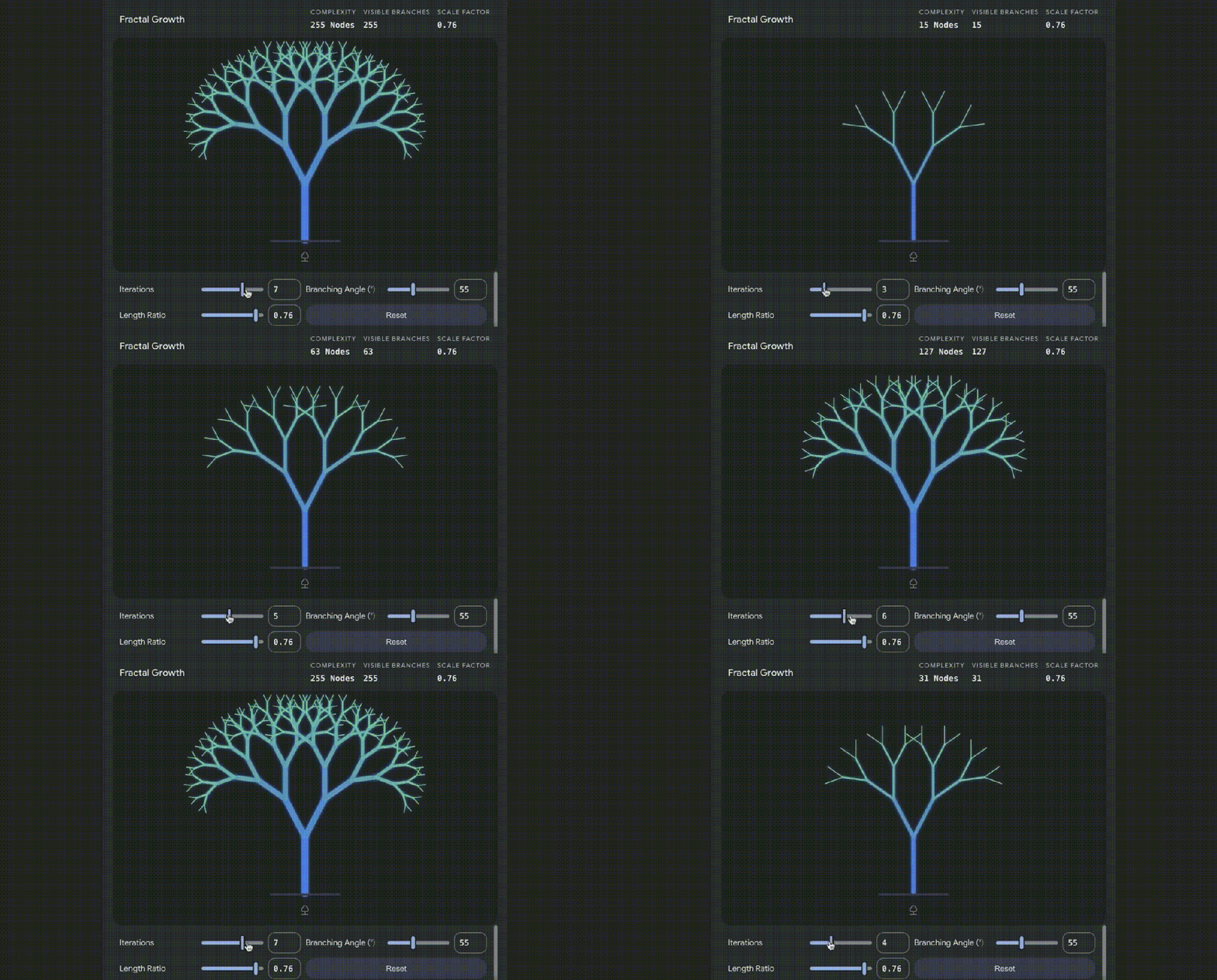
For example, if you input "show double pendulum motion", Gemini will generate an interactive double pendulum model. Users can adjust parameters such as pendulum length, mass, and initial angle to observe the real-time changes in chaotic motion.
By entering "demonstrate the Doppler effect", Gemini can intuitively experience the principle of pitch change by adjusting the wave source speed and the observer's position.
Its core advantage lies in "interactivity," allowing users to freely rotate the viewpoint, zoom the model, adjust variables with sliders, input precise values, and even pause and reset the simulation.
This "dynamic" exploration approach is more interesting and deepens understanding than rote memorization of formulas.
According to Google, the feature is being rolled out to all users (education and Workspace accounts are not yet supported), covering multiple disciplines including physics, chemistry, biology, and mathematics.
02
ChatGPT: Dynamic visualizations of 70+ math, physics, and chemistry topics
Google is not the only player eyeing this market.
Just a month ago, OpenAI also launched a similar dynamic visualization feature for ChatGPT. When users are learning the Pythagorean theorem, they can see an interactive right triangle and manually adjust the lengths of the two legs. The hypotenuse will update its value in real time, which is a visible and tangible process of change.
Currently, ChatGPT's visualization capabilities cover more than 70 math and science topics, including the perfect square formula, Charles's Law, compound interest calculations, Coulomb's Law, Hooke's Law, Ohm's Law, and other core concepts for high school and university students.
A key statistic: According to OpenAI, over 140 million people use ChatGPT weekly to assist with learning math, physics, and chemistry. This figure alone demonstrates the enormous demand for interactive AI tools in education.
Unlike Gemini's 3D simulations, C hatGPT currently focuses more on 2D interactive charts. While their focuses differ slightly, they both ultimately aim to make abstract concepts actionable.
03
Baidu Search: Embedding interactive components into an entry point used daily by 700 million people.
Looking at the domestic market, although Baidu hasn't launched a standalone "AI simulation generation" product, its strategic approach is still worth noting.
On Baidu search results pages, when users search for certain knowledge-related keywords, they will directly see interactive components that can be operated directly on the results page without needing to be redirected or downloaded.
For example, you can drag the solar system to see the actual distances between planets; you can also follow the Yellow River and explore the cities it flows through; you can even disassemble a molecular structure to see its internal composition; you can try out the physical principles of pinhole imaging; adjust the parameters to see how changes occur according to the Pythagorean theorem...
Back in January, Baidu Encyclopedia announced the launch of its AI-powered knowledge interaction product, "Dynamic Encyclopedia," aiming to transform knowledge delivery from passive reception to active exploration. This platform uses visual models and interactive operations (such as clicking, dragging, and parameter adjustment) to transform abstract principles into visual, operable dynamic images, intuitively presenting the underlying principles and logical connections of knowledge. This breaks away from the static and one-way model of traditional knowledge acquisition, lowering the barrier to understanding complex knowledge.
For example, in the dynamic encyclopedia on the theme of "Solar System", users can not only read text descriptions, but also visualize the real-time orbits of the eight planets, see their internal structure, and compare their celestial characteristics.
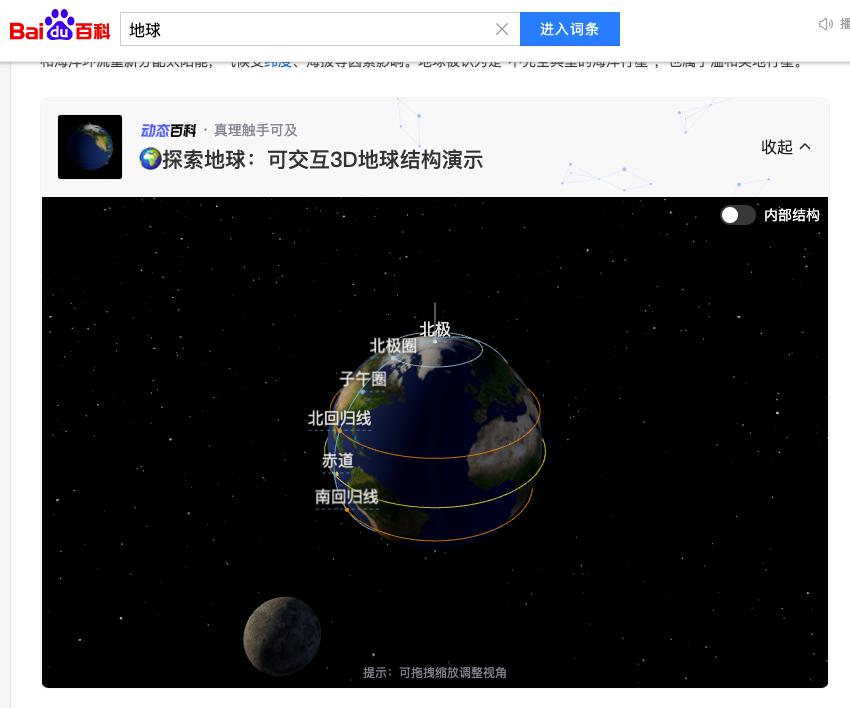
It's clear that Baidu's strategy has become matrix-like, using search as a traffic entry point, encyclopedia as a content foundation, and AI as a technology engine. In contrast, Google and OpenAI currently only have the "AI assistant" layer, lacking the support of an authoritative knowledge base like Baidu Encyclopedia that has been accumulated over a long period.
Baidu Search is also significant as an entry point. The Baidu App boasts over 700 million monthly active users, and searching is a high-frequency activity that occurs daily. Users don't need to know the concept of "AI simulation," or even deliberately use a particular function; when they enter a knowledge-based question in the search box, the interactive component automatically appears on the results page.
In other words, Baidu chose to embed interactive learning tools into users' existing habitual paths, so users can use them almost without noticing.
04
Learning is shifting from "passive observation" to "active exploration".
The actions of these three tech giants all point to a trend: AI is transforming learning from "seeing" to "doing".
It transforms abstract formulas into actionable variables and invisible physical processes into visualized dynamic images. Through this "play," students are actually building a deeper, more intuitive understanding.
Previously in China, there were professional dynamic simulation software programs that required separate download and installation before they could be used. Now, however, one can simply use large models or search on Baidu, which means there are several more convenient options available.
According to research data from Valeriu Crudu and MoldStud's team in 2024, classes using interactive 3D models outperformed those using traditional textbooks in applied exams by 31%. This is because "learning by doing" activates deeper levels of cognitive processing.
In the AI era, learning methods are shifting from "watching" to "experiencing," from "memorizing" to "exploring," and from "passive" to "active." As long as learners are interested, they can always reach their goals.
This article is from the WeChat public account "Duozhiwang" (ID: duozhiwang) , author: Wang Shang, published with authorization from 36Kr.