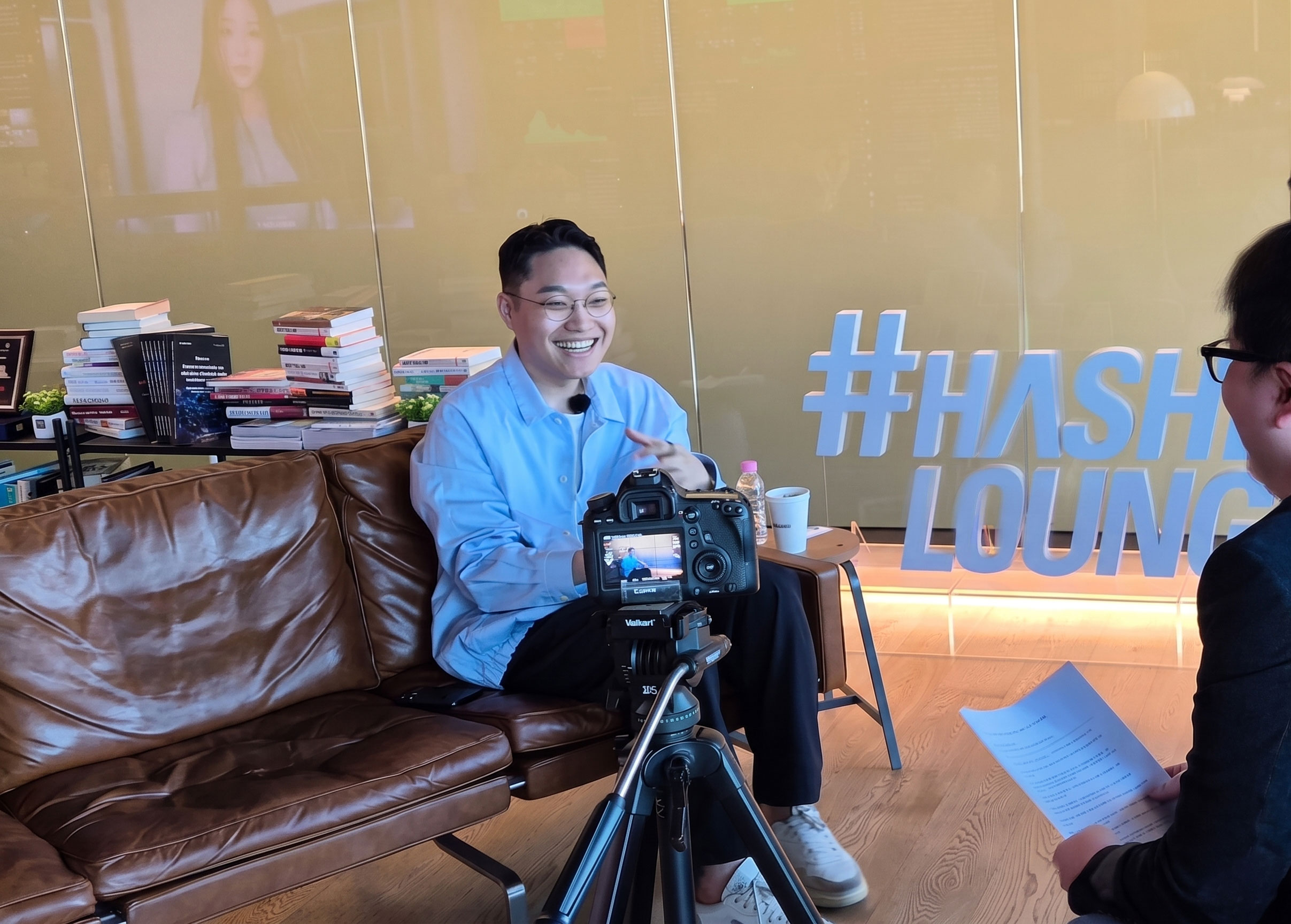
Located on the 20th floor of a building overlooking Gangnam-daero, the Hashed Open Lounge reveals circular signs on the ceiling where names like #HASHED EMERGENT and FACTOMIND shine side by side. Real-time cryptocurrency prices and news flow across a large screen on one side of the lounge, while a stage for forums and meetups is situated on the opposite side. The space itself feels like a declaration. It was here that I met Kim Ho-jin, CEO of Hashed Open Finance.
A developer by profession who graduated from a science high school and majored in Computer Science and Mathematics at KAIST. After working as a consultant at BCG, he joined Hashed and is currently quietly building 'Maroo,' a mainnet specialized for Korean Won stablecoins. He was not a man of many words, but every word he spoke was substantial.
Only 1% of the currency was moved on-chain.
CEO Kim oversees fintech-related businesses within Hashed and concurrently holds positions at two entities: Hashed Open Finance and Shard Lab, an R&D organization. The division of roles between the two organizations is simple. While Shard Lab researches core technologies such as account abstraction and handles global partnerships, Hashed Open Finance is responsible for deploying that technology into the real world in collaboration with domestic regulations and institutional players.
The critical awareness behind the launch of this organization was clear. "Currently, even US dollar stablecoins account for only about 1% of the total broad money supply (M2). Although it has grown significantly, this effectively means that only about 1% of real-world finance has been moved on-chain. We pondered why this is the case."
He identified three main causes: privacy, compliance, and governance. "In public blockchains, every transaction—including who I sent how much to whom—is made public. Can a company whose cost structure is a trade secret use blockchain in such an environment? I wouldn't use it either. Second, for Regulated DeFi to move on-chain, current laws must be applicable as they are. Third, a country's financial infrastructure is its national sovereignty and security. The entire domestic financial system must not be affected by a failure in the external network."
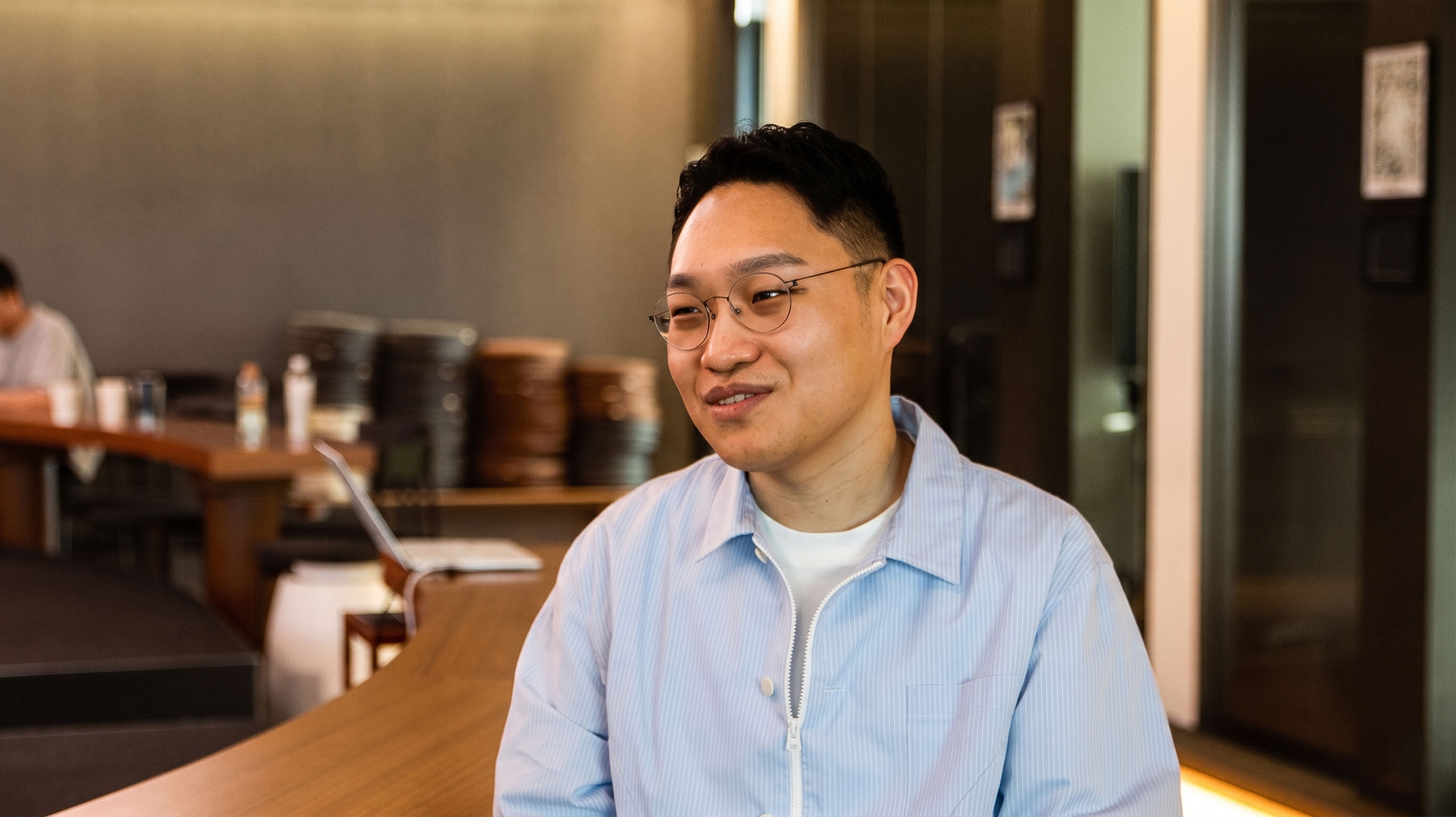
"Why Maru? ... Korea Must Be a Public Chain to Avoid Becoming a Galapagos"
The answer derived from this awareness of the problem is the mainnet 'Maru'. Maru is a Layer 1 (L1) mainnet designed in-house without relying on existing L1 networks such as Ethereum or Solana, and it features a structure specialized for Korean Won stablecoins.
Many people ask why we don't simply use private chains due to privacy concerns. CEO Kim's answer was firm. "I am convinced that we must use a public chain to avoid Korea becoming a 'Galapagos Island.' We must simultaneously resolve the limitations of the current financial sector while maintaining interoperability with other blockchains. The most difficult challenge was finding a middle ground that removes real-world constraints while preserving the inherent nature of blockchain as public and open source."
One of Maru's core design features is the use of the KRW stablecoin as a native token, without the need for a separate token. Transaction fees (gas fees) are also paid in KRW stablecoins. He explained that this design holds significance beyond mere convenience. "Blockchain is not only a financial network but also a next-generation cloud service. It is a layer that stores and executes data. The fact that KRW stablecoins are used for gas fees means that as this network becomes more active, additional demand for KRW stablecoins will naturally arise. Furthermore, we decided not to have a separate token because we believe that all participants in the KRW economy should equally share in the benefits of this public infrastructure."
Stablecoins Become Agent Currency
When asked about the potential of a Won stablecoin, CEO Kim explained the outlook by dividing it into short-term and long-term perspectives. In the short term, the Korean crypto market itself is already exceptional. "It is a market that sometimes ranks first globally in daily BTC trading volume. It is true that among non-reserve currencies, there is no other currency with as much potential as the Won."
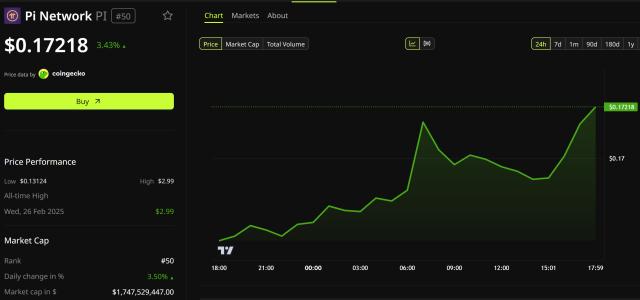
Pi Network DEX Pricing Controversy… Is the '23.8% Protection Mechanism' Paradox Growing?
View full Alpha Report →However, what he emphasized more was the long-term picture. "Ultimately, stablecoins, including the Korean Won stablecoin, will become agent currencies. Currency used by both humans and AI agents. We often say, 'You cannot build a digital economy without digital currency.' If you are trying to create an agent economy, it cannot be established without agent currency."
In this context, the fact that Korea is emerging as a frontrunner in the AI competitive landscape was also considered important. "If more LLMs, services, and applications emerge and utilize stablecoins, it creates national-level potential that goes beyond simply expanding the AI startup ecosystem. I believe that as AI advances, the importance of stablecoins will grow even more."
The Agent Economy Understood Through Automatic Airplane Ticket Payments
When explaining the combination of AI and blockchain, he gave a very specific example.
"Let's say you plan to travel to Tokyo next month and give an agent a command to handle the payment if the airfare drops below 300,000 won. However, this is more complicated than you might think. What if the price drops at 4 AM and you are asleep? The agent needs to make the payment, but you can't open up your entire account, and even if you grant them just a 300,000 won limit, they might buy something questionable. Ultimately, there are numerous issues to resolve, ranging from agent authentication and verifying that they are acting within the scope of your commands to the delegation of payment authority during that process."
He stated that this is not merely a technical issue, but a paradigm shift in infrastructure. "If the payment entity shifts from humans to agents, we must redesign the entire financial infrastructure that has been built around humans until now. This is why Maru is pursuing an AI-native chain. Our goal is to create a structure where agents are connected to my wallet and can execute autonomously within the permitted scope."
"Wouldn't it be exclusive since it's under Hashed VC? On the contrary, it's the opposite."
When asked if being an organization under the VC firm Hashed might actually restrict openness, he replied that it was paradoxical. "Because our core business is venture capital, that is actually not the case. We benefit only when the entire blockchain market grows. Rather than a single company succeeding, a successful case needs to emerge for others to follow suit and the market to expand. The purpose of this company's establishment is to serve as that catalyst."
He drew a clear line, stating that Maru cannot be viewed as Hashed's exclusive product. "We have no intention of doing anything on our own. When there is a company that wants to use blockchain to solve a problem or apply it in a certain way, we want to help turn that vision into reality. It doesn't matter whether they are a bank, a fintech company, a credit card company, or a non-financial firm."
He revealed that, in fact, Maru had kept unconditional channels of consultation open to various market players even before the announcement. He also offered a different perspective on regulations. "It is regrettable that domestic discussions seem to be focused solely on regulations. There are things that can be created and developed even if regulations are not clearly defined. If it weren't for players like Circle or Tether, these discussions wouldn't have even started in Korea. Substantive attempts also facilitate discussions on regulations."
Testnet Completed, Opening Expected in May
When asked about the current development progress of Maru, CEO Kim revealed a specific timeline. "We are already conducting internal testing on some live services, and the first testnet is complete. We are undergoing an enhancement phase that incorporates feedback from various players, and we plan to open the testnet and development toolkit to a wider audience between the end of April and May."
There is always opportunity in this change, keep building.
At the end of the interview, I asked what message he wanted to convey to investors and developers struggling in the bear market. He thought for a moment and answered slowly.
There are many people who have been in this field longer than I have, so I would not dare to offer advice. However, I can tell you one thing. We are now living in an era where things we thought would never change are actually changing. I believe this is a greater change than when smartphones were first introduced. Aren't SaaS companies, which seemed invincible, facing a crisis due to AI? Opportunities always exist within such major changes.
He concluded by once again emphasizing his conviction regarding the intersection of blockchain and AI. "The future comes regardless of the market. Technological, societal, and business progress are bound to come. I would be truly grateful if you, the builders, would devote significant effort to making the future you envision a reality. We will do our utmost to help in any way we can."
The sunset over Gangnam-daero was fading beyond the glass window. The lights at the Hashed Open Lounge began to brighten one by one.
<Copyright ⓒ TokenPost, unauthorized reproduction and redistribution prohibited>