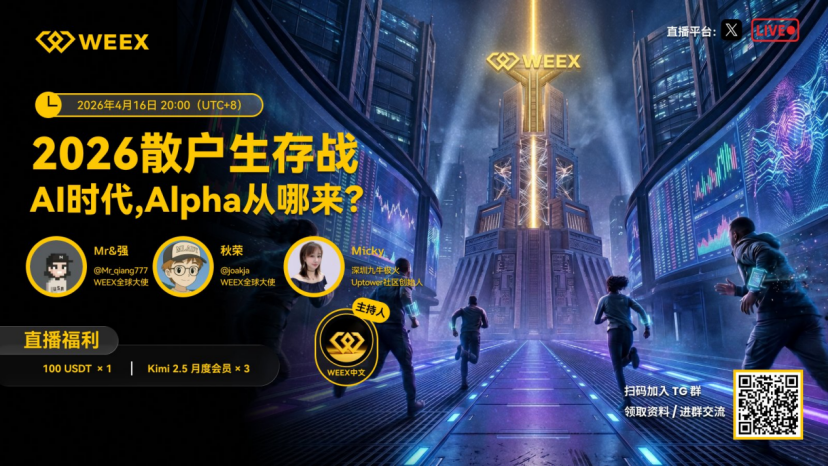
On April 16, 2026, WEEX Chinese official account hosted an online Space roundtable discussion on its social media platforms themed "2026 Retail Investor Survival Battle: In the AI Era, Where Does Alpha Come From?" Several professionals from the trading, community, and market research fields participated in the discussion. The participants engaged in a nearly one-and-a-half-hour discussion from different perspectives, focusing on the changes in trading logic, the boundaries of risk management, and the future development path of the industry in the context of the rapid popularization of AI technology.
Unlike previous short-term discussions surrounding market trends or strategies, this discussion was more of a systemic reflection on whether trading rules are being rewritten . Several guests agreed that AI has moved from its early conceptual stage to practical application and is gradually changing the way people participate in the market. At the same time, the core of trading competition is shifting from "acquiring information" to a contest of abilities to "understand information and execute decisions."
The information gap is disappearing; new advantages come from cognition and execution.
In traditional trading environments, the speed of information dissemination often determines profit opportunities. However, with the widespread application of AI tools, the efficiency of market information acquisition and data processing has significantly improved, enabling ordinary users to quickly acquire and organize large amounts of information. The direct result is that trading models that relied on "information asymmetry" are gradually weakening.
Several WEEX guests pointed out in the discussion that while AI has indeed achieved some degree of "equal access" to information, it has not eliminated risks or changed the nature of the market. The factors that truly determine long-term performance remain concentrated at the execution level, including fundamental capabilities such as position management, stop-loss discipline, and emotional control.
In other words, as more and more people use similar data sources and analytical tools, market differences will no longer come from "who knows faster," but from "who makes more reliable judgments" and "who executes more rigorously." This change also means that trading advantages will be more reflected in cognitive systems and risk control capabilities, rather than in a single technical tool itself.
AI will change "how you see" first, rather than "how you do it".
Regarding the practical application of AI in the trading field, this discussion reached a relatively clear consensus: AI will first restructure the information processing process, rather than directly replacing trading decisions.
Currently, most AI tools still focus on functions such as data processing, indicator analysis, and information summarization. Their advantages mainly lie in improving information processing efficiency, rather than completely taking over trade execution. To truly achieve fully automated trading, several complex issues need to be addressed, including the boundaries of responsibility, risk control, and strategy stability.
Some guests mentioned that while the transition from "auxiliary analysis" to "automatic order placement" may seem like a small step, it involves more than just technological capabilities. It also includes compliance requirements, system security, and users' risk tolerance. Therefore, in the foreseeable future, AI is more likely to become a "helper" rather than a "replacement" for traders.
This "semi-automated" state is also considered to be the main form of the market for a considerable period of time to come: humans are responsible for the final decision-making, and AI is responsible for providing support.
The technical barrier is decreasing, but the cognitive barrier is increasing.
Another frequently mentioned topic is the impact of AI on the barrier to entry for ordinary users.
From an operational perspective, AI has indeed significantly reduced learning costs. For example, by generating strategies and ideas through natural language and automatically filtering market information, it enables more users to enter the market environment more quickly.
However, the increase in information volume has also brought new challenges.
When a large number of similar analytical results appear in a short period of time, users are more likely to fall into an "information cocoon" or over-rely on a single judgment model, thus ignoring the market changes themselves.
In this context, the real threshold has not disappeared, but rather shifted.
In the past, the barriers might have been technical skills or experience, but now they are more likely to be related to judgment and risk awareness.
Several participants in the discussion cautioned that AI's output is essentially still a probabilistic judgment, not a deterministic result. If users treat it as an absolute answer and ignore their own responsibility for decision-making, it may actually amplify the risks.
As AI becomes a market tool, security and trust become even more important.
As AI is increasingly used in trading and information dissemination, security issues have become an important part of the discussion.
In recent years, there have been cases in the market where AI is used to generate fake news, simulate market sentiment, and even carry out phishing attacks, which have increased the difficulty of identification to some extent.
During the discussion, several guests emphasized that future risks may come not only from market fluctuations themselves, but also from the authenticity of information sources and the transparency of algorithmic decision-making.
When users cannot clearly understand the judgment logic of AI, the decision-making process can easily become a "black box," which will place higher demands on the market trust mechanism.
Therefore, both platforms and users need to establish a more robust risk management system.
For users, maintaining multi-source verification, avoiding emotional trading, and adhering to basic risk control principles remain the most effective security strategies.
For trading platforms, strengthening the identification of abnormal behavior and improving information transparency and risk warning capabilities are considered to be key directions for future development.
The relationship between AI and exchanges is evolving from a tool to an ecosystem.
In the final stages of the discussion, the topic gradually shifted to future cooperation models within the industry.
Participants generally agreed that the value of AI in the next stage of the transaction field will not only be reflected in the functions of a single product, but more likely in the collaborative capabilities of the entire service system.
For example, personalized news feeds, intelligent risk alerts, and more user-friendly trading tools are all seen as areas with real-world application potential. At the same time, the way content creators, community organizers, and platforms interact may also change due to the application of AI technology.
This change means that future competition will no longer be just about technology, but about ecological capabilities.
Whoever can better integrate data, content, and user needs is more likely to establish a long-term advantage in the new market environment.
In the age of AI, discipline remains the most scarce skill.
The WEEX Space discussion sent a clear signal:
AI is changing the way we trade, but it hasn't changed the nature of trading.
No matter how advanced the technology becomes, the market is always driven by human participation and decision-making, and the outcome is determined by risk management capabilities.
As information becomes increasingly easy to obtain, the truly scarce abilities become calm judgment and long-term execution.
For ordinary users, AI can be an important tool for improving efficiency, but it should not become a substitute for thinking.
For the industry as a whole, how to maintain a balance between technological innovation and risk control will become one of the key issues for future development.