Author: Zhou, ChainCatcher
This month, another suspected price manipulation incident in the crypto market has surfaced. The RAVE token started at about $0.25 on April 8 and soared to about $26 to $28 in just ten days, with its market value once exceeding $6 billion and briefly entering the top 20 globally.
Subsequently, blockchain detective ZachXBT posted accusations of insider manipulation and called on three leading exchanges to intervene in the investigation.
As of press time, RAVE has fallen to around $0.50, a drop of more than 98% from its peak, and its market capitalization has shrunk from a peak of over $6 billion to around $130 million .
What exactly happened behind this surge and plunge?
Timeline: From a surge to a 95% flash crash
RAVE is the native token of the RaveDAO project. This project focuses on the Web3 offline entertainment sector, aiming to bring electronic music events to the on-chain world through blockchain technology. Users can use RAVE tokens to purchase tickets and participate in governance. The project also regularly holds offline events in Singapore, Dubai, Hong Kong, and other locations.
On-chain data shows that wallets associated with the project's deployers transferred a large number of RAVE tokens to Bitget about 10 hours before the price surge, when the token price was still below $0.50 and there were no official announcements or information disclosures.
Meanwhile, about 74% of traders on Binance held short positions, indicating a general lack of confidence in this illiquid token.
Subsequently, insiders withdrew a large number of tokens deposited in Bitget, and the selling pressure on the exchange disappeared instantly. Short short, now without counterparties, began to be forced to liquidate their positions. For every cent the price rose, more short sellers were forced out of the market, creating a mechanical cascading buying effect.
From April 8th to April 18th, RAVE completed its upward journey from $0.25 to approximately $26 , an increase of over 10,000%. The daily liquidation volume in the derivatives market reached $44 million, second only to Bitcoin and Ethereum.
According to ZachXBT's timeline, he sent a private message to the co-founder of RaveDAO on April 13. The message was read 8 hours later, but no reply was given.
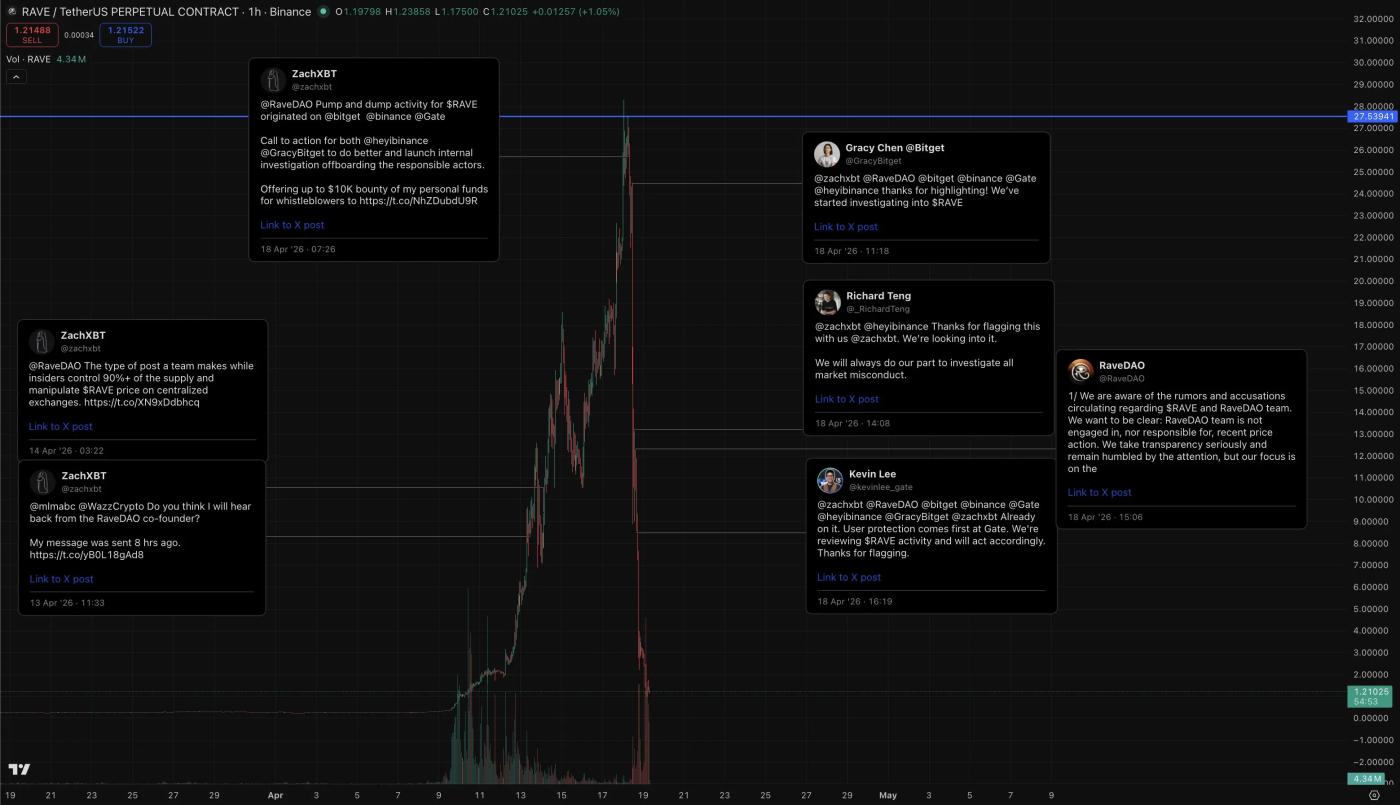
At 7:26 AM (UTC) on April 18, ZachXBT publicly posted on the X platform, accusing RAVE of insider manipulation and naming Bitget, Binance and Gate exchanges, calling on each platform to launch an internal investigation.
In his post, he listed nine wallet addresses associated with the initial token distribution, claiming that these addresses collectively controlled approximately 95% of the RAVE supply. He also reconstructed the complete transfer chain before the pump, pointing out that this was a typical "short squeeze" operation.
In addition , ZachXBT offered a $10,000 bounty to encourage insiders to provide evidence, which was later increased to $25,000. He also stated that he did not hold any RAVE positions.
The post received a flurry of responses from various parties on the same day it was published.
- At 11:18 AM, Bitget CEO Gracy Chen was the first to confirm the launch of an internal investigation, replying, "Thank you for the tip, we have begun an investigation into RAVE."
- At 2:08 PM, Binance CEO Richard Teng followed up, stating, "We are investigating and will continue to review all market misconduct as always."
- At 15:06, RaveDAO issued an official denial statement.
- At 4:19 PM, Gate's Kevin Lee also announced a review, emphasizing "user protection as a priority."
The swift statements from the three exchanges have, to some extent , accelerated the collapse of market confidence . RAVE has now fallen to around $ 0.50 , a drop of more than 98% from its peak.
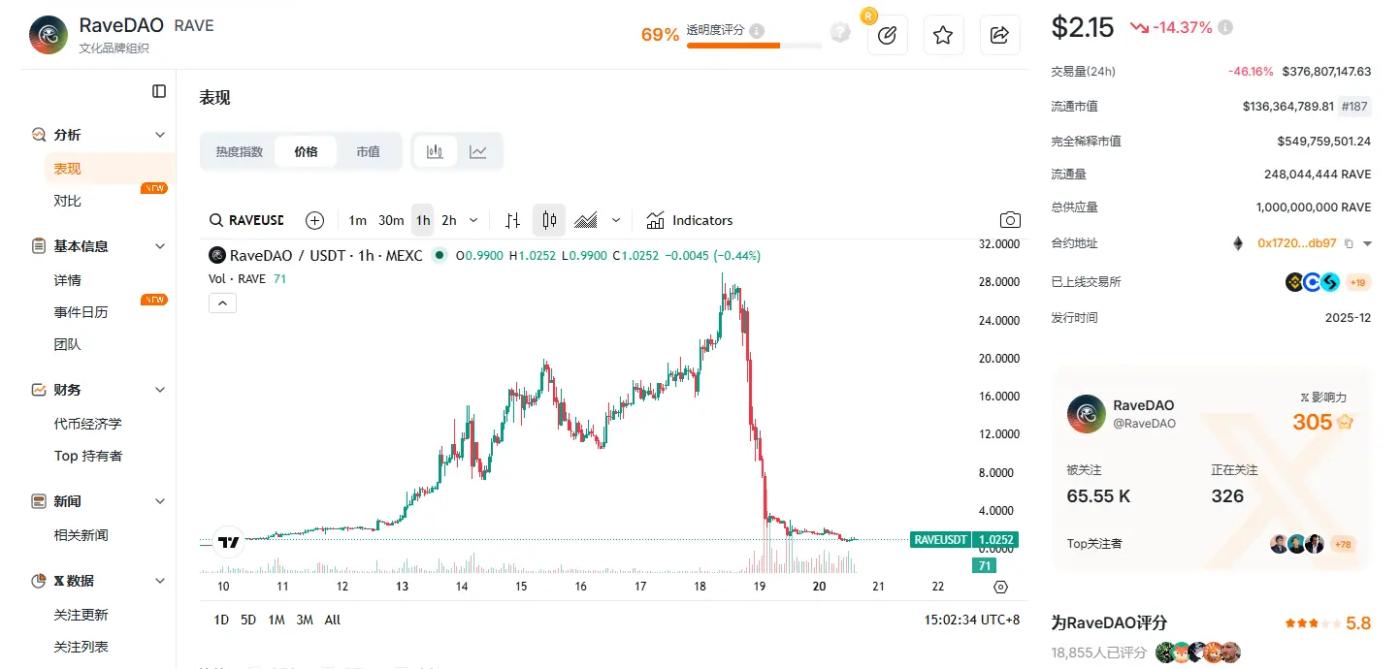
Image source : RootData
Project team's response and community concerns
What angered the community even more was the content of the statement released by the project team during the collapse.
RaveDAO issued multiple denial tweets, clearly stating that the team did not participate in price manipulation, emphasizing that the project's long-term mission is to promote on-chain adoption in the live streaming and music fields, and plans to explore token locking mechanisms triggered by price or performance, using a portion of the activity profits for operations, marketing, and charitable donations.
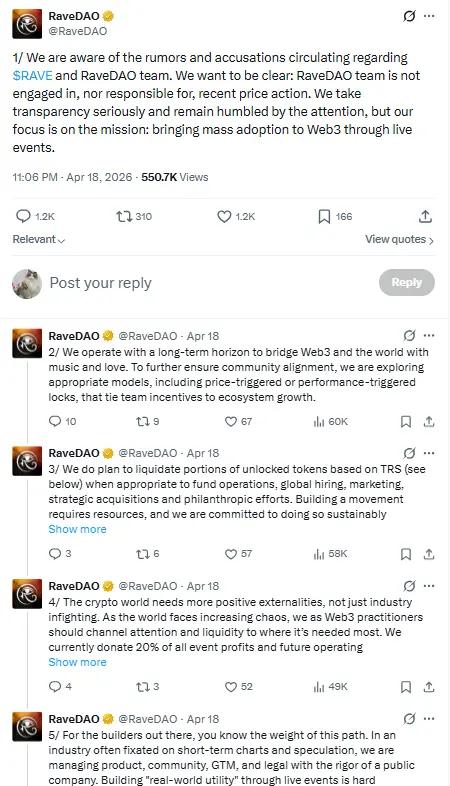
The statement did not directly address any specific on-chain allegations made by ZachXBT , leading to an almost unanimous wave of mockery in the community comments section.
In a subsequent update, ZachXBT pointed out that after the crash, the team's multi-signature addresses continued to deposit large amounts of RAVE into Bitget, causing the price to drop again by about 40%, indicating that the cash-out activity had not stopped.
In addition , ZachXBT also listed several projects, including SIREN, MYX, COAI, and PIPPIN, with similar suspected abnormal pricing behavior, suggesting that this may be a replicable trading template.
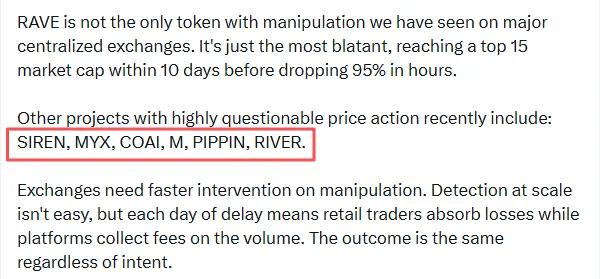
Source : ZachXBT tweet
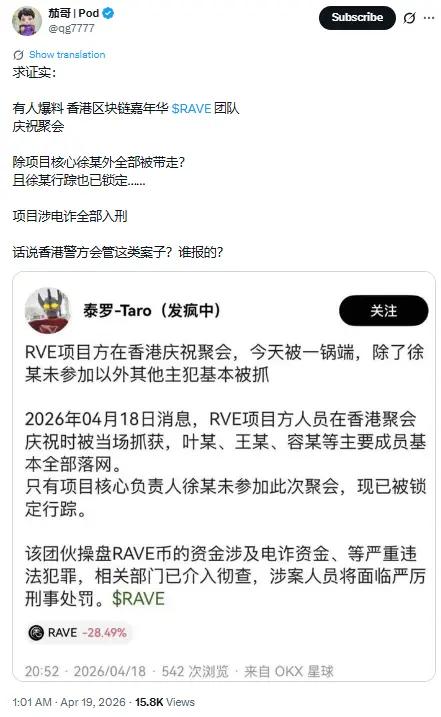
During the incident, a rumor circulated in the community. According to a post by user @qg7777 seeking verification, the RAVE team was taken away by police at a celebration party, with the exception of Felix Xu, and the post implied that the project might be involved in telecom fraud. However, as of now, this claim has not been confirmed by police announcements or mainstream media.
Team background comes to light
As the incident unfolded, the background of the project team was thoroughly investigated by the community.
According to well-known crypto KOL @FabianoSolana, there are three key figures behind RaveDAO.
- Felix Xu (@felixmxu): Co-founder of RaveDAO , a graduate of NYU Stern School of Business, was selected for Forbes Asia's 30 Under 30 list. He previously founded ARPA Chain and Bella Protocol, and co-founded the quantitative hedge fund ZX Squared Capital. His early projects received support from Binance Labs (now renamed YZi Labs).
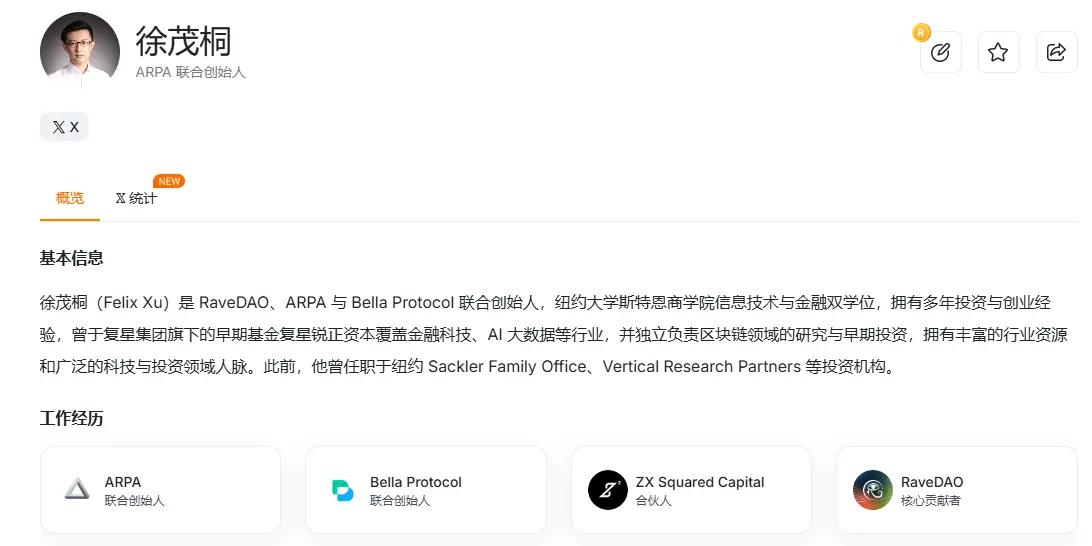
Image source : RootData
- Yemu Xu (@wildwoodmoo): A core contributor and long-term partner at Felix (co-founder of multiple projects). He deliberately remained anonymous for the RAVE project and has almost completely disappeared from the X platform since February.
- Ronald Elliot Yung (@elliot_yung): Spokesperson, responsible for answering media interviews.
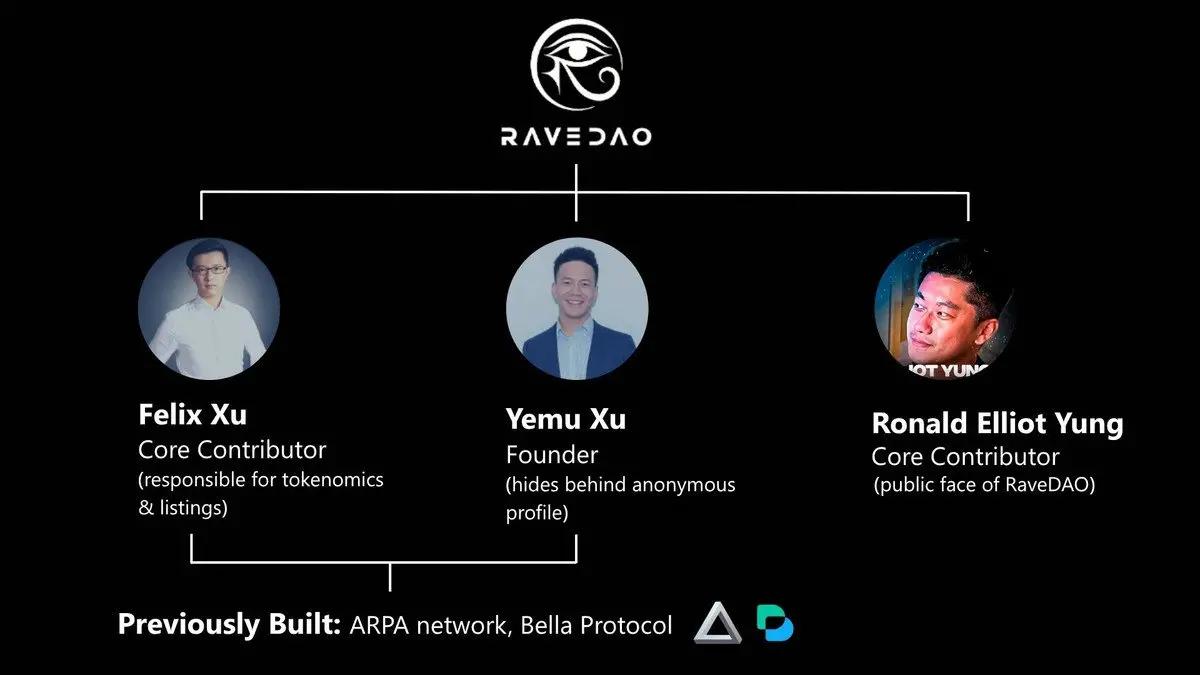
Image source : X user @FabianoSolana
The community views RAVE as the team's third project, and the questions focus on one point: with such a highly concentrated supply, how can prices rise " organically " to a market capitalization of over $6 billion?
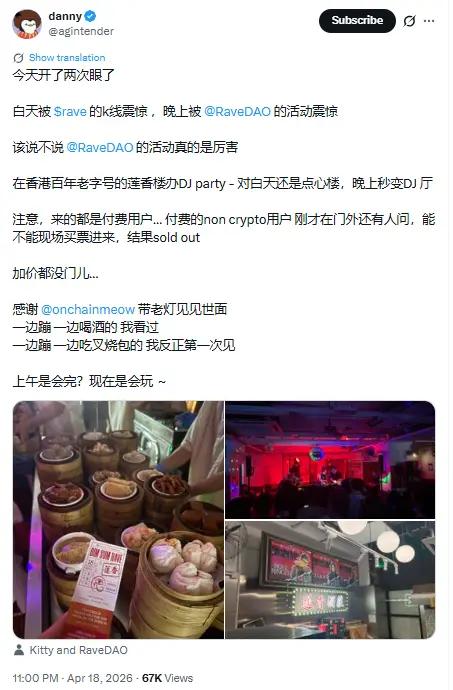
It's worth mentioning that, according to community sources, on the day of the collapse, the project team held an offline event at Lin Heung Tea House, a century-old establishment in Hong Kong. The restaurant, a traditional dim sum restaurant by day, transformed into a DJ party venue at night. Reportedly, most participants were paying users outside the crypto industry, and tickets were extremely difficult to obtain. Many joked that this was a "victory celebration after the sale."
Reflections on the Role of Exchanges
The three exchanges' attitude in their investigation is commendable, but one question still needs to be addressed.
Felix Xu's team has two previous publicly documented projects: RAVE, which exhibits extremely concentrated token distribution and an abnormally low circulating supply—both publicly available on-chain information. Shouldn't a compliant exchange have identified these issues during the listing review process?
Crypto exchage primarily generate revenue from transaction fees and listing fees. A highly volatile and popular token can bring substantial trading volume to a platform. Does this business logic constitute an inherent motivation to ignore potential risks?
The swift response from exchange executives like Gracy Chen and Richard Teng is certainly a positive sign, but "we are investigating" is just the beginning, not the final answer. The losses already suffered by retail investors will not be automatically refunded simply because an investigation has begun.
In this farce , it is an individual, ZachXBT, who plays a kind of public oversight role in a regulatory vacuum. This also exposes another side of the market: when a post from an anonymous detective can be more effective than institutional protection, where exactly is the investor protection mechanism in the crypto market?
However, ZachXBT himself is also controversial. Well-known crypto KOL @jason_chen998 bluntly stated that ZachXBT was once hailed as a champion of justice in the crypto, but after events such as liquidating his own namesake token for approximately $5 million and the Polymarket insider trading scandal, his so-called righteous persona is no longer believable. Placing all hopes for market fairness on one person is neither fair nor realistic.
Renowned crypto KOL "Big Lion from Australia " stated that his support for ZachXBT's intervention stemmed from RAVE's clearly excessive manipulation. He pointed out that similar market-making projects have existed in the past, such as Myx, River, and Siren, where the operators typically withdrew when profits were nearly realized, maintaining a tacit understanding. RAVE's problem lies in its far greater greed than usual; allowing such behavior to continue could pose a significant systemic risk to the entire market.
Perhaps what the crypto market truly needs is to translate what ZachXBT did into institutional arrangements: stricter listing review standards, more transparent disclosure of token allocation information, and more binding exchange monitoring mechanisms. Only in this way can extreme volatility like that of RAVE be better controlled at its root.
The situation is still developing, and the investigation results warrant continued attention. For ordinary investors, this case serves as a reminder that carefully examining the circulating supply, team background, and unlocking arrangements is always crucial for protecting their assets when participating in highly volatile new projects.