Only 7% of the top 100 games have supported NFT leasing, and players rent NFT mainly to reduce costs or increase chances of winning.
Original title: " NFT Rental in Web3 Gaming "
Written by: Double Protocol, Winkrypto
Compilation: Frank, Foresight News
The main points:
- Most of the users in the Web3 gaming space come from a few top games;
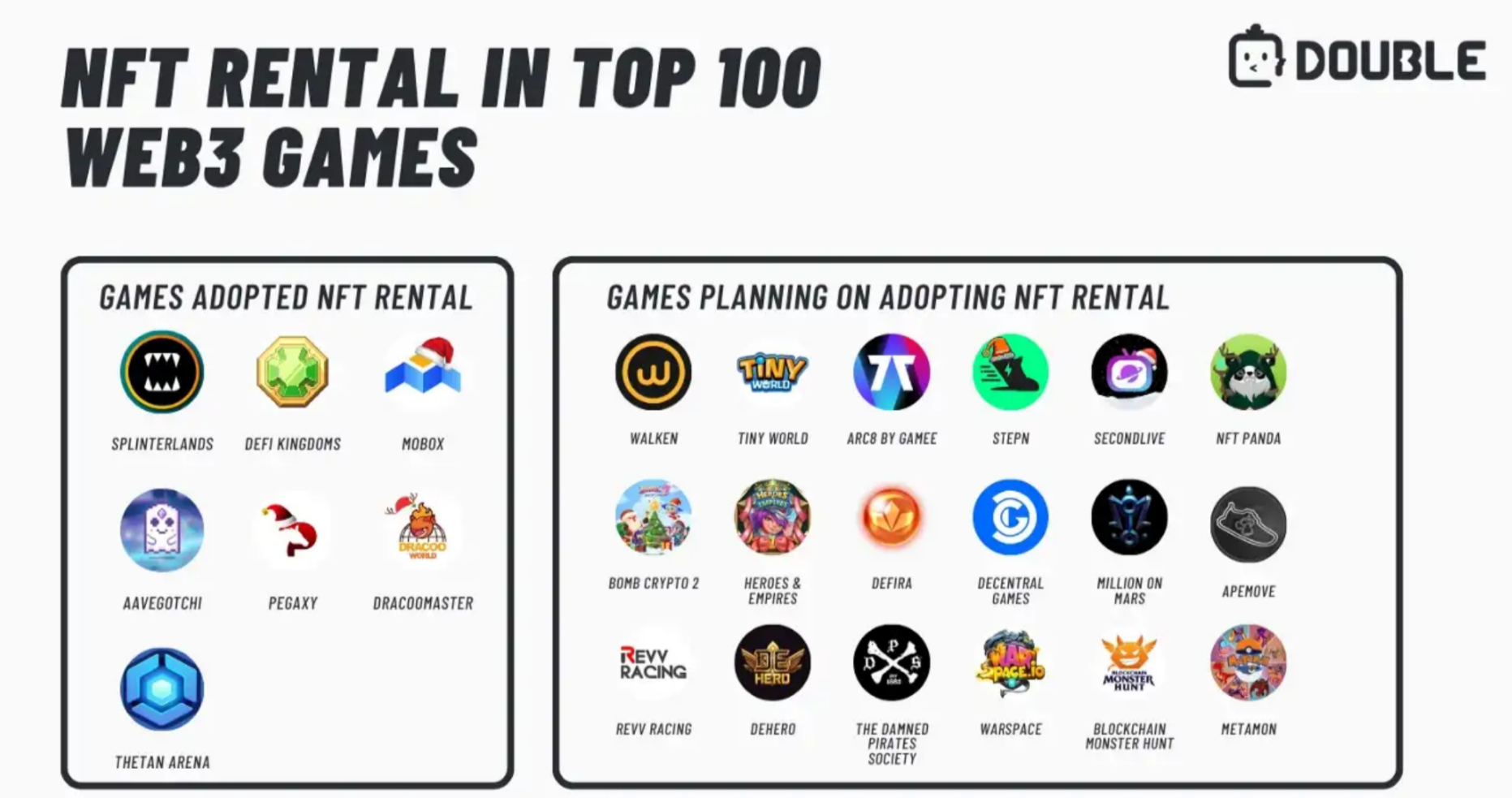
- Among the top 100 games, 7% support NFT rentals, and 18% plan to adopt this model;
- The main reason for gamers to use leasing is to reduce costs and increase the chance of winning in NFT games by using or combining NFTs;
- Barriers to game developers adopting their own rental marketplace include technical hurdles, lack of prioritization, or counter-intuition;
The mission of Web3 games is to enable gamers to own and sell in-game assets truly hassle-free, but it doesn't stop there, as digital assets become more and more like real-world assets, gamers will be able to Various other categories of financial transactions, and this begins with leasing.
In this article, we will explore the following questions:
- How many games have adopted, want to adopt or plan to adopt NFT rental function?
- What is the rationale behind renting out these game assets?
- What are the barriers for game developers to adopt their own rental marketplace?
Users are concentrated in a small number of top games
The data source we chose is metadata.io's ranking of the games with the highest daily average 30-day unique active users on June 12, 2022. Before looking at the rental data in these games, we should first understand the attributes of these games.
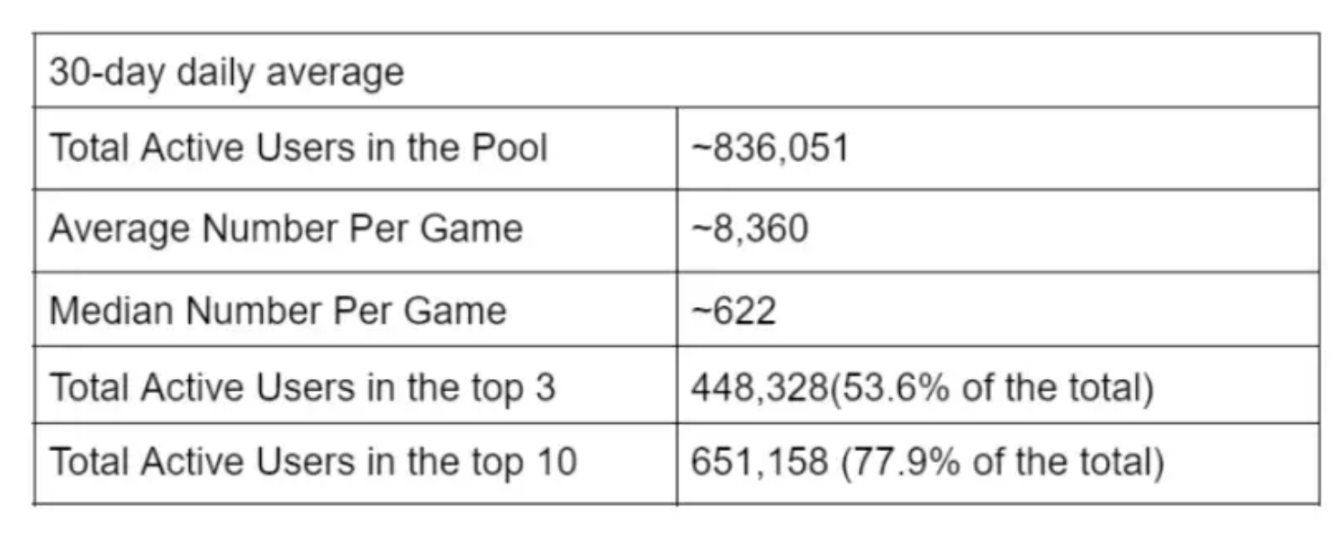
From the data in the above figure, it is clear that in terms of users, the GameFi project winner takes all, and the users of the top three games account for more than half of the total users. By looking at the difference between the median and the average, we can see that Most users come from a small group of top games.
Blockchain network distribution
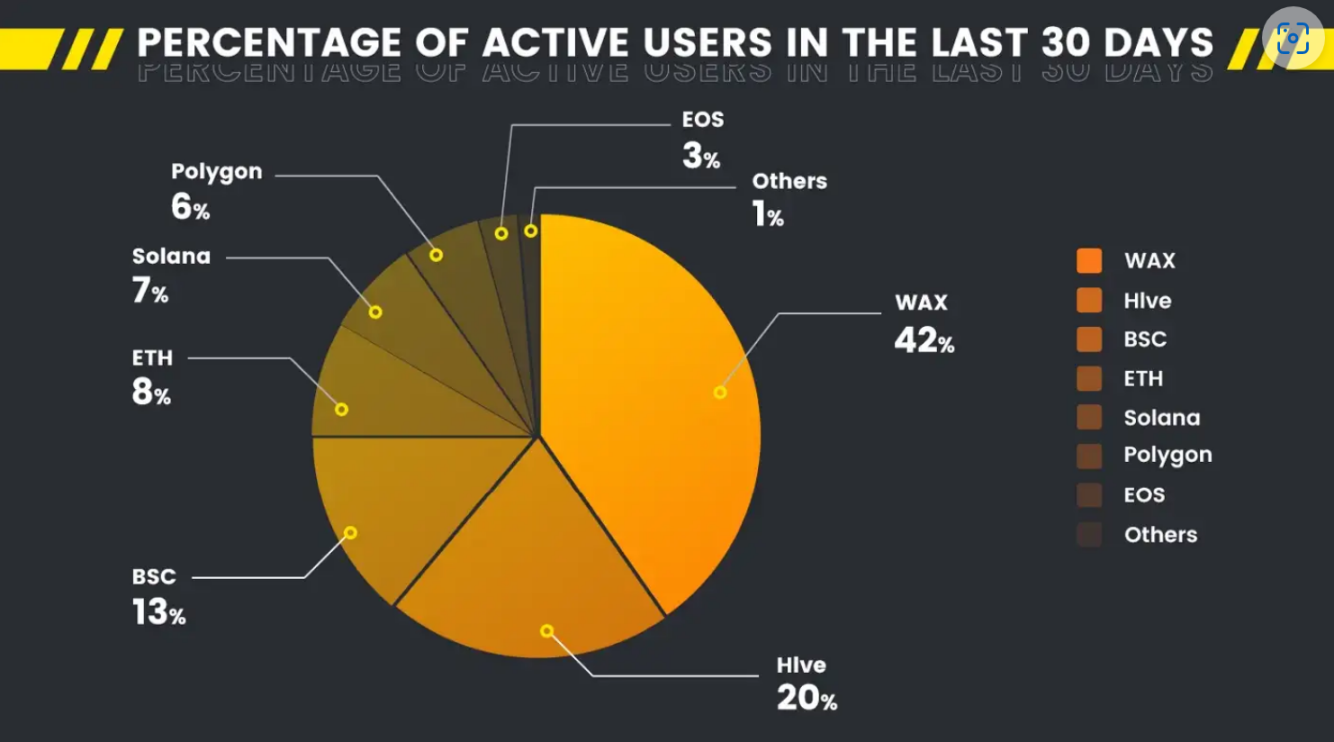
In terms of ecosystem performance, no single player seems to dominate, but WAX, BNB Chain, Polygon, and ETH appear to be the leading GameFi blockchain networks among them.
25% of games have or will feature NFT rentals
We then investigated whether the games in the corresponding data had an NFT rental feature, and if not, whether they had plans to implement this feature, documenting it in their roadmap, white paper, etc.
Therefore, they can be divided into three categories:
- Have your own NFT rental marketplace/function: 7%
- Haven’t implemented NFT leasing yet, but have publicly expressed interest or committed to doing so in the future: 18%
- Haven't implemented NFT leasing yet, and haven't publicly expressed interest or made a commitment: 75%
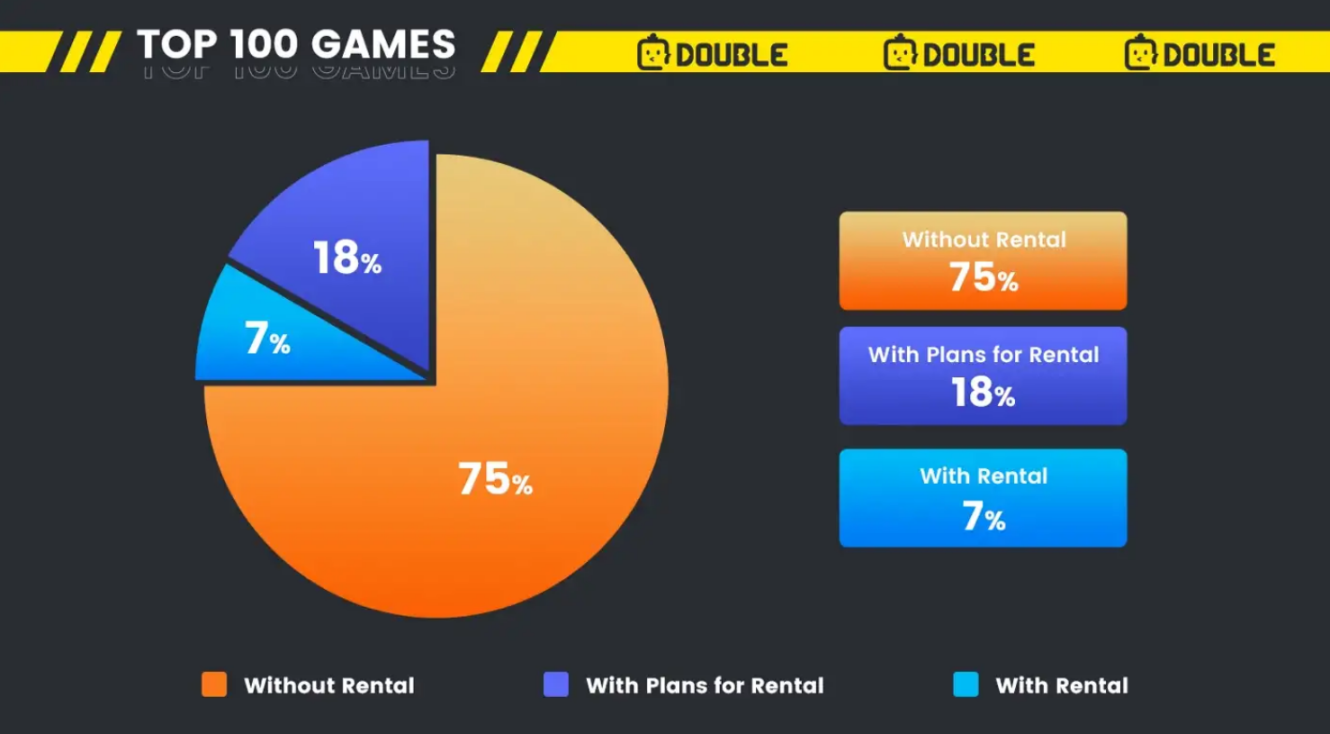
While rental games appear to be a minority, we also looked at the share of players in each of these categories, and rental games also represent a disproportionate share of the player base relative to the number of games in existence (20.4% ).
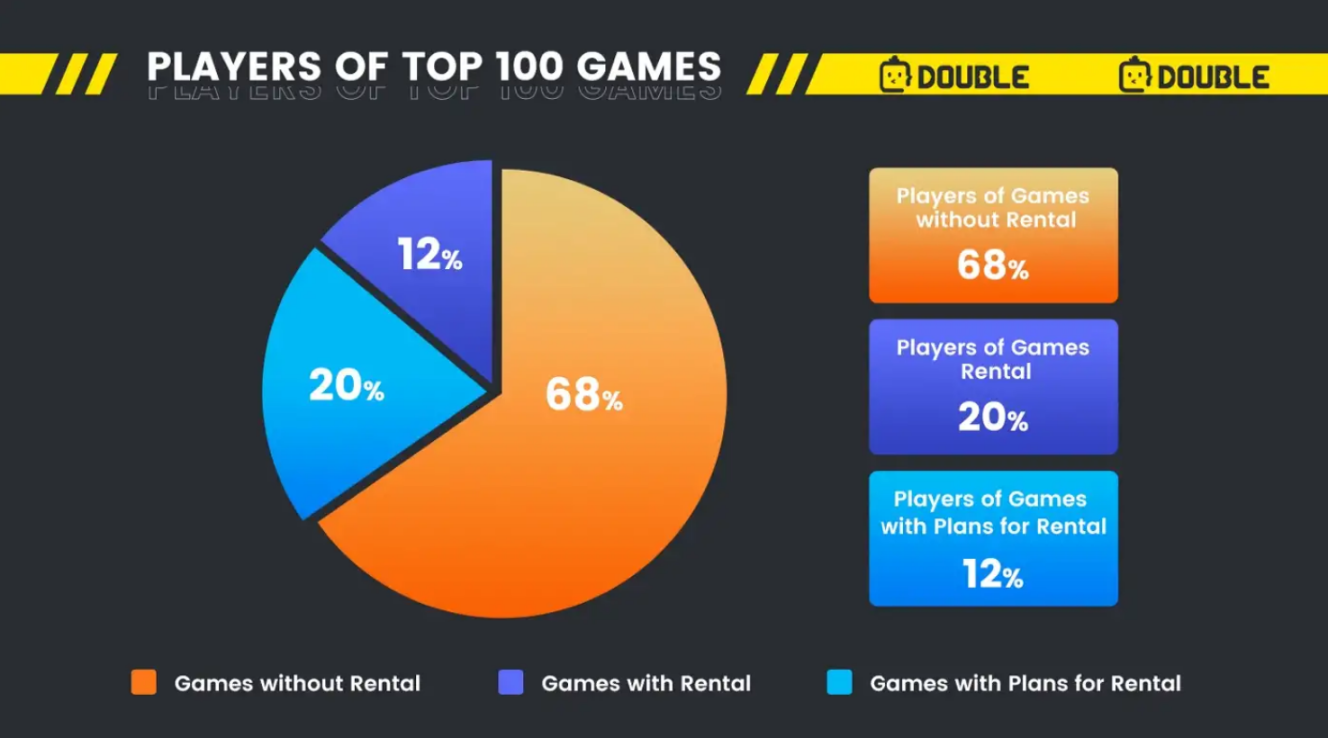
One possible explanation is that leasing may make in-game NFT assets more accessible to new players who would otherwise be reluctant to purchase an NFT directly to play the game.
Another possible explanation is that once a game's player base reaches a certain level, game developers are more motivated or able to build an NFT rental market.
The main reason for gamers to use leasing is to reduce costs and increase the chance of winning in NFT games by using or combining NFTs.
Reasons to Leasing NFTs: Reduce Costs or Increase Chances of Winning
1. Splinterlands
overview
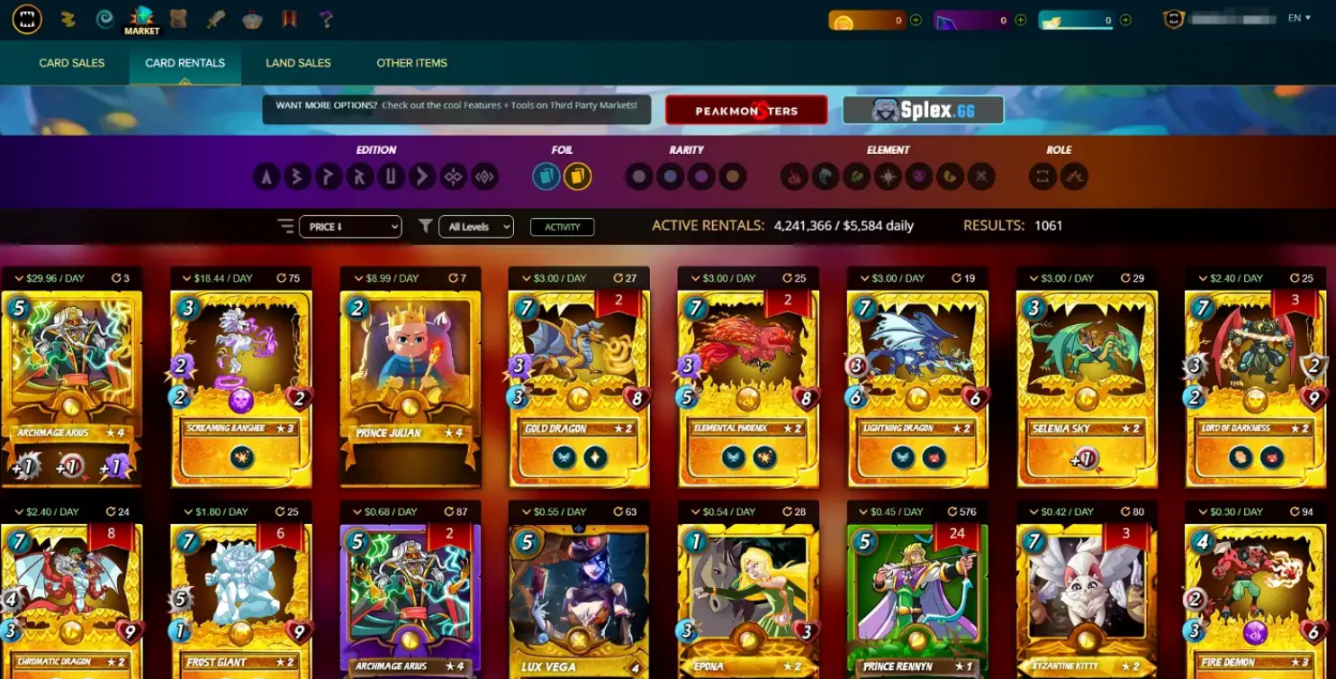
Splinterlands is an online collectible card game using blockchain technology, where each card in the game is available as a tradable NFT. Players can earn income in the game through tournaments, ranking matches, and missions, and game card NFTs can be purchased and rented through third-party online marketplaces.
Advantages of renting in games compared to buying/trading
- Daily missions: gamers need to play different factions (water, fire, earth, etc.), but don't have to have enough cards to play each faction, but can choose to rent cards to complete the mission;
- Brawl Rentals — brawl (guild fighting): this may have certain restrictions on their battles, and in order to participate in these activities, it is necessary to use a niche card that gamers are less willing to buy;
- Experimentation: Players have the opportunity to try out new builds and combinations with cards they don't own before committing to a purchase.
2. DeFi Kingdoms

overview
DeFi Kingdoms (DFK) is a browser-based pixel art game built on the Harmony network that combines DeFi functionality with game elements. Its DEX uses the Uniswap V2 protocol to enable users to exchange tokens and provide liquidity to earn fees.
Advantages of renting in games compared to buying/trading
- Summoning: Summoning a hero requires two heroes, players can own them, but they can also rent heroes to summon new heroes;
- Reduce the cost of summoning new heroes: The cost of summoning is linked to generations, so if gamers have heroes of a higher generation, they can use one of your heroes to rent a hero of a lower generation at any time, thereby reducing the cost of summoning. In many cases, even if the game player pays a certain amount of JEWEL to the owner of the rented hero, renting a hero of a lower generation is more economical than using a hero of a higher generation, such as a hero of the 5th generation;
- Maximize the chances of getting good heroes: Gamers can rent premium heroes to use alongside their own heroes, which can have a better chance of getting higher quality heroes.
3. MOBOX: NFT Farmer

overview
MOBOX: NFT Farmer, listed on BNB Chain in early April 2021, describes itself as a unique infrastructure built on top of the DeFi ecosystem and combines it with games through NFT. The GameFi infrastructure uses liquidity pools, liquidity mining, and NFTs to find the best revenue strategy for users and generate unique NFTs that can be used in multiple games, which enables MOBOX users to play games for free and earn money in the process.
In addition, MOBOX is also a game DApp, in which players can pledge LP tokens or stable coins and get rewards in the form of liquidity mining tokens KEY. KEY can be used to unlock NFT, which can be used as game characters or mortgage assets in the MOBOX platform.
NFTs play a vital role in the MOBOX ecosystem as users require MoMo NFTs to become active in the MOBOX ecosystem.
Advantages of renting in games compared to buying/trading
- Players can get gold coins by putting MOMO in the MOMO vault. The output of normal quality MOMO is low, while the gold coin collection speed of rare quality MOMO is generally above 100 pieces per minute. If there is a shortage of gold coins, renting MOMO is considered the fastest and safest method;
- Gamers can participate in a loot feature, similar to Clash of Clans. Rented MOMOs usually have relatively high stats, and are a good choice if the gamer is new to the game and wants to consistently win loot.
4. Thetan Arena

overview
Launched in December 2021 by Wolffun, Vietnam's leading game company, Thetan Arena has received investment from venture capital institutions such as Animoca Brands and is backed by the game association YGG.
It is one of the largest MOBA (multiplayer online battle arena) games on BNB Chain, combining free games and game earning modes, with two types of tokens - Thetan Coin (THC) and The Gem (THG), Players earn THC or THG by participating in battles or completing other tasks.
Advantages of renting in games compared to buying/trading
- Earn gTHC through daily battle loot;
- Earn Power Points to upgrade gamers' NFTs;
- Opportunity to attend special upcoming events.
5. Aavegotchi

overview
Aavegotchi is a DeFi-enabled encrypted collectible game developed by Singapore-based Pixelcraft Studio, allowing gamers to stake NFT avatars with tokens of interest and interact with the Aavegotchi Metaverse, a unique combination of DeFi and NFT.
Aavegotchis are pixelated ghosts living on the Ethereum network, powered by the ERC-721 standard, their value is determined by rarity, and the rarity level is calculated by a variety of factors, such as basic characteristics, number of pledged collateral / aToken and equipped with wearable devices.
To level up Aavegotchis, gamers can participate in a variety of events, including mini-games, governance, and parties, and Aavegotchis can also increase in rarity by equipping in-game wearables and upgrades.
Advantages of renting in games compared to buying/trading
- Players can collect tokens in the game to mint golden altars, and players without ghost NFTs can rent them from the rental market to enter the game;
- Buying an Aavegotchi typically costs around 400 GHST, while renting it costs a small amount of less than 1 GHST (see Aavegotchi rental data ).
6. DracooMaster

overview
Dracoo Master is a strategic roguelike deck building game on BNB Chain, Dracoo's card arrangement allows gamers to realize endless possibilities in Sacred Peak real-time multiplayer online competitive game. In Dracoo Master, there are functional tokens BAS and governance tokens DRA, gamers can use BAS tokens to breed Dracoos and create summoner equipment.
Dracoo Master players can also collect DRA tokens through adventures and battles in the game. At the same time, players can collect and evolve different types of Dracoos, and obtain DRA tokens through battles. Dracoo NFT can be traded on the NFT market.
Advantages of renting in games compared to buying/trading
- For users who are not blockchain players, they can use legal currency to rent Dracoo NFT to play games during in-app purchases;
- Renting NFT with fiat currency not only lowers the threshold for playing blockchain games, but also is a more economical way for users who cannot afford NFT in certain regions.
7. Pegaxy

overview
Pegaxy is a P2E PVP style horse racing game where gamers can compete with 14 other horse racers for the top 3, each race has random element variables including wind, water, fire, speed and more.
Using strategic upgrades, food, and skills, players must be in the top 3 to earn the platform's utility token, VIS (Vigorus). In-game, players can breed, merge, rent, sell, and race their Pega to earn VIS tokens, a system that enables teams to build large guilds and scholarship programs, and even offers solo players access to in-game rewards through daily competitions. Token opportunity.
Advantages of renting in games compared to buying/trading
There are three types of leases in the Pegaxy game, which are fixed leases, profit sharing, and direct leases.
- In a fixed lease scenario, once the lessee accepts the agreement and the Pega is in the escrow wallet, the owner will receive a fixed amount of PGX from the escrow account, but will not be able to redeem their Pega within a fixed period of time to ensure that the lessee is in a fixed amount of PGX. Redeem Pega during the lease period;
- The profit sharing model incentivizes hard work while reducing manager/owner workload. Scholars/Renters can access NFTs for a lower fee than the fixed rental option, but share some of the profits with the Manager/Owner;
- The direct rental system is designed specifically for guilds, allowing managers to create rental contracts which can then be sent directly to scholars for them to accept.
Pegaxy enables massive rental programs and guild growth through an in-game economic model, creating a wide range of opportunities for those who want free access to the game.
What are the barriers for game developers to adopt their own rental marketplace?
While the advantages of allowing gamers to be able to rent NFTs to play games instead of buying them are clear, it is clear from our observations that games with this feature are still in the minority.
Here are a few possible explanations for why more games haven't launched their own rental market:
technical barrier
NFTs based on the ERC-721 and ERC-1155 token standards are generally not available out of the box and are only transferable. While it is possible to lease them out without collateral, doing so can be tricky and take a long time to develop.
For this reason, we released new token standards ERC-4907 and ERC-5006, which are extensions of ERC-721 and ERC-1155 respectively, simplifying the process.
lack of priority
Almost all games using NFTs are relatively new projects, with new features rolling out every month. With the NFT rental feature, there are a million different tasks to complete: new gameplay, server maintenance, bug fixes, etc.
For some games, developers also have to address other priorities before implementing something like a rental marketplace, especially if the benefits aren't fully understood yet.
counterintuitive
The role of NFT and cryptocurrencies in games is to "enable real ownership of game assets". Of course, for leasing, there is no exchange of ownership. Therefore, for mainstream gamers and game developers, although NFT and block On-chain ownership may be one leap forward, but NFT-based leasing is another cognitive leap built on top of it that could affect its adoption.
epilogue
Games that employ rentals generally have more user engagement and capture a disproportionate share of active users. Because leasing makes NFT more accessible and affordable for new users who are not yet willing to invest a lot of money before buying game digital assets.
Experienced users may choose to rent specific cards or game components for an event, which may also be because NFT rentals allow players to try certain play combinations and builds before committing to a purchase.
Regardless, we expect NFT rental adoption to grow steadily alongside NFT-based games themselves.