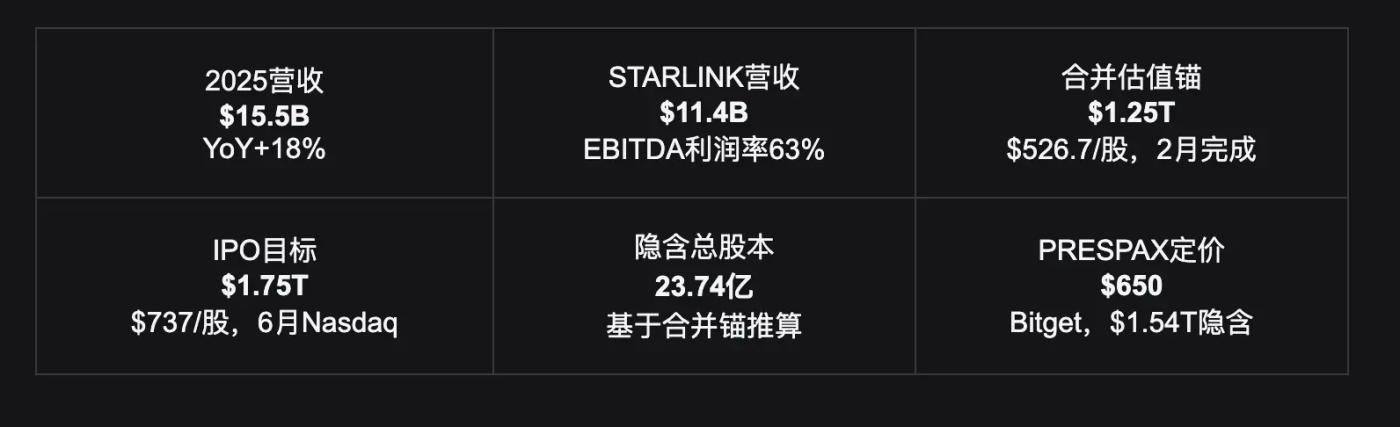
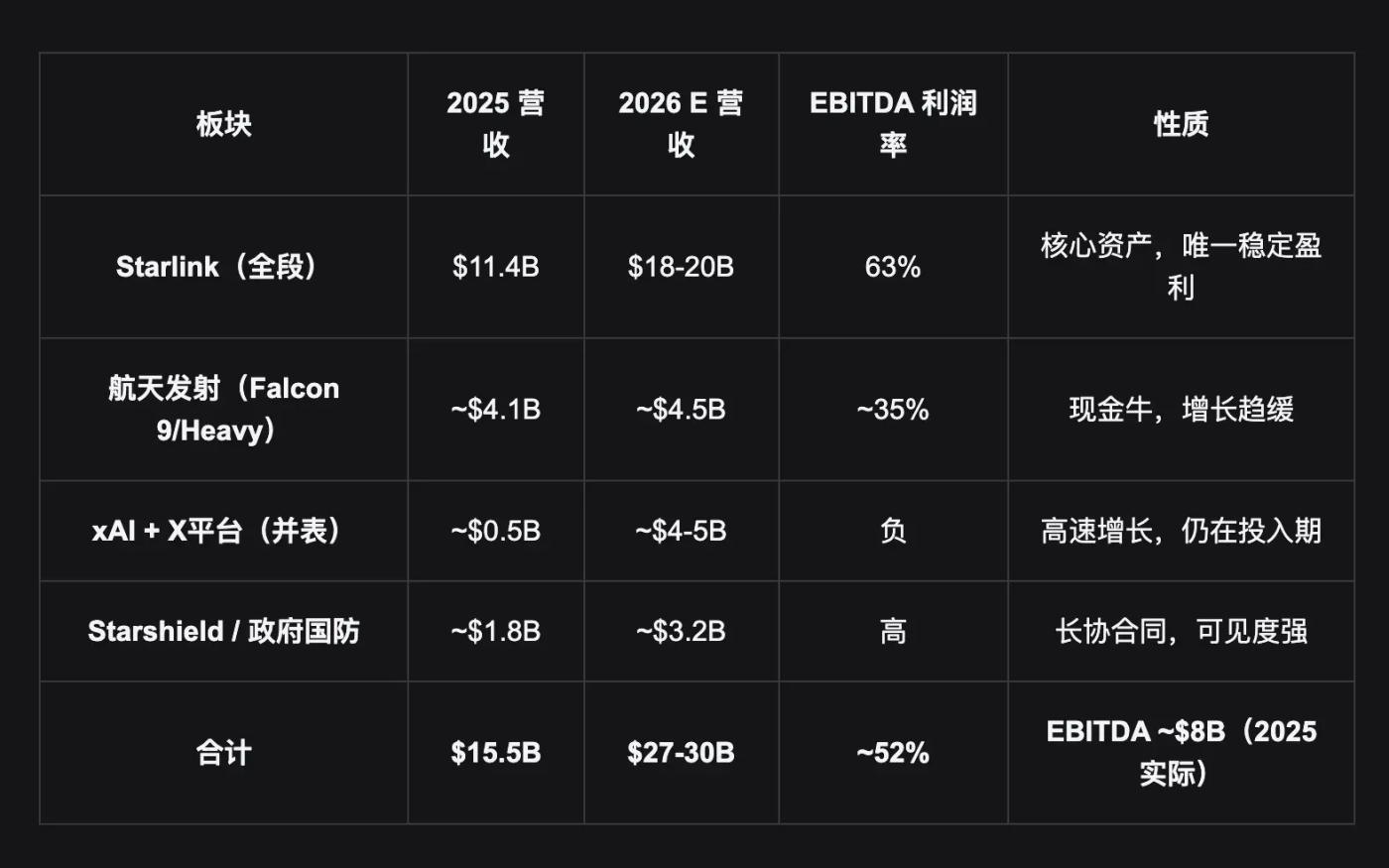
SpaceX is projected to achieve $15.5 billion in revenue and $8 billion in EBITDA by 2025, while Starlink is currently the most profitable global satellite network. After merging with xAI, the company will simultaneously possess launch capabilities, global low-Earth orbit bandwidth, and AI inference capabilities—forming a complete closed loop for its orbital data center strategy. The $1.75T IPO target price is fundamentally supported, and the index inclusion mechanism will generate sustained structural buying after listing. Currently, the most cost-effective liquid investment opportunity is Bitget preSPAX, priced at $650, implying a valuation of $1.54T, lower than all comparable benchmarks.
What is SpaceX: Three moats, one vertical closed loop
SpaceX's business cannot be understood within a single framework. It is simultaneously a rocket company (with a global commercial launch market share exceeding 60%), a satellite operator (Starlink has over 9 million users, covering over 100 countries), a defense contractor (with contracts for Starshield and Space Force), and, starting in February 2026, an AI company (xAI will be fully consolidated into its financial statements). These four entities are not parallel but rather have a clear strategic interdependence.
Falcon 9 is cash cow, not a growth engine. It's projected to have around 130 launches by 2025, with a commercial price range of $67M-$97M per launch and a market share exceeding 60%. However, growth in this business is nearing its ceiling, and Starship will create internal competition once it matures. Its value lies in the continuous cash flow it generates to support the company's capital expenditures.
Starlink is currently the company's core asset. Revenue is projected at $11.4 billion in 2025, with an EBITDA margin of 63%, making it the only business unit capable of independently supporting the company's valuation. User numbers are growing from 4.5Mbps at the beginning of the year to over 9Mbps by the end, and are expected to surpass 10Mbps in February 2026. The revenue structure is divided into three tiers: consumer broadband ($120/month), enterprise/maritime/aviation ($5,000+/month), and government/defense (Starshield, long-term contracts). Quilty Space predicts that Starlink's total revenue will reach $20 billion in 2026, with EBITDA of approximately $14 billion. This prediction is based on the scaling of D2C (direct-to-consumer) services and continued penetration into the enterprise market, and does not involve aggressive assumptions.
xAI is the source of the platform's premium, not a valuation bubble. After consolidation, SpaceX gains a Grok user base of 64 million MAU, $3.3 billion+ in advertising and subscription ARR from the X platform, and Musk's complete strategic layout for AI computing power. The stock-for-equity ratio of 0.1433 means xAI is acquired at a valuation of $250 billion—a price that, compared to Anthropic ($61.5 billion/$3 billion ARR) and OpenAI ($157 billion/$11 billion ARR), reflects a premium derived from the X platform's acquisition and Grok's rapid growth, rather than pure narrative.
Spectrum and orbital resources are intangible assets, not reflected in financial statements. The $17 billion acquisition of EchoStar's spectrum assets in 2025 secured operational qualifications for Direct-to-Cell. With the FCC spectrum allocation changing from a first-come, first-served basis to a competitive bidding system, SpaceX's early strategic planning creates a competitive barrier against increasingly stringent regulations. The Space Force PLEO contract capped at $13 billion/10 years and the five-story Ukrainian military communications contract worth $537 million—the strategic irreplaceability of government contracts far outweighs their commercial value.
Track data center: When the bottleneck of AI shifts from computing power to power
The first major constraint on AI development in 2025-2026 is not chips, but power. In the US, the construction cycle for power transmission networks is as long as 10-15 years, and distribution infrastructure is severely lagging behind. The location of data centers is increasingly constrained by network capacity, not geographical location or labor force. Jensen Huang and Sam Altman have mentioned this bottleneck on multiple occasions—this is not a complaint, but a constraint on capital allocation decisions.
The logical starting point of the Orbital Data Center (ODC) is the removal of physical constraints, not an engineering gimmick. Deploying computing nodes in geostationary or low Earth orbit allows bypassing the three core constraints of the ground network: power capacity, heat dissipation, and data sovereignty compliance.
The core finding of Google's 2025 thesis is that if LEO launch costs fall below $200/KJ, the energy cost for orbital data centers will be $810-$7,500/kW/year, on par with the $570-$3,000/kW/year cost for ground data centers, thus reaching the economic feasibility threshold. The target cost for Starship is $100/KJ.
The energy density in space is significantly higher than on Earth. Geostationary orbit receives approximately 1.4 times the peak solar irradiance on Earth, with no significant reduction. In theory, low Earth orbit could achieve 24-hour uninterrupted power generation (compared to no more than 4 hours of effective power generation per day for terrestrial photovoltaic systems). Heat dissipation relies on vacuum radiation rather than mechanical cooling; the thermal management system can be specifically designed for the orbital environment, independent of ground-based air conditioning infrastructure.
The technical feasibility has been empirically proven, not hypothetical. In 2025, Google used a V6e Trillium cloud TPU paired with AMD servers to complete total dose effect (TID) and single-particle event (SEE) tests. The conclusion was that, except for a brief disorder in HBM at a dose of 2krad (Si), end-to-end computation was normal throughout. 2krad is already three times the required lower limit, meaning that commercial AI chips, with appropriate shielding, have the capability to run in orbit. This is a Google Research-level paper, not Musk's PowerPoint presentation.
SpaceX is already taking action. It plans to submit an application to the FCC by the end of 2025, outlining a plan for an orbital data center system encompassing 1 million satellites . Musk has publicly stated that AI satellite launches will begin within 2-3 years. Simultaneously, SpaceX is developing large-scale solar energy manufacturing, aiming for a capacity of 100GW, to prepare the supply chain for the large-scale deployment of orbital photovoltaic arrays.
The current project challenges are real and require further explanation:
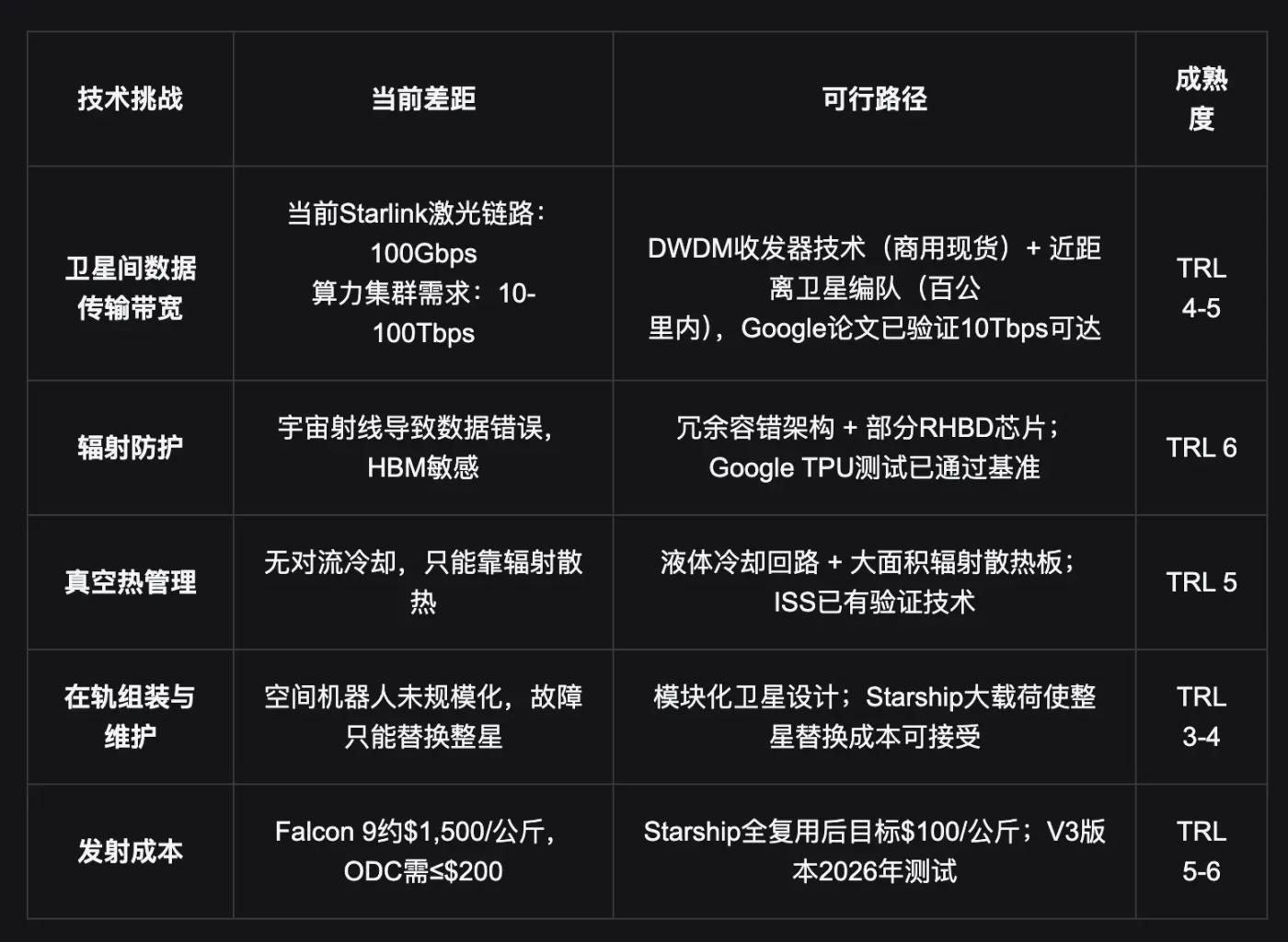
Each of the aforementioned challenges has a known engineering solution in principle, and none relies on undiscovered physical laws. Compared to reusable rocket technology before 2015, when skeptics argued that recovering the first-stage booster was "feasible in principle but impractical in engineering"—SpaceX achieved sea recovery in 2016 and began actual reuse in 2017. The engineering challenges facing ODC are more complex, but SpaceX's resources are far greater than those available in 2015: the world's largest satellite constellation operation experience, the world's lowest-cost launch system, and AI engineering capabilities after xAI's consolidation.
More importantly, it possesses uniqueness. No other company simultaneously boasts: large-scale, low-cost launch capabilities (Starship), a global low-Earth orbit bandwidth network (Starlink 6000+ satellites), AI model and inference capabilities (xAI/Grok), and on-orbit operational experience (real-time management of thousands of satellites). Amazon has Kuiper and AWS, but its launch capabilities rely on third parties, making costs uncontrollable. Amazon lacks launch capabilities, strategically tying itself to SpaceX with a 5% shareholder stake. The moat of this combination isn't technological advantage, but rather the unreplicable nature of vertical integration.
The weight of ODC in the current valuation should be understood as an in-the-money option, rather than a discount to the core business. Even if SpaceX's ODC never materializes, Starlink's cash flow is enough to support a valuation of $1T+. ODC is the source of option value for the valuation to evolve towards $1.75T or even higher, and the characteristics of options are: the shorter the time frame and the higher the technological maturity, the more certain the option value.
Segment valuation: Is there fundamental support for $1.75T?
$1.75T corresponds to $737 per share, representing a 40% premium over the merger anchor of $527. The following SOTP is a forward valuation based on projected financial data for 2026 , intended to assess whether the IPO pricing is within a reasonable range, and not to reiterate the historical anchor at the time of the merger.
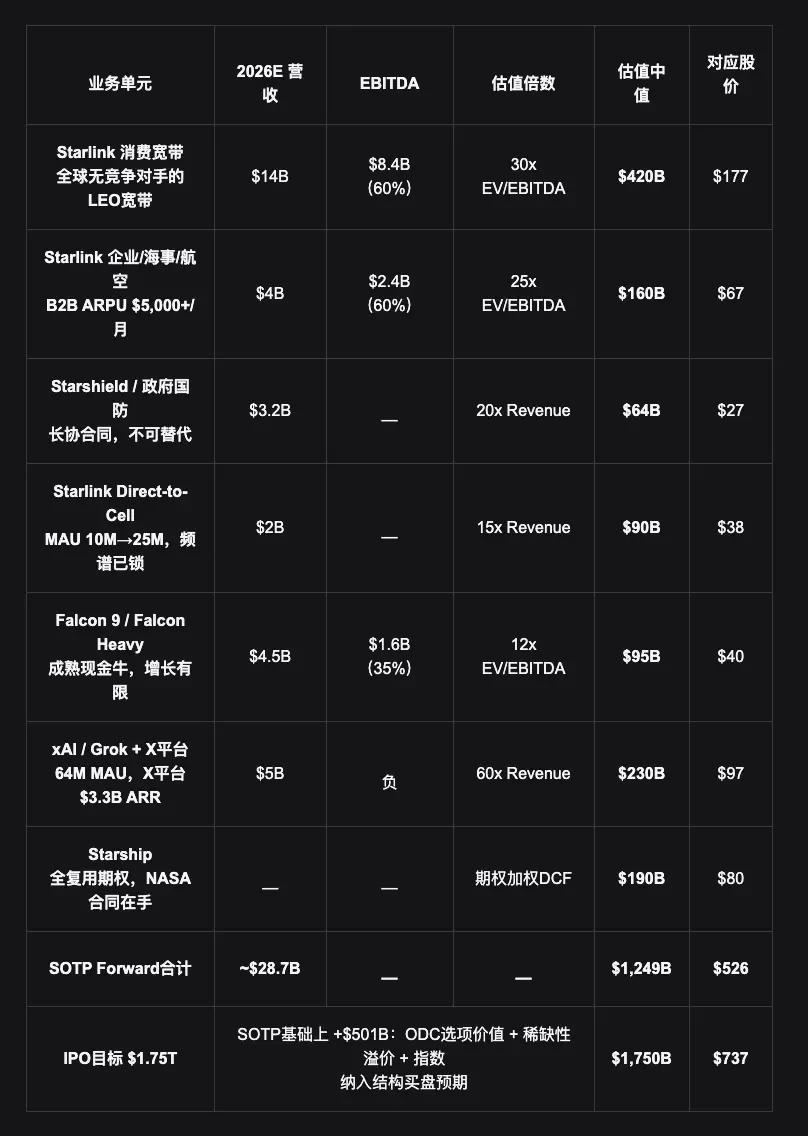
xAI's 60x revenue pricing is based on: Anthropic's $61.5 billion/$3 billion ARR (20x), and OpenAI's $157 billion/$11 billion ARR (14x). xAI has a higher growth rate and is backed by the cash flow of the X platform, making 60x a reasonable upper limit. The Starship option is worth $190B. Assumptions: 30% probability of achieving full reusability and commercialization; in a successful scenario, the market capitalization contribution would be $630B, discounted to $190B.
The SOTP forward median of $1.25T ($526/share) perfectly matches the merger anchor—indicating that the merger pricing is anchored to the fundamental valuation, without a premium. An IPO target of $1.75T, with an additional pricing of approximately $500 billion on top of the SOTP, requires three types of support:
First, the intrinsic option value of ODC. If Starship reduces launch costs to $100/kWh, the economic feasibility of ODC has been validated in Google's arguments. Historically, the option premium given to monopolistic platform infrastructures (AWS, Starlink itself) has often been reflected in valuations 5-7 years before realization. An option premium of $30-50 billion for ODC is not aggressive.
Second, the market scarcity premium. SpaceX is the only publicly investable company that simultaneously possesses aerospace infrastructure, a global communications network, and AI capabilities. This scarcity has historically always corresponded to an additional premium. Palantir (government data + AI) has long enjoyed 40-70x revenue, not because of its growth rate, but because there are no substitutes.
Third, the forward discounting of structural passive buying. This part will be discussed in detail in the next section, but the core logic is: passive index inclusion will create hundreds of billions of dollars in forced buy orders after listing, and the market will discount this support in advance when pricing the IPO.
Overall assessment: The $1.75T valuation is justifiable within the 2026E forward valuation framework, and the premium has a clear source and is not arbitrarily given. The $2.0T high-end target requires Starlink to exceed expectations in 2026E or ODC to accelerate, which is less likely than the baseline scenario.
Why it's not a high point after listing: The structural buying mechanism of passive funds.
Actively managed investors can choose not to buy, but passive index funds cannot. When SpaceX is included in the Nasdaq 100 and S&P 500, all funds tracking these indices must be allocated accordingly; there are no exceptions or timing options. This is a key structural difference between SpaceX's post-IPO listing and a typical IPO.
Nasdaq passed the SR-NASDAQ-2026-004 rule amendment in Q1 2026 (effective May 1): For newly listed companies with a market capitalization entering the top 40 of the Nasdaq 100, an assessment will be triggered on the 7th trading day after listing, and mandatory inclusion will be required on the 15th trading day. SpaceX, with a market capitalization of $1.75 trillion, entered the top five globally, and there is no reason why it should not trigger this rule.
The new rules also introduce a low float multiplier: when the publicly traded float is less than 20%, the index weight calculation will use a multiplier of up to 5. If SpaceX retains control and releases only 5% of its shares to the market, the index weight will be calculated based on an equivalent float market capitalization of 25%. This means that the allocation demand for funds tracking funds like QQQ (valued at $372.5 billion) could far exceed the actual total number of shares in circulation.
1. IPO listing (expected June 2026)
Listed on Nasdaq at $1.75T. Retail allocation is 30% (the highest ever). Musk retains a majority stake to maintain control, resulting in extremely low public float.
2. 7th Trading Day: Index Inclusion Assessment Triggered
It ranks among the top five globally in market capitalization, and its inclusion in the top 40 of the Nasdaq 100 was a foregone conclusion. The low-circulation multiplier mechanism was activated, and the equivalent weight was amplified to five times the actual circulating supply.
3. Trading Day 15: All passive funds are simultaneously forced to buy.
QQQ, QQQM, and all Nasdaq 100 tracking funds simultaneously executed allocation instructions. At the same time, to free up capital, approximately $100 billion worth of existing weighted stocks, including NVDA, AAPL, and MSFT, had to be sold. Steve Sosnick (Interactive Brokers): "If everyone buys at the same time, who will be the natural seller?"
4. Five months later: The lock-up period ends, and a price floor has been established.
When the 180-day lock-up period for insiders expired, the index fund had already completed its position building at a relatively high price. Passive buying created structural price support, allowing insiders to reduce their positions in an orderly manner. This is not manipulation; it's a mechanism.
Tesla's historical reference: After the announcement of its inclusion in the S&P 500 in November 2020, Tesla's stock price rose 57% in the 30 days leading up to the inclusion. At that time, its valuation was equivalent to the combined market capitalization of the world's nine largest automakers, with a PE ratio of several hundred times. Six months after inclusion, the stock price fell by about 10%—but this was due to the extreme valuation itself, not a problem with the index inclusion mechanism. SpaceX's fundamentals are significantly stronger than Tesla's in 2020, and its EBITDA is positive.
Apollo's chief economist, Torsten Slok, estimates that if SpaceX and OpenAI were to go public at the same time, the combined weighting of the top 10 stocks in the S&P 500 would rise from about 40% to nearly 50%. The result of this concentration trend is that index funds essentially become amplifiers of super-weighted stocks, and SpaceX is the most important new component in the coming years.
Google holds approximately 5% of SpaceX's equity, valued at over $100 billion based on a $2T valuation. Google is not a passive shareholder—it signed a long-term data backhaul and edge computing agreement with SpaceX in 2025 and has launched a preview version of "Anthos Space Edge," routing AI inference tasks to the nearest low-Earth orbit satellite coverage area. SpaceX's orbital assets are being integrated into the physical foundation of Google's cloud ecosystem, providing strategic support for its post-IPO valuation.
Pre-IPO Market: Three Price Discovery Channels and Pricing Analysis
There are currently three channels offering pre-market exposure to SpaceX. The core anchor is $526.7/share = $1.25T (consolidated pricing), with a total outstanding share capital of 2.374 billion shares. The following analysis examines the pricing, structure, and upside potential of each channel.
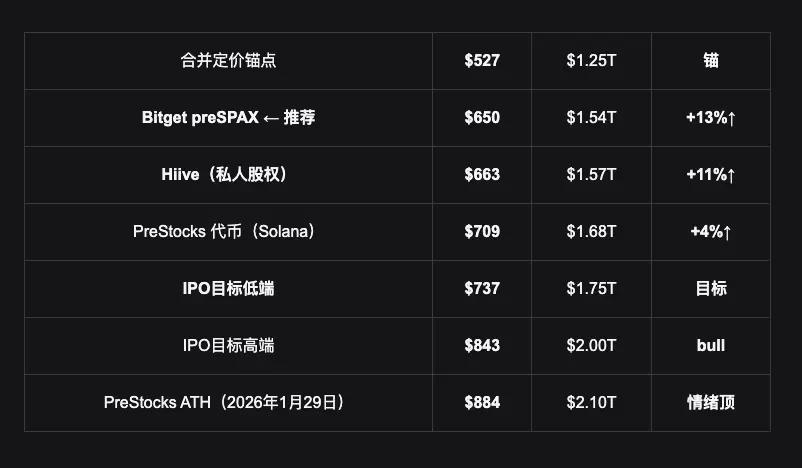
BITGET IPO PRIME · Tokenization · Referral preSPAX $650 Implied valuation of $1.54T, launching on April 21st. Low end of IPO target +13.4% High end of IPO target +29.7% Backed by Republic, the benchmark index is linked to SpaceX's performance after its public offering. $650 is the lowest market price among all currently tradable channels , lower than Hiive private equity ($663) and PreStocks tokens ($709), and requires no accredited investor qualifications. The economic exposure directly tracks the public market price after SpaceX's IPO. |
True Equity – Qualified Investors Only Hiive $663 Implied valuation: $1.57T · 100+ active orders Low end of IPO target +11.2% High end of IPO target +27.1% Genuine equity transfer, the most liquid private equity platform. 3-5% renewal fee, lock-up period depends on shareholding structure. Price higher than preSPAX $13, but grants direct shareholder rights. Qualified investors only. |
Synthetic Assets - SOLANA Chain PreStocks $709 Implied valuation: $1.68T·ATH$884 (1/29) Low end of IPO target +3.9% High end of IPO target +18.9% With a market capitalization of $4.7 million and daily trading volume of $840,000, liquidity is extremely poor. The price is already above pre-SPAX $59, only 4% below the IPO low. It reached $884 on January 29th, implying $2.10T, before retracing to its current position. The price does not reflect fundamentals but rather reflects small-circle sentiment on the Solana chain. |
Pricing Conclusion: preSPAX at $650 is the only option among the three channels that simultaneously satisfies both "lowest pricing" and "acceptable liquidity." Compared to Hiive: $13 cheaper (-2%), no accredited investor qualifications required. Compared to PreStocks: $59 cheaper (-8.3%), with 9.5 percentage points more upside potential and better liquidity (Republic backing vs. Solana's self-issued token). After the IPO, preSPAX's settlement will reference SpaceX's open market price, providing a clear path to economic returns.
Scenario Analysis and Key Assumptions
pessimistic scenario $421—$527 Starship continues to falter, xAI company API 2026E falls short of $1.5 billion, Musk's political risks impact government contract renewals, and tightening macroeconomic conditions lead to a discounted IPO price. Valuation is returning to SOTP fundamentals, with Starlink's $11.4 billion revenue still supporting a $1T floor. From a pre-SPAX price of $650, the downside is approximately -20% to -30%. |
Baseline scenario (primary scenario) $737—$780 Starlink's 2026E valuation is projected at $16-18 billion, Grok's enterprise API revenue is $1.5 billion, and the successful completion of its IPO triggered its inclusion in the Nasdaq index, with passive buying supporting its post-listing momentum. Based on the pre-SPAX price of $650, the upside is approximately +13% to +20%, potentially within 6 months. |
Optimistic scenario $843—$950 Starlink exceeded expectations, reaching $20 billion. Starship achieved a milestone in full reuse during its roadshow, and ODC announced its first commercial contract. Retail investor sentiment combined with passive buying resonated. From a pre-SPAX price of $650, the upside is approximately +30% to +46%. |
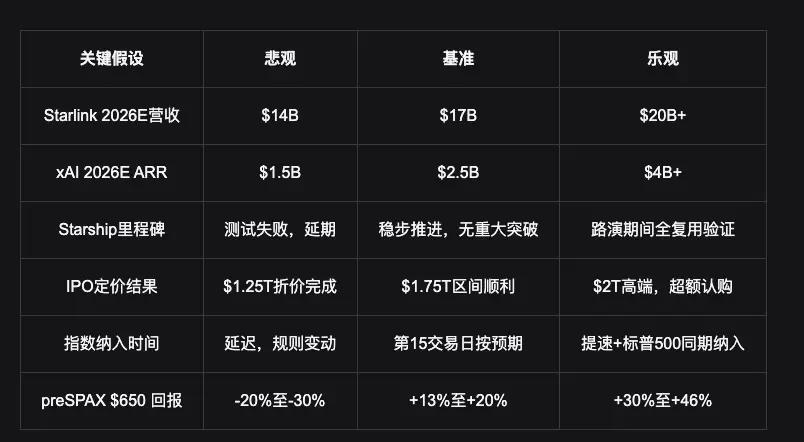
Key downside risks: ① A major accident involving Starship (highest probability impact); ② The continued deterioration of the relationship between Musk and Trump affecting government contracts; ③ Nasdaq index rule revisions facing challenges at the congressional level; ④ A sharp tightening of the macroeconomic environment leading to the closure of the entire IPO market. While the probability of any of these risks occurring independently is relatively limited, their combined impact is significant.
This report is for internal research reference only and does not constitute investment advice. Tokenized products (preSPAX, PreStocks) do not grant shareholder rights, have no voting rights, and no dividend rights. Economic returns are linked to a reference index, and the settlement mechanism relies on platform credit. Private equity (Hiive) is limited to qualified/certified investors, with a renewal fee of 3-5%, and the lock-up period depends on the shareholding structure. SpaceX S-1 is currently under confidential review; the IPO valuation, timing, and issuance structure may all change. The TRL (Technology Readiness Level) rating is based on the researcher's independent judgment and is for reference only.
Data source
CNBC— SpaceX × xAI Merger $1.25T (Feb 2026) · Sacra— SpaceX Equity Research (Feb 2026) · SpaceNews— Starlink Revenue 2025 · NASA SpaceFlight—EchoStar $17B Spectrum · Augustus Wealth—S-1 Filed $2T · Hiive $663 (Apr 18) · PreStocks CoinMarketCap · Bitget preSPAX GlobeNewswire · Sacra — xAI · Tencent Technology "SpaceX IPO Countdown" · Wall Street Club
"SpaceX's Trillion-Dollar Valuation" · "Space Race 2.0" · Dolphin Research: "Can SpaceX Really Reshape Space Economics?"