Despite being one of the world’s most traded commodities, investing in oil is still not as straightforward as you might expect. Geopolitical conflict, changing demand forecasts, and a widening menu of investment vehicles have made the decision more complex than a simple “buy an ETF” approach.
The Iran-Hormuz crisis pushed Brent crude above $100 a barrel in the first half of 2026. At the same time, the IEA cut its demand outlook and now expects a contraction of 80,000 barrels per day. So the real question is not just whether oil deserves a place in your portfolio, but which investment route is best suited for your goals, time frame, and risk appetite.
This guide compares five optimal ways to invest in oil, points out the common traps, and helps you choose the option that fits you best in 2026.
KEY TAKEAWAYS➤ Physical oil investment is relatively rare; most investors use ETFs, stocks, or futures to gain exposure.➤ Energy stock ETFs are the simplest entry point but track companies rather than crude oil prices.➤ Futures-based ETFs can lose value over time due to contango and contract roll costs.➤ Oil returns depend more on timing cycles than long-term growth in global demand➤ Structural risks like roll costs, taxes, and liquidity often outweigh simple price direction
In this guide:- In a nutshell: How to invest in oil in 2026
- Why does oil still matter as an investment in 2026?
- How do oil prices work?
- What are the 5 ways to invest in oil?
- Which oil investment method fits your situation?
- What is contango and why do most oil ETFs lose money?
- What should you avoid when investing in oil?
- How does the energy transition affect oil investing?
- Frequently asked questions
In a nutshell: How to invest in oil in 2026
Let’s quickly highlight the main methods before we get into the technical nitty-gritty:
Five ways to buy oil in 2026:
- Eenergy stock ETFs (XLE, VDE): It’s the easiest option, require low capital, and provides broad exposure to oil companies.
- Buy individual oil stocks: Suitable if you want dividends or prefer to pick specific companies.
- Use commodity ETFs or futures: It provides direct oil price exposure, but comes with higher risk and complexity.
- Consider MLPs: Income-focused option with tax implications.
- Direct participation programs: High-risk, illiquid investments for accredited investors.
Why does oil still matter as an investment in 2026?
Oil still matters because global demand remains relatively high (above 95 million barrels per day) despite the market going through the worst supply crisis in decades. And it is not expected to peak until the mid-2030s. However, the investment case has changed. It is no longer about long-term growth, but about timing cycles.
The shift became clear in April 2026. The IEA, in its April 2026 Oil Market Report, revised its demand outlook from growth of 730,000 barrels per day to a contraction of about 80,000 barrels per day. That reversal came as supply shocks from the Iran–Hormuz crisis caused what could be called the largest supply disruption in history.
At the same time, production declines across major exporters showed how fragile supply can be during geopolitical stress. According to OPEC data, several Gulf producers saw sharp output drops during the disruption. Iraq’s production collapsed 61%, Kuwait’s dropped 53%, the UAE fell 44%, and Saudi Arabia declined 23%.
IEA Executive Director Fatih Birol described the situation as one of the largest supply shocks in modern energy markets, with millions of barrels per day affected in a short span.
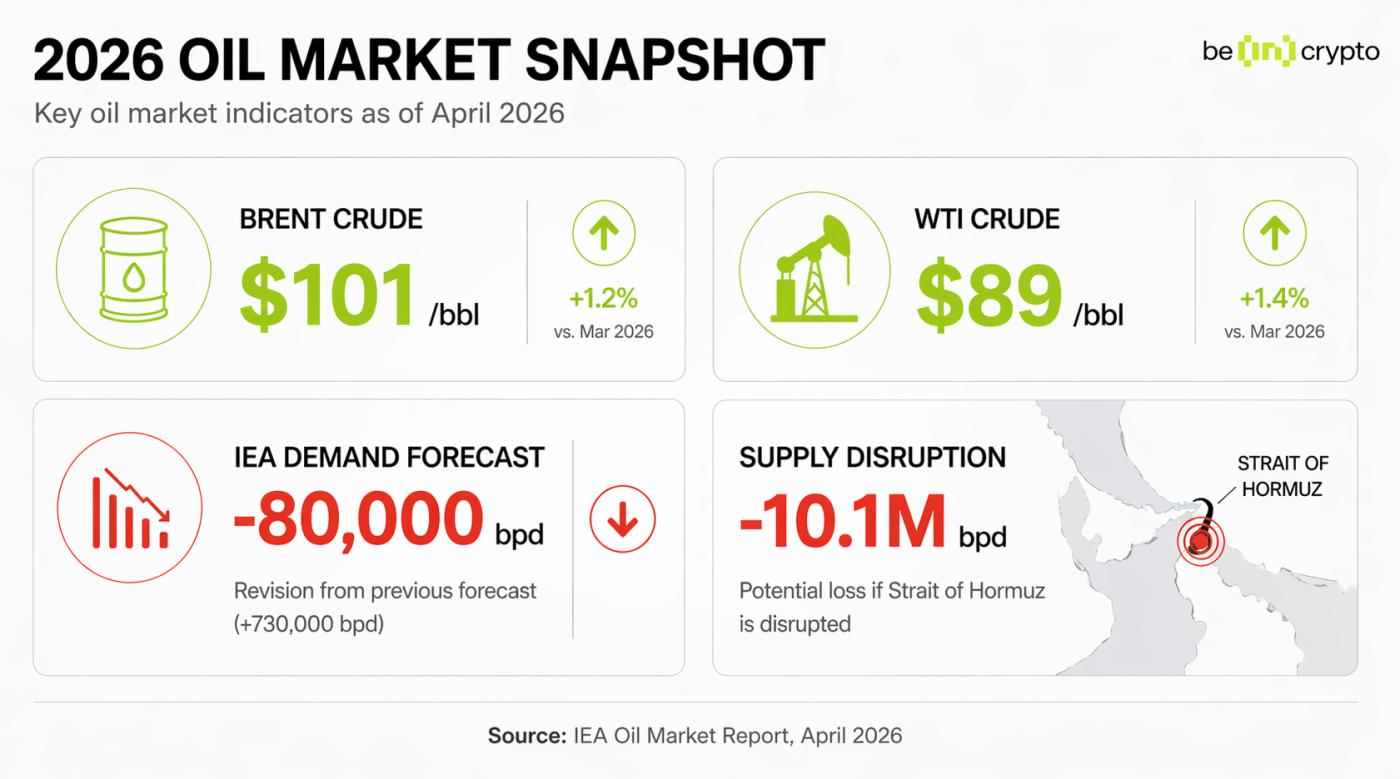 Key oil market indicators as of April 2026: BeInCrypto
Brent crude traded above $102 per barrel and WTI held above $89 per barrel as of Apr. 23, 2026. These prices reflect a market caught between collapsing supply and demand destruction from high fuel costs.
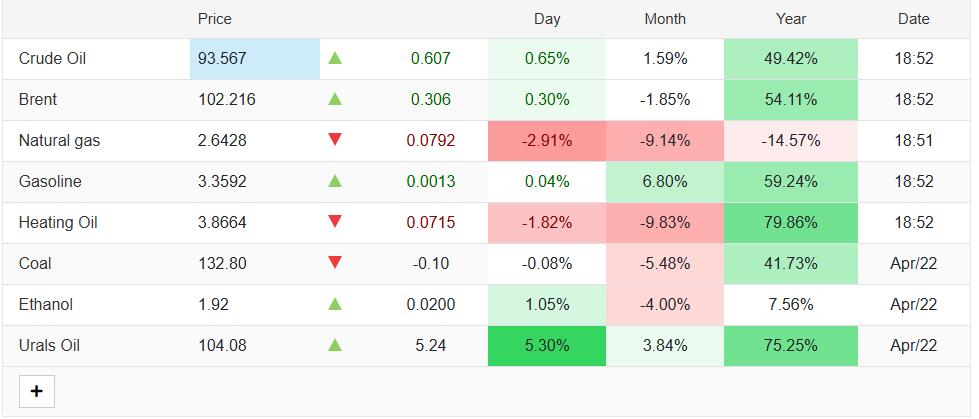 Brent crude price hovering over $102 as of Apr. 23, 2026: Trading Economics
Despite the volatility, however, long-term demand expectations remain intact. For instance, Vitol pushed its peak demand forecast back to the mid-2030s in its February 2026 outlook, projecting that demand could reach 112 million barrels per day at its height.
In other words, oil is not disappearing. It is transitioning from a growth story to a cyclical income story, and your investment approach should reflect that switch.
How do oil prices work?
Oil prices are typically driven by four core forces: OPEC+ production decisions, geopolitical events, US dollar strength, and inventory data. These factors interact constantly, which is why oil prices can move sharply in short periods.
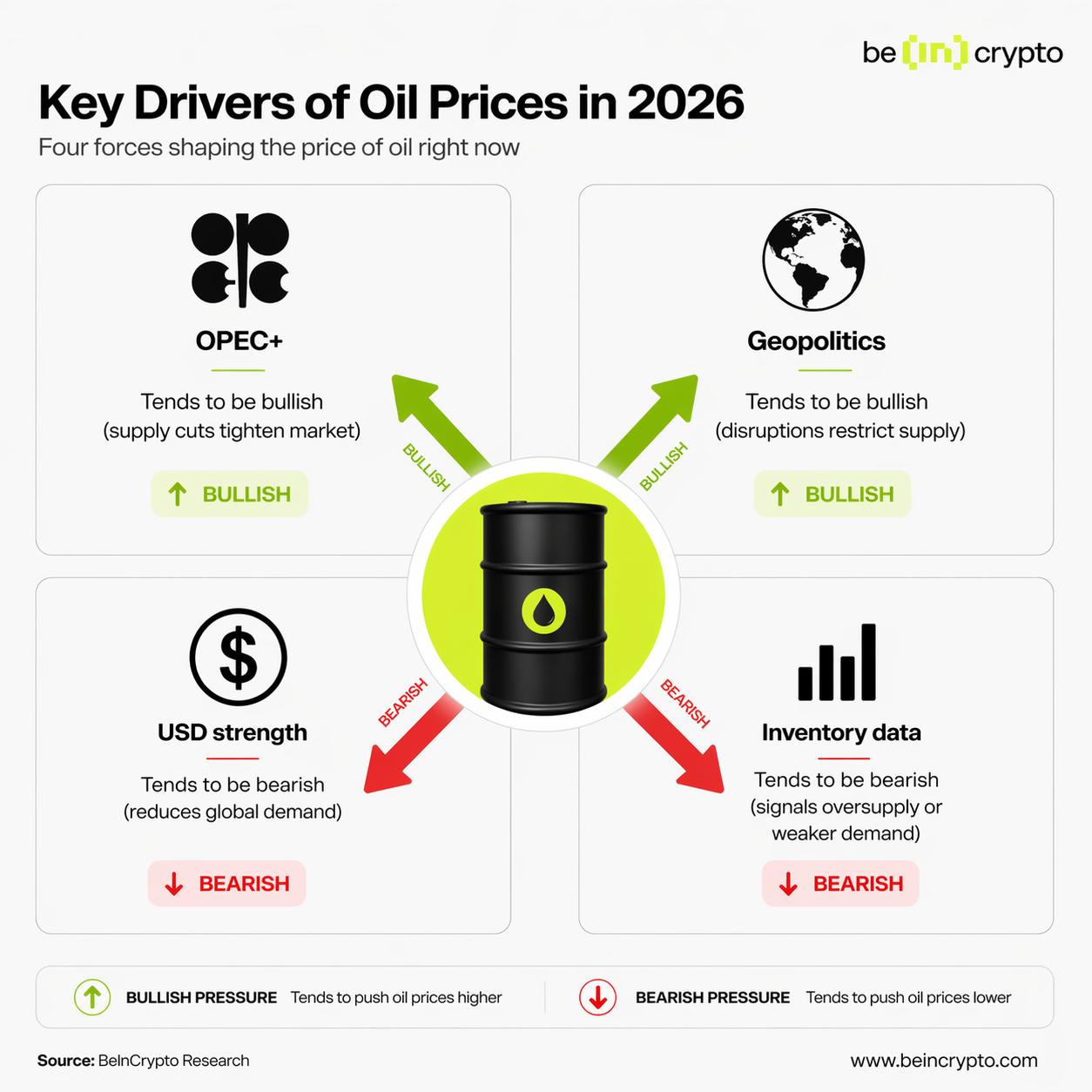 Key drivers of oil prices: BeInCrypto
➤ OPEC+ production decisions: OPEC+ controls roughly 40% of global oil supply, so its output decisions carry significant weight. Production cuts tend to tighten supply and support prices, while increases can push prices lower. In 2026, the Iran–Hormuz crisis disrupted Gulf output, leaving actual production well below official targets.
➤ Geopolitics: Geopolitical events can affect both supply and demand. Disruptions to key routes, such as the Strait of Hormuz, can restrict supply, while prolonged conflict can reduce demand in affected regions. In 2026, the partial closure of Hormuz — which typically handles around 20% of global oil flows — created a major supply shock.
➤ US dollar strength: Oil is priced globally in US dollars. When the dollar strengthens, oil becomes more expensive for buyers using other currencies, which can reduce demand and weigh on prices.
➤ Inventory data: Weekly inventory data from the U.S. Energy Information Administration (EIA) provides a near-term view of supply and demand balance. Unexpected drawdowns usually signal tighter supply and push prices higher, while inventory builds suggest oversupply and tend to pressure prices.
| Price driver | How it moves oil | Current context (April 2026) |
|---|---|---|
| OPEC+ decisions | Production cuts support prices; increases pressure prices | Gulf output remains below targets due to disruption |
| Geopolitics | Supply disruptions push prices higher; demand shocks can limit gains | Strait of Hormuz partially closed; ~10M bpd affected |
| USD strength | Stronger dollar reduces global demand | Dollar elevated amid risk-off flows |
| Inventory data | Drawdowns are bullish; builds are bearish | Strategic reserves released; inventories volatile |
What are the 5 ways to invest in oil?
There are five main ways to invest in oil:
➤ Best for beginners: Energy stock ETFs (XLE, VDE)➤ Best for stock pickers: Individual oil stocks (XOM, CVX)➤ Best for short-term trading: Oil futures or commodity ETFs (USO, BNO)➤ Best for income: MLPs or dividend-paying oil majors➤ Best for direct oil exposure with tax benefits (high risk): Direct participation programs
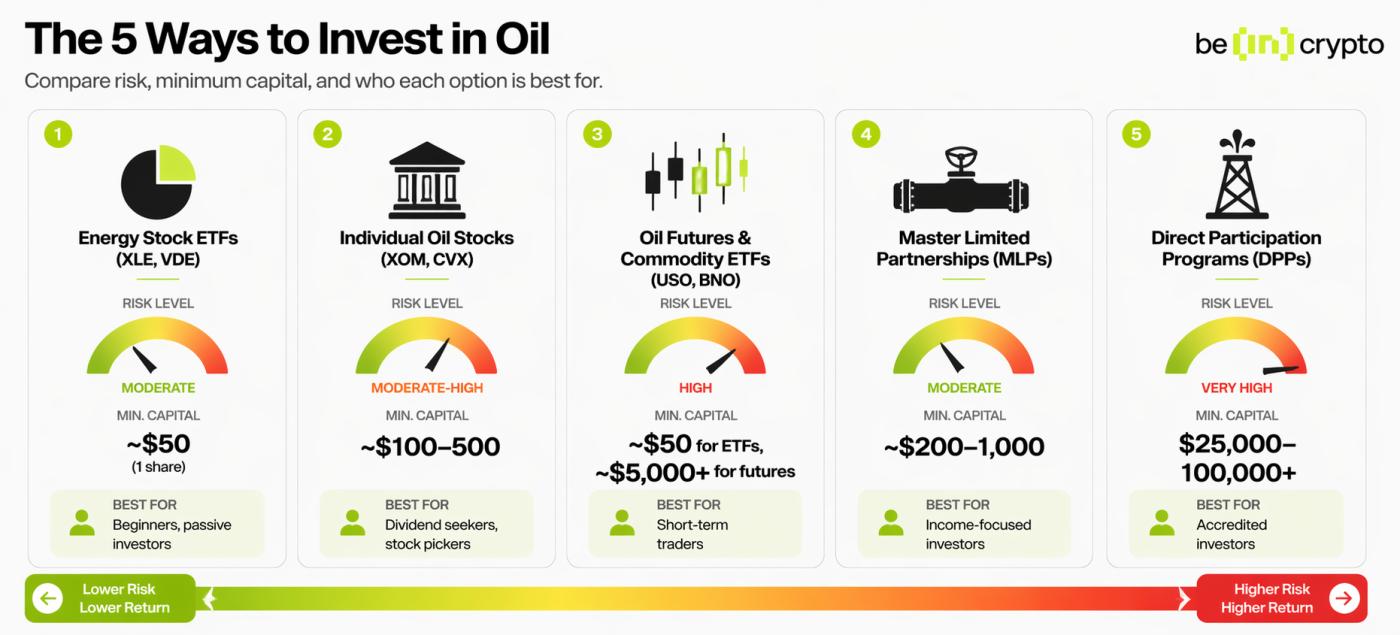 Different ways of investing in oil: BeInCrypto
Energy stock ETFs
Energy stock ETFs are the simplest way to gain oil exposure, especially if you are starting out. These funds hold a basket of oil and gas companies and trade on major exchanges like regular stocks.
For example, the Energy Select Sector SPDR Fund (XLE) returned about 25.8% year-to-date through mid-April 2026 and offers a dividend yield near 2.6%. However, these ETFs track company performance, not crude prices directly. The link to oil is strong, but not exact.
Bottom line: A practical entry point for most investors, with low costs, built-in diversification, and no tax complexity.
Individual oil stocks
Individual oil stocks give you direct exposure to specific energy companies. Majors like ExxonMobil (XOM) and Chevron (CVX) offer dividend income along with price exposure, while exploration and production firms tend to move more sharply with oil prices.
The trade-off is concentration risk. A single company can underperform even when oil prices rise, due to operational issues, hedging decisions, or capital allocation choices.
Bottom line: Suitable if you want dividend income or targeted exposure, but it requires company-level analysis beyond just tracking oil prices.
Oil futures and commodity ETFs
Oil futures and commodity ETFs aim to track crude oil prices more directly. Commodity ETFs like United States Oil Fund (USO) do this by holding futures contracts rather than physical oil.
This structure introduces a key issue known as contango, where rolling contracts over time can steadily erode returns. The impact is not always obvious in the short term but becomes significant over longer holding periods.
Bottom line: Useful for short-term exposure to oil prices, but generally unsuitable for long-term holding due to roll costs.
Master limited partnerships (MLPs)
Master limited partnerships, or MLPs, are publicly traded partnerships that own midstream infrastructure such as pipelines, storage terminals, and processing facilities. They generate revenue from transport and storage fees rather than oil prices, which makes their cash flows more stable.
The trade-off is tax complexity. MLPs issue K-1 forms instead of standard 1099s, which can complicate filing and may create issues such as UBTI in certain accounts.
Bottom line: Suited for income-focused investors, but the tax structure requires careful consideration.
Note: MLPs can generate unrelated business taxable income (UBTI) inside tax-advantaged accounts like IRAs. Exceeding $1,000 in UBTI triggers a separate tax filing requirement even within a retirement account.
Direct participation programs (DPPs)
Direct participation programs involve investing directly in oil wells or drilling operations. These offerings are typically limited to accredited investors and can provide tax benefits, including deductions for intangible drilling costs.
The trade-off is illiquidity and risk. Capital is often locked in for years, there is no active secondary market, and the sector has a long history of problematic or misleading offerings.
Bottom line: High-risk option with potential tax advantages, suitable only if you can commit capital long term and conduct thorough due diligence.
Here’s how these 5 methods compare:
| Method | Best For | Risk Level | Min. Capital | Liquidity | Key Watch-Out |
| Energy stock ETFs (XLE, VDE) | Beginners, passive investors | Moderate | ~$50 (1 share) | High (exchange-traded) | Tracks energy sector, not oil price directly |
| Individual oil stocks (XOM, CVX) | Dividend seekers, stock pickers | Moderate-High | ~$100-500 | High | Company-specific risk beyond oil prices |
| Oil futures and commodity ETFs (USO, BNO) | Short-term traders | High | ~$50 for ETFs, ~$5,000+ for futures | High | Contango drag erodes long-term value |
| MLPs (midstream pipelines) | Income-focused investors | Moderate | ~$200-1,000 | Medium | Complex K-1 tax filings required |
| Direct participation programs | Accredited investors | Very High | $25,000-100,000+ | Very Low | Illiquid, long lock-up periods, fraud risk |
Which oil investment method fits your situation?
The best oil investment method depends on four factors. Your available capital, how long you plan to hold, your risk tolerance, and whether tax efficiency matters. The table below maps four common investor profiles to recommended approaches.
| Investor Profile | Recommended Method | Why It Fits | What to Watch |
| Beginner with $500 or less | Energy stock ETF (XLE or VDE) | Low minimum, instant diversification, high liquidity | Returns track energy sector broadly, not crude price |
| Income-focused investor | MLPs or dividend-paying oil majors (XOM, CVX) | Steady quarterly distributions, lower price volatility | MLP K-1 tax forms add filing complexity |
| Experienced short-term trader | Oil futures or commodity ETFs (USO, BNO) | Direct crude price exposure, leverage available | Contango drag makes long holds destructive |
| Accredited investor seeking tax benefits | Direct participation program | Intangible drilling cost deductions, depletion allowances | Illiquid, high minimums, due diligence essential |
- Beginner with $500. Start with a diversified energy ETF. One share of XLE costs roughly $95 as of April 2026 and provides exposure to over 20 oil and gas companies. No tax complexity, no K-1 forms, and you can sell on any trading day.
- Income-focused investor. Look at midstream MLPs or large-cap oil companies with long dividend track records. ExxonMobil and Chevron have maintained or increased dividends for decades, though MLP distributions come with K-1 tax reporting.
- Experienced trader. Commodity ETFs or direct futures contracts give you crude price exposure. The critical rule is time horizon. These instruments are built for weeks or months, not years.
- Accredited investor. Direct participation in drilling programs can allow first-year write-offs of 60% to 80% through intangible drilling cost deductions. The risks are equally substantial, and this path requires careful vetting.
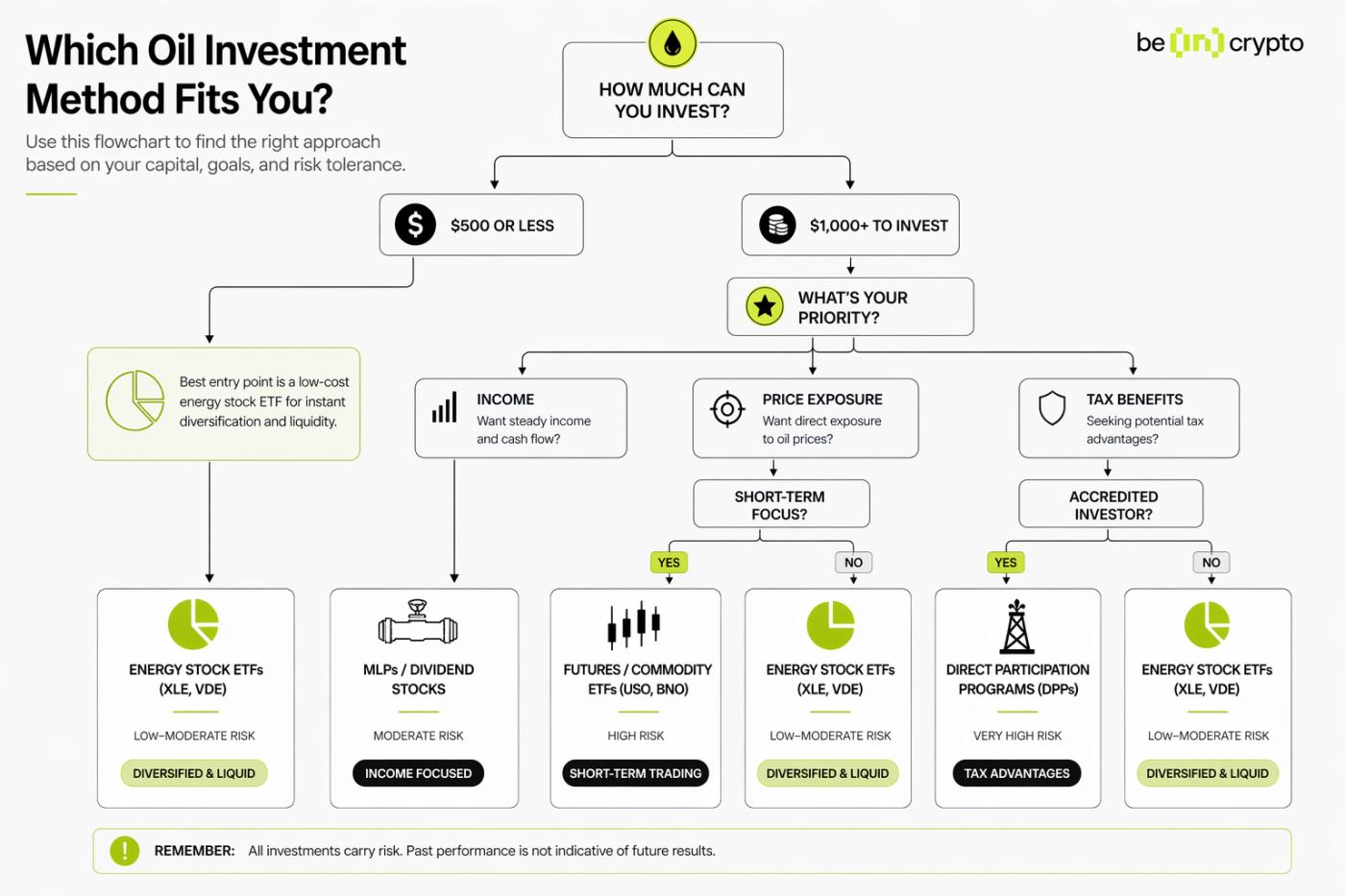 Choosing the optimal oil investment method: BeInCrypto
What is contango and why do most oil ETFs lose money?
Contango is a futures market condition where longer-dated oil contracts cost more than near-term ones. It is one of the main reasons commodity-tracking ETFs such as United States Oil Fund (USO) can lose value over time, even when oil prices rise.
Futures-based ETFs hold contracts that expire every month. When a contract nears expiration, the fund sells it and buys the next month’s contract. This process is called rolling.
In contango, the fund sells low and buys high every single month. That price difference, called negative roll yield, steadily drains value.
The opposite condition, backwardation, occurs when near-month contracts cost more than later ones. Rolling in backwardation benefits the fund. But contango has been the dominant structure for most of the past decade.
The impact shows up clearly over time. According to FinanceCharts data as of April 2026, USO has delivered a negative total return of roughly 21% over the past decade, with annualized returns of around negative 7% based on recent data.
In contrast, XLE returned 25.77% year-to-date in 2026 alone, because equity ETFs do not suffer from roll costs.
Contango drag is like a slow leak in a tire. Each month’s roll costs a little air pressure. Over a few weeks, the tire still works. Over a year, it goes flat. USO is a trading tool, not a buy-and-hold investment.
| Feature | Commodity ETF (USO) | Energy Stock ETF (XLE) |
|---|---|---|
| Tracks | WTI crude futures (rolling contracts) | S&P 500 energy companies |
| Roll cost exposure | Yes, from monthly contract rolls | None |
| 10-year total return | Approx. negative 21.5% | Positive total return (dividends included) |
| Dividend yield | None | ~2.6% (as of April 2026) |
| Typical holding use | Short-term use | Medium- to long-term use |
| Expense ratio | ~0.7–0.8% | ~0.08–0.10% |
What should you avoid when investing in oil?
The five most common oil investment traps are leveraged ETFs, illiquid partnerships, buying at geopolitical price spikes, ignoring tax complexity, and confusing oil stocks with oil price bets. Each one can erode returns even when your directional call on oil is correct.
➤ Leveraged oil ETFs destroy capital over time. Products like ProShares Ultra Bloomberg Crude Oil (UCO) deliver 2x or 3x the daily return of oil futures. They suffer from contango drag and volatility decay. Even if oil rises 20% over six months, a 2x leveraged ETF may return far less than 40% depending on the price path.
➤ Illiquid partnerships can trap your capital for years. Some direct participation programs and private oil LLCs have no secondary market. The SEC has issued repeated warnings about fraudulent oil offerings that promise high returns while locking up investor funds.
➤ Buying at the top of a geopolitical spike is a classic mistake. Oil surged above $100 per barrel in early 2026 due to the Iran-Hormuz crisis. Crisis-driven spikes often partially reverse once supply chains adapt or conflicts de-escalate.
➤ Ignoring tax complexity can erase your returns. MLPs, futures (taxed under the 60/40 rule), and direct participation deductions all carry different treatments. An investor who earns 10% on an MLP but loses 3% to unexpected tax liability has a very different real return.
➤ Confusing oil stocks with oil price bets leads to surprises. Energy companies hedge production, make capital allocation decisions, and carry debt. ExxonMobil may underperform during an oil rally if it hedged aggressively. Oil stocks are businesses, not price proxies.
Before committing capital, ask one question: Does this product benefit from oil price moves directly, or will structural costs like contango, leverage decay, or management fees eat into returns regardless of where oil goes?
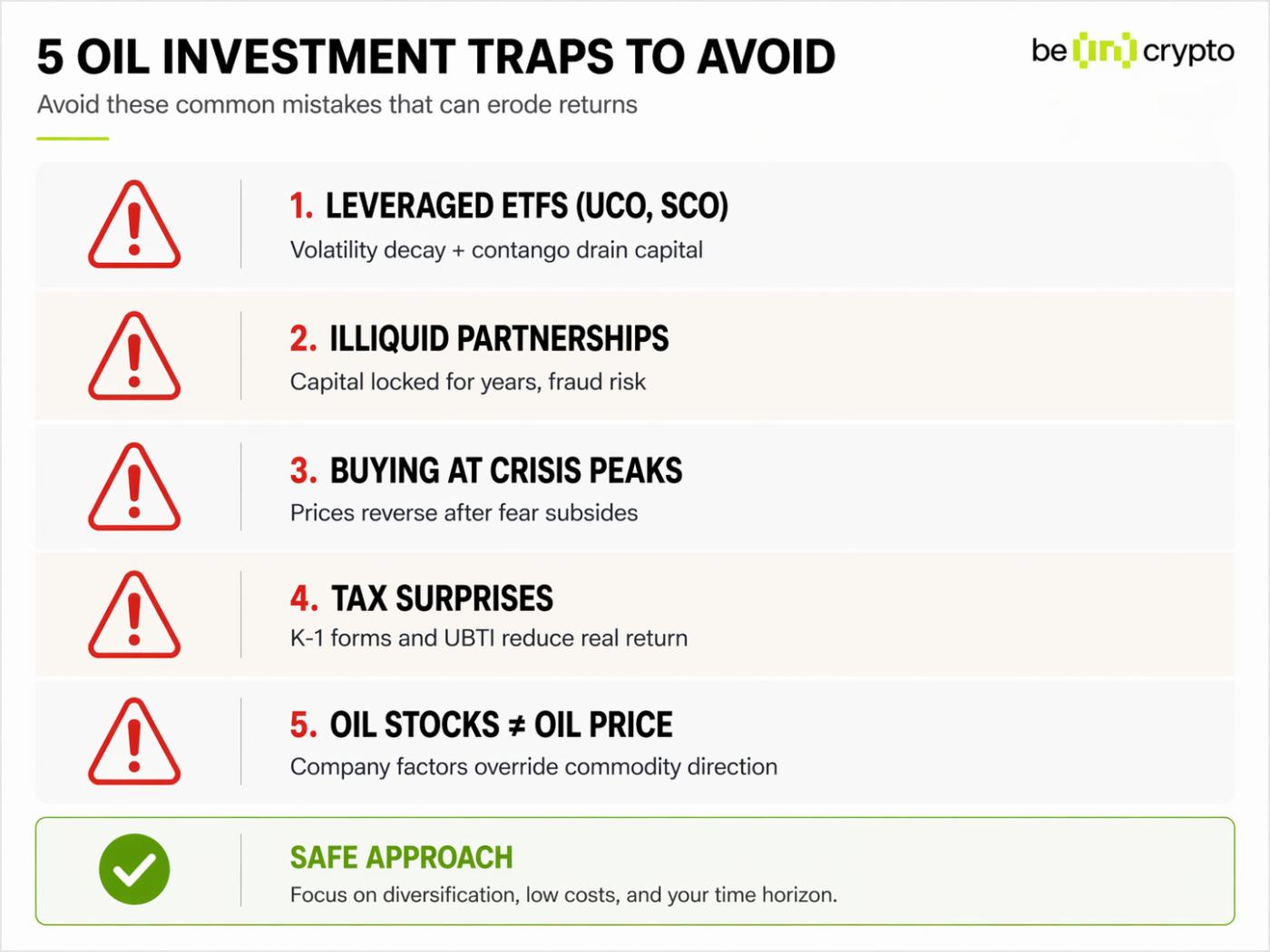 Common mistakes oil investors make when starting out: BeInCrypto
How does the energy transition affect oil investing?
The energy transition does not remove oil demand. It changes the timeline and the type of exposure that makes sense. Peak demand is now expected in the mid-2030s, which means oil looks less like a long-term growth asset and more like a cyclical one.
Recent projections reflect that shift. Vitol expects global oil demand to peak at around 112 million barrels per day. However, demand is not uniform across products.
Gasoline consumption is expected to peak earlier, in the early 2030s, and then decline by roughly 1.8 million barrels per day by 2040. By contrast, jet fuel demand is projected to grow by about 2.6 million barrels per day over the same period as global air travel expands.
So, to cut a long story short, the energy transition does not eliminate oil demand. It changes the timeline and changes which oil investment strategies work best. Peak demand is now expected around the mid-2030s, which means oil is a shorter-runway asset than in previous decades.
Vitol CEO, Russell Hardy, noted in a recent conversation with CNBC that oil demand is likely to peak within the next decade, suggesting a slower transition than many earlier forecasts implied.
| Demand Segment | Direction by 2040 | Implication for Investors |
| Gasoline (road transport) | Declining, peak early 2030s | Upstream E&P companies face volume pressure |
| Jet fuel | Growing (+2.6M bpd) | Airlines and aviation fuel suppliers benefit |
| Petrochemicals | Growing steadily | Integrated majors with chemicals divisions hold value |
| Overall oil demand | Plateau mid-2030s at ~112M bpd | Shorter holding horizons, dividend focus over growth |
The IEA’s April 2026 report noted that a growing number of countries have implemented policies to actively reduce oil demand.
For you, the investor, that translates into a few practical adjustments:
1) Shorter holding periods make more sense than decade-long positions;
2) Dividend-focused energy stocks can hold up better than growth-oriented exploration companies; and
3) Midstream infrastructure assets often prove more resilient when overall demand growth slows.
Frequently asked questions
Can you invest in oil without buying physical barrels?
Yes, and virtually all retail oil investors do exactly that. The most accessible methods include energy stock ETFs like XLE, individual oil company shares, and commodity ETFs like USO that hold futures contracts. Futures-based ETFs give you price exposure to crude oil without any physical storage. You can also gain indirect exposure through MLPs that own pipeline infrastructure.
What is the cheapest way to invest in oil in 2026?
Energy stock ETFs offer the lowest barrier to entry. A single share of the Energy Select Sector SPDR Fund (XLE) trades near $95 as of April 2026, and many brokerages offer fractional shares starting at $1. These funds charge low expense ratios, typically under 0.10%, and require no special account types or accreditation. Commodity ETFs like USO also trade at accessible price points, though their long-term cost of ownership is higher due to contango drag.
Why do oil ETFs lose money when oil prices go up?
Futures-based commodity ETFs like USO suffer from a structural cost called contango drag. The fund must sell expiring futures contracts and buy the next month’s contracts at higher prices in a contango market. This monthly roll cost erodes the fund’s value regardless of the direction crude spot prices move. Over 10 years, USO has lost approximately 21.5% in total return despite oil prices recovering. Energy stock ETFs avoid this problem because they hold company shares, not futures contracts.
Is investing in oil stocks the same as investing in oil?
No. Oil stocks are shares in companies that produce, refine, transport, or sell petroleum products. Their prices are influenced by oil prices but also by company-specific factors like earnings, dividend policy, debt levels, hedging strategies, and management decisions. A company like ExxonMobil may underperform during an oil price rally if its refining margins compress or it has hedged at lower prices. Oil stocks are businesses, not direct price proxies.
What happens to oil investments during a war or geopolitical crisis?
Geopolitical crises typically cause oil prices to spike due to supply disruption fears. The 2026 Iran-Hormuz crisis sent Brent crude above $100 per barrel after Gulf production plunged dramatically. However, price spikes from conflict often partially reverse as markets adapt through alternative supply routes, reserve releases, or demand destruction. Investors who buy at the peak of a crisis-driven rally frequently face losses when conditions stabilize.
Is oil still a good long-term investment?
Oil remains a relevant portfolio asset, but the investment case is changing. Peak demand is now forecast for the mid-2030s, which limits the growth runway. Long-term investors may find better risk-adjusted returns in dividend-paying energy majors or midstream MLPs than in growth-oriented exploration companies or commodity tracking ETFs. Holding horizons should be shorter than in previous decades, and investors should consider oil as a cyclical income allocation rather than a secular growth bet.