Could the next financial crisis be caused not by human intervention, but by AI?
A recent bombshell – Mythos, a new model from AI giant Anthropic – has sent shockwaves through Wall Street.
01
On the very day the Mythos model was released, an extremely rare scene unfolded:
U.S. Treasury Secretary Bessant and Federal Reserve Chairman Powell set aside their regular agendas and urgently convened a closed-door meeting at the Treasury Department with the CEOs of all major Wall Street banks.

U.S. Treasury Secretary Scott Bessant (left) and Federal Reserve Chairman Jerome Powell (right)
Attendees included key figures in the U.S. financial system, such as Citigroup CEO Jane Fraser, Goldman Sachs CEO David Solomon, and Morgan Stanley CEO Ted Pick.
It's worth noting that the last time the Federal Reserve and the Treasury invoked this level of emergency response was likely during the 2008 subprime mortgage crisis.
This time, their goal is not to "raise money to save the market," but to ensure that banks realize that although the latest artificial intelligence model, Mythos, has just been released, the systemic risks it poses may even exceed those of the subprime mortgage crisis of yesteryear.
Powell's personal attendance sent an extremely somber signal to the outside world:
This is no longer a technical discussion, but a top-level issue concerning financial stability and even national security.
But this wasn't just a one-sided alarm in the US; market anxiety quickly spread across the Atlantic. Almost simultaneously, the Bank of England and the Financial Conduct Authority (FCA) swiftly initiated emergency consultations and assessments with the National Cyber Security Centre (NCSC).
The Bank of Canada also summoned the country's banks and financial institutions separately for a risk briefing at the highest level.
The series of actions taken by the central banks of the United States, the United Kingdom, and Canada within 10 days is unprecedented in the history of AI regulation.
02
Just how amazing is Mythos?
Anthropic claims that Mythos has an incredible ability to uncover hidden vulnerabilities in the software used by banks, power grids, and government agencies worldwide.
OpenAI CEO Sam Altman likened Mythos to "dropping bombs while selling $100 million worth of air-raid shelters."
Simply put, it can identify and exploit bugs in "all major operating systems and all major web browsers" to launch devastating attacks on systems without human guidance.
Mythos independently discovered "thousands" of zero-day vulnerabilities during several weeks of internal testing. It also uncovered a 27-year-old vulnerability that had been hidden in the highly secure OpenBSD system.
Meanwhile, it discovered a vulnerability that had been lurking for 16 years in another video processing tool—a vulnerability that even the top automated testing tools had failed to detect, like blind men touching an elephant, even after running it millions of times.
Previously, top human hacking teams could only find a maximum of 100 such high-risk vulnerabilities per year. Mythos' output is 10 to 100 times that of top human teams, and it can reduce the development time of exploits from "weeks" to "hours".
Typically, financial institutions' "firewalls" are among the most robust defenses globally, built with top-tier security experts worldwide, creating a formidable moat.
But Mythos exhibits an asymmetric destructive power that renders financial "firewalls" extremely vulnerable.
This leads to two fatal problems:
First, could Mythos be used by criminals to attack the financial system? Will the money we keep in our bank accounts still be safe?
Second, will similar models be "weaponized" by some countries in the future, for example, to attack institutions and companies of hostile countries?
It's terrifying to think about.
Even the developer, Anthropic, is now a bit scared and has proactively announced that Mythos will not be open to the public and will only be available to a few organizations for testing.
03
The times are changing so fast that people can't keep up.
Tan Shaoyou, a researcher at Zhigu Trends, believes that the evolution of AI is creating an unimaginable divide, which is not only a cognitive gap but also a huge power disparity.
While ordinary people still regard Doubao and DeepSeek as chatbots, the large-scale models mastered by the world's top AI teams are already enough to overturn the foundation of the financial system.
A recent report by Morgan Stanley points out that AI has one fundamental difference compared to previous technological revolutions: speed.
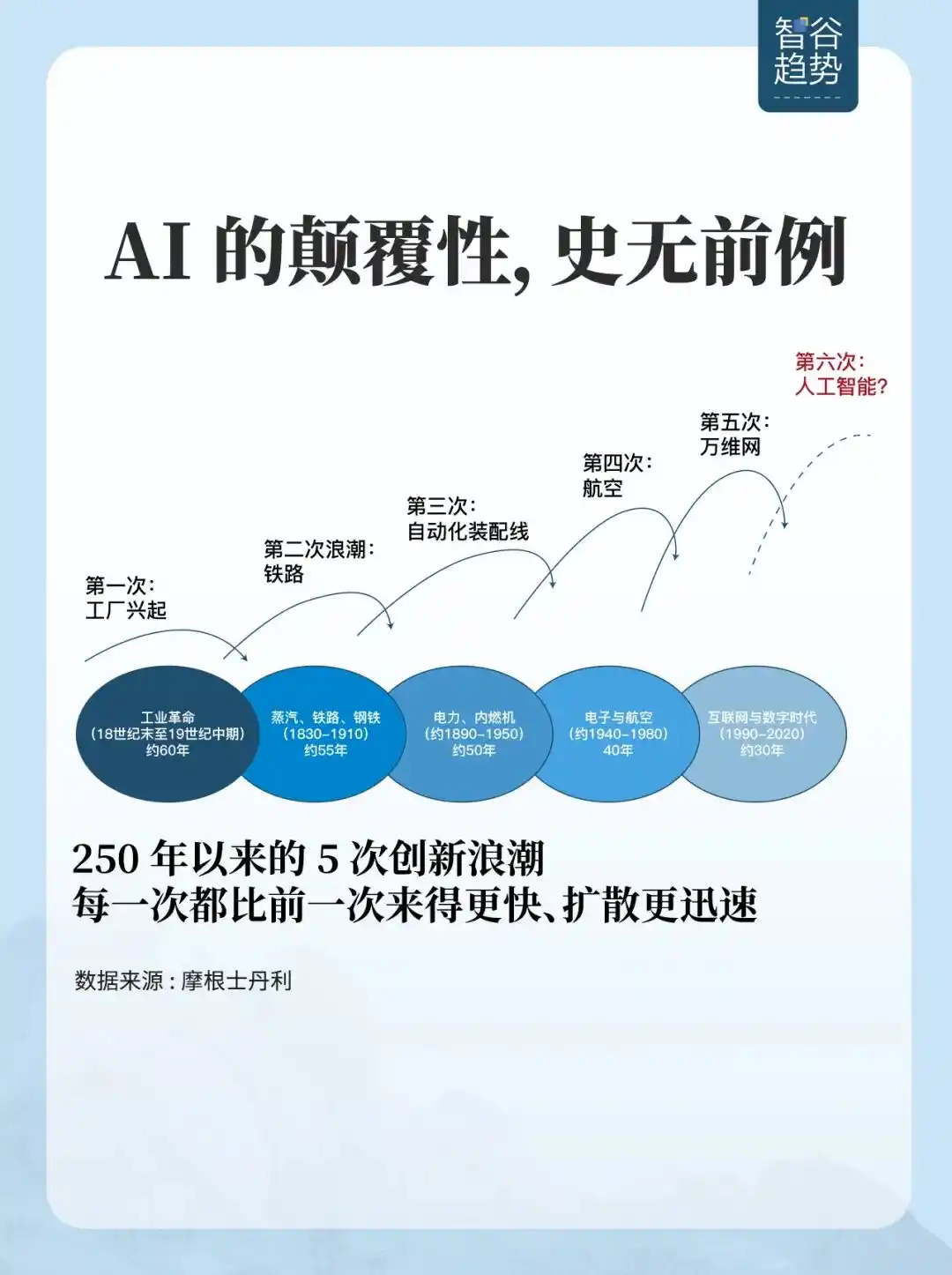
It took humanity sixty years to complete the Industrial Revolution, thirty years for the internet, but ChatGPT reached 100 million users in just two months. The curve of technology diffusion is breathtakingly steep.
The problem is that a historically significant chasm has been created between the pace of technological iteration and the enactment of regulatory laws, the development of social and even corporate defense mechanisms, and the training and education of personnel.
As Kevin Hassett, director of the National Economic Council, frankly stated in an interview:
The White House and even the government are not yet fully prepared to deal with this explosive iteration.
Goldman Sachs CEO Solomon described this round of threats as "highly vigilant," because the current bottom line of defense has changed from "constantly strengthening the firewall" to "using the strongest AI to fight the strongest AI."
This means that the gap between the rapid pace of technological advancement and social adaptation has widened to an unprecedented level. Friction will be more intense than ever before.
As Musk said, "The next 3-7 years may be very difficult for ordinary people."
In response, ordinary people must embrace the concept of lifelong learning. The ability to continuously define and raise complex questions is the greatest competitive advantage in the AI era.
At the same time, AI can replace your skills, but it cannot replace your assets. Building an income structure that does not rely on "selling time" becomes even more important.
This article is from the WeChat official account "Zhigu Trend", author: Buyu