Original article | Odaily Odaily( @OdailyChina )
Author|jk

Introduction: Who is laying the groundwork for the next bull market?
The crypto bull market of 2024-2025 was essentially an institutionalized story. What propelled Bitcoin past $100,000 wasn't retail FOMO, but rather the net inflows into ETFs after BlackRock's IBIT launch and Strategy's continuous bond financing for cryptocurrency purchases. The underlying logic of that bull market was inseparable from the quiet accumulation of positions by institutions during the 2022-2023 bear market.
History seems to be repeating itself, but with drastically different details. In the first quarter of 2026, Bitcoin retreated more than 25% from its peak, while Ethereum experienced an even deeper drop, and market sentiment cooled again. However, against this backdrop, a number of institutions acted in the opposite direction to price movements: corporate treasuries increased their holdings, sovereign wealth funds increased their holdings, bank-affiliated ETFs were launched, and traditional European financial institutions entered the stablecoin market. All of this points to the same question: if the next major market rally will still be driven by institutional funds, then who exactly is buying during this bear market positioning phase?
Odaily reporters conducted an in-depth investigation into the inflow of funds into the crypto market in the first quarter.
In conclusion: Even with the market's severe correction in the first quarter, institutional funds continued to flow into the crypto market. Bitcoin fell more than 25% from around $88,000 to mid-$60,000, while Ethereum's decline was even deeper at 35%. However, Strategy (formerly MicroStrategy) bucked the trend, increasing its Bitcoin holdings by over $10 billion. Sovereign wealth fund Mubadala and other institutions also took advantage of the downturn to increase their positions. Meanwhile, approximately 26 single-asset crypto ETFs completed their issuance or submitted applications under the new SEC General Listing Rules framework.
The funds flowing into the market in the first quarter of 2026 showed a clear divergence : some hedge funds significantly reduced their holdings (Brevan Howard cut his IBIT holdings by 85%), while corporate treasuries, university endowments, ETF issuers, and the Abu Dhabi sovereign wealth fund took the opportunity to buy on the buy the dips . In venture capital, while the number of deals plummeted by 49%, the total quarterly funding amount remained at approximately $5 billion to $6.8 billion, with three deals (BVNK, Kalshi, and Polymarket) accounting for half of the total. Externally, in September 2025, new SEC regulations reduced the ETF approval cycle from 240 days to 75 days; on March 17, 2026, the SEC and CFTC jointly declared staking rewards as non-securities, thus triggering a surge in the issuance of collateralized ETFs.
Part 1: Active Institutional Buyers and Funding Deployment
New Crypto ETF (January-April 2026)
This quarter saw a flurry of new cryptocurrency ETF launches. Bitwise launched the Chainlink ETF (CLNK) on the NYSE Arca on January 14, raising $2.5 million in seed funding. Canary Capital launched two products on the same day, January 13: a Litecoin spot ETF (LTCC, with a cumulative AUM of approximately $9.7 million, the first spot LTC product in the US) and an HBAR ETF (the first spot Hedera product in the US); the company subsequently launched a staking SUI ETF with staking rewards in February. Grayscale also launched a SUI staking ETF in February. 21Shares launched the SUI ETF (TSUI, with AUM of approximately $12.5 million) on Nasdaq on February 24, and the Polkadot ETF (TDOT, with a fee rate of 0.30%, the first spot DOT product in the US, with an AUM of approximately $11 million in its first week) on March 6.
Older investors have also launched several ETFs. BlackRock launched the iShares Ethereum Staking Trust (ETHB) on March 12, becoming the first ETH staking ETF from a mainstream institution, with approximately 82% of staking profits directly distributed to holders. Morgan Stanley launched the Morgan Stanley Bitcoin Trust (MSBT) on April 8, the first bank-backed spot BTC ETF in the US, with a fee rate of 0.14%. It attracted $34 million on its first day and reached a total size of $133 million eight days after its launch. In addition, ProShares launched the CoinDesk 20 Crypto Index ETF (KRYP) in January and February, listed on the NYSE Arca; NEOS launched the Enhanced Bitcoin High Yield ETF (XBCI) around January 29; Bitwise launched the Proficio Currency Depreciation ETF (BPRO, a combination of BTC and precious metals); Nomura/Laser Digital launched the Bitcoin Diversified Income Fund (BDYF, a tokenized yield product) on January 22; 21Shares launched the Strategy Yield ETP (STRC) with BTC as the underlying asset in Zurich on February 25; and Hashdex expanded its NCIQ in the first quarter to cover BTC, ETH, XRP, SOL, and XLM.
In general, new money ETFs, which are ETFs for cryptocurrencies with smaller market capitalizations, are being launched, but ETFs launched by more established, older money ETFs are still concentrated on older, high-market-cap cryptocurrencies.
Notable ETF applications (still pending approval as of April 23)
Morgan Stanley submitted S-1 applications in early January for spot BTC (MSBT, listed in April), Solana, and ETH trusts. Goldman Sachs submitted an application for a Bitcoin premium/options strategy ETF on April 14. Hyperliquid (HYPE) attracted applications from four institutions : Grayscale (GHYP, March 20), Bitwise (BHYP, April 10), 21Shares (THYP, April 14), and VanEck (VHYP), none of which have been approved for listing. Grayscale, VanEck, 21Shares, Bitwise, and Canary have all submitted applications for ADA spot ETFs, and CME's ADA futures contracts were launched on February 9. Truth Social (Yorkville) submitted applications for a BTC+ETH combined ETF and a Cronos enhanced yield ETF on February 13. Bitwise submitted 11 crypto strategy ETFs (covering AAVE, UNI, ZEC, TAO, etc.). REX-Osprey/Defiance submitted 27 crypto ETF applications, including collateralized products and 3x leveraged products.
Currently, Hyperliquid's ETF remains the most anticipated.
ETF Fund Flows (Q1 2026)
The flow of funds in spot BTC ETFs fluctuated significantly : net outflows of approximately $1.6 billion occurred in January (the third consecutive month of net outflows according to crypto.com data), but with the return of buying in March and April, the net outflow narrowed to a positive value for the quarter. BlackRock's IBIT remains its flagship product, with net inflows of approximately $8.4 billion in the first quarter, but its AUM shrank from approximately $78 billion to approximately $54 billion due to price declines. Ethereum ETFs set a record of 19 consecutive days of positive inflows in early January. XRP ETFs saw net inflows of $1.07 billion for the quarter , with 43 consecutive days of positive inflows, significantly outperforming BTC-related products during the same period. The combined AUM of Solana ETFs (BSOL, FSOL) surpassed $1 billion in April; Goldman Sachs disclosed holdings of $108 million in SOL ETFs .
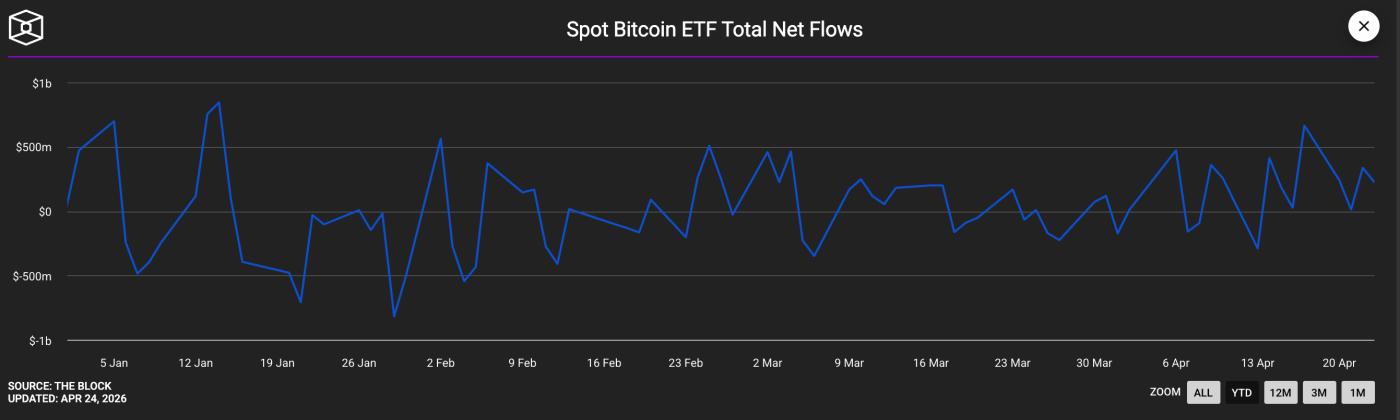
Net inflow was positive for the whole quarter
Listed Company Bitcoin Vault Purchase Records
Strategy (MSTR) continued its aggressive accumulation this quarter. As of April 20, 2026, Strategy held a total of 815,061 BTC, with an average price of $75,527 and a cost basis of approximately $61.6 billion. Metaplanet (3350.T), a Japanese listed company, disclosed on January 1, 2026, that it purchased 4,279 BTC at an average price of $104,638, totaling over $380 million; in the first quarter alone, it increased its holdings by 5,075 BTC, reaching a total of 40,177 BTC as of April 2, with a purchase cost of approximately $400 million in the first quarter.
Strive (ASST) purchased 123 BTC on January 13th at an average price of $91,561, totaling $11.3 million. Subsequently, it completed an all-stock merger with Semler Scientific. The merged company held a combined 12,798 BTC, ranking 11th among corporate treasuries. The merger was completed on January 16th. By mid-March, Strive, through the merger of PIPE and Semler, held approximately 13,628 BTC. DDC Enterprise (NYSEAM) increased its holdings by approximately 600 BTC in January alone, reaching a total of 2,383 BTC by March 19th, with a total value of $182 million.
BSTR Holdings (led by Adam Back and operated by Cantor SPAC) announced its IPO with 30,021 BTC (worth $2.14 billion). Twenty One Capital (XXI) held 43,514 BTC (worth over $3.1 billion) as of April 2nd, making it the second-largest Bitcoin holder among publicly traded companies. Hyperscale Data (GPUS) entered the market on April 21st with 663 BTC, investing $50.3 million, targeting a $100 million treasury.
Ethereum and staking-related corporate vaults
BitMine Immersion (BMNR) is currently the largest enterprise Ethereum treasury, staking 74,880 ETH (approximately $219 million) through the MAVAN platform in the first quarter. In the week ending April 20, 2026, it purchased 101,627 ETH (over $230 million), its largest single-week purchase so far in 2026. As of April 20, the company held approximately 5 million ETH, of which approximately 3.33 million were staked, with an AUM of approximately $12.9 billion. SharpLink Gaming (SBET) is the second largest Ethereum treasury, holding approximately 867,000 ETH (worth between $1.7 billion and $2.3 billion), nearly 100% of which are staked, as disclosed on March 10.
Major reducing party
Bitcoin mining companies were net sellers overall in the first quarter. MARA Holdings sold 15,133 BTC between March 4th and 25th, raising $1.1 billion to repurchase convertible notes; Riot Platforms sold 3,778 BTC, raising $290 million; Nakamoto Holdings sold 284 BTC; and Genius Group liquidated its entire 84 BTC holdings on April 1st. The Kingdom of Bhutan (Druk Holdings) has transferred approximately $42 million worth of BTC in small amounts throughout the year. Strategy, a single company, accounted for 94% of all publicly traded companies' net BTC purchases in March.
Trends in Banks and Asset Management Institutions
Morgan Stanley has not only submitted an ETF application, but also applied to the OCC for a national license to operate a digital trust bank in February 2026, and announced that it would open BTC/ETH/SOL trading to retail clients through E*Trade/Zerohash.
On January 23, UBS announced that it would offer BTC/ETH trading services to its Swiss private banking clients, covering its $7 trillion wealth management business.
Citigroup announced the launch of its institutional-grade BTC custody infrastructure at the Strategy World conference on February 26. Standard Chartered launched its institutional BTC/ETH custody service in Hong Kong in January and was reportedly in talks to acquire all of its Zodia Custody stake (April 8).
BBVA recommends that high-net-worth clients allocate 3-7% of their assets to crypto assets.
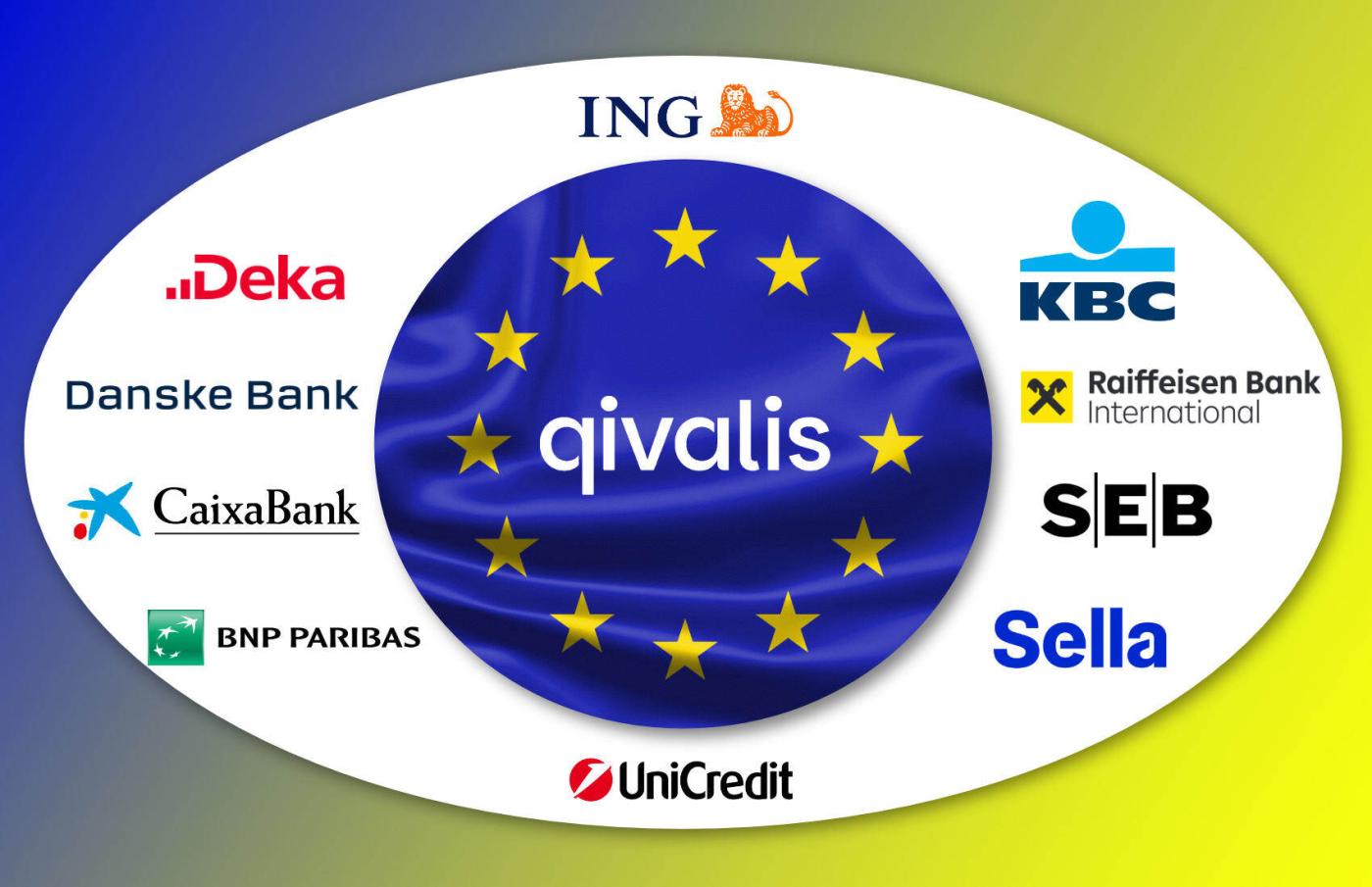
Twelve European banks (BBVA, BNP Paribas, ING, UniCredit, UBS, Danske Bank, Svenska, Svenska Savings Bank, DZ Bank, DekaBank, Lefassen Bank, and Banca Sella) formed the Qivalis Euro stablecoin consortium on the Fireblocks platform, in compliance with the MiCA regulatory framework (April 21).
Vanguard has opened up third-party crypto ETFs to its 50 million brokerage clients across its $11 trillion platform. Fidelity is offering a 1% BTC allocation option in its 401(k) retirement plans, which has reportedly attracted approximately $800 million in funding.
Nomura Securities, Daiwa Securities, and SMBC Nikko Securities have all announced plans to launch cryptocurrency exchanges in Japan by the end of 2026.
13F Disclosure (Holdings in the fourth quarter of 2025, to be disclosed in February 2026)
Goldman Sachs' crypto ETF holdings totaled approximately $2.36 billion , covering BTC ($1.06 billion), ETH ($1 billion), XRP ($152 million), and SOL ($109 million), but BTC and ETH positions decreased by 39% and 27% respectively compared to the previous period.
Mubadala (Abu Dhabi's sovereign wealth fund) increased its IBIT holdings by 46% to 12.7 million shares (approximately $631 million) , adding about 2,300 BTC against the market downturn.
Al Warda Investments (part of the Abu Dhabi Investment Authority) increased its holdings in IBIT to 8.2 million shares (approximately US$437 million), pushing Abu Dhabi's total sovereign capital crypto exposure to over US$1 billion.
Millennium increased its holdings of IBIT by approximately 67% (equivalent to approximately 8,100 BTC, making it the largest holder overall).
Jane Street increased its stake in IBIT by more than 50% to 20 million shares.
Harvard University reduced its IBIT holding by 21.5%, but established its first ETH position (3.87 million ETHA shares, worth $86.8 million). Dartmouth College became the fourth Ivy League school to join the fray.
Regarding reductions in holdings: Brevan Howard significantly reduced his IBIT holdings by 85% (from 37.5 million shares to 5.5 million shares, equivalent to a reduction of approximately 17,700 BTC); Farallon reduced by 70% (a reduction of approximately 2,800 BTC); Tudor reduced its holdings by approximately 1,300 BTC; DeShaw hedge fund halved its IBIT holdings; and Sculptor almost completely liquidated its FBTC holdings (reducing them by approximately 90%).
Sovereign wealth funds and governments
Besides Mubadala and Al Warda, Luxembourg's sovereign wealth fund FSIL maintained a 1% Bitcoin allocation (approximately €8.5 million), becoming the first Eurozone sovereign wealth fund to hold BTC. El Salvador continued its strategy of "buying 1 BTC daily" (currently holding 7,547 BTC, totaling approximately $635 million) and added $50 million to its gold reserves on January 29. The Czech National Bank (purchased in November 2025, extending to 2026) remains the only central bank in the world holding Bitcoin.
The US Strategic Bitcoin Reserve has seen no increase in holdings to date. CoinDesk confirmed on March 6 that the Trump executive order is "slow to progress"; the reserve still holds only approximately 328,372 confiscated BTC. White House Digital Assets Committee member Patrick Witt reiterated his commitment, but no actual purchases have taken place. Among US states, only Texas has injected $5 million into IBIT in November 2025 (an additional $5 million remains unused). New Hampshire and Arizona have related legislation, but neither has actually deployed funds. Reports persist that CalPERS plans to allocate 1% (approximately $500 million) of BTC , but CalPERS has not officially confirmed this.
Family Office
Two surveys reveal contrasting trends: JPMorgan Private Bank's 2026 Family Office Report shows that among 333 surveyed institutions (with an average net worth of $1.6 billion), 89% reported having no Bitcoin holdings , with AI investment being their primary focus. The BNY Mellon Wealth/NOIA survey , however, indicates that 74% of ultra-high-net-worth family offices are investing in or exploring crypto assets (a significant increase from 53% in the previous year), with a typical allocation of 2-5%, approximately 5% for Asian institutions and 2-4% for US and European institutions.
Part Two: Summary of Crypto Venture Capital Funding in Q1 2026
The first quarter of 2026 saw a paradox in crypto VC funding: while total capital remained relatively stable (down 8% to 16% year-over-year), the number of deals plummeted by 49%. The most comprehensive statistics come from Crypto-Fundraising.info (April 1st), recording 222 deals including M&A, totaling $6.81 billion; excluding M&A, pure VC funding totaled 183 deals, amounting to $4.77 billion. DefiLlama/DL News (April 4th, VC only) tracked 53 deals exceeding $10 million, totaling approximately $5 billion. JPMorgan estimates total inflows into digital assets in the first quarter at approximately $11 billion, about one-third of the same period in 2025. Galaxy Research's regularly published quarterly crypto VC report was not yet available as of April 23rd, but its Q4 2025 baseline ($8.5 billion/425 deals) provides a comparable comparison.
Core data
Compared to Q1 2025 ($5.37 billion in VC funding, 358 deals) and Q4 2025 ($8.5 billion, 425 deals), Q1 2026 saw total VC funding of approximately $4.77 billion, a year-over-year decrease of 11% and a quarter-over-quarter decrease of 44%. The number of deals was 183, a sharp year-over-year decrease of 49% and a quarter-over-quarter decrease of 57%. Notably, the average VC funding round size surged 76% year-over-year to $35.9 million (median $8 million), reflecting a significant polarization: seed rounds were the most active in terms of deal size ($37 deals, totaling $252 million), while the average size of the four Series C funding rounds reached a high of $108.8 million. The average pre-seed round was only $1.75 million, indicating a near-shrinking mid-tier market.
Three transactions wiped out half a quarter.
Funding this quarter was characterized by extreme concentration and significant delays . March alone saw $4.43 billion in funding (65% of the total for the quarter), compared to a dismal $686 million in February.
The following three transactions alone totaled $3.4 billion, accounting for about half of the total disclosed financing in the quarter: BVNK, a payment sector acquisition target ($1.8 billion, March 17), prediction market platform Kalshi (Coatue led a growth round, valuing the company at $22 billion, with $1 billion raised on March 19), and Intercontinental Exchange's strategic investment in Polymarket ($600 million, March 27).

The competition for market leadership is already fierce in the financing arena.
Other notable large-scale funding rounds include: Rain ($250 million Series C funding in the stablecoin payments sector, led by Iconiq/Dragonfly/Galaxy, valuing the company at approximately $1.95 billion, January 9); BitGo's IPO on the NYSE, raising $213 million (January 22); XBTO's strategic funding of $217 million (March 25); Flying Tulip's token offering of $206 million ($FDV $1 billion); Whop's $200 million investment from Tether (February 25); BlackOpal's RWA funding of $200 million (January 8); Kraken/Payward's $200 million secondary market transaction led by Deutsche Börse, valuing the company at $13.3 billion; LMAX Group's $150 million investment from Ripple (January 15); Alpaca's $150 million Series D funding; and Bluesky's $100 million Series B funding led by Bain Capital Crypto (March 19). (Day); Anchorage Digital received a $100 million investment from Tether, valuing the company at over $4 billion (February).
Sector Distribution: Payments and Prediction Markets Outperform DeFi
The star sectors of the 2021 bull market cycle—blockchain games, NFTs, and L1 infrastructure— have almost disappeared from the top of the funding rankings .
- The payments/stablecoins sector topped the list with $2.39 billion (35% of the total, 17 transactions);
- The prediction market followed closely with $1.72 billion (25.2%, 11 deals);
- Finance/CeFi ranked third with $835 million (12.2%, 25 transactions).
- RWA (Real-World Asset) raises $284 million (4.2%, 7 deals).
- Trading markets/platforms: $255 million (3.7%, 2 deals)
- Infrastructure/L1-L2 financing totaled $184 million (2.7%, 12 deals).
- DeFi only raised $89 million (1.3%, 5 transactions).
- NFTs, blockchain games, and metaverse are almost negligible.
The top three sectors together absorbed 72% of the total funds disclosed in the quarter.
Active investment institutions
Coinbase Ventures topped the list of institutional investors with 12 investments, more than double that of the second-place investor. Following them were Tether (8 investments), Animoca Brands (7 investments), CMT Digital (6 investments), and tied with a16z crypto, Castle Island, Big Brain, and Galaxy Digital (5 investments each).
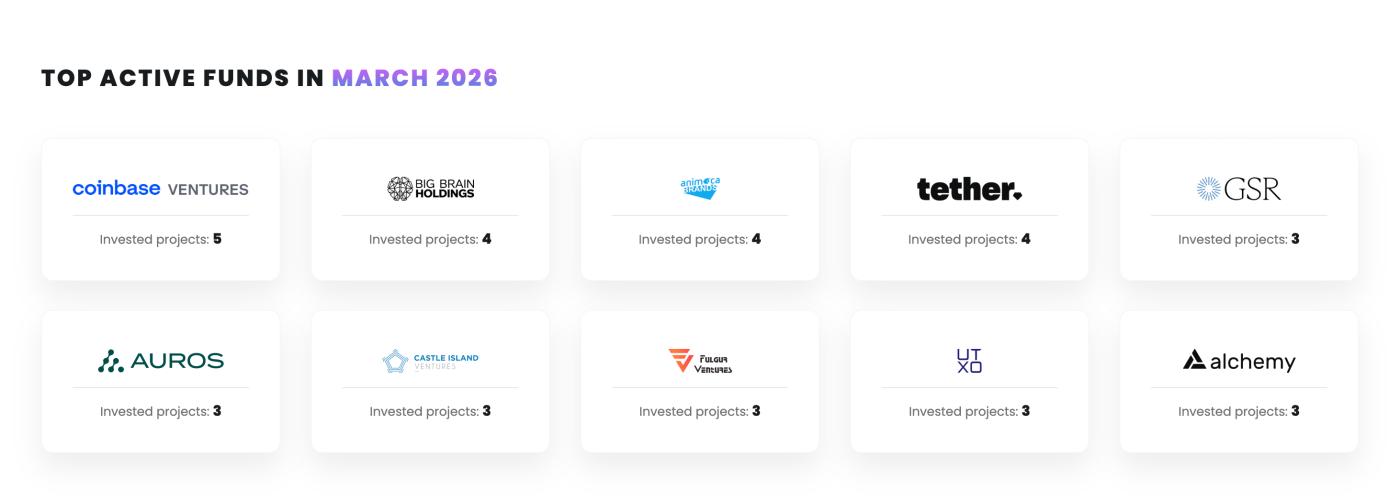
Most active funds in March
Traditional financial institutions are entering the infrastructure sector with unprecedented力度 (intensity/scale) : Franklin Templeton participated in four funding rounds, Intercontinental Exchange invested in Polymarket, Deutsche Börse acquired a stake in Kraken, and Citadel Securities, Bain Capital, Sequoia Capital, and Alibaba also participated in relevant funding rounds in the first quarter. Geographically, the three largest funding rounds (BVNK, Kalshi, Polymarket) and the BitGo IPO all originated in the United States, indicating that US capital's share in crypto VC continues to maintain the level of approximately 55% seen in the fourth quarter of 2025.
Conclusion: Institutional funds exhibit a dumbbell structure.
In early 2026, the institutional crypto investment landscape was undergoing a two-way divergence.
On the buy side, institutions with a long-term holding mentality, such as Strategy, BitMine, Metaplanet, Mubadala, and BlackRock ETFs, took advantage of the market downturn to increase their holdings, while tactical hedge funds (Brevan Howard, Tudor, Farallon) and most Bitcoin mining companies turned to net selling. Strategy alone bought more Bitcoin in the first quarter than all other publicly traded companies combined, and its weekly purchases from April 13-19 set the third-largest record in history.
On the venture capital front, a similar polarization is unfolding: mega-funding in payments and prediction markets continues to expand, while small and medium-sized projects are generally facing a funding shortage. This shift in leadership across sectors—from DeFi/NFT/blockchain games to stablecoins, prediction markets, and compliant CeFi infrastructure—signifies that the industry's growth engine is gradually shifting from a speculative, crypto-native narrative towards a trading model closer to regulated fintech .
The biggest uncertainty currently stems from the US strategic Bitcoin reserve: despite high-profile pronouncements from the administration over a year ago, actual fund deployment remains at zero. If the National Defense Authorization Act of 2026 opens a funding path, it will fundamentally reshape market demand. Until then, the real footing is being paid for by corporate treasuries and sovereign wealth funds, not Washington.