Author: Alex Xu
For most of the past few years, BTC has been my largest total asset position (it is no longer).
In this BTC bull market cycle:
At 70,000 , I unwound the small leverage I had added during the deep bear market (around 1.1-1.2 times, completed through BTC collateralized lending).
With a portfolio size of 100,000 to 120,000 , I reduced my BTC position from full to around 30%.
There were also some minor operations during this period, such as adding a small amount of BTC when it pulled back to 50,000+ in 2024, and adding a small amount of BTC when it spiked to 60,000 in February this year. These operations were all based on a long-term bullish view on BTC.
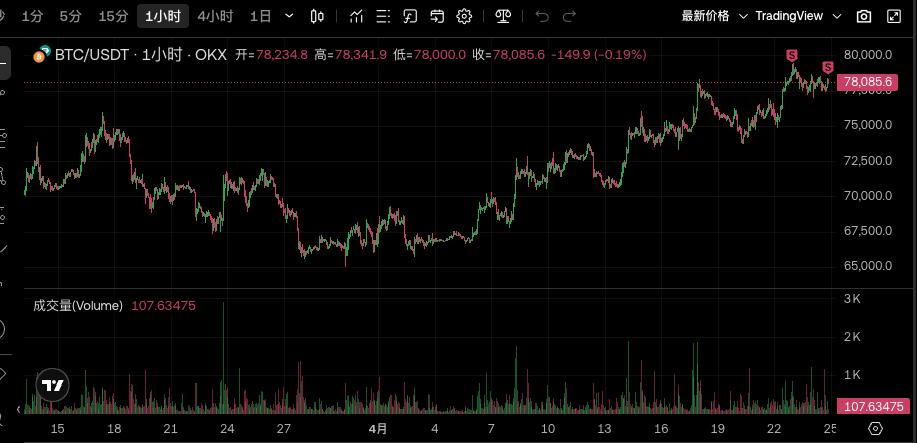
Based on the usual cyclical logic, now is a good time to accumulate more BTC and wait for the next bull market cycle. However, during the recent BTC rebound, I further reduced my BTC position, which was already as low as 30%, at the 78,000-79,000 level.
I must continuously monitor the assets I hold and conduct regular fundamental reviews. Reducing my BTC holdings is also an action taken after continuous review and deliberation. The conclusion is that I will lower my expectation for the peak market value of BTC in the next bull market .
Let's analyze the reasons:
First, the potential energy driving the next BTC cycle to continue its surge is not as strong as in the previous cycles.
In previous BTC cycles, there was an expectation of an exponential expansion of the investor base, from financial experiments by niche geeks to asset allocation by the general public and even institutions. This narrative has been gradually realized in each previous cycle.
In the round from 2023-2025, it entered the holdings of mainstream financial institutions through the listing of compliant ETF products, and received strong support from Trafigural Financial institutions represented by BlackRock, plus strong shill from the president of the world's largest country. If we want to elevate the narrative to another level, its next round would require it to at least enter the balance sheets of leading sovereign nations, for example:
More sovereign funds (currently mainly from Abu Dhabi).
Central Bank Reserves
Government fiscal reserves alone (such as those of the states in the United States) may not be enough, as the purchasing power they can provide is relatively small and far less than that of traditional financial institutions.
However, in my opinion, achieving this leap in the next 2-3 years will be quite difficult. Initially, this bull market was fueled by the expectation that Bitcoin would be included in the US Federal Reserve, but that hope was largely disproven last year.
Currently, very few US states have even passed Bitcoin reserve legislation. At its peak in early 2025, over 20 US states were pushing for Bitcoin reserve legislation; now, only a small number have passed, and some are even incomplete, requiring separate proposals and approvals for their purchase budgets.
Currently, central banks in major countries have not shown any obvious interest in BTC. Its short history of consensus, excessive volatility, and the existence of gold as a competitor all make it very difficult for BTC to be included in central bank balance sheets.
Second, it increases my personal opportunity cost.
Over the past six months, I have gradually discovered many good companies, and their prices are currently quite attractive. These companies will be the main focus of my portfolio adjustments (another part is to increase cash reserves).
Third, there is the negative impact of the overall downturn in the crypto industry on Bitcoin demand and consensus.
Currently, very few business models in the crypto industry are viable, and most Web3 models (socialfi, gamefi, depin, distributed storage/computing power, etc.) have been gradually proven false over time. In reality, only DeFi has truly generated positive cash flow and profits. However, DeFi's overall development in the latter half of this cycle has been relatively mediocre, primarily due to the shrinking of high-quality native assets in the industry, leading to a contraction in DeFi businesses (still mainly focused on lending and DEX trading).
The shrinking of the entire crypto industry's base and the reduction in practitioners and investors will also lead to a slowdown or even a loss of BTC holdings.
Hypeliquid, as an on-chain exchange, is an outlier that has grown against the trend. However, its success largely stems from taking a share of the existing market from centralized exchanges (CEXs) and later incorporating 24/7 trading of asset classes outside of crypto (commodities, US stocks, pre-IPO assets), with relatively little direct value transfer to BTC. Relying on regulatory arbitrage and standing out as a lone player, Hypeliquid is unlikely to hedge against the overall industry-wide trend of contraction (the impact of prediction markets is similar).
Fourth, the financing costs for Strategy, the largest buyer of BTC, continue to rise.
Its primary financing method currently involves issuing perpetual preferred stock (STRC), with interest rates already reaching 11.5%. Furthermore, it's about to switch from monthly interest payments to bi-weekly payments, otherwise the market price of STRC will become unstable. This gives me a rather uneasy feeling, even though Strategy's current financial situation is still far from a potential financial collapse.
Furthermore, we can see that, apart from Strategy, almost all the previously very active BTC DAT concept stocks have died out, leaving only Strategy standing alone. Strategy doesn't need to actually collapse to suppress the price of BTC; as the largest listed holder and net buyer of BTC, a decrease in its buying speed and depletion of its financing capacity will trigger significant marginal selling pressure.
Fifth, gold, Bitcoin's main competitor in the non-sovereign asset sector (value proposition: hedging against fiat currency inflation), has narrowed the gap with Bitcoin in terms of product offerings.
We previously stated that Bitcoin, the "electronic gold," is superior to gold because it has better divisibility, portability, verifiability, and decentralization.
However, this round has seen the emergence of "tokenized gold," which is no different from Bitcoin in terms of verifiability, portability, and divisibility, and its scale is growing rapidly.
(Reference: rwa.xyz's statistics on the scale of tokenized commodity assets, the majority of which are tokenized gold)
Of course, many people would say that tokenized gold relies on centralized credit, but in my opinion, whether or not it relies on centralized credit is not actually a necessary condition in the crypto industry, because one of the core infrastructures of the entire crypto industry—stablecoins—is mostly based on completely centralized credit.
Sixth, with Bitcoin's halving, the problem of insufficient security budget is becoming increasingly serious.
(Exploration of new fee sources such as inscriptions and BTC L2 has largely failed). This is a well-worn topic, but it remains a problem. On the other hand, I don't think quantum computing poses a significant threat, as the community already has solutions.
Summary and Q&A
Of course, I'm still bullish on BTC after reducing my holdings; otherwise, I should have sold everything. It remains one of my largest asset holdings, and I hope it can continue to rise.
Other issues may include:
Why reduce it now?
Because there has been a significant rebound recently, I'm reducing my intake.
What if my weight increases after I lose weight?
If the reasons for my pessimism become less valid due to changes in the external and internal environment, or if more positive factors emerge that I hadn't considered before, and the price wasn't too high at the time, I will buy it back.
If the price was already too high to justify buying it back, then it means my understanding of the asset was not commensurate with it, and I should accept the outcome.
This is just one person's opinion, for reference only.