After consuming countless GPU resources and burning through enough electricity to power several cities for a year, OpenAI's latest AI raw image model, GPT-Image-2, has once again reached a high point in its life.
Reading palms/faces for humans.
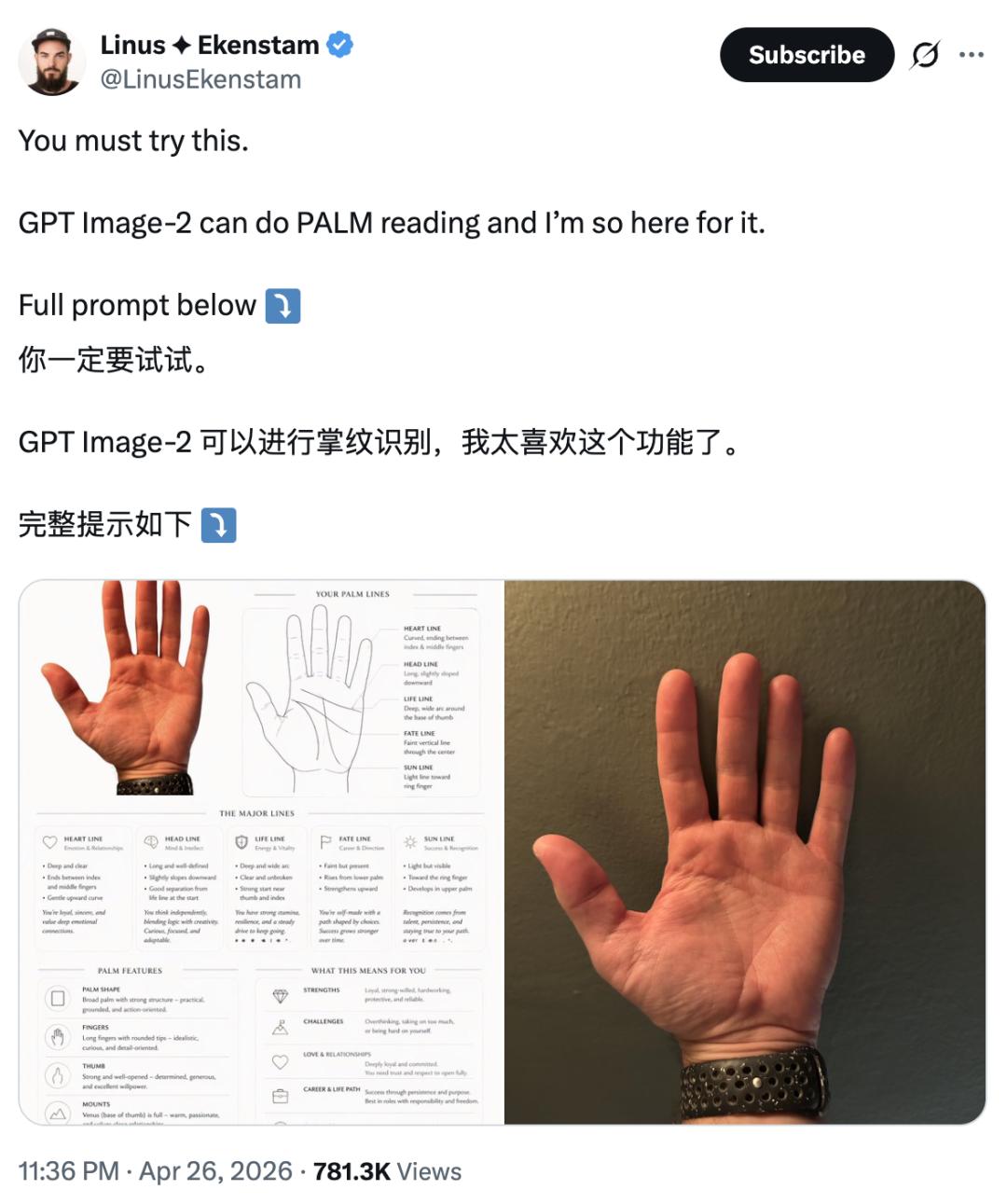
Simply take a high-resolution photo of your palm and send it to GPT-Image-2 along with a short prompt, and it will transform into a cybernetic fortune teller, generating a beautifully formatted and meticulously worded palmistry personality and career guide for you.
This fun test, which was first launched by AI enthusiast Linus Ekenstam, quickly turned into a fortune-telling frenzy across the internet.
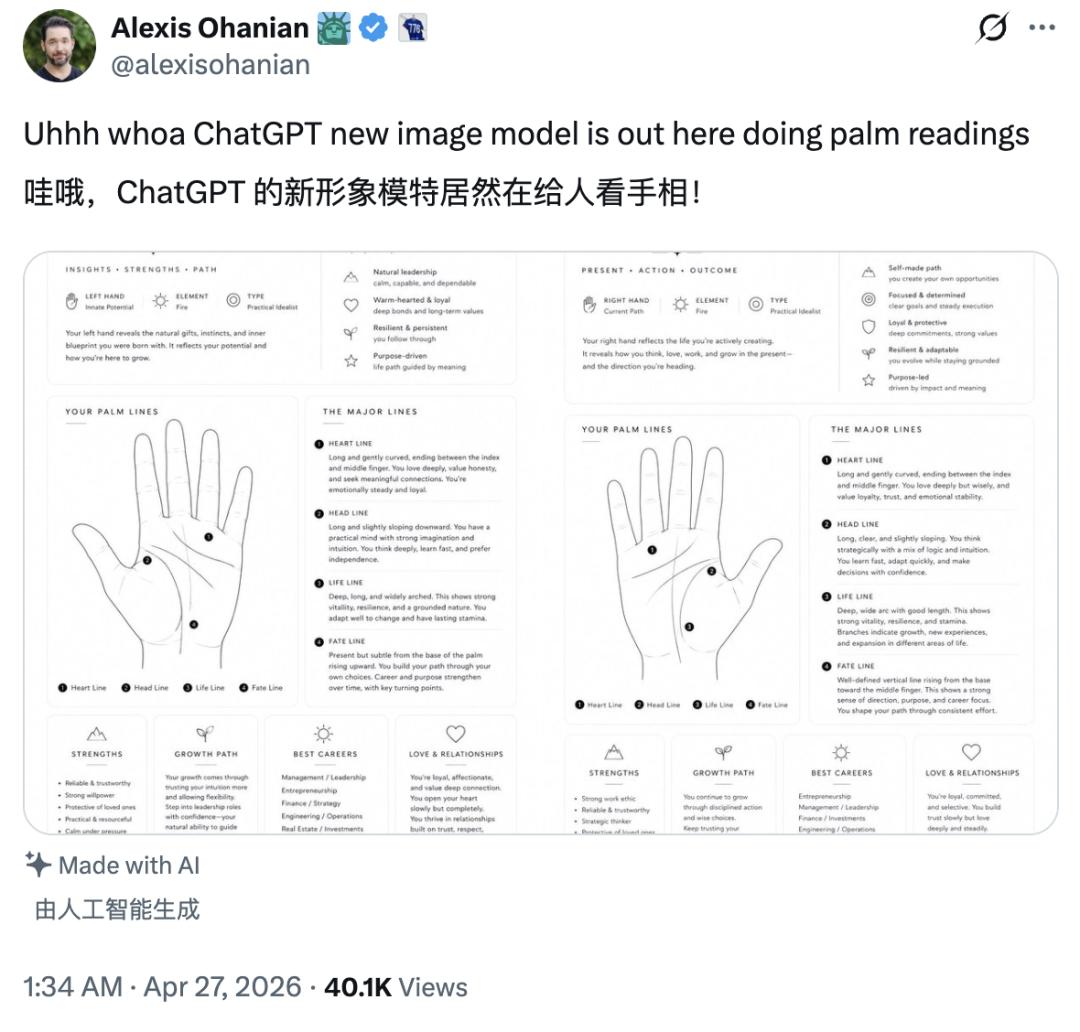
Even Reddit co-founder Alexis Ohanian couldn't resist and obediently handed over a close-up of his hand to the AI. Then, he happily accepted the high praise of being a "pragmatic idealist suited for entrepreneurship."
Justine Moore, an investment partner at a16z, also joined in the fun.
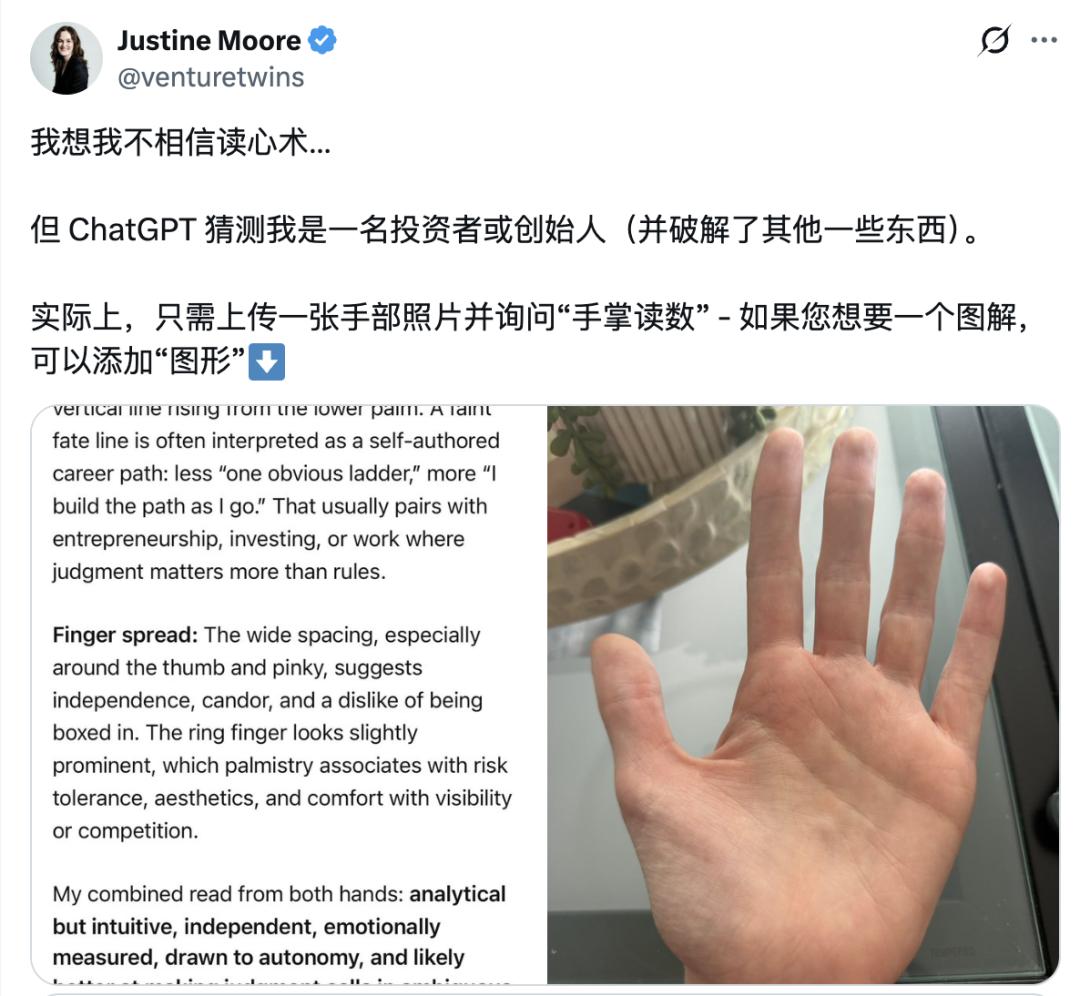
Here are the key words for Linus Ekenstam:
Original prompt: based on my hand I want you to make a complete palm reading guide, Analyze the palm, the style of the guide should be clean and minimal, thin lines, rounded cards, overall very expensive looking. Focus on the palm reading, create a simple black on white contour of my main lines, as a little artwork. do your best)
(Translation: Based on my palm, I would like you to create a complete palmistry guide, analyzing the lines on my palm. The guide should be minimalist in style, with fine lines, rounded corners, and an overall high-end feel. Focus on palmistry, using simple black and white outlines to draw my main palm lines as a small illustration. Please do your best to complete it.)
To verify the authenticity of this cyber-divine oracle, we immediately arranged a comprehensive real-world test. We sent it a picture of a worker who had been working late into the night, and wow, the AI seriously praised it along the lines of its palm.
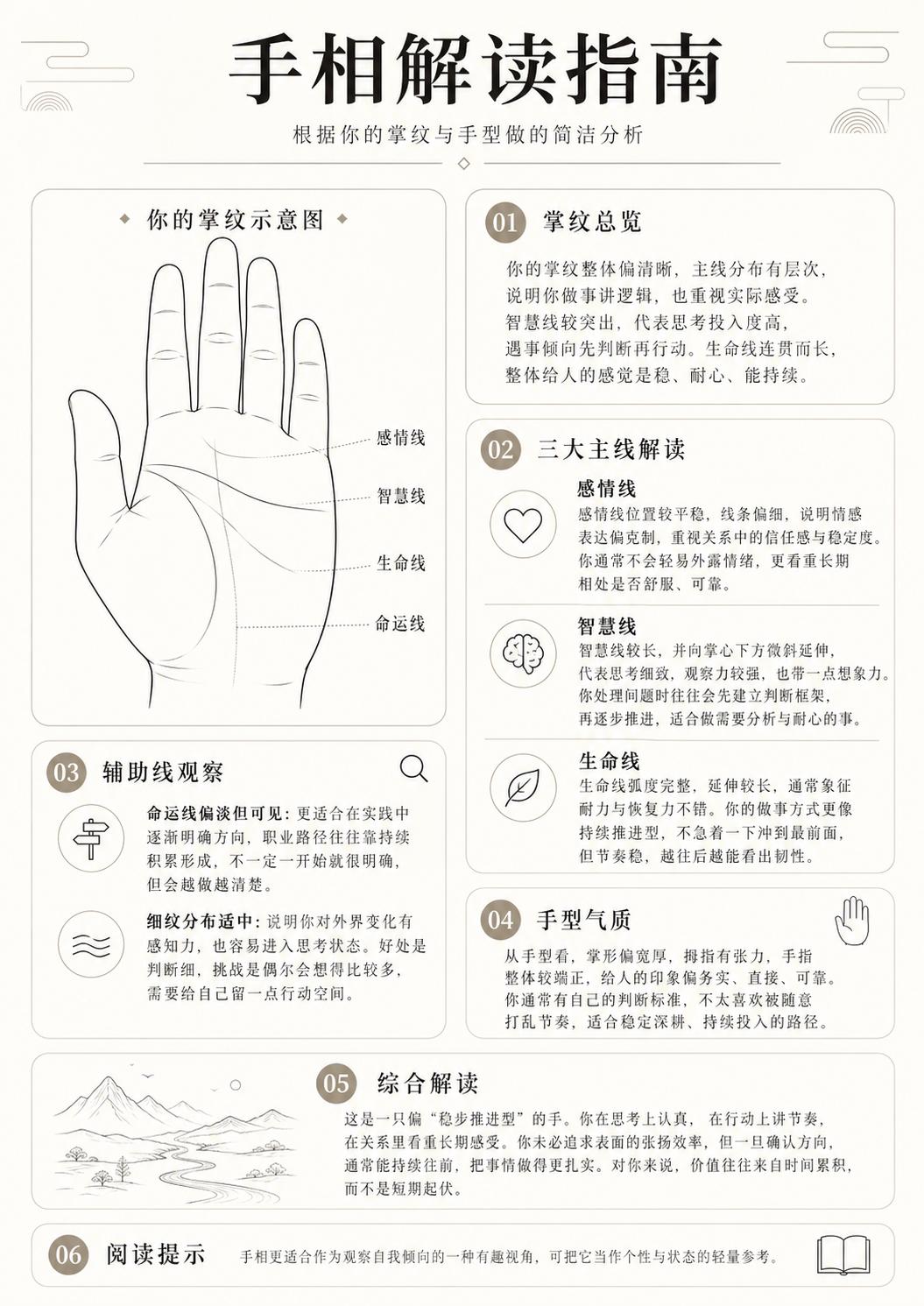
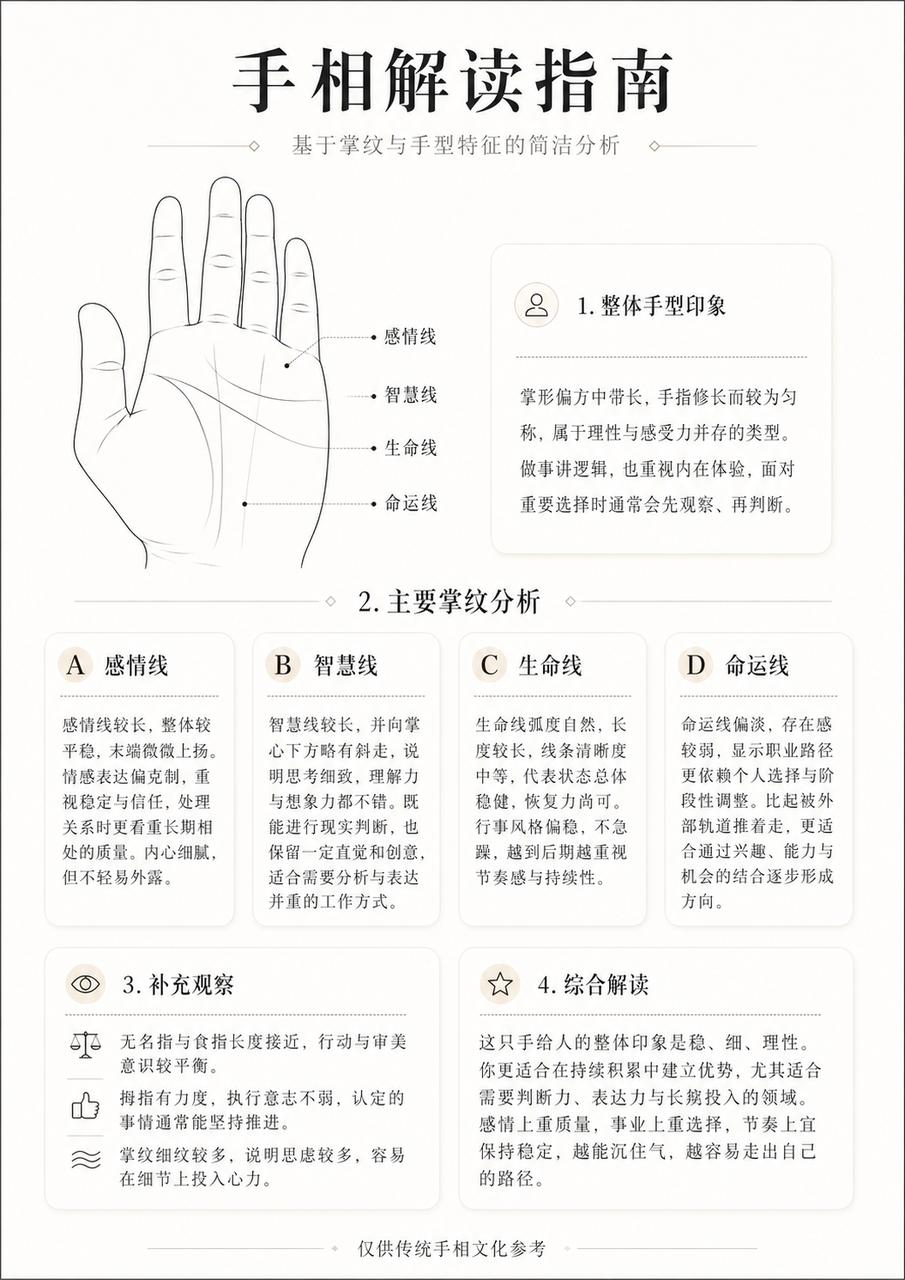
Prompt: Based on my palm, I would like you to create a complete palmistry guide, analyzing the lines on my palm. The guide should be minimalist in style, with fine lines, rounded corners, and an overall high-end feel. Focus on palmistry interpretation, using simple black and white outlines to draw my main palm lines as a small illustration. 2K
Based on the same prompt, I tested it again, and the results were roughly the same. The more I looked at it, the more it matched my self-assessment. Could this AI really be a demigod descended to earth?
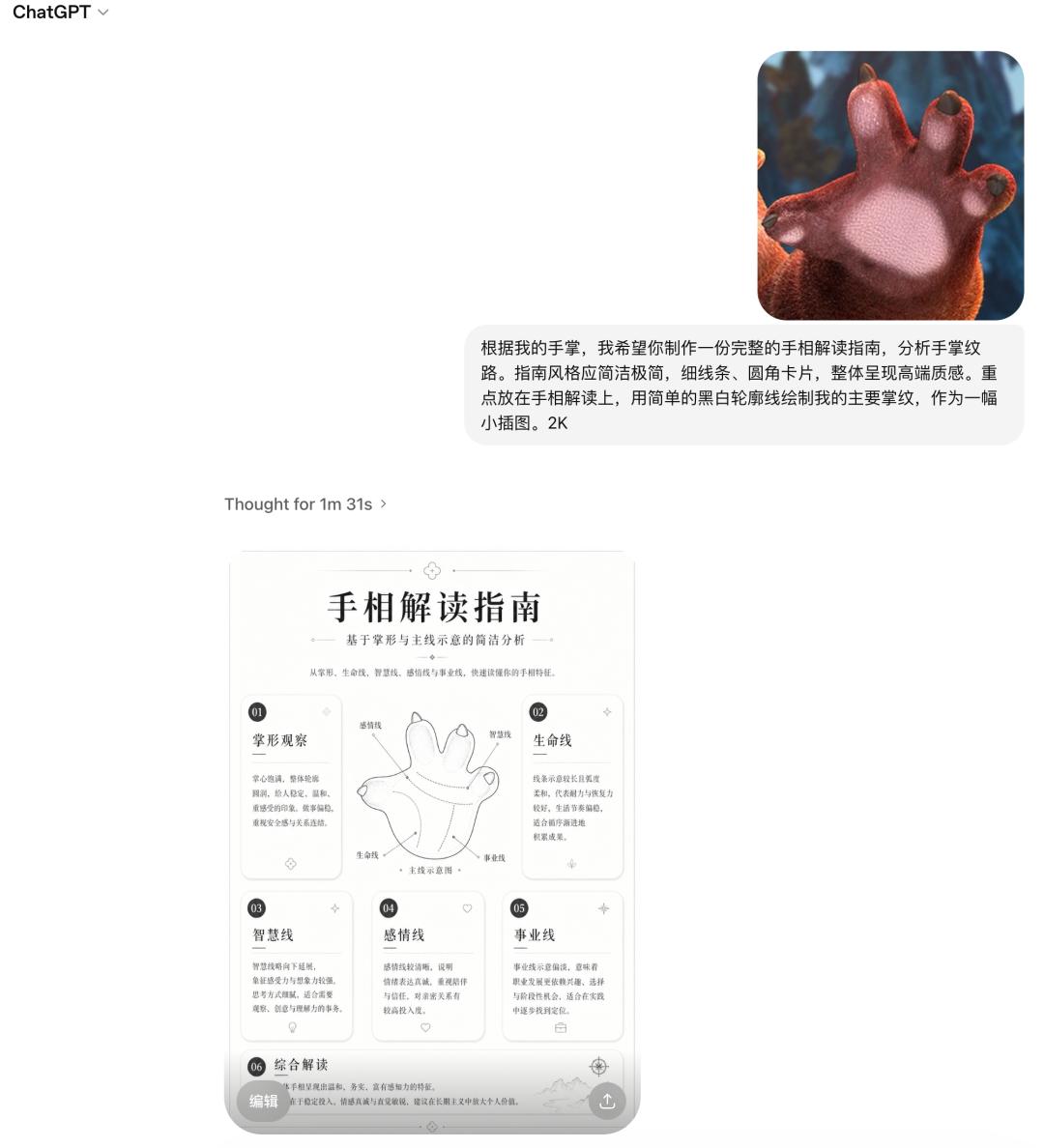
Wait a minute, the art style is starting to get absurd.
You could just toss them a picture of Bear Big's paw print from "Boonie Bears." They'd still launch into a long, serious-sounding rant. They're not even picky about species anymore, are they?
Besides palmistry, there's even a version that analyzes facial features. Elon Musk, the world's richest man, was described as "rational, restrained, and steady."
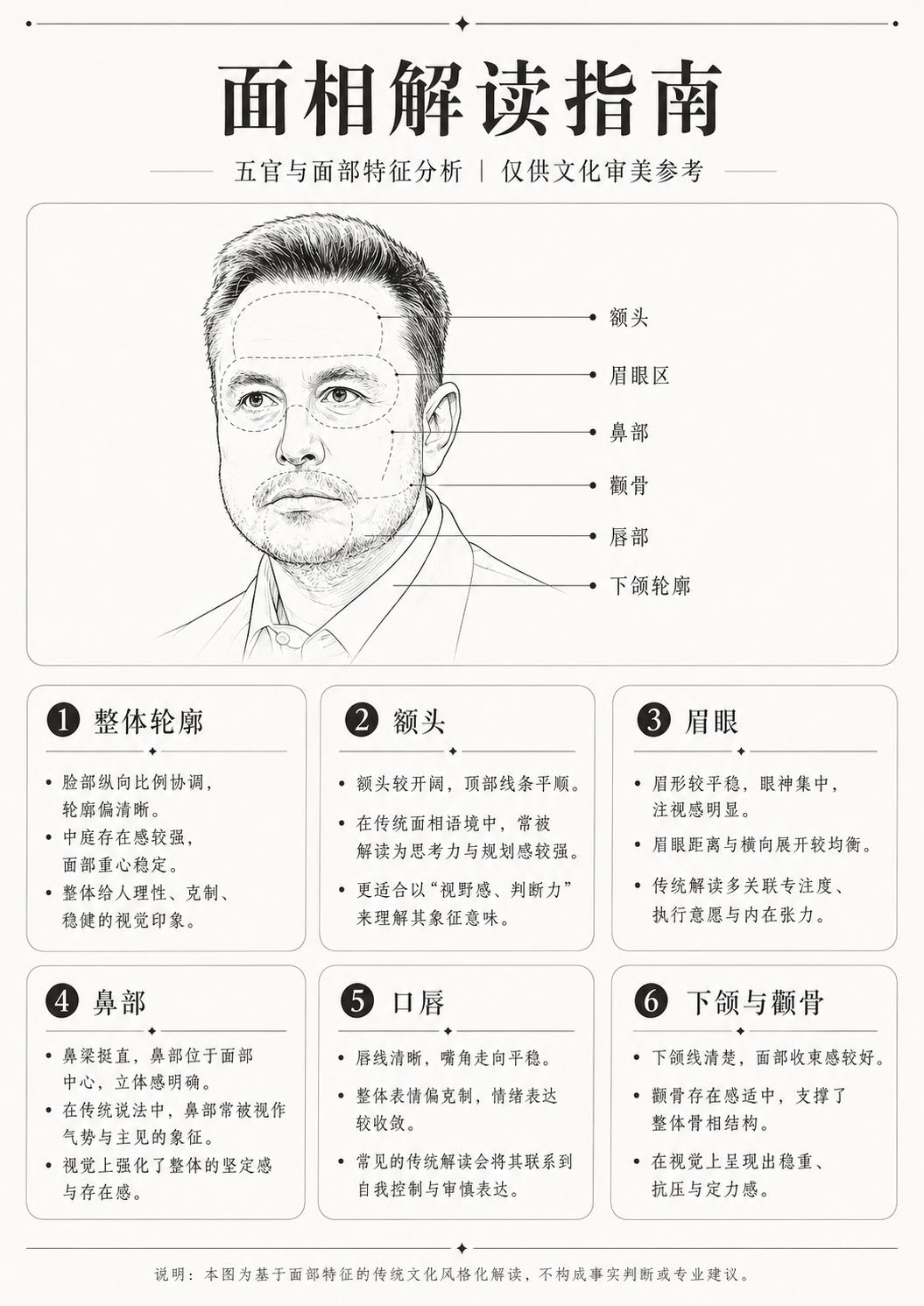
Prompt: Based on my facial photograph, create a complete face reading guide, analyzing my facial features and characteristics. The guide should have a minimalist, clean style, using fine lines and rounded corners to create a high-end feel. Focus on face reading, using simple black and white outlines to depict my main facial features and area divisions as a small illustration. 2K
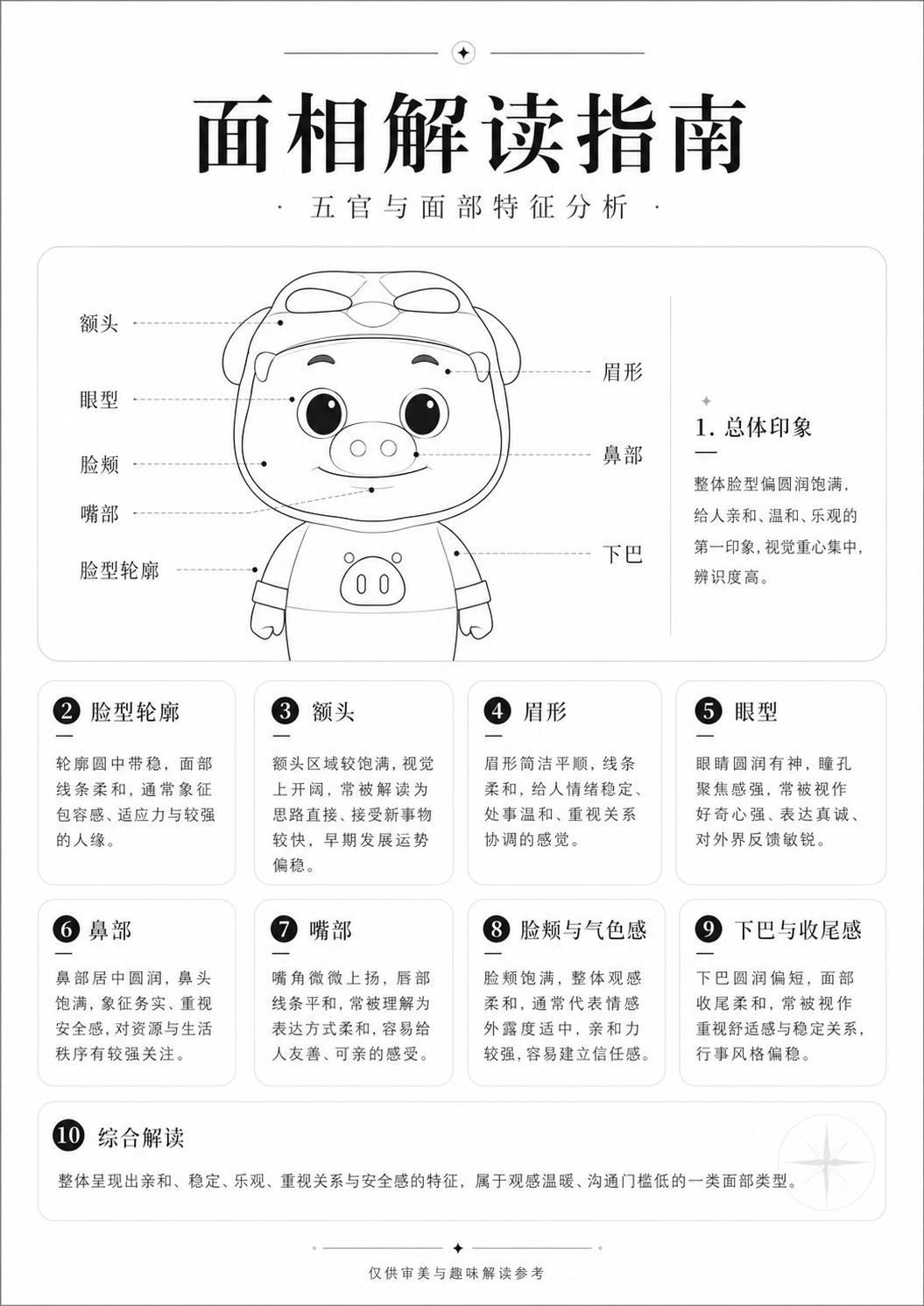
Let's throw another picture of Pig Hero's face at him. After reading this sophisticated personality analysis, one can only sigh and say, "Old Pig, there's a reason why you've become popular again."
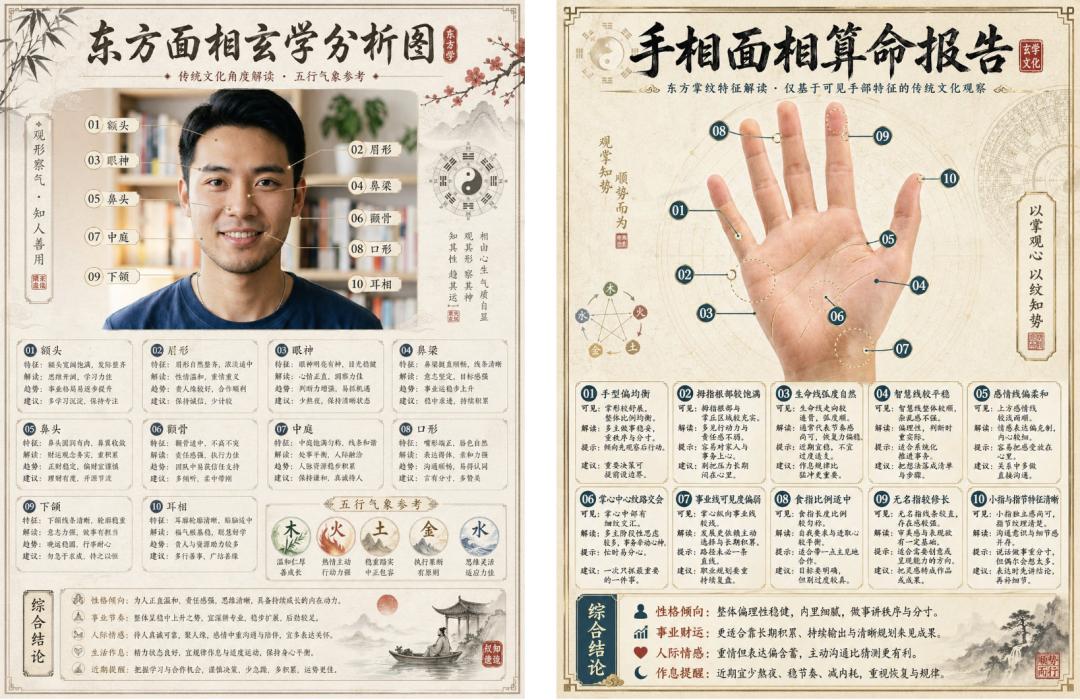
Blogger @MrLarus also provided an advanced version of the face reading test.
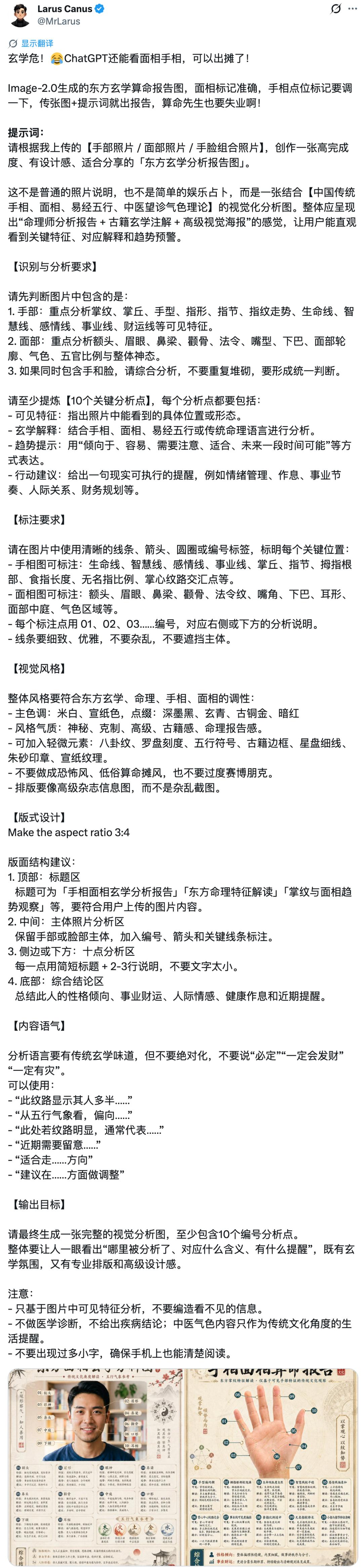
Scroll up and down to see more content
🔗 https://x.com/MrLarus/status/2047930679552307370
Of course, using AI to read palms/faces is not a new thing, and it's very popular on Chinese social media. After the release of Nano Banana Pro, some netizens explored similar ways to use it, but the image quality may not be as good as GPT-Image-2.
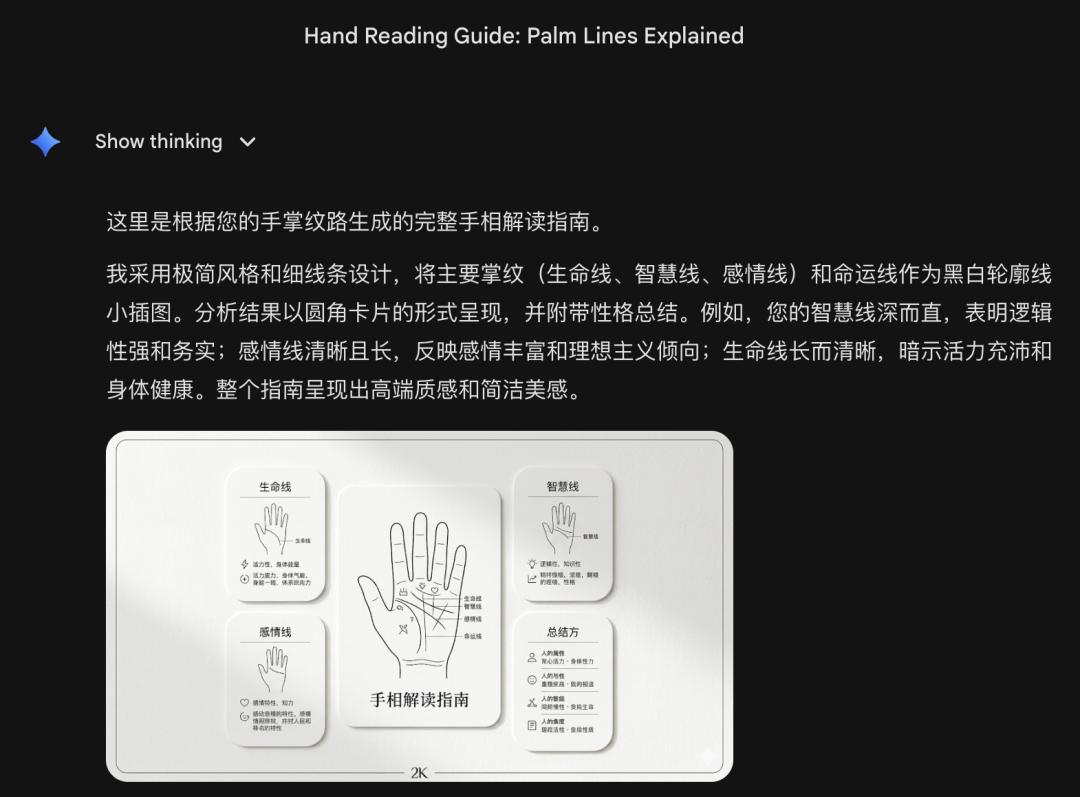
The core logic of this approach is extremely simple: it precisely targets two major human weaknesses: the desire to explore the unknown future and the urgent need for external validation of one's self-worth.
The fortune-telling results given by GPT-Image-2 are less about being "accurate" and more about having "high emotional intelligence." In the screenshots shared by Linus Ekenstam, it doesn't use the traditional fortune teller's scare tactic of "a dark complexion indicates impending bloodshed," but instead employs various modern workplace slang terms.
For example, it praised Linus as a "loyalist with principles" and outlined a perfect career path for him. This is practically a perfect replica of the Barnum effect in the AI era.
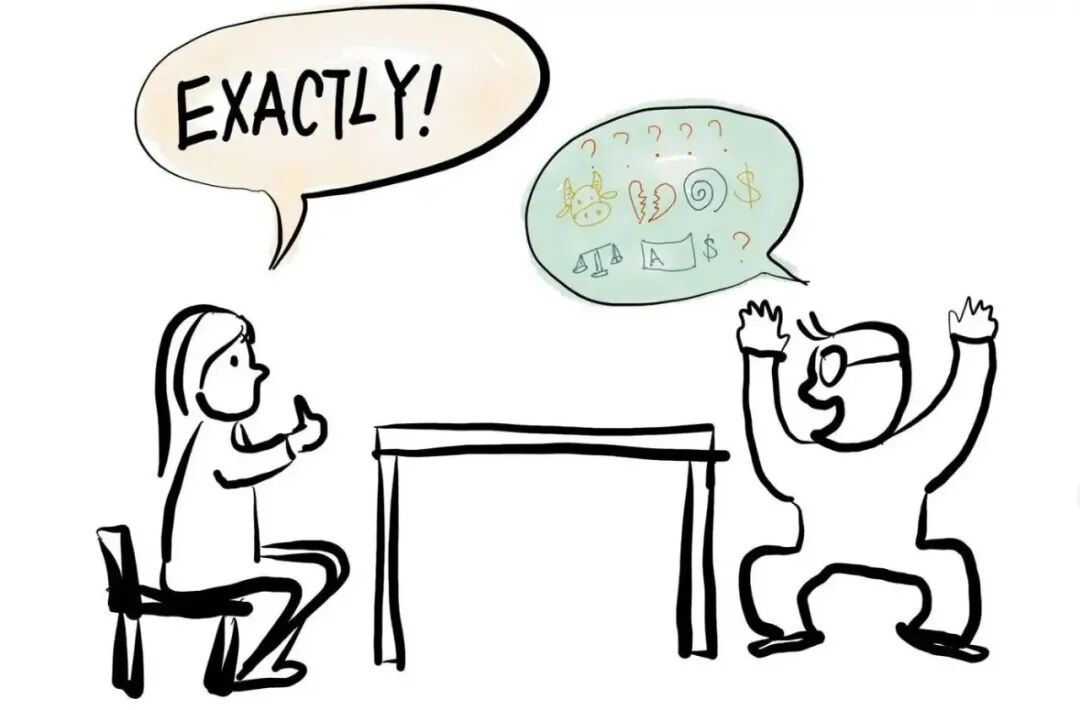
Those seemingly tailor-made personality descriptions actually fit anyone who aspires to success perfectly. As one netizen aptly put it: "Isn't this all machine-generated nonsense? Haha, you just need to adjust the model's temperature (the parameter that controls the randomness of AI generation), and it can come up with all sorts of creative ways to praise you."
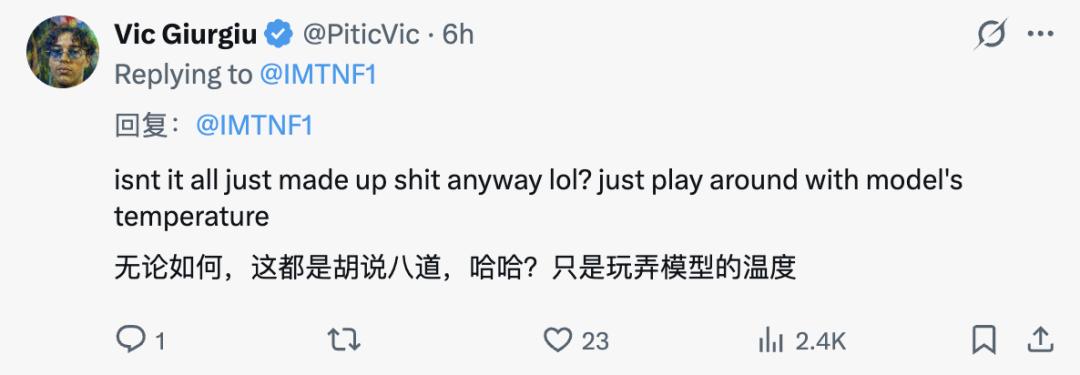
But the public doesn't care whether it's metaphysics or not; they only care that it "understands them."
Some developers with an exceptionally keen sense of opportunity immediately smelled money in this absurd frenzy. For example, one netizen commented: "Someone will use this to develop a million-dollar blockbuster app."
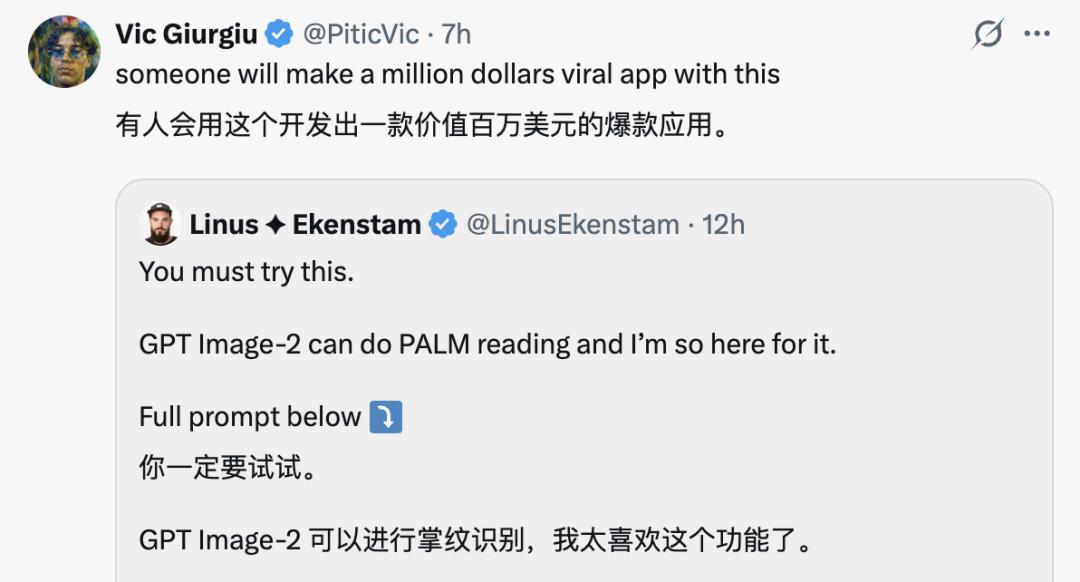
No need to train complex models or delve into specific industries; simply connect to OpenAI's API, add a fantastic UI, and a "cyber fortune-telling stall" that can continuously print money is set up.
In the gold rush of the AI era, it seems that selling shovels and offering psychological comfort are still the most profitable.
However, it should be noted that using this method may actually leak your palm print and fingerprint information. Biometric features that hackers have previously struggled to steal are now being literally "handed over" by users themselves.
Sam Altman may not actually use your palm print to steal your credit card, but once this highly granular real human biometric data is put into the bottomless training corpus, it completely slips out of your control.
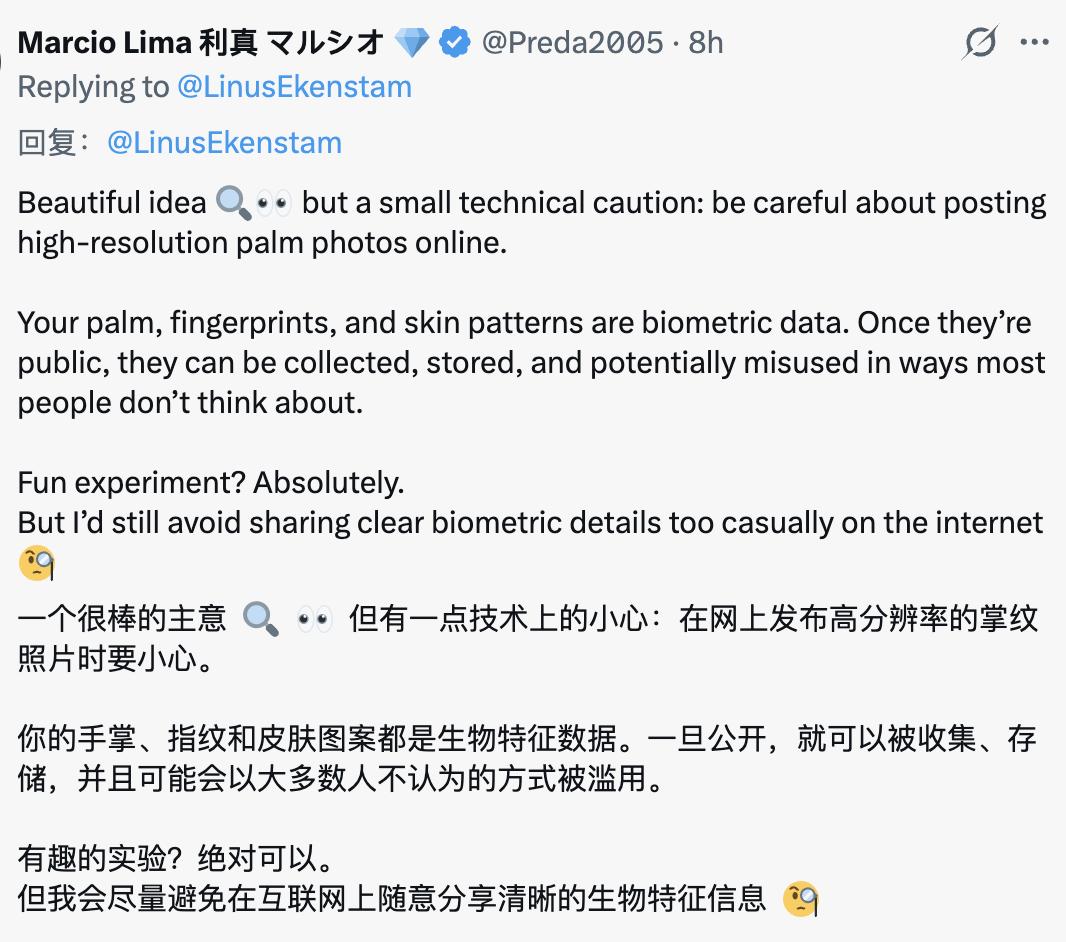
The last straw that breaks the camel's back is often the unwitting breach of one's bottom line. In today's world of frequent data security incidents, who can guarantee that these "AI fortune-telling" apps won't package and sell your palm print data to third parties?
When we review the entire history of internet technology, it's practically a cycle of constantly changing and evolving cybernetics.
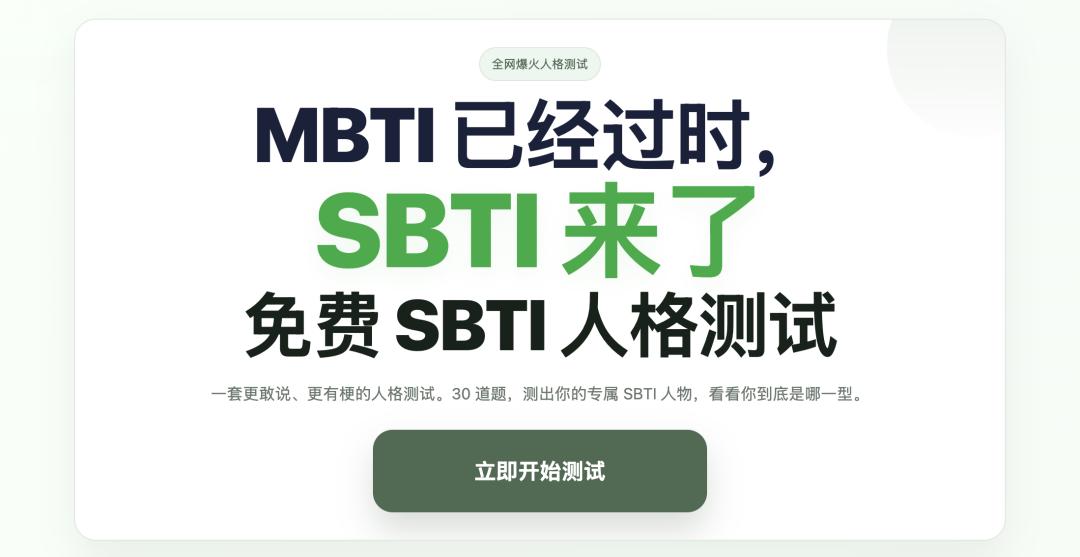
From early web-based astrological compatibility to the wildly popular MBTI/SBTI personality tests; from ChatGPT being used to calculate tarot cards when it was first released to using the latest visual models to read palm lines today, the more sophisticated and rational the technology becomes, the more humans like to use it to resolve the uncertainties in life.
We are obsessed with AI fortune telling because we live in an era full of anxiety and change. Beyond just having fun, we need an omniscient and omnipotent "god" to reassure us.
AI plays this role perfectly. It has no emotions, it possesses massive amounts of data, and its output carries an undeniable "machine objectivity"—even though we know in our hearts that it is merely manipulating probabilities and vocabulary.
It is both romantic and absurd.
AI-generated mystical content is for entertainment purposes only; please do not take it seriously.
This article is from the WeChat official account "APPSO" , authored by Discover Tomorrow's Products, and published with authorization from 36Kr.