Source: Bitcoin Magazine
Compiled by: Felix, PANews
BitMEX co-founder Arthur Hayes delivered a speech at the Bitcoin 2026 conference, in which he explained his bullish outlook on Bitcoin, why Kevin Warsh is not the hawkish figure some fear, and how a quietly enacting banking regulation on April 1st could unleash trillions of dollars in new credit. Furthermore, Hayes set a year-end price target of $125,000 for Bitcoin and explained his "wartime money printing" theory behind this target.
PANews has compiled the following summary of the speech.
Over the past few days, I've deeply considered how money printing policies will evolve, taking into account the development of AI and the situation in the Iran-Iraq conflict, which led to the content of this speech. Clearly, my stance has shifted to a more bullish one, and I will explain why below.
Of course, we cannot ignore the ongoing war, so before elaborating on our core arguments, I must establish a few assumptions. First, we will not die from nuclear annihilation; because in the event of nuclear annihilation, any investment would be meaningless, so let's set that concern aside for now. Second, the market will view this event as some kind of "short-term" event, whatever that may mean. Now it's time to think about money creation and printing, and what that means for Bitcoin.
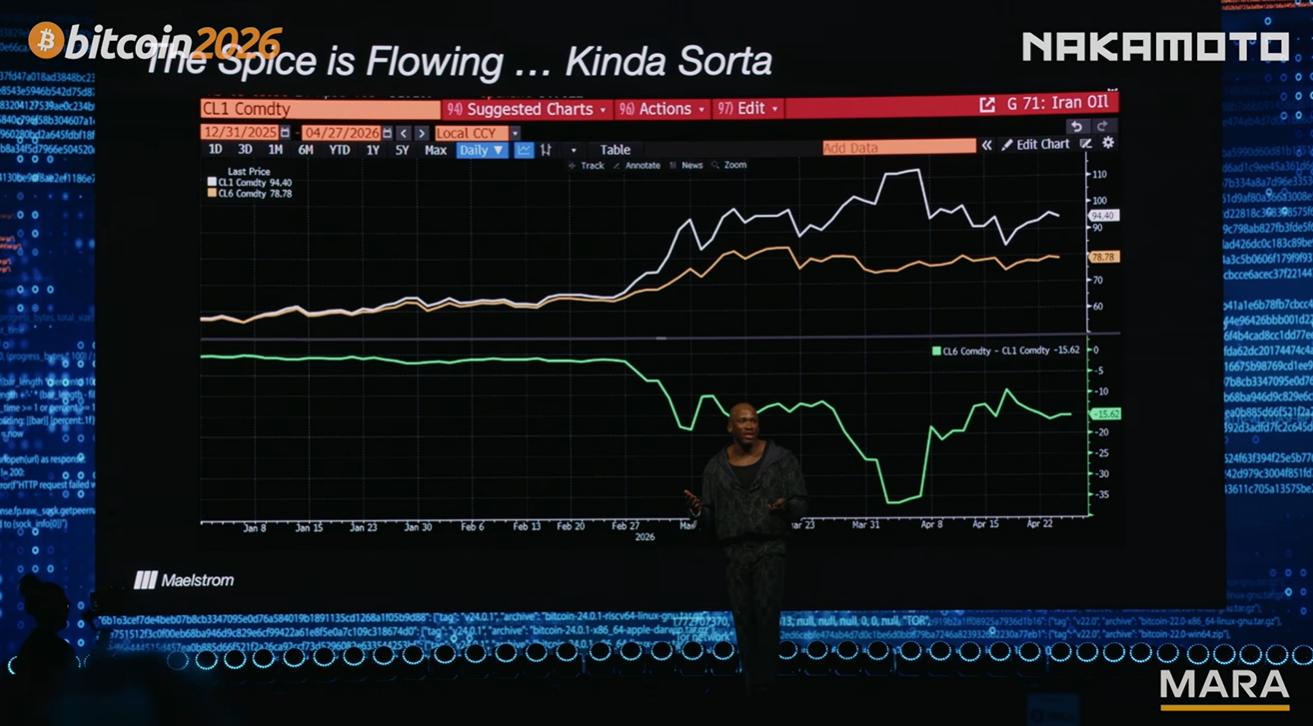
Every morning, I analyze a chart from Bloomberg to see how the war is actually impacting my portfolio. This chart shows the price spread between the six-month WTI crude oil futures contract and the current month contract. I don't care about Trump's or Iran's propaganda war; my only concern is whether enough goods and oil can pass through the Strait smoothly. The chart shows the situation has improved, meaning front-end prices are trending towards back-end prices, indicating that while the situation is bad, it's not at its worst. So I can ignore it for now and move on to other things.
Every time I give a speech, I always talk about printing money. However, my thinking has shifted since my last article, published about two weeks ago. I now believe that in the medium to long term, liquidity will turn positive. Therefore, if we consider the negative side, we see deflation caused by AI. There's been much discussion about how many knowledge workers will lose their jobs because efficient and inexpensive models can perform knowledge-based tasks. A few months ago, I wrote an article outlining my expectations for these losses. I believe this could result in hundreds of billions of dollars in losses for the banking system.
Regarding the Federal Reserve, I'll discuss that later. The market is very concerned about the nominee for Fed Chair, Kevin Worsh, with everyone speculating whether he'll be a hawk or a dove. I will analyze his remarks objectively; basically, they are neutral, neither beneficial nor harmful to liquidity. Those market participants who are panicking about Worsh being a super-hawkish Fed Chair haven't grasped the underlying signals. Finally, let's look at commercial bank lending. Why is commercial bank lending increasing? Why would the war economy in the US and overseas prompt banks to extend more loans to those involved in various weapons production and related component manufacturing? Furthermore, changes in banking regulations will allow banks to increase the leverage ratio of their balance sheets.
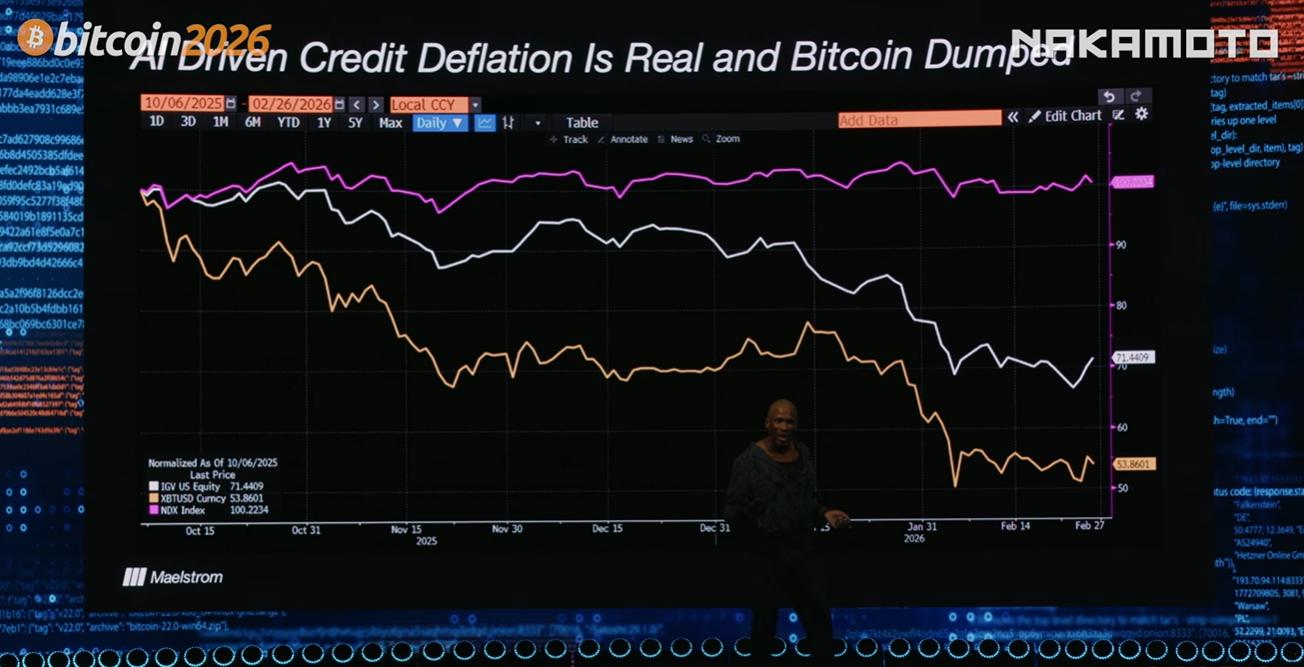
I've been following this chart since last October. The magenta line represents the Nasdaq index, the gold line represents the price of Bitcoin, and the white line represents US tech ETFs.
Most people, at least institutional investors, now believe that Bitcoin's price is approaching that of the Nasdaq, and it has indeed performed this way over the past four or five years. However, since Bitcoin hit its all-time high of $126,000 last October, it has fallen by about 50%, while the Nasdaq has remained relatively stable. Large-cap tech stocks have performed reasonably well.
But if you look closely at the tech stocks that have been hit hard, you'll find that they are almost all SaaS companies. These companies produce products that AI can now accomplish for just $10 a month, whereas they were previously priced at $10,000, or some other ridiculously high price. These stocks have been severely impacted. I believe this foreshadows a credit crunch that central banks haven't realized, they haven't printed enough money, and Bitcoin has been affected as well. This is the situation before the war. My chart is current as of February 28th.
Another wish of mine is to fire all my accountants and lawyers. I've spent far too much money on them. I can't wait for Claude to take over everything. This would have a very bad impact on those who lend money to high-income individuals. This is basically my view on AI becoming the new subprime crisis and what that could mean for the commercial banking system.
I believe this very argument led to Bitcoin's decline from last October to the end of February this year, during the period of the Iraq War. However, since the start of the war, Bitcoin has consistently outperformed other stocks, surpassing the Nasdaq and SaaS stocks. I think Bitcoin is now focused on wartime inflation. Now that the US and many other countries have explicitly acknowledged a state of war, insufficient defense spending, and the need to print more money to manufacture more bombs, what will happen next?
So, let's put AI aside for now and talk about the Federal Reserve. In January of this year, when Kevin Warsh was nominated as Chairman of the Federal Reserve, the market panicked. Since the 2008 financial crisis, he had been critical of the Fed's massive balance sheet and publicly stated his intention to shrink it and cut interest rates.
If you've read my articles, you'll know I've always argued that the quantity of money is more important than its price. Therefore, I'm more concerned with his comments on the balance sheet than with how short-term interest rates will move. If the market believes that Warsh's appointment will reduce dollar liquidity, then they will be bearish on Bitcoin and other risk assets. This is what we've recently seen in the media as the "soon-to-be super-hawkish Fed chairman."
These regulations would restrict how banks hold assets on their balance sheets and the amount of capital they must hold for them. But I don't think that's the case. I believe the Fed will essentially be transferring reserves, Treasury securities, and repurchase agreements to the commercial banking system, and achieving this through new banking regulations. These regulations will restrict how banks hold assets on their balance sheets and the amount of capital they must hold for them. Finally, I think the most important thing to understand about Warren's impact on the Fed is to understand that he faces a very significant constraint: he must work closely with Treasury Secretary Scott Bessant to ensure that any actions he takes on the Fed's balance sheet do not impair Bessant's ability to issue billions of dollars in bonds.
Here is a very simple balance sheet. There are no specific numbers here because I know it might be a bit complicated for some people. On the asset side, there are Treasury bonds, mortgage-backed securities (MBS), and repurchase agreements. These are instruments that help people finance the purchase of Treasury bonds. On the liability side, there are bank reserves, the Treasury's general account, government checking accounts, and currency in circulation.
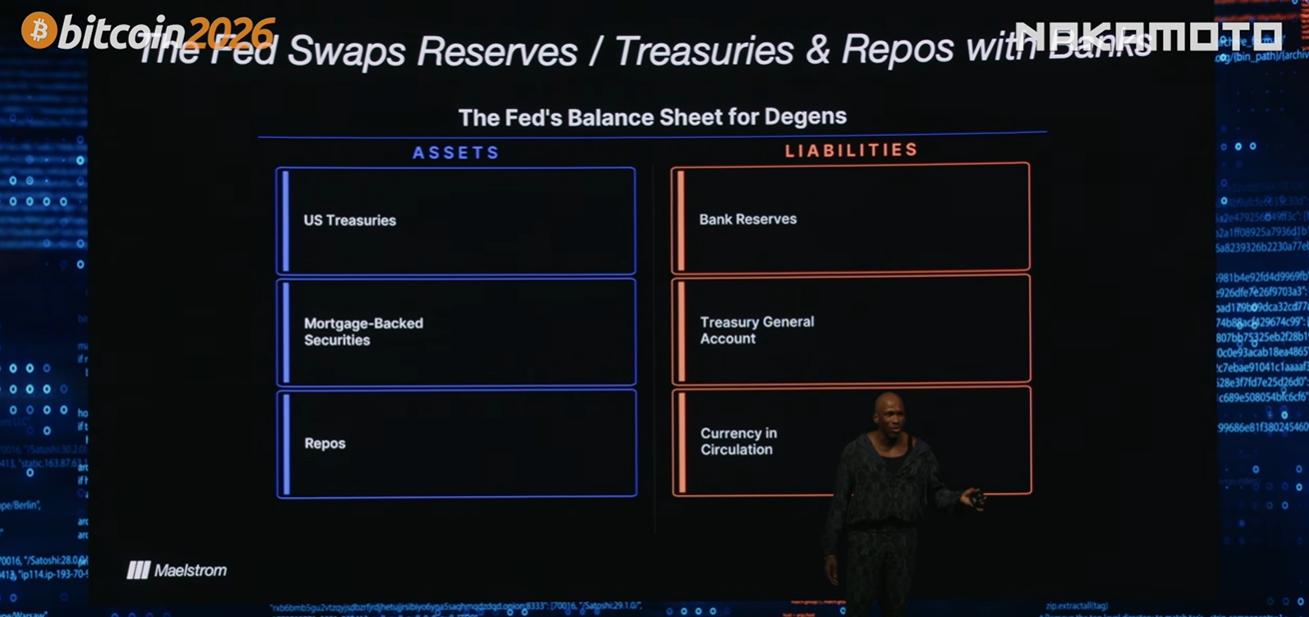
Basically, since 2008, the Federal Reserve has increased its liabilities related to bank reserves and purchased assets from the banking system. These assets include Treasury bonds, mortgage-backed securities, and repurchase agreements. When Warren said the balance sheet was too large, he meant the Fed held too many bonds and wanted to shrink it. So, he might sell bonds. But that would have a huge impact on the market. Or, I think what's being hinted at right now is that he will engage in asset swaps with the U.S. banking system. Commercial banks' balance sheets, which are the Fed's reserves, are also considered assets. There are approximately three trillion dollars in these reserves held on the Fed's balance sheet. Their funding sources include loans, deposits, and shareholder equity. Therefore, for a given size balance sheet, there must be a corresponding amount of equity. This is called the capital adequacy ratio. So, the Fed and banks need to swap. Banks need to release reserves, reduce their demand for reserves, and replace these reserves with Treasury bonds and repurchase agreements.
This is precisely what has driven the deregulation of the U.S. commercial banking system. So whenever you hear U.S. government monetary officials talk about deregulation, they mean that we want to allow the banking system to absorb all the debt we create and remove it from the Federal Reserve's balance sheet.
The ultimate goal is for US commercial banks to take over the baton of money creation from the Federal Reserve, with their balance sheets including Treasury bonds and repurchase agreements, and liabilities including deposits and shareholder equity. The key is that the net impact on dollar liquidity is neutral. Nothing is sold, nothing is bought; it's simply a swap transaction. In terms of who can hold what, it's purely a regulatory expedient. But ultimately, Warsh can stand up and tell everyone that he has successfully shrunk the Fed's balance sheet. But in reality, as investors, what do we care about? The end result is nothing.
Furthermore, Warsh won't clash with Bessant. They can simply replace Powell's face in their previous photo with Warsh's. Ultimately, we've already issued $38 trillion in debt, and the government needs the funds. The Federal Reserve will fulfill its duty to ensure orderly markets so that people can buy this debt.
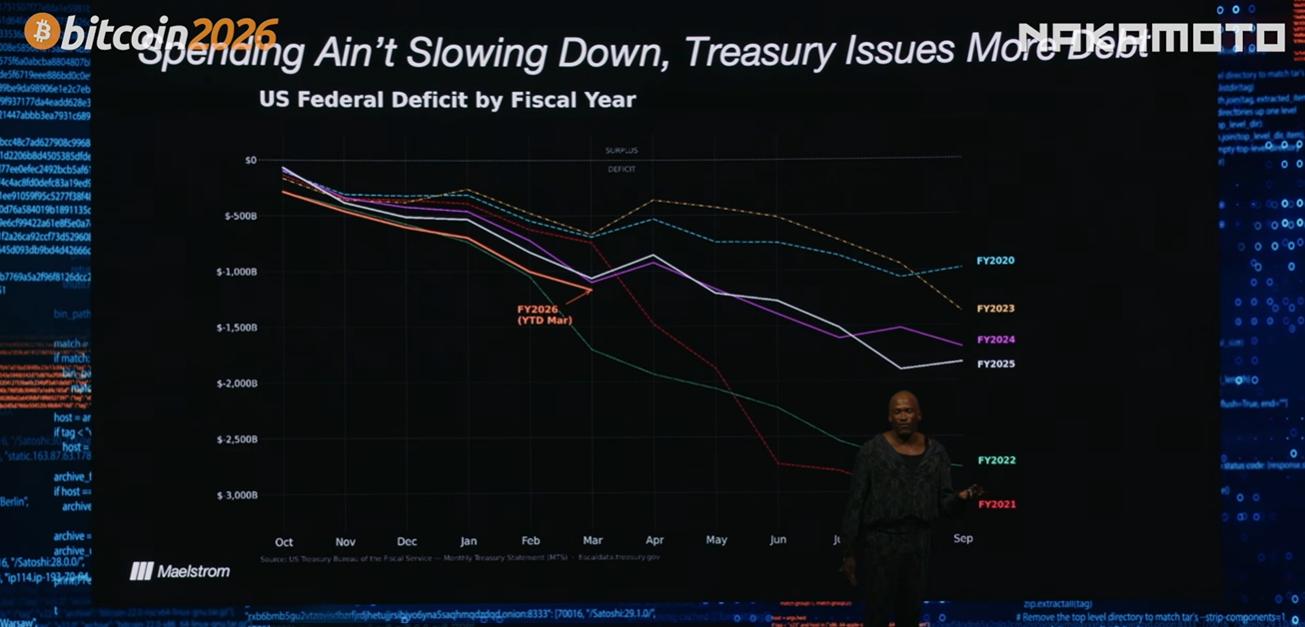
Let's look at the spending figures. This is a chart for the current fiscal year, from October to September of the following year. As you can see, from the COVID-19 pandemic through the presidency, to the current largest peacetime deficit in U.S. history, the deficit in fiscal year 2026 is slightly higher than in fiscal year 2025. Now, the key point of all this is that the U.S. Treasury is not reducing spending. Trump hasn't said he'd drastically cut spending. Last year's DOGE plan has been forgotten. Now it's all wartime spending. His new defense budget is 50% higher than before, reaching $1.5 trillion. This doesn't sound like the Treasury or politicians are going to cut spending together so the Federal Reserve can shrink its balance sheet.
Therefore, all the talk about the Federal Reserve shrinking its balance sheet is unfounded, because politicians and the Treasury behind them are constantly increasing the debt. Here's another chart. Who's buying this debt? Foreigners aren't buying as much debt as before. I've excluded countries typically used for hedge fund basis trading. As you can see, the 25% share of debt held by foreigners has remained largely unchanged, while the total debt has increased significantly. This means a new, price-insensitive buyer is needed to acquire all this debt, and that buyer is the US commercial banking system.
The banking system is able to increase its debt holdings because of a new regulatory rule that took effect on April 1st of this year: the Enhanced Supplemental Leverage Ratio (ESLR). This new rule allows banks to hold fewer reserves and other types of assets to support loans and other items on their balance sheets. This means that large banks like JPMorgan Chase and Citigroup can issue more Treasury bonds and repurchase agreements in the market and obtain rollovers from the Federal Reserve. For smaller banks, which are the engine of lending in the US economy, they can increase the amount of construction and industrial loans they issue.
S&P Global estimates that the ESLR u balance sheet reduction will generate $1.3 trillion in new loans. So why would banks have lending demand? One criticism of this analysis from some other macroeconomic analysts is that they argue the banking system lacks demand, failing to create enough loans, or that demand is insufficient. But there is an excellent source of demand: the U.S. Department of Defense. They not only invest equity in certain transactions but also provide guarantees for underwriting production. Banks see companies with guaranteed clients like the government (which can print money) and lend to them. They also lend to resource extractors who mine the critical resources needed to manufacture bombs.
Finally, all AI capital expenditures are now considered a national security issue. Therefore, when a mega-corporation cannot finance its debt with free cash flow and turns to market financing, they will find large banks with massive balance sheets willing to provide debt support. So, keep a close eye on construction industry loans; I think you can get relevant information from the Federal Reserve weekly.
The advantage of bank loans lies in their multiplier effect, which is higher than that of central bank loans, empirically estimated to be about three times. We have already observed this empirically. This means that approximately $4 trillion in funds will be created, which is far greater than the credit losses that could result from AI taking away people's jobs. This is why I am more bullish on Bitcoin.
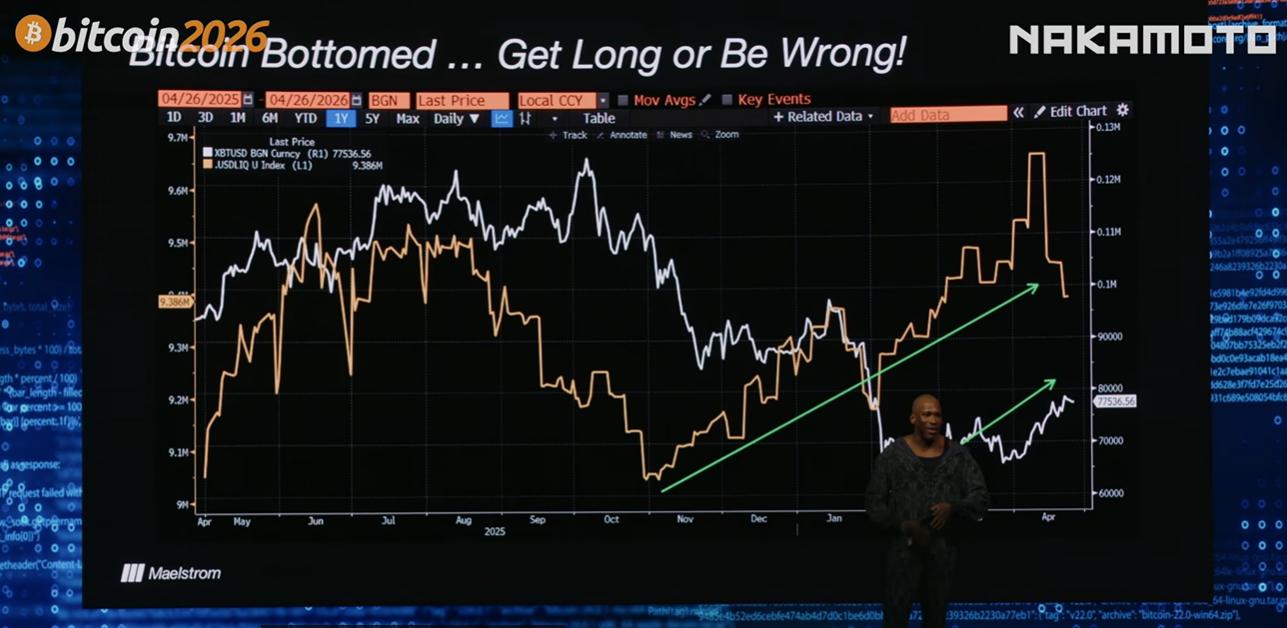
This liquidity chart bottomed out last November, roughly the same time Bitcoin bottomed out . I think we've experienced some volatility and fluctuations. Now it's time for a breakout. That's why I believe Bitcoin will continue to rise. I think my year-end target price is around $125,000, but the exact number isn't important. Thank you.
Related reading:Arthur Hayes: Bitcoin year-end price target $125,000