Compiled by: @tradinghoex @0xBenniee
Translation by: @0xBenniee
For the vast majority of users entering the crypto world, the sole purpose is because it's one of the few places where ordinary people can truly control their own financial destiny. Most people come here for " life-changing trades " and profits, not just because they love the underlying technology.
The problem is that the rules of this game are set so that there can only be one winner, namely the market makers.
This article will thoroughly dissect how this manipulation works, what tools you need to identify it in advance, and how to avoid becoming a "bagholder." All conclusions are based on real-world cases of manipulated tokens over the past 7 months.
Two scripts, same ending
Not all "criminal pump-and-dump schemes" operate on the same principle. After studying seven manipulated tokens over seven months, we discovered two distinct patterns. Both relied on low-circulation tokens on Binance and ultimately resulted in losses for retail investors/exchanges, but the underlying mechanisms for withdrawing funds were fundamentally different .
MYX: The Squeeze
Phase 1 — Setup
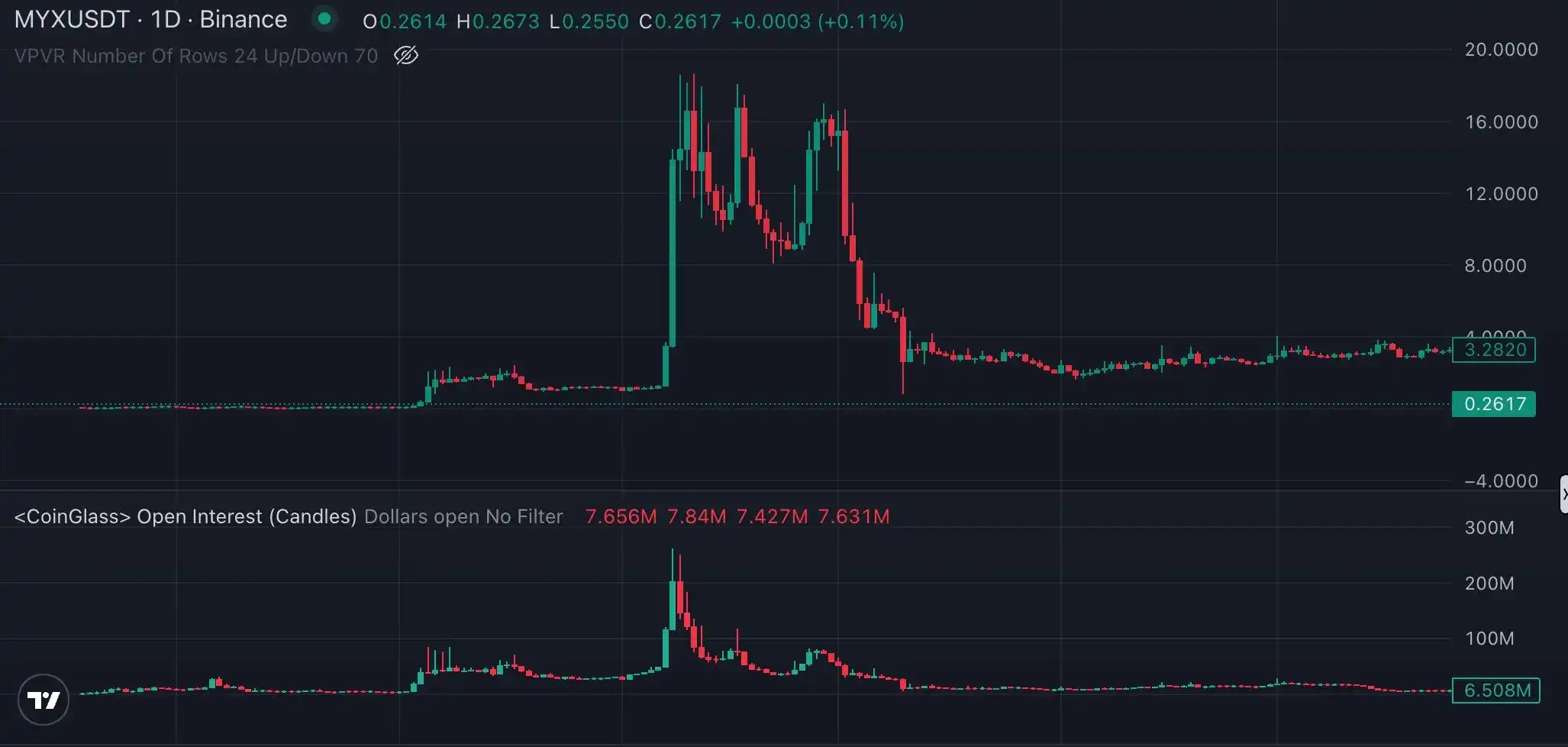
According to historical data from CoinMarketCap, the "big move" that ultimately propelled the MYX to a high of $19 began at the end of August 2025. At that time, it broke through from below $0.10 to around $1.20 and continued to rise into the range of several dollars in the following weeks.
In-depth analysis of this surge reveals it was a carefully orchestrated operation by six wallets : they executed 2,240 small buy orders on PancakeSwap, accumulating a total of $3.92 million worth of MYX tokens, which were then deposited into a centralized exchange's account address.
Research on Arkham also revealed that during August–September 2025, multiple wallets systematically injected USDT into the MYX liquidity pool in a “rotation pattern.” 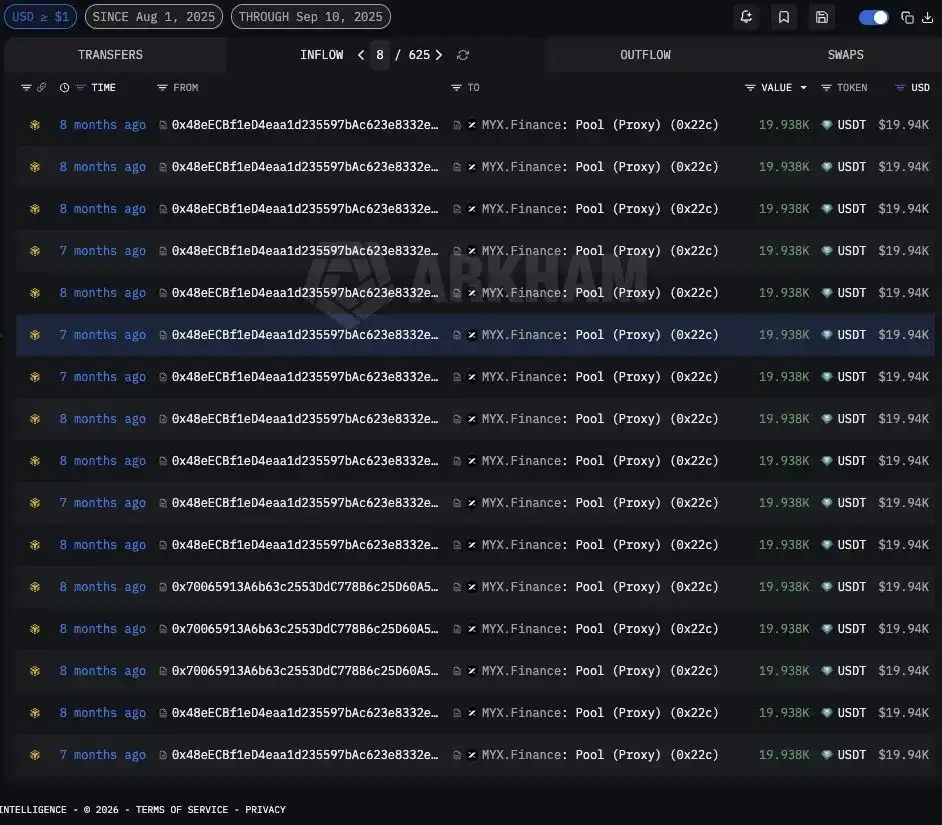
- A wallet was acquired in batches of $90,000–$108,000;
- The second wallet saw inflows in batches of $20,000–$67,000;
- The third wallet executed dozens of almost identical $19,938 injections.
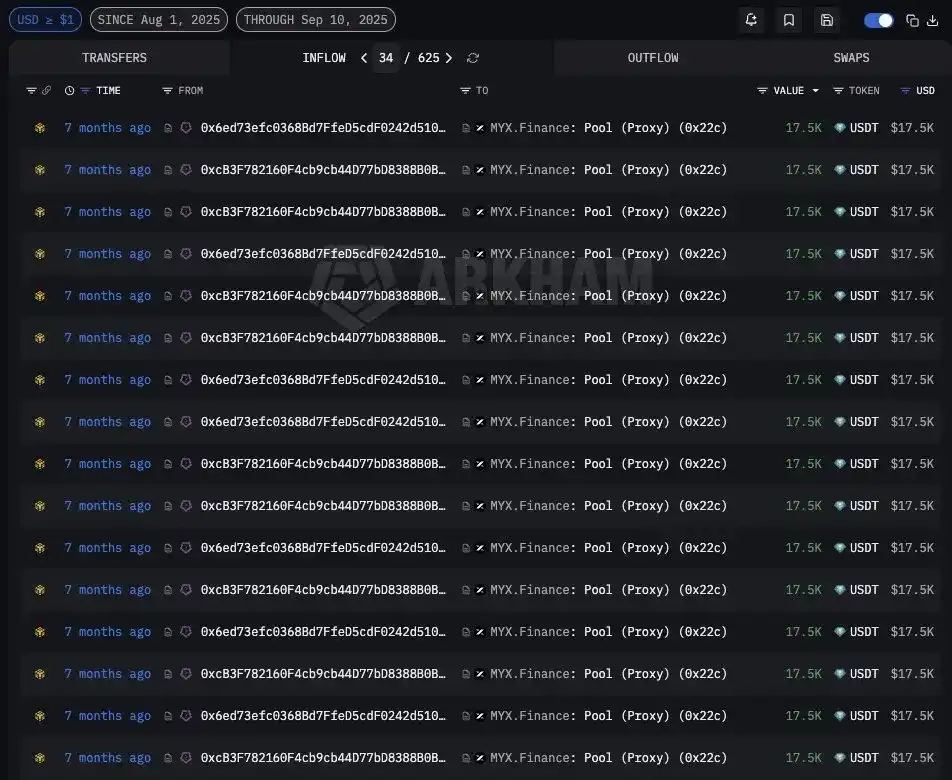
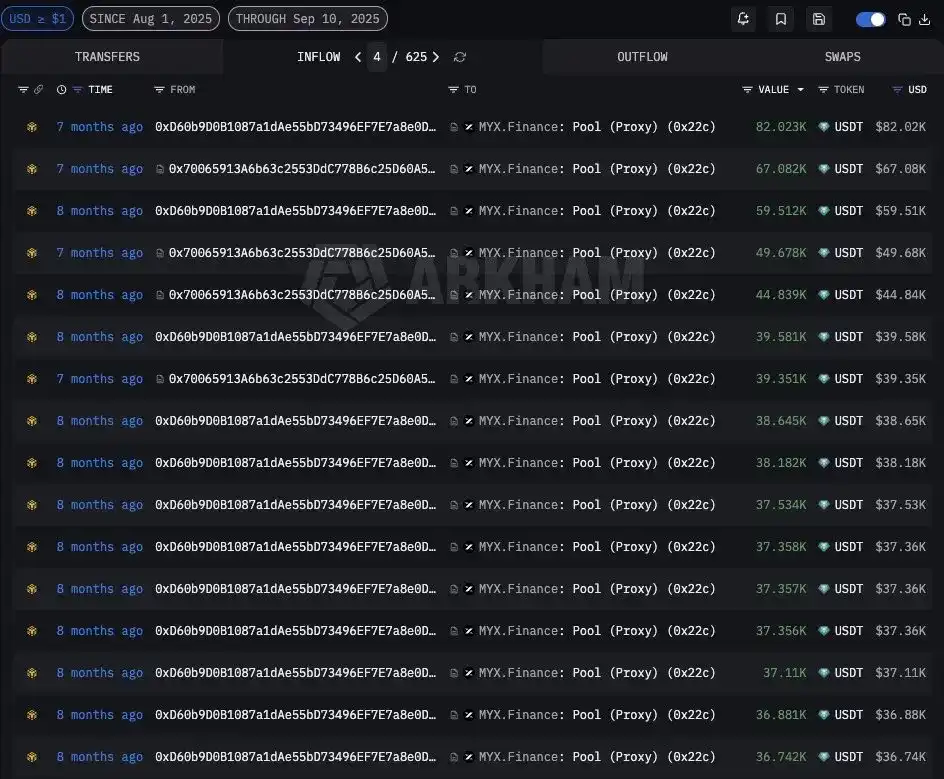
These wallets made multiple small purchases on the blockchain and then distributed the funds among themselves. This operation allowed them to control the circulating supply off-exchange before the price surge, while simultaneously evading the risk control measures monitored by whale. Through this covert accumulation phase, market makers enabled whale to control the supply undetected, laying the foundation for subsequent manipulation.
Phase 2 — Lure Shorts (to lure short sellers)
Historical data from CoinGecko shows that the price range for MYX in late July to early August 2025 was $0.10–$0.11 .
- August 3: Jumped to $0.168;
- August 4: Reached $0.398;
- August 5: Reached $1.29 – a 1,190% increase in 5 days .
The unlocking of 39 million tokens occurred on August 6, when the price was $1.65, right in the middle of this initial surge.
This pump was deliberately made to look "unsustainable." Every cautious trader who looks at the fundamentals, seeing a tiny market capitalization token with no users surge by 1,550%, had the same thought in their mind: "This is a sure thing for short."
Over the next month (August 6th – September 6th), the MYX consolidated between $1.05 and $2.00, briefly touching $2.00 on August 16th before falling back, reaching $1.31 on September 6th. This month-long sideways movement appeared to have formed a top . More short positions entered the market. 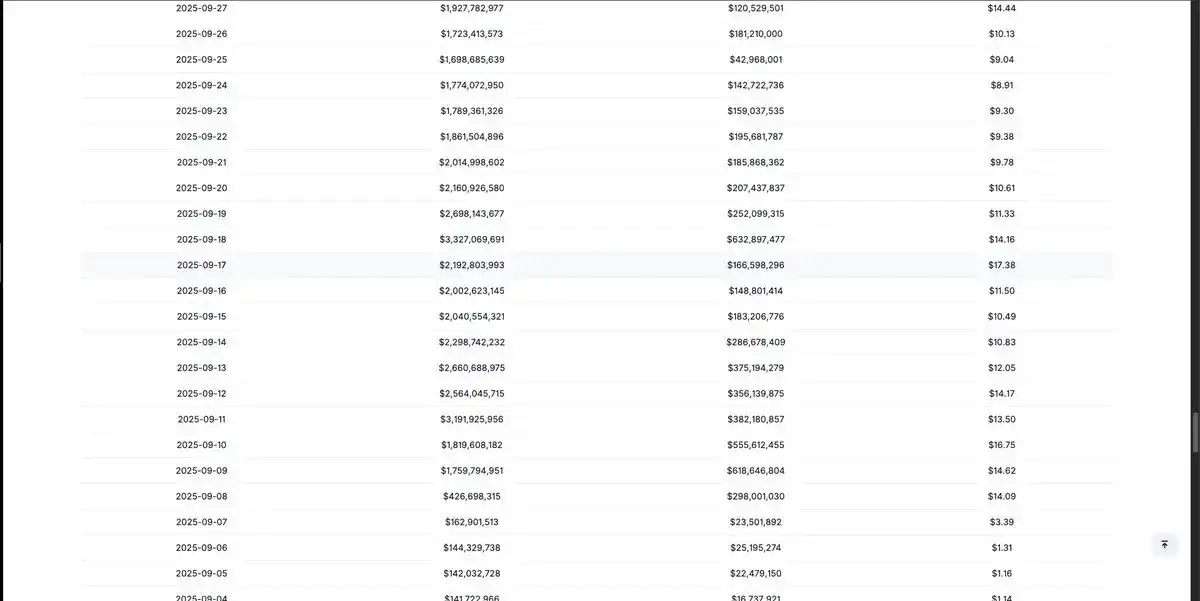
As of April 2026, only 28.18% of MYX's total supply had been unlocked, with 71.82% still locked or undergoing linear release . During the pump in August-September 2025, the circulating supply was even lower, while the project team typically controlled 95% or more of the tokens.
There's a common misconception here: Market Cap & Fully Diluted Value (FDV)
Market cap = Current price x Circulating supply
Fully-diluted value (FDV) = price x max supply
Generally, the initial circulating supply of a strongly manipulated coin is around 10-20% . The actual cost of controlling the market depends on MC (Million Dollar Cap) rather than FDV (Fundamental Value). This can lead some to short due to fear of high market capitalization, but the true circulating supply only considers MC and the actual tokens circulating off-exchange.
Phase 3 — The Trap (Deepening the Layout)
During that month of consolidation, funding rates turned deeply negative —short sellers had to pay -2% every 4 hours, meaning they would have to pay -12% just for holding a position for one day , not even taking into account situations where prices were flat or rising. 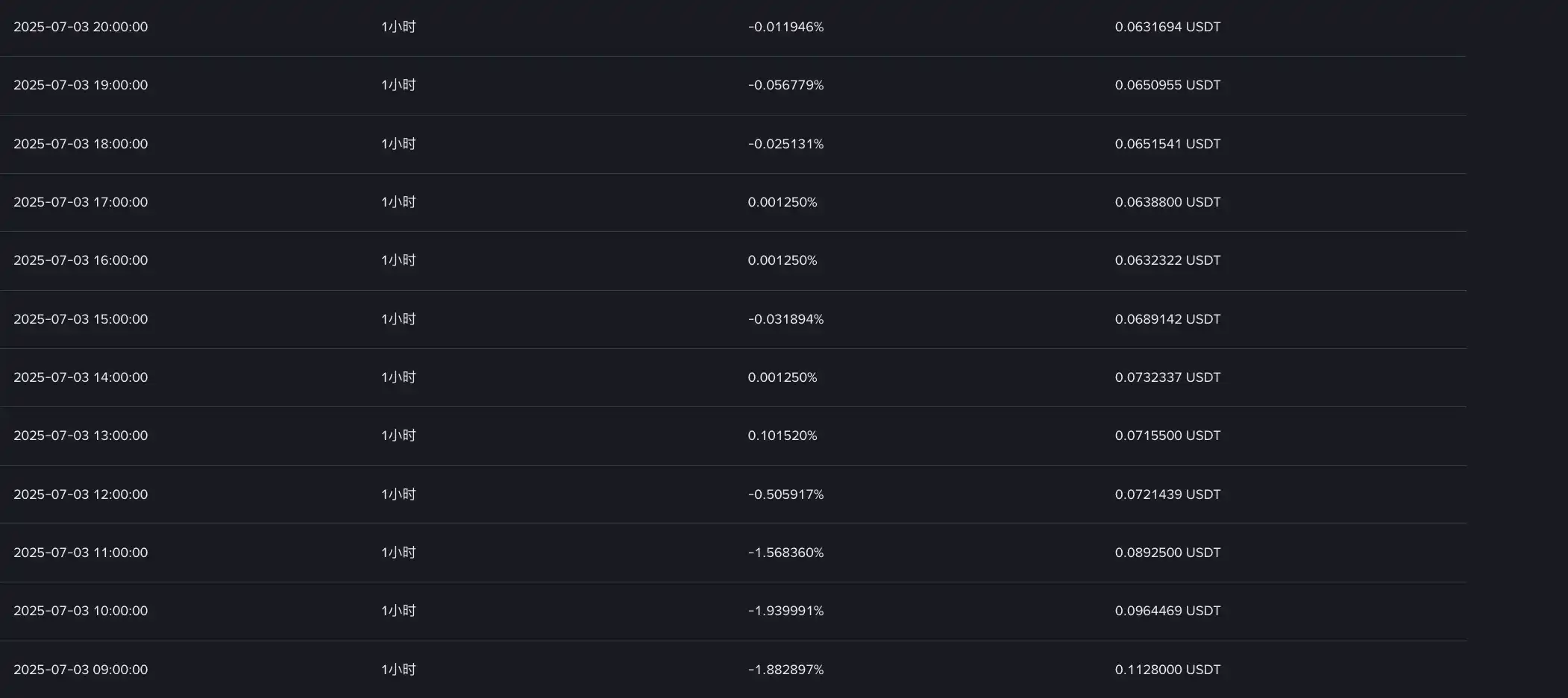
The traders used this phase to close out their initial long positions and then add to their positions. The $1-2 range plus deep negative fees made it look like a "token that had already peaked." More short sellers entered the market, convinced that a "market crash was imminent."
Phase 4 — The Squeeze
Coinglass data confirms this strategy:
- September 6 : OI (Open Interest) $95.15M, Price $1.31;
- September 7 : Prices nearly tripled to $3.39, the first wave of short sellers was wiped out, and OI surged as new long and short positions flooded in;
- September 8th : MYX surged from $3.39 to $14.09 in a single day. According to analysis from the WEEX exchange, $16.53 million was liquidated that day alone, of which $13.68 million came from short covering . Each liquidation triggered a forced buyback, pushing the price higher and thus triggering the next round of liquidations. OI soared to over $370 million;
- September 9 : Pushed up to $14.6
- September 10 : Reached $16.75. Coinglass shows that during this period, daily contract trading volume surged to $9-10 billion+ .
The short squeeze then continued until mid-September, with prices fluctuating between $10 and $17, gradually eliminating the remaining short sellers. 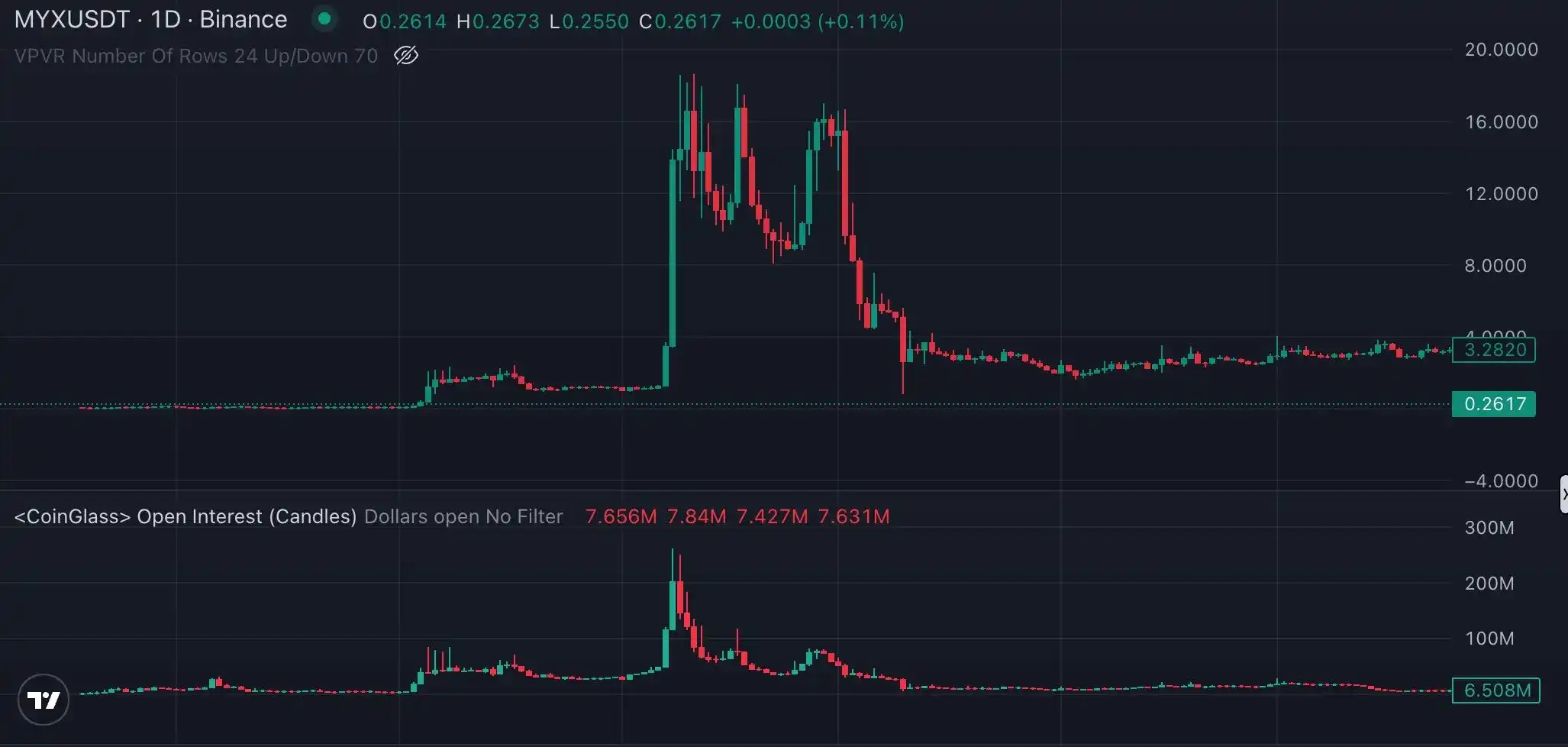
Phase 5 — (The Exit)
After the short positions were exhausted and the price reached its peak, the trader reversed their position : opening short positions at the high price and gradually closing out the original long positions. Then, they began transferring tokens to centralized exchanges for spot trading, but did not sell them.
This is the second trap that some experienced on-chain players fall for. Seeing the transfer from "wallet to exchange," they instinctively judge that "a market crash is coming" and go short. However, those transfers are just a trap. Before the actual crash, the manipulators first wipe out this new wave of short sellers, complete the final harvest, and then truly leave the market.
COAI: Pump and Dump (a pump-and-dump type)
COAI launched in September 2025 with an opening price of $0.22. Within two days, it dropped to $0.17 due to selling by airdrop recipients. For the next seven days, the price traded quietly between $0.17 and $0.39 – this was an accumulation window.
On October 6th , COAI launched 5x leveraged contracts on the Aster exchange. On the same day, the price surged from $0.39 to $2.42. Binance Alpha was the first platform to list COAI (on September 25th, the same day as TGE), with Bybit following around October 30th. The entire BNB ecosystem was experiencing upward momentum at the time, and the "BNB season" narrative provided perfect cover for the price surge.
As of April 2026, only 24.86% of the total supply of COAI had been unlocked, with **75.14% still being released linearly.** This means that during the price surge in October 2025, the actual circulating supply will be even lower, and the control of the supply within the market will be even tighter.
Bubblemaps' on-chain analysis revealed 60 wallets that were simultaneously funded, each receiving exactly 1 BNB from Binance at 11:00 UTC on March 25th , and then executing identical automated trading strategies through Binance Alpha. This high degree of uniformity in behavior led Bubblemaps to directly point out that these addresses were subject to centralized manipulation or highly coordinated actions . 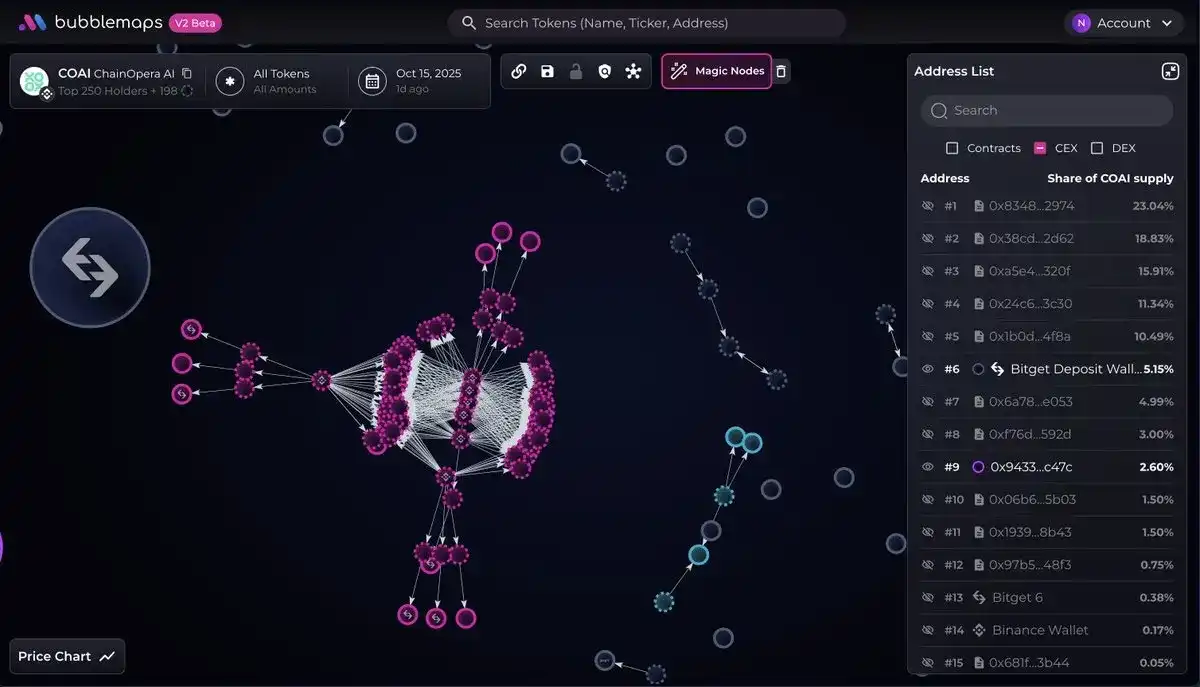
bubble maps:https://x.com/bubblemaps/status/1978865917552660795
The market began to accelerate after that. Coinglass data shows:
- Before Aster launched: OI cost approximately $30.2M;
- October 7th: OI (Options for Intelligence) surged to $207.6M, priced at $2.99;
- October 9th: OI $350.93M, price $5.82;
- October 12: ATH traded around $44–45 during the day.
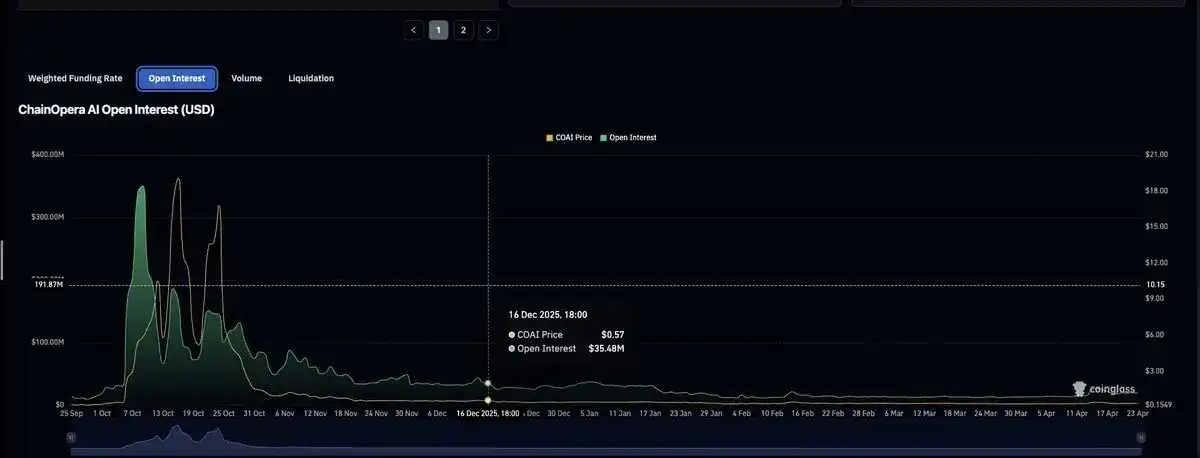
Data from coinglass
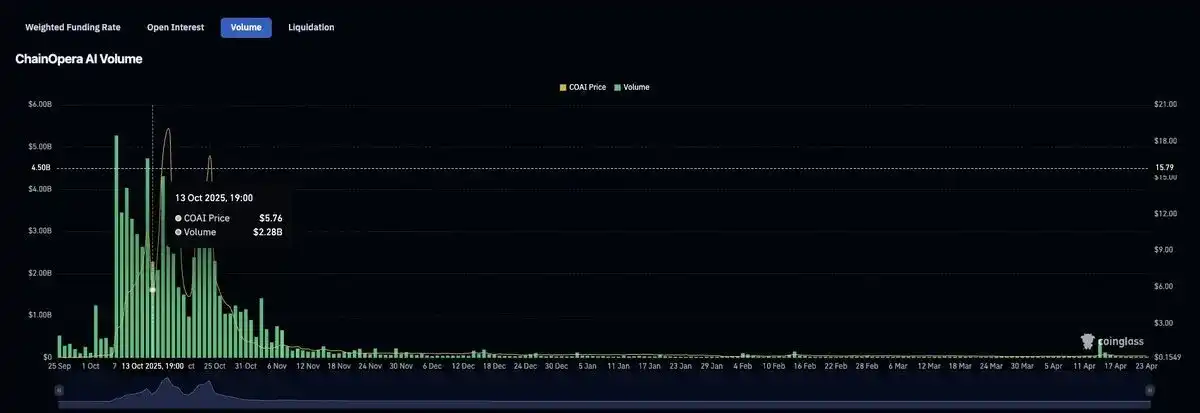
coinglass: https://www.coinglass.com/currencies/COAI
Following ATH, OI experienced a series of rapid declines on Coinglass.
Differences from MYX
COAI did not follow the five-stage script of MYX. MYX had a clear consolidation period of up to a month between the initial surge and the short squeeze—a deliberate "bait + trap" cycle: market makers waited for short sellers to enter the market, causing funding rates to turn deeply negative, and then triggering a chain reaction of margin calls.
COAI is different. From its launch to ATH, it was almost seamless, without any interruptions . Since over 75% of the supply was locked on the day of launch, the tradable circulating supply was extremely thin. A pair with such high control doesn't need to create a short squeeze to dominate the price with such low circulation and harvest the remaining liquidity in the market through off-exchange financing.
Commonalities of these tokens
1. Low Float
- COAI unlocked 19.65% during TGE;
- MYX is 9.21%.
- Low initial circulation, low circulating supply + high control of shares
2. All the tokens involved in the case have BNB Chain contracts, including AIA (which is advertised as "the largest AI agent infrastructure," deployed simultaneously on the SUI/BSC/BTC chains at launch). BNB Chain offers cheaper transaction fees and direct access to Binance Alpha.
Some tokens are deployed on multiple chains simultaneously:
- AIA: SUI, BNB Chain;
- Rave:Ethereum, Base, BNB Chain;
- River:Ethereum, Base, BNB Chain.
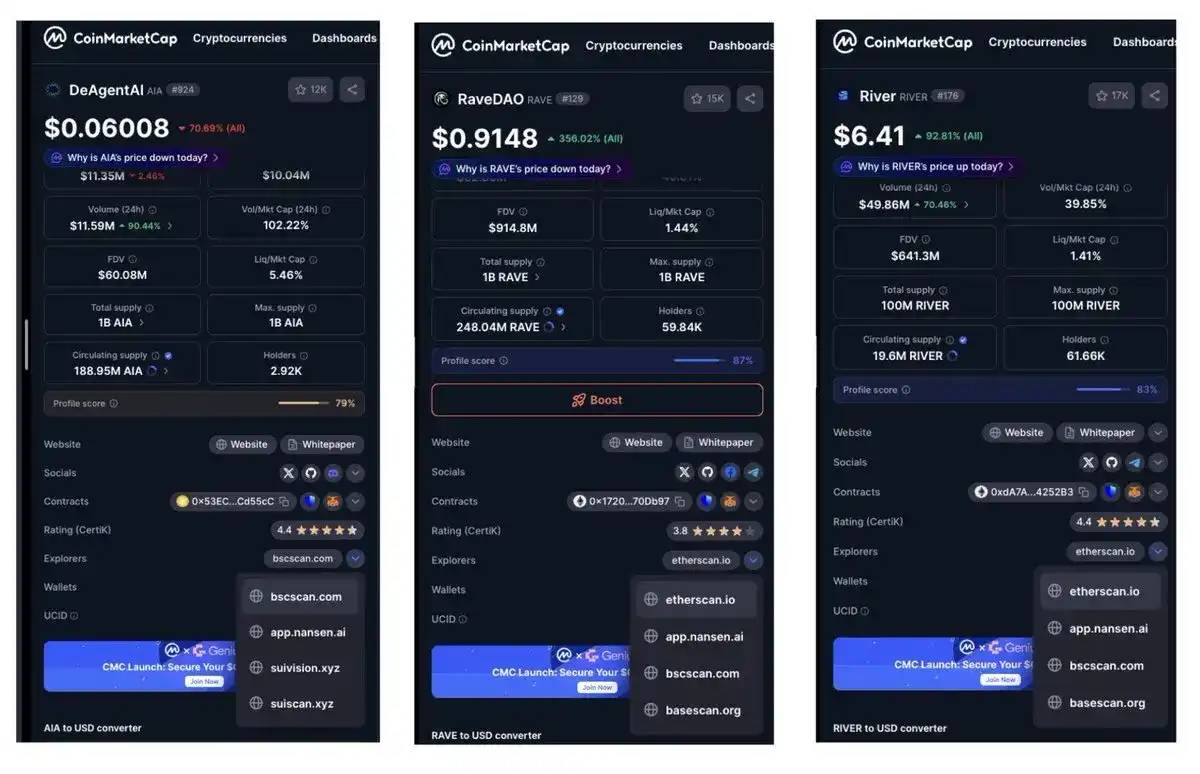 多链部署给操盘方提供了更多的可利用面:他们可以把代币移到流动性最薄的链上、制造价差再做套利、利用跨链桥机制制造操纵机会(比如Power 利用Ronin 桥暂停的那次操作),并在出货阶段把代币分散到多个流动性池里。链越多,可被操纵的场所就越多。
3. Binance Alpha → Binance Futures: BNB Chain launch → Binance Alpha → Binance Futures. The launch of futures is the most crucial step —it provides traders with a leveraged liquidation platform, and futures are also the primary arena for profit-taking.
4. AI Narrative (in most cases)
Most of the tokens discussed in this article are packaged as AI projects—AI agents, AI infrastructure. MYX is a perpetual contract protocol, and PIPPIN is the only exception (a pure meme coin with absolutely no AI packaging). But as long as the AI label exists, there's a story to tell for every price pump.
Retail investors are more willing to invest in a token with an AI story than in a random BNB chain token without a narrative .
5. Coordinated Wallet Accumulation
- COAI: 60 wallets, each worth 1 BNB;
- PIPPIN: 50 wallets funded by HTX, controlling 44% of the supply;
- MYX: 6 wallets, 2,240 small PancakeSwap purchases;
- SIREN: 200 wallets, controlling 50% of the total supply.
These operations are typically spread over several weeks or months.
How is it manipulated at the order book level?
OI Brushing (fake open interest/fake open interest volume)
"OI inflation" refers to market makers artificially inflating the OI (Online Investor) figure by buying and selling against themselves or by using coordinated accounts to open and close positions on exchanges with poor liquidity, without actually creating any real market risk exposure . This inflated OI makes the token appear more active than it actually is, thereby attracting more retail investors and creating the illusion of "ample liquidity."
MYX 是个清晰的例子。 Coinglass 显示,9 月逼空期间合约日成交量飙到$9–11B ,同期OI 在$95–396M 之间波动, Vol/OI 比值高达24 倍。正常代币这个比值在3–8 倍之间,任何高于20 倍的数字都意味着相当一部分成交量是伪造的。
According to WEEX's analysis, two-thirds of MYX's total trading volume was concentrated on Bitget —a single exchange accounting for the majority of activity for a token with a small market capitalization. This concentration itself is another sign of wash trading: when a token listed across multiple exchanges has most of its trading volume concentrated on one, that exchange's trading volume is likely artificially inflated to attract attention and influence other exchanges' listing decisions. 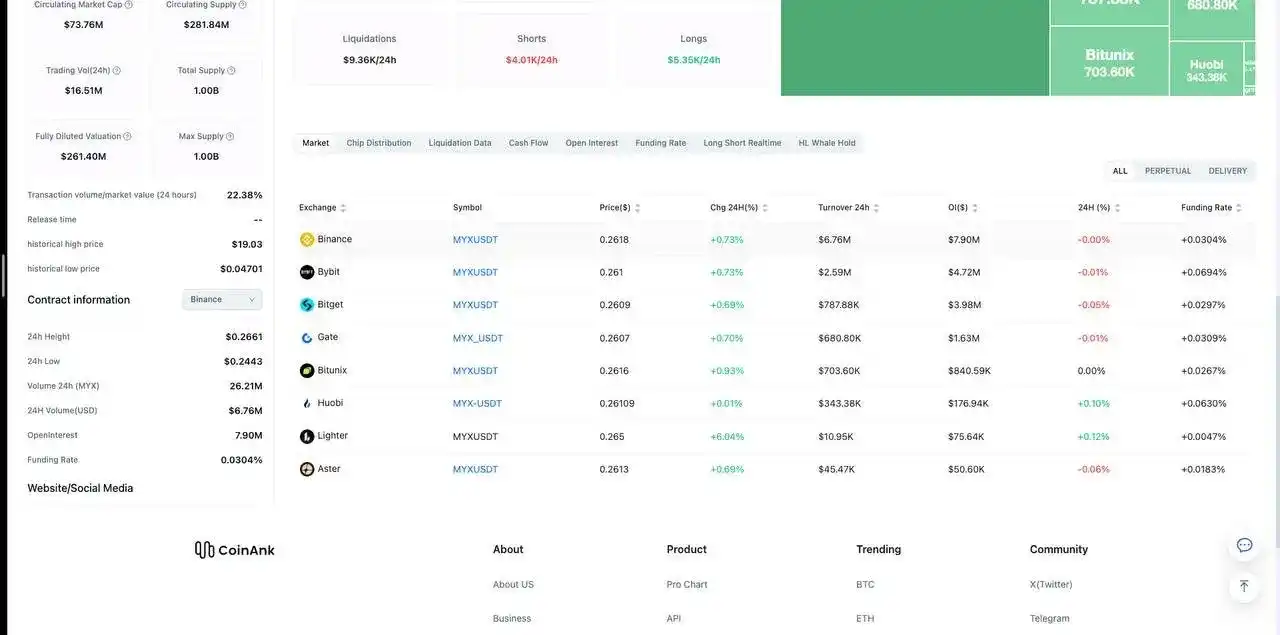
CoinAnk: https://coinank.com/instruments/MYX/SWAP/Binance/MYXUSDT/1h
CoinAnt's current MYX data shows that OI is now distributed proportionally across exchanges, largely consistent with each exchange's overall market share. Bitget's share dropped from 66.67% during the short squeeze to 20% afterwards. This indicates that the concentration during that period was temporary and directly related to manipulation, rather than genuine trading activity.
Order book microstructure: earlier warning signals
上面那些"OI 刷量"信号告诉你成交量或持仓是假的;前面案例里的钱包集中度数据告诉你筹码是被控制的——但这两类信号都是布局完成之后才能看到的东西。订单簿则提供了更早的指标——它是吸筹"正在发生"时的实时指纹。
以MYX 为例,吸筹阶段从7 月底跑到8 月初。 Coinglass 上OI 和价格在那段时间还都是平的,但订单簿层面,吸筹已经清晰可见——只要你在看。
When a whale uses TWAP (Time-Weighted Average Price) or iceberg orders (both techniques used to break large orders into hundreds of smaller ones, spread over time, and deliberately conceal their presence), a specific set of fingerprints will appear in the order book:
- The depth of the sell orders continues to thin : whale are systematically absorbing sell orders close to the market price, but each order is inconspicuous when viewed individually, and so slow that it is imperceptible;
- Buy orders keep piling up : Buy orders keep appearing near the market price, and they are being bought up more slowly than they are being replenished.
- A persistently high bid-ask imbalance (B-Ask Imbalance) : consistently above 0.4 . This is unusual in a normal market; a sustained positive imbalance indicates that buying pressure is suppressing selling pressure , meaning someone is continuously absorbing sell orders in the market.
The formula is as follows:
Imbalance = (Buying volume - Selling volume) ÷ (Buying volume + Selling volume). 0.4 indicates that 70% is buying and 30% is selling. Maintaining a price above 0.4 for a long period on a low-market-cap token suggests that someone is significantly increasing their holdings.
However, truly clever accumulation is hard to detect —a good market maker will never let buy orders significantly outnumber sell orders, as that would give them away. They will proportionally increase buy orders to match the growth in sell orders , making the account appear balanced, while quietly pushing the buy-sell ratio up from 0.95 → 0.97 → 0.99 over a week. At any given moment, the snapshot will "look normal," but the pattern of buy orders slowly outnumbering sell orders, yet never breaking through 1.0 or falling back, is itself a hallmark of TWAP.
Case Study: GWEI
This token provides a clear visual sample of "order book accumulation" in real-time data. When a low-market-cap token enters the listing or acceleration phase, the order book will show obvious anomalies: concentrated buying orders, sudden changes in depth structure, and prolonged positive imbalance . 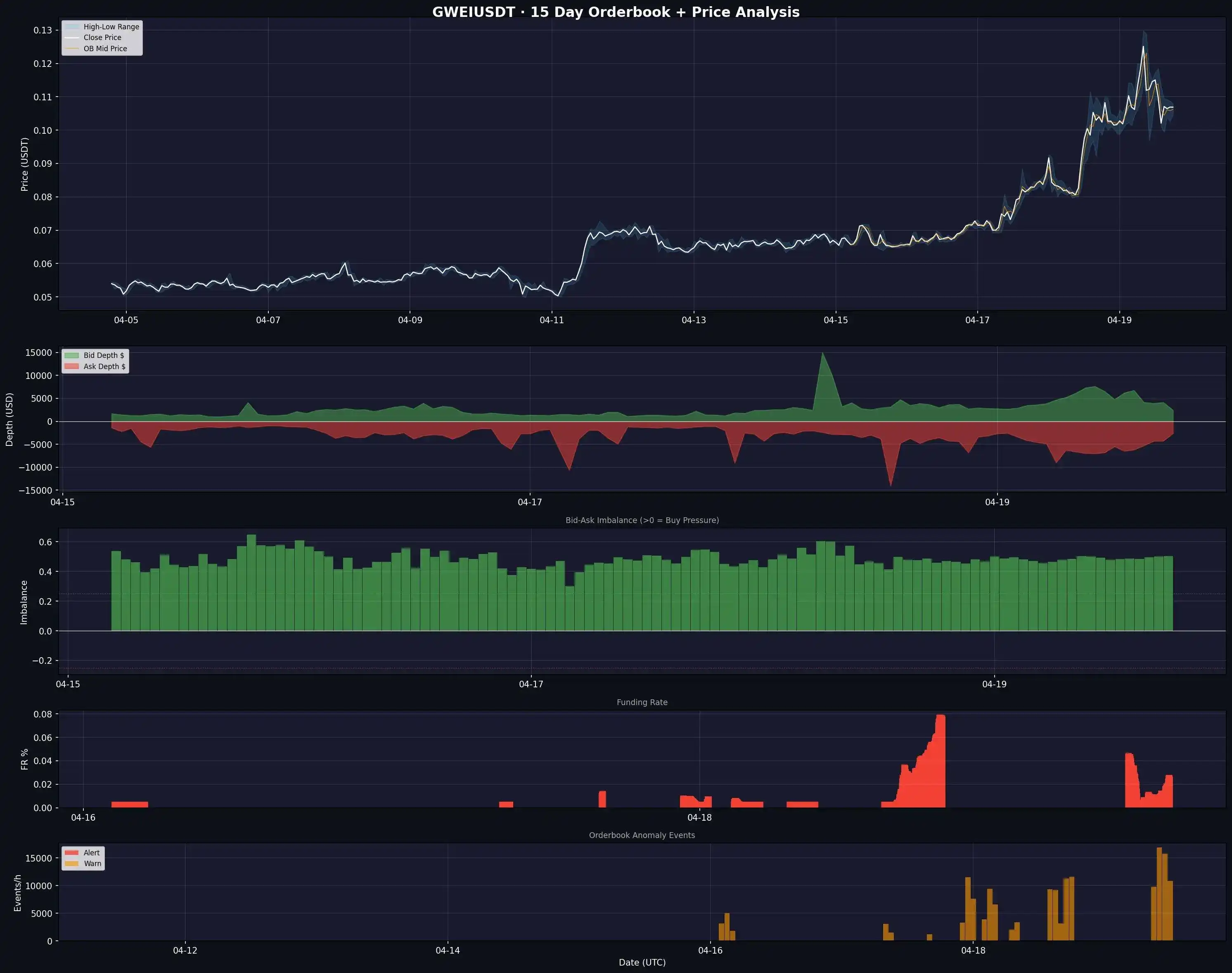
https://x.com/0xBenniee/status/2046138877425893508?s=20
After April 16th, the price entered an acceleration phase, rising from $0.07 to $0.12. During the same period, three things happened simultaneously:
- 订单簿异常事件每小时飙升至15,000+ 次。这些是与正常交易量不匹配的异常下单、改单、撤单。正常代币每小时只产生几百次此类事件。飙升至1.5 万次意味着订单簿被自动化系统主动管理,不是人类。
- 卖盘深度持续变薄。价格上方的卖墙被系统性吸收。不是一笔大单扫掉(那样太显眼),而是长时间、持续的研磨式吸收,看起来像普通交易,直到把多个小时的累积效果叠加起来你才能看出问题。
- The buy-sell imbalance has been above 0.4 for an extended period . One or two occasional readings are meaningless, but a sustained level above 0.4 for several hours indicates that accumulation is underway .
The funding rate surged to 0.08% around April 18th, which was a confirmation signal of the acceleration phase. By then, the accumulation phase was basically complete, and the price surge had begun.
How do you monitor it yourself?
Historical order book data cannot be retrieved via API —once a point in time has passed, the order depth is lost. To capture it, you need a bot that periodically snaps up snapshots of the order book and saves them locally.
The most basic configuration is:
- A DigitalOcean server costing $6/month;
- A Python script;
- The order book depth of Binance contracts is retrieved every 60 seconds;
- Store it in an SQLite database.
It can track multiple tokens simultaneously— every USDT perpetual pair on Binance Contracts is accessible through a public API, requiring no API key .
Limitations of real-time order book monitoring:
- When a whale uses a market order to scan levels beyond the top 20, this indicator fails to capture it at all;
- It cannot distinguish between "orders being filled" and "orders being actively cancelled";
- On low-market-cap coins, signals can also be faked – so relying solely on order book data to open positions is very risky .
The current data is best suited as one of multiple monitoring factors. Expanding it to the top 50 and combining it with other indicators will significantly improve accuracy.
Cross-exchange price manipulation
币安使用一个综合指数(Composite Index) :它从多个交易所拉取价格数据,加权后算出标记价格(Mark Price) 。决定你的仓位什么时候被强平的,是标记价格,不是最新成交价。 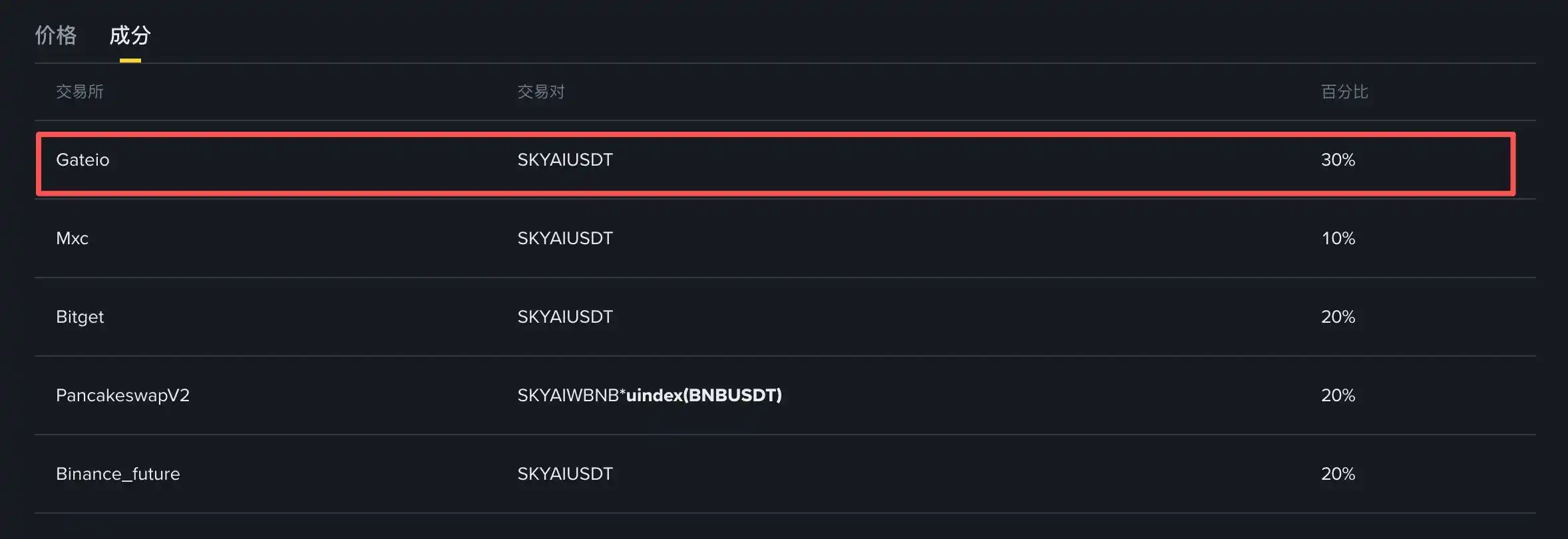
https://www.binance.com/zh-CN/futures/funding-history/perpetual/index
The problem is this: if the index includes exchanges with thin spot trading like Aster, Gate, or Mexc , market makers only need relatively little capital to manipulate prices on those exchanges, thus influencing Binance's mark price . This means—they don't even need to trade on Binance to trigger liquidation on Binance.
Market makers also use Aster to hedge: long on Binance and short on Aster (or vice versa) , making the entire manipulation Delta neutral .
To check if a token is involved in Aster arbitrage activity, simply check its exchange distribution on CoinAnk. If a low-market-cap token with almost no spot liquidity has contracts on Aster, and the contract launch time coincides with the Binance contract launch time, this is a signal .
How to read short squeezes in real time
Knowing the script isn't enough; you also need to understand which stage of the script you're currently in . The following five signals, taken together , can tell you whether a short squeeze is in progress, about to end, or already over.
1. Funding Rate
- Short squeeze in progress: Short sellers continue to pay long positions, and deep negative rates persist = short squeeze still has fuel ;
- The short squeeze is coming to an end: rates are returning to zero, the imbalance is being leveled, and short sellers are starting to close their positions voluntarily rather than being forced to liquidate.
- Exit signal : The rate turns positive (longs pay shorts), the shorts have been wiped out and there is no one left to force, the price is likely to turn downwards.
2. OI vs. Price
- A short squeeze is underway: both prices are rising in tandem , new short sellers are constantly entering the market and getting liquidated, and each liquidation pushes the price even higher;
- The short squeeze is nearing its end: OI is declining while prices remain stable , reducing the number of positions that can be liquidated and weakening the momentum of chain buying.
- Exit signal : OI rises when prices fall – new positions are being opened on the short side, and they are winning. The trader may have already reversed their position and short themselves.
3. Taker Ratio
- Short squeeze in progress: Buyers are in control, actively buying up sell orders – someone is continuously sweeping the market;
- The short squeeze is nearing its end: the balance between bulls and bears is balanced, with no clear dominant force.
- Exit signal : Seller-dominated for several consecutive hours - continuous active selling by sellers means that distribution has begun, and the operators are selling to the remaining buying liquidity.
4. Large on-chain transfers
- Short squeeze in progress: zero large transfers , no one is selling;
- The short squeeze is nearing its end: small-amount transfers are beginning to appear;
- Exit signal : Large wallets are shifting to CEXs .
Tools for research
CoinAnk
CoinAnk is a crypto derivatives data analytics platform that aggregates data from major exchanges (including DEXs such as Hyperliquid, Lighter, and Aster) and transforms it into actionable trading insights. As a single dashboard, it is currently the most comprehensive tool for detecting price pumps . Specific usage:
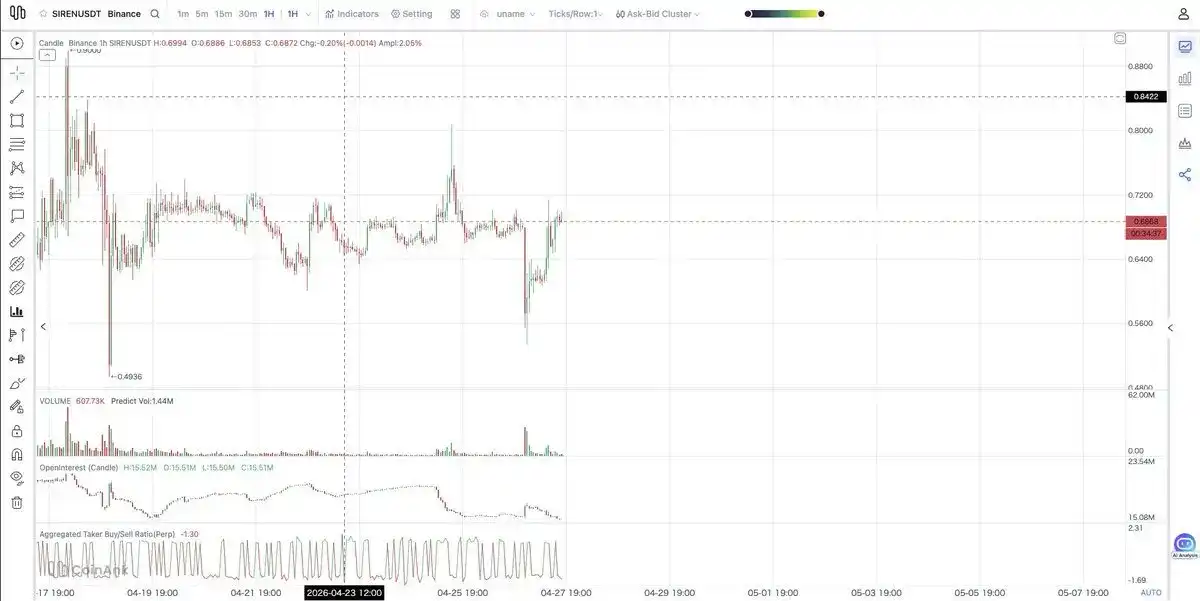
- OI Tracking : On any token page → OI tab, OI data from all exchanges is displayed on a single chart, overlaid with price. You can switch between 1H/4H/daily charts. On the 1H chart, you can see "Price vs. OI Divergence" signals in real time .
- Funding Rate : On the same token page → Weighted Funding Rate tab. When the rate is below -0.05% for multiple consecutive 8-hour periods, it indicates that a short squeeze is underway .
- Liquidation Data : Token Page → Liquidation Tab. Displays the amount, exchange, and long/short direction of a single liquidation order. Sort by amount to find the largest single liquidation —if a $300M OI only generates a maximum single liquidation of $50k, this OI is artificially inflated. CoinAnk's Liquidation Heatmap has high resolution and supports multiple timeframes; brighter colors indicate more potential liquidations at that price level—these areas are often the "points" where market makers seek liquidity .
- Cross-Exchange OI Distribution : Compare the OI of the same token across multiple exchanges. If a low-market-cap token has almost the same OI on Bitget and Binance, then the OI on the smaller exchange is likely fake .
- Trading Volume : Token page → Volume tab. Compare daily trading volume with OI (On-Exchange). A Vol/OI ratio > 20 is likely due to wash trading; the normal range is 3–8 times .
- OrderFlow and Footprint Chart : CoinAnk provides real-time order flow analysis with built-in imbalance detection. It allows you to see the precise trading volume at each price level within a single candlestick chart—corresponding precisely to the order book microstructure signals mentioned earlier.
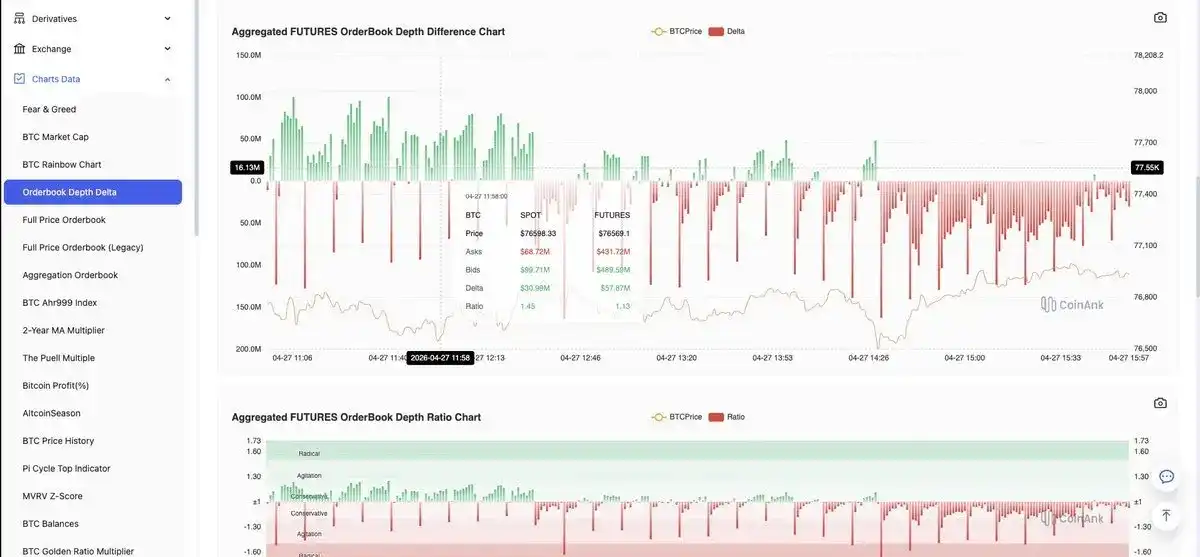
https://coinank.com/chart/indicator/order-depth
- Long/Short Ratio : This displays real-time buying pressure versus selling pressure, with the Long/Short Ratio line superimposed on top. When the green bars (buyers) consistently exceed the red bars (sellers), and the ratio is consistently > 1.0, buyers are in control —this is how the Taker Ratio signal mentioned earlier in "Real-time Reading of Short Squeeze" is presented on the chart.
- Pro Chart : Overlays traditional candlestick charts and derivatives data (OI, funding rates, long/short ratio, liquidation levels) onto a single chart. This saves you the trouble of constantly switching tabs when tracking a volatile cryptocurrency price surge in real time .
Newsliquid
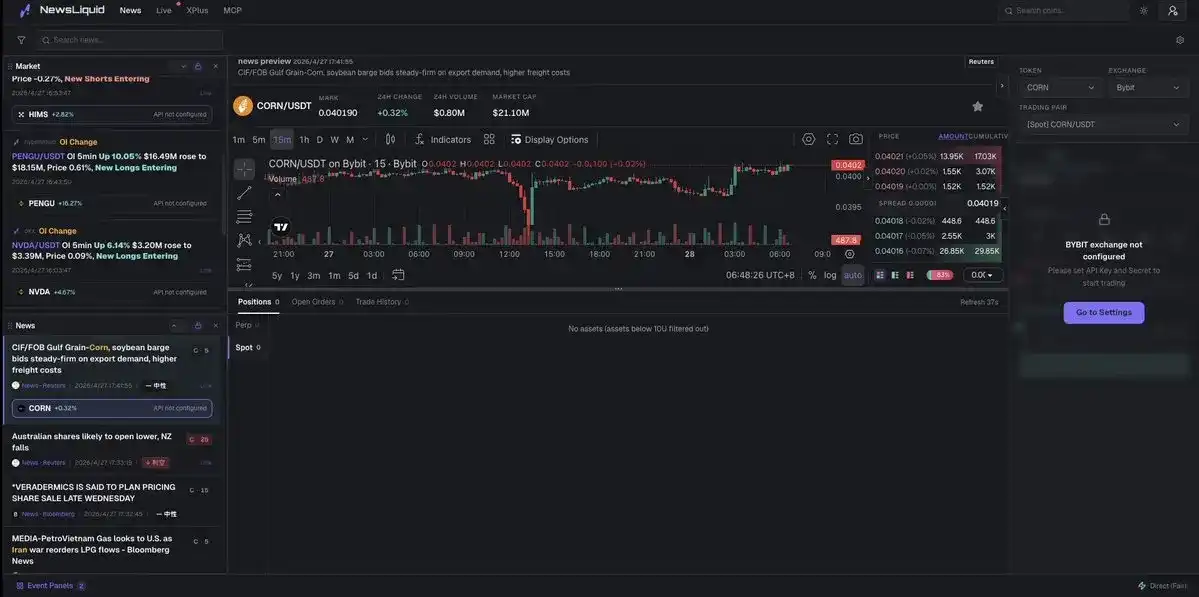
Newsliquid is essentially a real-time Bloomberg terminal for the crypto world—integrating news, market data, social monitoring, and trading infrastructure into a single interface.
- News + TradingView : The left-hand real-time news feed displays breaking headlines, alongside OI change alerts. TradingView charts are directly integrated. You can also connect to your exchange account via API and trade directly on the interface .
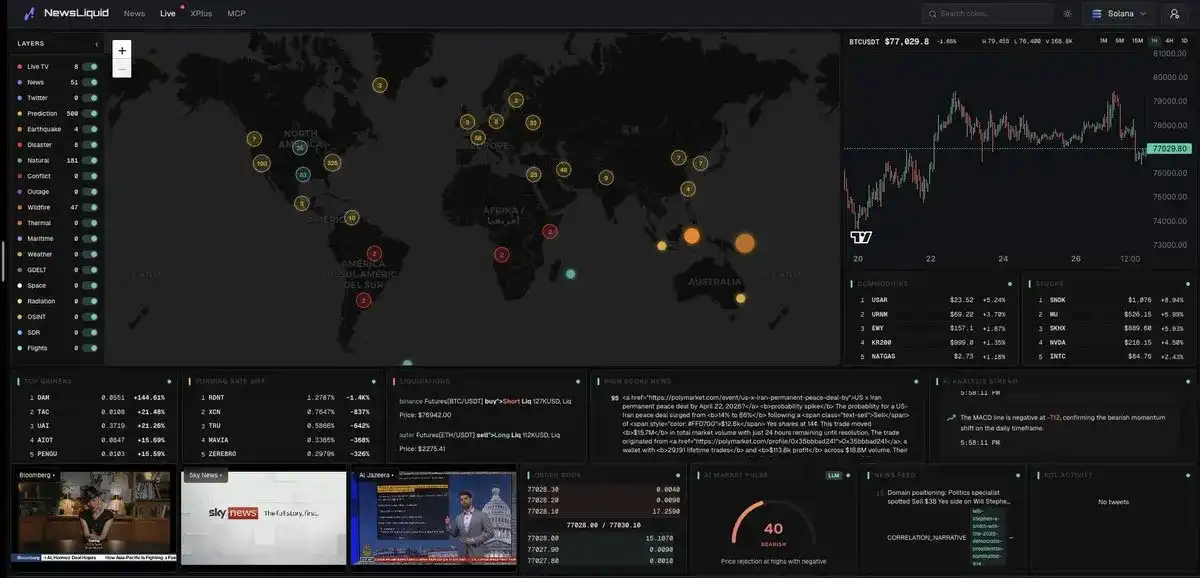
- Real-time panel : Global event map, covering multiple categories such as TV, News, X, Conflict, Outage, Prediction, OSINT, etc.; the bottom displays the gainers list, funding rate differences, etc.
- X (Twitter) Tracker : Real-time monitoring of encrypted Twitter accounts, with EN/CN, meme accounts, and custom filters; the right panel displays follow relationships.
- MCP Services : MCP servers are open to the public, including OpenNews (real-time encrypted news search, AI summaries, sentiment analysis), OpenTwitter (user information, tweet search, KOL tracking), OpenTrade (DEX trading, on-chain data, token analysis), Twitter to Binance Square (Twitter content is automatically synchronized to Binance Square), and 6551 daily news (daily encrypted news summaries and market analysis).
Coinglass
The most widely used free derivatives dashboard; most of the OI and volume data in this article are verified here. Track OI, funding rates, liquidation, and long/short ratio.
Arkham Intelligence
On-chain wallet analysis. MYX's wallet rotation pattern was discovered here. Search for any token → look at the inflow/outflow tags → sort by amount in descending order to find the largest fund flows. If multiple wallets share the same source of funds, or ultimately all deposit into the same CEX deposit address, they are likely the same entity .
Bubblemaps
A visualized wallet cluster graph. Paste a contract address, and it will connect wallets according to the source of funds. COAI's 60-wallet pattern and PIPPIN's 50-wallet pattern were both identified using this tool .
CoinGecko + CoinMarketCap
Price verification and token data. CoinGecko's Historical Data tab provides daily prices from the launch date —all price points on the MYX and COAI timelines in this article are verified here. CoinMarketCap's Unlock Tracker displays a linear release schedule and the "circulating vs. locked" ratio .
The game is manipulated; everyone knows it. The only advantage is understanding the script and continuously refining it before you become the one left holding the bag .
Never be the exit liquidity
Recommended reading:
I used AI to analyze 221 cryptocurrency contracts and finally found the only way to survive trading in volatile cryptocurrencies.
Original link