Bitcoin is standing at what I consider to be the most crucial price level in recent months. The $80,000 to $81,000 range is not just ordinary technical resistance; it is the "ceiling" of this long period of consolidation and a true fork in the road that will determine the market's future direction.
If you've been observing and waiting during this period, I think your patience has been commendable; this week is not yet the time to go long. Whether the price can truly stand above this level needs time to verify, and the risk of a false breakout ("one-day wonder") still exists. Before the structure is confirmed, the cost of hasty entry often outweighs the regret of miss the pump.
However, I also don't want to ignore another possibility: if Bitcoin really breaks through and holds this time, then the volatility of the past few months may be coming to an end, and at that time we will actively position ourselves for long positions and participate in the trend.
Summary of key trading insights this week:
- BTC Multi-Period Price Structure Analysis (Detailed Explanation in Part 1)
- BTC Market Forecast for This Week and Medium- and Short-Term Trading Strategies (Detailed Explanation in Part Two)
- In-depth analysis of HYPE's hourly chart structure (detailed explanation in Part 3)
- HYPE Weekly Market Forecast and Short-Term Trading Strategy (Detailed Explanation in Part Four)
- Last week's trading recap: HYPE short-term long position yielded approximately 5.77% profit (details in Part 5).
So the core focus this week is on this question – can Bitcoin truly break through $80,000 to $81,000? Let's break it down layer by layer, from the daily chart to the hourly chart.
I. Multi-timeframe trend structure analysis of Bitcoin
1. BTC Daily Chart Chart Structure Analysis: (Based on the market trend after the low point on February 6, 2026)
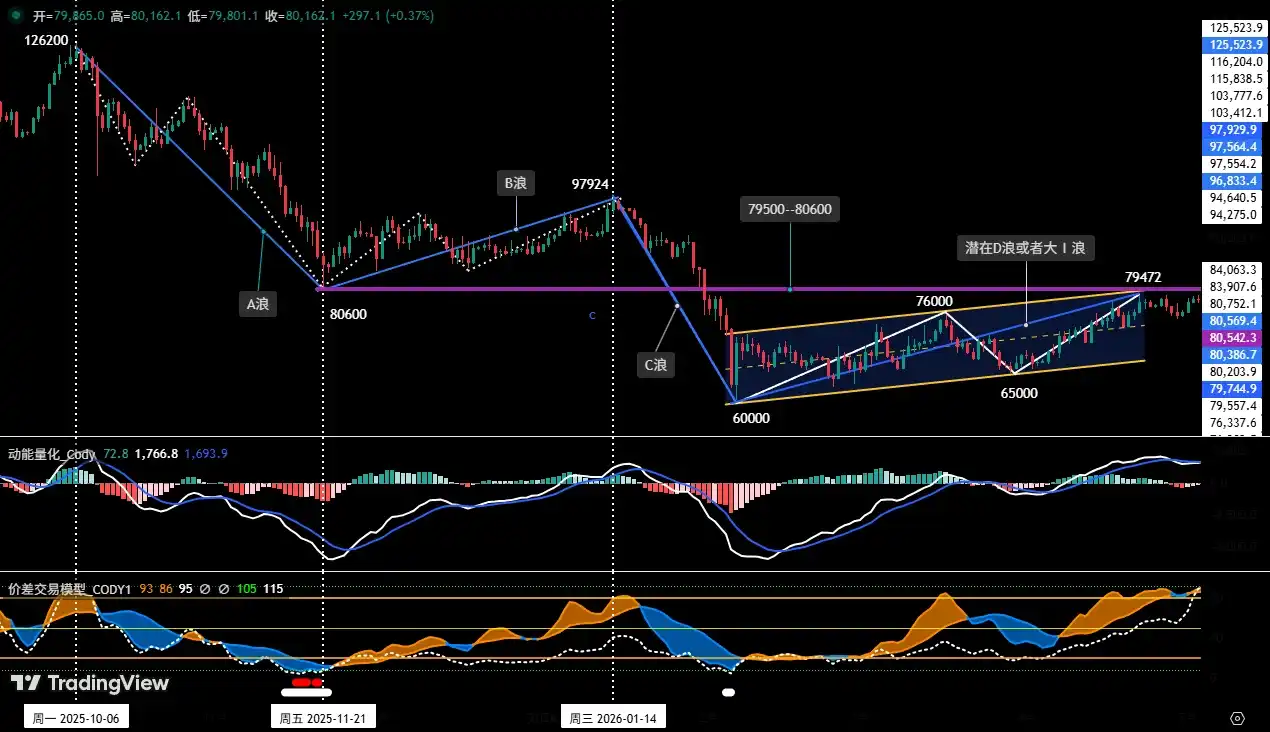
Figure 1
As shown in Figure 1, Bitcoin is currently in the key price range of $79,500 to $80,600 (marked in purple in the figure), which has become a core "watershed" for the market. The effectiveness of this resistance will directly determine the nature and subsequent direction of the rebound that started from the low of $60,000 on February 6.
Below are two core path analyses:
The first path: A valid upward breakout and sustained hold above this level increases the likelihood of a trend reversal.
- Triggering conditions: If the price of the coin can effectively break through and stabilize above this area, and the upward momentum (both in terms of price and time) continues to expand.
- Technical analysis suggests that the daily correction since the October 2025 high ($126,200) may have ended at the February 6 low ($60,000), and the market trend may have fundamentally reversed.
- Outlook: This rebound can be seen as the starting point of a potential major Wave I (impulse wave). A major Wave II (corrective wave) pullback may follow, but it is highly likely that the correction will complete above $60,000.
The second scenario: If the upward attempt fails, the risk of a downward continuation pattern increases.
- Triggering condition: The price encounters resistance in this area, exhibiting a "one-day wonder" or "false breakout" followed by a rapid price decline.
- Technical analysis: This rebound is more likely a D-wave rebound within a potential downtrend, rather than a trend reversal.
- Outlook: After the rebound ends, a wave E correction is expected, and there is a high probability that it will fall below the previous low of $60,000.
In summary, this price range is a litmus test for market sentiment. A firm hold above this level opens up further upside potential, while failure could mean a deep pullback. The outcome of the battle between bulls and bears in this area will guide the core direction of the next phase and is a key reference for assessing potential shifts in market structure.
2. In-depth analysis of BTC hourly chart structure: (using a 4-hour analysis period)
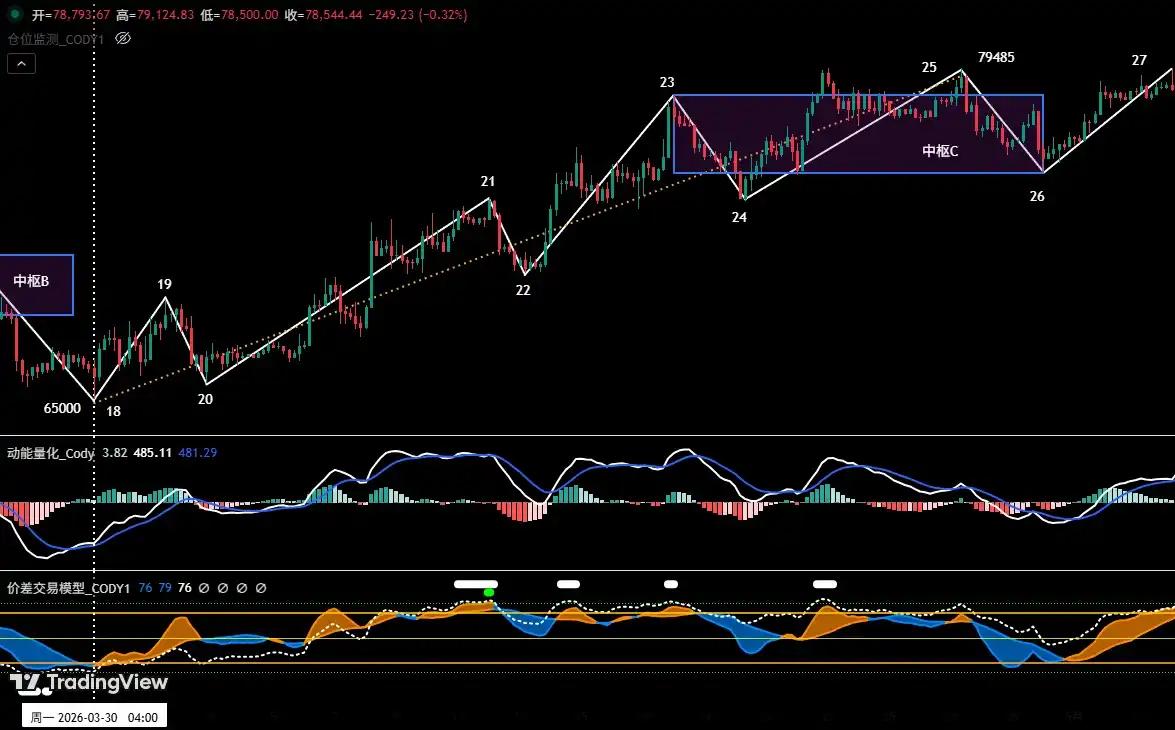
Figure 2
As shown in Figure 2, the daily-level rebound that started from the low of $65,000 on March 30th can be subdivided into nine segments on the 4-hour chart: 18-19, 19-20, 20-21, 21-22, 22-23, 23-24, 24-25, 25-26, and 26-27. Among these, segments 23-24, 24-25, and 25-26 overlap, forming a "center C". Currently, the market is in the departure segment (segment 26-27).
Since the nature of the central pivot C is an upward central pivot, it is highly probable that the price corresponding to the departure segment endpoint 27 will break through the previous high of $79,485 and challenge $80,600.
II. Bitcoin Market Forecast and Trading Strategies for This Week
1. BTC price trend prediction for this week:
This week's key takeaway: The price is expected to test the resistance level around $80,600 this week, with a focus on whether it can effectively break through the key resistance zone of $79,500 to $80,600. Although easing geopolitical tensions may provide short-term upward momentum, the market is more likely to exhibit a wide-range fluctuation pattern due to macroeconomic pressures and structural contradictions.
2. Core pressure level:
- First resistance zone: $79,500–$81,000 (near the November 2025 low)
- Second resistance zone: $83,500 to $84,500 (a previous area of dense trading volume between bulls and bears).
3. Core support level:
- First support level: around $78,500 (near the upper boundary of the consolidation range).
- Second support level: $73,500–$75,000 area (previous important support level)
- Third support level: $69,500–$70,500 area (previous important support level)
4. This week's trading strategy (excluding the impact of unexpected news)
① Mid-term strategy:
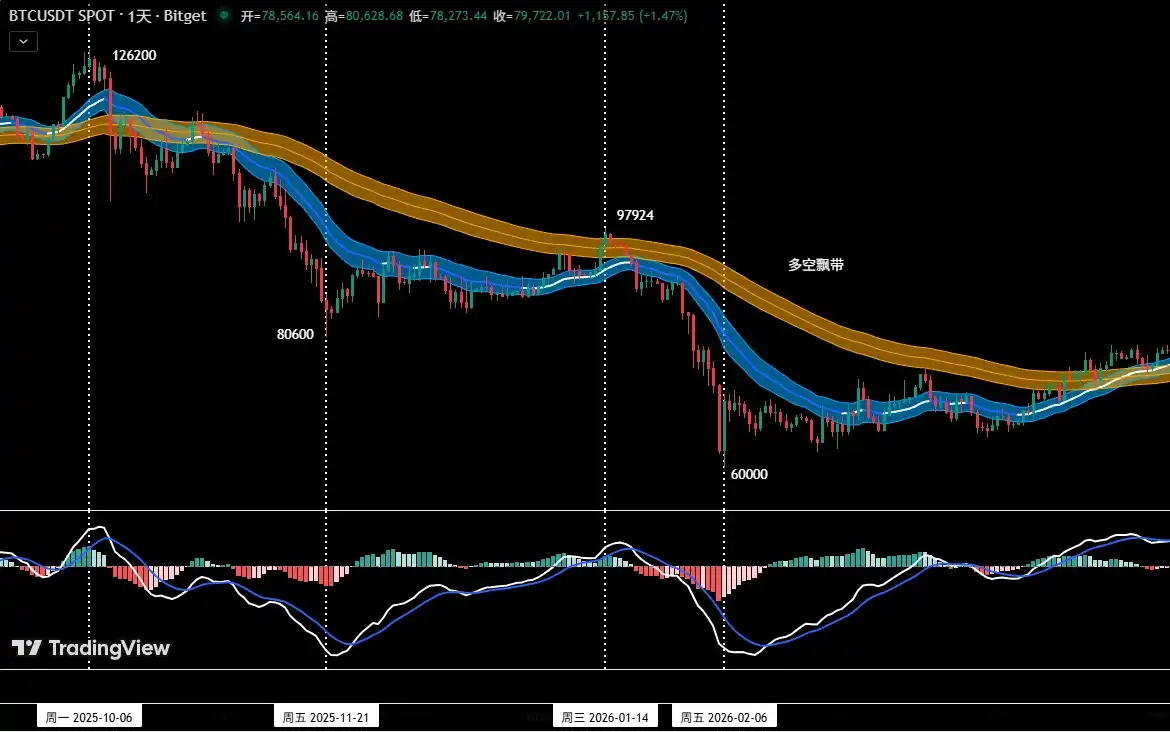
Figure 3
Position Monitoring Model: As shown in Figure 3, based on trading rules, before Bitcoin breaks through the upper trendline of the bullish/bearish band but its validity is confirmed, we maintain a neutral position and wait-and-see strategy for the medium term this week. We recommend waiting for a clear breakout result before entering the market, and avoiding chasing highs and lows.
② Short-term strategy: Use 30% of your position, set a stop-loss point, and look for opportunities to profit from price differences based on support and resistance levels. (Use 30-minute/60-minute timeframes as the trading period)
③ A/B Trading Plan: Currently, Bitcoin is about to test the core area of $79,500 to $80,600, and intraday volatility will increase. In short-term trading, to dynamically respond to the complex evolution of the market, prudent investors should abandon subjective assumptions and instead rely on objective trend structure analysis and quantitative model signals to formulate and strictly implement two specific trading plans, A and B.
Option A: If the price breaks through and holds above the support level, long.
- Opening a position: When the price breaks through and holds above the $79,500-$80,600 range, and combined with bottom signals from the quantitative model, a 30% long position can be established.
- Risk control: The initial stop loss is set below $78,500.
- Closing positions: When the price rebounds to near a key resistance level and is combined with model signals, positions can be gradually liquidated to realize profits.
Option B: If the support level is broken, short short on any rebound.
- Opening a position: When the price of the coin effectively breaks below the support level near $75,000 and this is combined with the top signal of the model, a 30% short position can be established.
- Risk control: The initial stop loss is set above $76,500.
- Closing positions: When the price falls to a key support level and combined with model signals, positions can be gradually liquidated to realize profits.
Having discussed Bitcoin, let's talk about HYPE.
In my view, this structure presents a fairly classic reversal signal—the upward momentum has clearly weakened, and the rebound strength is also narrowing. Of course, the trend is not yet definitively established. If it can effectively break through the previous high of $45.76, then the upward trend is not over, and it will likely follow Bitcoin's strength. After all, if BTC successfully stands on that platform, the overall market sentiment will be boosted, and Hype is unlikely to remain unaffected.
However, before a breakout is confirmed, my advice is: those already holding positions should set profit targets to protect existing profits; those without positions should continue to observe and not rush to buy. Let the market structure speak for itself before making a decision.
III. In-depth analysis of the HYPE trend structure
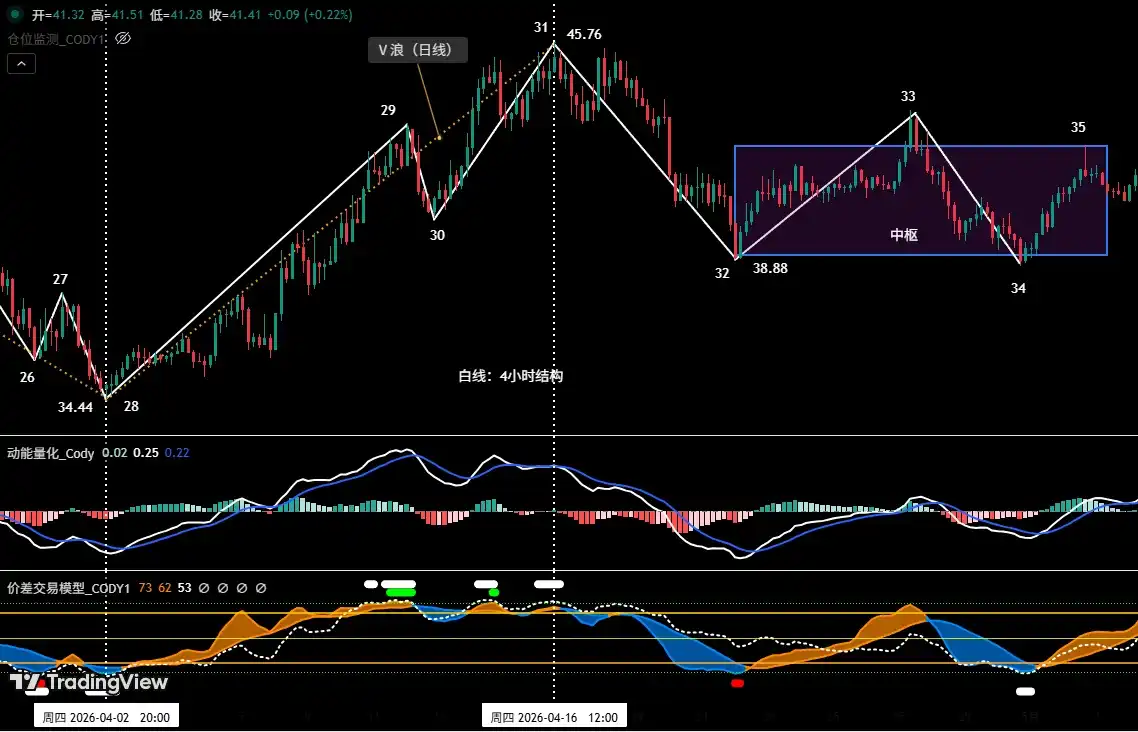
Figure 4
1. As shown in Figure 1, the correction that began from the high of $45.76 on April 16th can be subdivided into four segments on a 4-hour chart: 31-32, 32-33, 33-34, and 34-35. The segments 32-33, 33-34, and 34-35 overlap, forming a "downward consolidation zone." Currently, the market is in the 34-35 segment.
2. The 4-hour chart shows that HYPE's current price action presents a classic reversal signal. Specifically, during the correction phase (endpoint 32), the price broke below the previous low (endpoint 30, $40.17), and the subsequent rebound (endpoint 33) failed to reach a new high (i.e., break above endpoint 31, $45.76). This constitutes a potential reversal structure of "correction breaking below the previous low, rebound failing to reach a new high." Therefore, technical analysis suggests that the daily uptrend that started from the low of $34.44 on April 2nd is likely to have ended at the previous high of $45.76, and the market is currently in a daily-level correction phase. A subsequent break below the key support level near $38 would further confirm this conclusion. Unless the price can effectively break through and hold above the previous high of $45.76, the aforementioned bearish structure will not be broken, and a market trend reversal is possible.
IV. HYPE Market Forecast and Short-Term Trading Strategy for This Week
1. HYPE Market Trend Forecast for This Week:
This week's HYPE key takeaway: Focus on whether the current 34-35 range can effectively break through the previous high of $45.76.
2. HYPE's short-term trading strategy for this week:
- Based on the prediction that the overall trend of HYPE will turn into "adjustment or fluctuation", short-term operations should follow the trading principle of "following the trend and shorting on short".
- Based on signals from our self-developed quantitative model, we use 30-minute/60-minute timeframes as our operating cycles and allocate 30% of our position to capture entry and positioning opportunities.
- Entry Strategy: This week, if a resistance signal appears during the rebound from 34-35 (the price at endpoint 35 must be below $45.76), and this is combined with the top signals triggered by the two models, consider entering a short short. The position size must be controlled below 30%, and stop-loss discipline must be strictly adhered to.
V. HYPE Operation Review (April 27 - May 3)
Last week's trading strategy and core viewpoints have been validated by the market:
- HYPE Short-Term Trading Performance: Last week, HYPE completed a short-term long position (1x leverage), achieving a return of approximately 5.77%. (See Table 1 for details)
- BTC Price Movement Prediction Verified: In last week's article, we pointed out that the current price was facing dual resistance from the upper trendline of the daily channel and the core area between $79,500 and $80,600, making a direct breakout difficult. The current market movement has validated our previous prediction.
1. Review of short-term trading: (See Table 1)
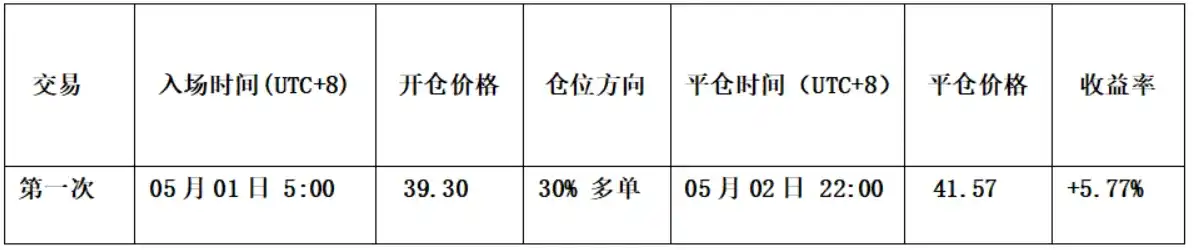
Table 1
2. Short-term trading review: (See Figure 5)
- Entry Strategy: First, the previous price action had completed a full correction structure; second, the spread trading model had already issued a strong bottom warning signal (red and white dots in the chart); third, the momentum quantification model triggered a bullish divergence signal. Therefore, we established a 30% long position at $39.30.
- Closing strategy: When the price rose to around $42.5, a resistance signal appeared, and the spread trading model triggered a top warning signal (green dot and white dot in the chart). Therefore, we closed all positions around $41.57.
- Summary: This transaction yielded a profit of approximately 5.77%.
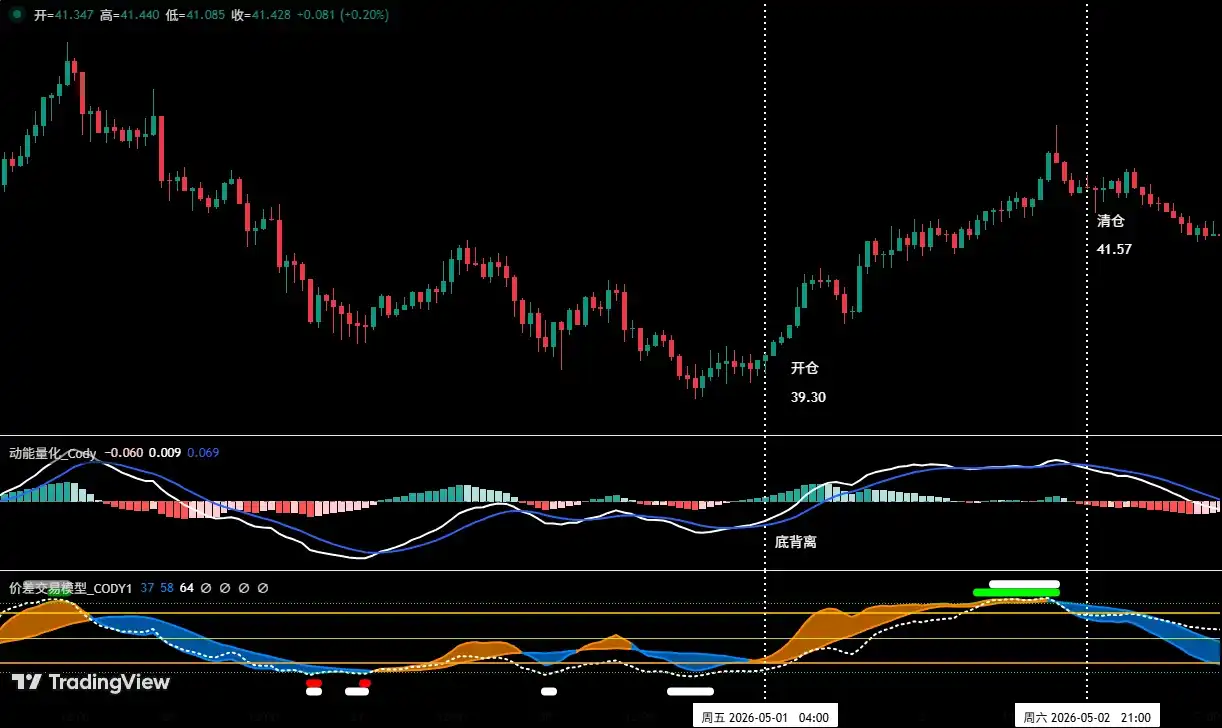
Figure 5
VI. Special Note:
- When opening a position: immediately set the initial stop-loss level.
- When profits reach 1%, move the stop-loss order to the opening cost price (break-even point) to ensure the safety of principal.
- When profits reach 2%, move the stop-loss order to the 1% profit level.
- Continuous monitoring: For every additional 1% profit in the coin price thereafter, the stop-loss level will be moved by 1% to dynamically protect and lock in profits.
Financial markets are constantly changing, and all market analysis and trading strategies must be dynamically adjusted. All views, analytical models, and operational strategies presented in this article are derived from personal technical analysis and are for personal trading journal use only. They do not constitute any investment advice or basis for action. The market is risky; invest with caution. Please do not make decisions based on this information.