The earnings season in the first quarter of 2026 provided a rather ironic commentary on the competitive landscape of global internet giants.
Google's parent company, Alphabet, reported revenue growth of 22% to $109.9 billion, with earnings per share of $5.11, a staggering 82% increase year-over-year. Meanwhile, Meta announced its triumphant return with a 33% revenue growth, $56.3 billion in quarterly revenue , and equally strong earnings.
However, the capital market's reaction was completely opposite to these figures. Following the earnings release, Meta's stock price plummeted by about 10% within days, while Alphabet saw growth. The underlying reason for this is Silicon Valley's AI anxiety. In the AI era, no one can predict what a company will look like three years from now. The changes and anxieties brought about by AI have even clouded the prospects for the next year. This stands in stark contrast to the straightforward logic of the past two decades of the internet cycle, where "high growth equals high valuation."
In a recent research report, Goldman Sachs pointed out that approximately 75% of current US stock valuations are based on "terminal value," which is the discounted present value of a company's expected earnings ten years from now. This means that the market is pricing in the distant future.
However, the paradox lies in the fact that the emergence of AI has actually filled the future with enormous uncertainty .
This explains the logic behind the rise and fall of Alphabet and Meta. As two tech giants heavily reliant on advertising revenue, Alphabet's 22% growth is driven by the explosive expansion of Google Cloud's business (63%), the complete reshaping of the search experience by AI Overviews and AI Mode, and AI Max, an AI-native advertising product with hundreds of thousands of advertisers. Meta, on the other hand, presents a contradictory picture—it runs rapidly on the foundation of social advertising, yet it must continue to invest huge sums of capital in the future of AI, with the return on investment still shrouded in uncertainty.
Google's AI Max: A Ticket to the AI Era
In fact, AI and cloud businesses occupy a very important position in Google's overall financial reports and related announcements.
Its importance was so great that it even directly reversed Google's stock price decline since February. Previously, market concerns mainly stemmed from two aspects: first, the uncertainty brought about by TurboQuant's memory optimization technology, and second, the competitive pressure from OpenAI's demand that Google list ChatGPT as its default search engine. The strong earnings report rescued Google from these two concerns, propelling its stock price to soar starting from March 30.
Of course, cloud computing, as an alternative infrastructure for AI, is a standard business for almost all internet companies. Correspondingly, there's AI MAX (according to Google's announcements, AI MAX's core capabilities are Search Term Matching, Text Customization, and Final URL Expansion). This can almost be seen as the only viable business for tech companies at present. As a product that began global public testing in May 2025, after a year of development, it has accumulated hundreds of thousands of advertisers, becoming the "fastest-growing AI search product" in Google's advertising portfolio.
According to Brendon Kraham, VP of Product Strategy at Google Ads, at a media briefing in April 2026, AI Max continues to unlock "billions of search queries that had never been effectively monetized before" for the platform. This means that when users submit complex, conversational, multi-step shopping or information queries through AI Mode, Google will no longer lose advertising opportunities due to a lack of accurate keyword matching, but will be able to dynamically generate ad responses based on a deep understanding of the user's intent.
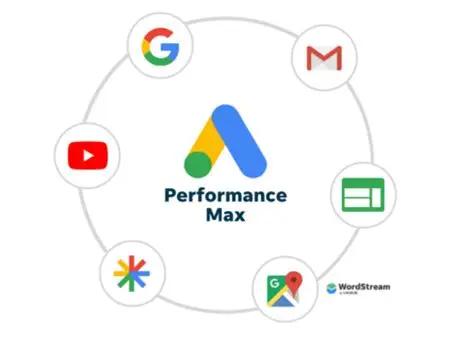
Previously, Google's digital advertising product, Performance Max (hereinafter referred to as PMax), had accumulated 4 million advertisers. Morketing interviewed industry professionals when the product was first launched in 2021. Essentially, advertisers provide the creative materials and objectives, while Google's AI decides: who to display the ad, in what context, and in what format. Of course, this is not a "lazy advertising platform"—PMax doesn't help advertisers "think of strategies," but rather better achieves the goals set by advertisers. All 4 million advertisers are eligible to run AI chat ads in Google's AI Overviews or AI Mode. Based on their trust in "black box" products like PMax, they are clearly more motivated to try subsequent AI Max applications.
From a business perspective, official Google data shows that advertisers enabling the full AI Max suite can achieve an average 7% increase in conversion rate or conversion value , while maintaining similar CPA or ROAS levels. However, reports from independent third-party testing agencies such as Monks Agency and Smarter Ecommerce present more complex results. For example, some retail advertisers have experienced a decline in ROAS, and inconsistent relevance of search term reports.
However, a closer look at these reports reveals that they primarily focus on technical aspects. Undeniably, at least for now, Google is indeed building a commercially viable AI advertising operating system with scalable commercial validation. The earnings call also revealed that many small and medium-sized enterprise advertisers are actively adopting AI automation tools. From Google management's perspective, these advertisers are turning AI into a new channel that directly generates positive ROI, rather than simply a tool to improve management efficiency.
Looking further ahead, Gemini is also being increasingly applied to the advertising field. Philipp Schindler (Google's Vice President of Global Sales and Operations and Chief Business Officer) revealed in the Q1 2026 earnings call that Google is deploying the Gemini model across all its advertising delivery infrastructure to drive a comprehensive upgrade in match accuracy, creative generation, and bidding strategies.
Clearly, Google is attempting to build an AI-based commercialization system, or rather, a completely new AI-based advertising system. For Wall Street, this is obviously more exciting than the 22% growth.
OpenAI needs a Sheryl Sandberg
Looking at Google alone might not be enough to demonstrate its advantage in the commercialization of AI. In stark contrast is OpenAI. ChatGPT, the most iconic product in the AI conversational field, boasts over 800 million weekly active users. However, according to reports from overseas media outlets such as Adexchanger in April 2026, despite some positive feedback in its testing, OpenAI only had about 600 advertisers at that time.
These 600 advertisers were initially "elite players" who had undergone rigorous screening.
When ChatGPT's advertising pilot program launched on February 9, 2026, it set a minimum investment threshold of $200,000 to $250,000 and a CPM price as high as $60, almost three times the bidding cost of social media platforms such as Meta, and even close to the inventory price of NFL games during prime time. OpenAI's plan was to use the high threshold to screen out truly large brand advertisers with budgets, while maintaining a "premium" positioning by controlling the ad display ratio (initially showing ads to less than 20% of eligible users).
If this strategy was indeed an undeniable success in the first six weeks, generating over $100 million in annualized revenue, it did not face widespread user opposition.
However, in its subsequent development, this boutique strategy ironically became OpenAI's glass ceiling. A CNBC report in mid-March 2026 revealed an extremely awkward industry situation: some early OpenAI advertisers committed to spending $200,000 to $250,000, but due to very limited ad inventory, the speed at which their budgets were spent was restricted. Some participants reported to the media that although they set substantial advertising budgets, the actual spending might only be around $2,000.
This means that while early performance data for ChatGPT ads was indeed impressive— for example, Criteo reported that the conversion rate of users recommended by the large language model was about 1.5 times that of other channels—some advertisers found themselves in the predicament of having a budget but being unable to effectively run it. This outcome is somewhat darkly ironic. In the past, advertisers worried about "not knowing where 50% of their budget was wasted"; but now, for sophisticated advertisers who highly value ROI and budget execution, their concern has shifted to "90% of their budget still sitting in their ad accounts."
More importantly, this kind of "saving" will clearly not impress advertisers. This money should have been spent in March, turning into real sales performance, not becoming an interest-free deposit. This experience of "having money to spend but not being able to" will ultimately only lead to budget shifting. After all, marketing budgets are never held for a single platform indefinitely; if they can't be spent, they will flow to established channels like Meta, Google, or TikTok that can efficiently utilize the budget.
OpenAI clearly recognized this predicament and quickly adjusted its strategy within the next nine weeks: it drastically reduced the minimum investment threshold from $250,000 to $50,000, launched a self-service ad management platform, lowered the CPM from $60 to $25 or even lower, and expanded ad visibility to unlogged users in April 2026 to increase its inventory.
On May 6th, China time, following the release of GPT-5.5 Instant, OpenAI prepared to fully launch its advertising platform for businesses. This means that free users worldwide will subsequently receive ad recommendations when using ChatGPT. Specifically, after a user asks a question and the AI answers, an ad module marked "Sponsored" will appear below.
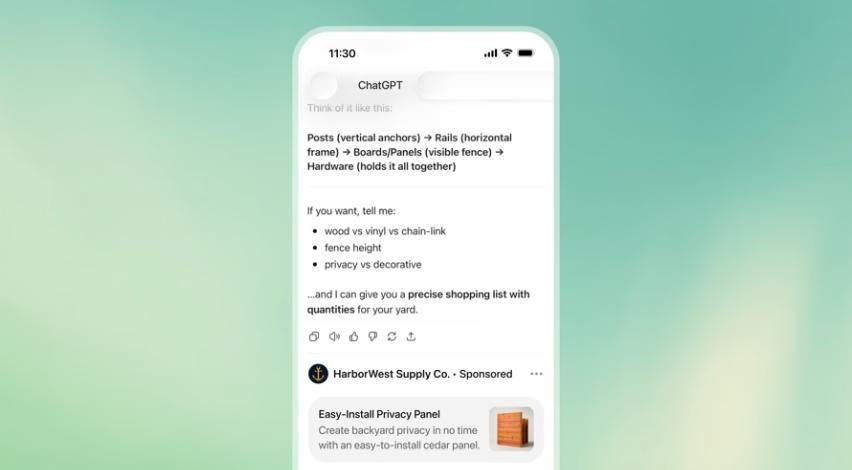
This module can display products from one or more advertisers. In longer conversations, ChatGPT will also consider the overall context to decide whether to display ads and which ads to display.
This is why ChatGPT updates include a memory feature.
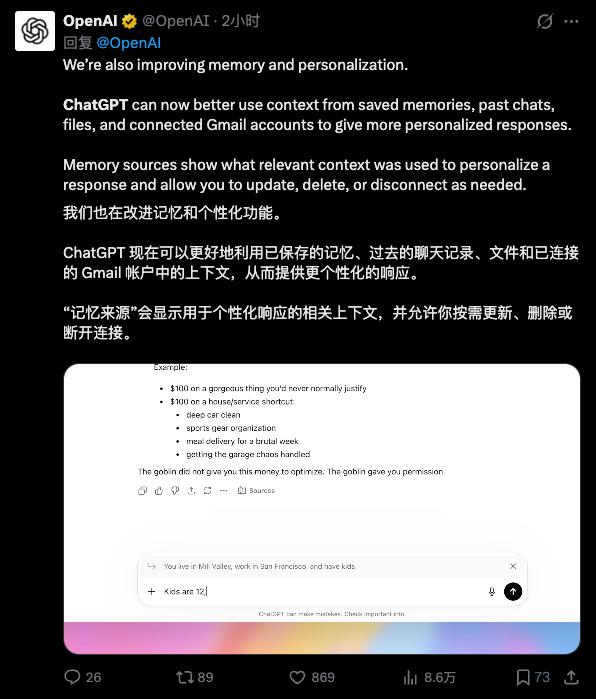
After all, the memory module not only helps users optimize their answers using context, but also helps AI deliver ads more effectively.
While fully open advertising features mean more ad inventory, GPT's current predicament isn't solely focused on insufficient ad inventory. AI has indeed changed many things, but some core elements remain unchanged: mature ad auction algorithms, accurate understanding of user intent, a robust attribution system, self-service ad delivery tools, and public relations and marketing capabilities that help advertisers understand these tools.
These are the capabilities that ChatGPT currently lacks most, and they are also the reasons why Google can operate smoothly while OpenAI seems somewhat awkward.
Meta: The ad engine roars, but AI narratives lose focus
If ChatGPT is "good product but lacks scale", then Meta stands at the other end of the spectrum - it has the world's largest social advertising scale and growth rate, but Wall Street has lost patience with its narrative of AI monetization.
Specifically, in the first quarter of 2026, Meta's advertising business performed almost perfectly: app family advertising revenue reached $55 billion, a year-on-year increase of 33%; ad impressions increased by 19%, and the average ad cost rose by 12%. Daily active users reached 3.56 billion, a number that means Meta reached nearly half of the world's population.
The advertising system that Sheryl Sandberg built for Meta back then still demonstrates remarkable resilience. Later, a series of actions by Javier Olivan (Meta's new COO) ensured that Meta's advertising business, despite the significant blow from the Apple AT&T framework, could still provide stable cash flow support for Meta and Zuckerberg's future ambitions.
Therefore, if we only look at these numbers, Meta should seem to be the darling of the capital market.
However, the stock price plummeted 10% after the earnings report was released. Wall Street and investors believe that Meta's significant upward revision of its full-year 2026 capital expenditure forecast to $125 billion to $145 billion, $10 billion higher than previously expected, is due to rising component costs and data center expansion needs. This figure represents a further increase from actual spending in 2025, indicating that Meta is burning through cash on AI infrastructure at an unprecedented pace.
During the earnings call, CEO Mark Zuckerberg emphasized that these investments are aimed at building “Personal Superintelligence” and advancing the grand vision of Meta Superintelligence Labs.
But Wall Street analysts see a different picture. For example, Doug Anmuth, an analyst at JPMorgan Chase who downgraded Meta to neutral, believes that the competition for full-stack AI is intensifying, and Meta's return on investment path for AI infrastructure outside of advertising is far more difficult than previously modeled by the market.
Therefore, what the capital market needs at this stage is a clear system, framework, and future possibilities. Even if these possibilities seem like castles in the air, as long as there is clear data feedback and clear user profiles, like Google, it means that even if AI may disrupt everything in the next 6 to 12 months, as long as this system looks stable now, it can bring stable valuations to companies for the next ten years.
Moreover, Meta's history is full of precedents where large-scale, long-term investments ultimately yielded slow or even no returns.
From his ambitious bet on the Metaverse to AI glasses and the virtual reality ecosystem , Zuckerberg has never lacked future-oriented ambitions, but few of these ambitions have yielded tangible revenue. This latest move appears no different from previous ones: Meta has raised its full-year capital expenditure forecast without providing a corresponding timeline for AI monetization. Even more dramatically, Meta is currently likely the largest user of Claude Code, a product of its potential competitor Anthropic.
In stark contrast, Alphabet's AI monetization roadmap is clearly visible: AI Max and PMax are reshaping the underlying logic of search advertising; Google Cloud, with a 63% growth rate and a backlog of over $460 billion in unfulfilled contracts, has become the core hub for enterprise AI services; Gemini Enterprise's paid monthly active users grew by 40% quarter-over-quarter; and Waymo's self-driving taxis complete over 500,000 fully driverless trips weekly. Google's AI investment is not for the future, but for the present, with each quarterly financial report providing quantifiable and verifiable returns.
In contrast, Meta faces significant uncertainty. In Q1 2026, Meta's operating profit margin remained at 41%, flat compared to the same period last year. However, with capital expenditures continuing to rise, its free cash flow profit margin declined from 23.5% in the previous quarter to 22%. While Meta's AI narrative is grand, it remains largely at the level of a promise to "build infrastructure to empower the future." In Wall Street's valuation formula, the discount rate for promises is far higher than the rate of fulfillment.
While it's difficult to say whether this valuation logic is good or bad, it's undeniable that seeking certainty in an uncertain future has always been human nature. Even if this approach might further inflate the AI bubble, the bubble faced by stable giants appears more stable than a bubble of "large-scale long-term investment that fails to yield returns."
Conclusion: The Possibilities of Collaboration and the Fragmented World of AI Advertising
When we juxtapose the AI advertising landscapes of Google, Meta, and ChatGPT, a clear power structure emerges: Google has built a large-scale, industrialized AI advertising empire with AI Max and PMax, possessing a closed loop of millions of advertisers and billions of user queries; ChatGPT holds high-quality conversational traffic and user intent data, but is limited by its immature advertising infrastructure, unable to convert traffic into scalable ad inventory; Meta represents the ultimate form of traditional social advertising, experiencing strong growth but lacking a convincing story in the new battlefield of AI-native advertising.
In fact, jokingly speaking, the best option for Meta and OpenAI right now might be to join forces directly. Theoretically, the two could form a near-perfect complementary structure: ChatGPT would gain its most scarce resource—scaled advertising capabilities—and experience in serving a massive number of advertisers from Meta; Meta, in turn, would gain a long-desired native AI entry point, allowing it to seamlessly integrate ChatGPT into its platform, much like Google uses AI to comprehensively optimize its existing business.
Of course, such cooperation is likely just an "AI illusion," facing multiple obstacles in reality, including fierce competition, data sovereignty disputes, and antitrust regulations. Meta itself is heavily investing in large language model families such as LLaMA, attempting to build its own AI dialogue capabilities; OpenAI, on the other hand, is unlikely to easily hand over its core traffic entry point to a potential competitor.
However, at present, the competition in AI is facing its limits: the production of computing cards (or "graphics cards") is limited, data centers are competing with some undisclosed energy suppliers for electricity, the demand for land for new data centers and the conflict between the landowners and the existing land market are becoming increasingly intense, and capital expenditure and AI pathways are becoming increasingly crowded. As a zero-sum game gradually becomes the inevitable outcome of the AI race, cooperation is not entirely impossible.
Whether this collaboration materializes or not, the current earnings season has already sent an undeniable signal: the "anxiety" brought about by AI is spreading further. This anxiety will spread from Wall Street to Madison Avenue. Digital advertising has transformed from an emerging force into a traditional game that needs restructuring. Investors are no longer expecting short-term returns, but rather hoping to bet on a massive case that goes from 0 to 100.
At this juncture, whoever can build a comprehensive new digital advertising system will secure their ticket to the new era.
This article is from the WeChat Official Account "wj00816" (ID: Morketing) , author: Morketing, and published with authorization from 36Kr.