In the age of AI, specialists are vulnerable. Generalists are the hardest to kill.
Article author and source: J0hn, AGL Hunt
Who will be the first to be killed by AI?
Programmers have been arguing about this for almost two years, and there's still no conclusion. My assessment is...
01 Who to kill first
Friends in the front-end development community may have already resigned themselves to their fate.
Starting with GPT-4, the front end is "killed" every time a new model is released.
v0 is killed once, Cursor is killed once, Claude Artifacts are killed once. This year, GPT 5.5, Claude Opus 4.7, and Gemini 3.0 have all been released in succession, and the capabilities of the Coding Agent have reached a new level... The front end has been killed countless times.
But the front-end developers weren't too worried, because they discovered something: with AI, writing back-end code was no problem at all.
So who will die first? From the front-end perspective, the answer is those server-side developers who write CRUD operations every day: AI can write CRUD operations with its eyes closed!
Looking further ahead, even those engineers who used to be incredibly expensive in terms of algorithms and parameters are no longer safe.
Tools for automatic parameter tuning and automatic training are becoming increasingly mature. Jack Clark, co-founder of Anthropic, even published a long article a few days ago, claiming that by the end of 2028, the probability of achieving end-to-end automated AI research and development will exceed 60%. OpenAI has also announced that it will launch an "Automated AI Research Intern" program by September this year.
Even those who create AI are about to be replaced by AI.
So the question becomes: Is there a definite "order of death"?
02 Andrew Ng's speech
So, Andrew Ng personally stepped in.
Andrew Ng is the co-founder of Coursera, an adjunct professor at Stanford University, and has served as chief scientist at Baidu and head of Google Brain.

The Batch Journal
In the fields of AI education and engineering, he is arguably one of the most influential voices.
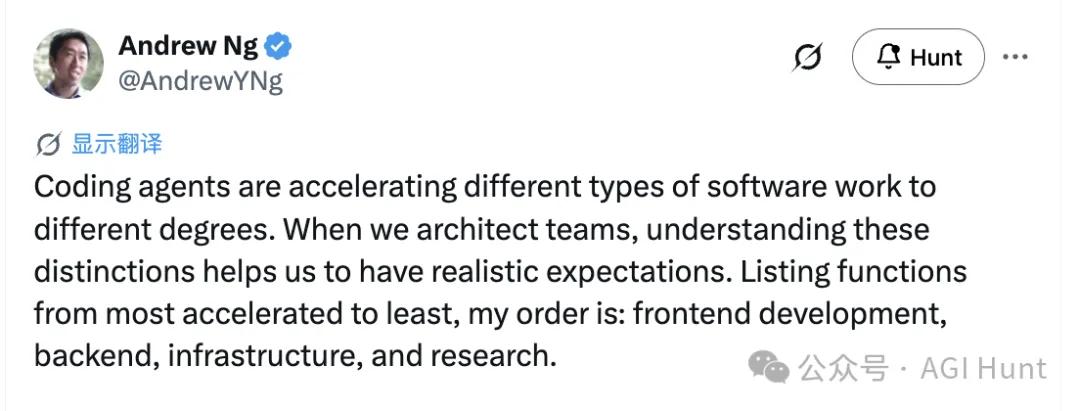
In the latest issue of his newsletter "The Batch," he provided a clear method for accelerating the sorting process:
Front-end > Back-end > Infrastructure > Scientific Research.
From left to right, the acceleration effect of AI decreases sequentially.
03 Front-end first
Andrew Ng believes that front-end development has been accelerated the most.
The AI Coding Agent is already very familiar with TypeScript, JavaScript, and frameworks such as React and Angular.
There's so much of this kind of code in the training data that it's hard to write it wrong...
More importantly, the current agent can open a browser on its own, see what the page it has written looks like, and then iterate and improve it. This "closed-loop" capability has transformed AI front-end development from "writing and praying" to "writing and self-checking".
He also mentioned that LLM programs remain weak in visual design. But if the design drafts are already in place, or if one doesn't care how refined the design is at all...
The speed at which it was achieved was simply astonishing.
04 The backend is a bit slow
The backend, however, is not so easy.
Andrew Ng's original words were:
"More human intervention is needed to guide the model to think about boundary situations that could lead to subtle bugs or security vulnerabilities."
Moreover, the impact of backend bugs is often hidden. An occasional database error is much harder to detect than a page style crash. While AI can assist with database migrations, data loss can still occur if not handled carefully.
He added a sentence:
"The backend designed and implemented by experienced developers is still far superior to that of AI novices."
This is a bit of a blow to front-end developers. In the back-end field, AI can't bridge the experience gap. If you're a beginner, even with AI's help, you still can't write code at the level of a veteran.
Those bosses who don't understand technology, you should learn from this... Don't be brainwashed by self-media (please don't include me).
05 Infrastructure
When it comes to the infrastructure layer, AI falls even further short.
For example, scaling an e-commerce website to support 10,000 active users while maintaining 99.99% availability involves a large number of complex engineering trade-offs, and LLM's knowledge in this area is still quite limited.
Andrew Ng mentioned in the article:
"I rarely trust AI for critical infrastructure decisions."
Finding bugs in infrastructure is an even bigger nightmare. A minor network configuration error may require extensive engineering experience to pinpoint. No matter how fast AI can write code, it can't be of much help in such scenarios.
Bosses, please take note of this!
06 The slowest scientific research
Finally, there's scientific research, which is also the field where AI acceleration is weakest.
That's not hard to understand. What is the core of scientific research? It's coming up with new ideas, proposing hypotheses, conducting experiments, observing the results, adjusting the hypotheses, and starting again... and so on.
The part that AI can accelerate is mainly "writing experimental code". Andrew Ng himself also uses agents to manage and track experiments, allowing a researcher to run more projects at the same time.
However, a large part of scientific research has absolutely nothing to do with writing code.
"Today's agents can only be described as marginally helpful to scientific research."
Andrew Ng also admitted that this four-category classification is an extremely simplified model. However, this simple mental model is indeed very useful for him in managing his team.
"I now demand a much faster delivery speed from the front-end team than I did a year ago. But my expectations for the research team haven't changed that much."
Besides the 07 job categories
Andrew Ng provided an acceleration gradient arranged by function, which is intuitive, easy to remember, and easy to use.
However, in my opinion, if we only look at the "function" dimension, we may miss some more essential things.
What AI is really killing is a type of "job characteristics".
Entry-level jobs are the most dangerous.
Whether it's front-end or back-end, as long as what you're doing involves "following templates" and "following specifications," AI can do it, and faster than you. Andrew Ng himself has said that experienced back-end developers are far superior to novices using AI. Conversely, the value of novices is being squeezed smaller and smaller.
Even jobs that don't require collaboration with others can be dangerous.
Code is human-computer interaction, but discussing requirements, making trade-offs, driving decisions, and coordinating teams are human-to-human interactions. AI can write an API for you, but it can't argue with product managers about the priority of requirements. The more communication and compromise are involved, the less AI can intervene.
Work that lacks creativity is particularly vulnerable.
Andrew Ng puts scientific research last, and this is why. Formulating a good hypothesis, discovering a counterintuitive pattern—these are still human tasks. The more a task can be broken down into clearly defined steps, the easier it is for AI to consume it.
Another category that is easily overlooked is the "average" work that appears most frequently in AI training data.
React components and CRUD interfaces have been written countless times, which is why AI can write code quickly and well. But with a unique system architecture and an interaction pattern that no one has ever tried before, AI has no reference point.
Instead of arguing about whether "front-end or back-end will die first," ask yourself this question:
How much of the work you do every day is just average?
08 How to Not Die
In my opinion, in the AI era, whether you're writing front-end or back-end code, working on algorithms or building infrastructure, you need to focus on two points:
One approach is to fully utilize AI to raise your own minimum standard, and then let it help you reach your maximum standard. AI can help you quickly accomplish things you already know how to do, and the time and energy saved should be invested in areas you couldn't reach before.
Another thing is to stop labeling yourself.
Front-end engineer, back-end engineer, algorithm engineer—these labels used to be symbols of specialization. But in the AI era, they are increasingly becoming shackles.
If all you can do is write React, then the day when AI can write React faster and better than you will be your doom.
But if you're proficient in both front-end and back-end development, capable of system design and client communication, and able to write both code and documentation...
AI can't kill you.
Unless, it really is going to kill everyone...
In the age of AI, specialists are vulnerable. Generalists are the hardest to kill.
Related links:
• Andrew Ng's original article: https://x.com/AndrewYNg/status/2051691741150081122
• DeepLearning.AI The Batch: https://www.deeplearning.ai/the-batch/issue-350/