Written by: Ada, TechFlow TechFlow
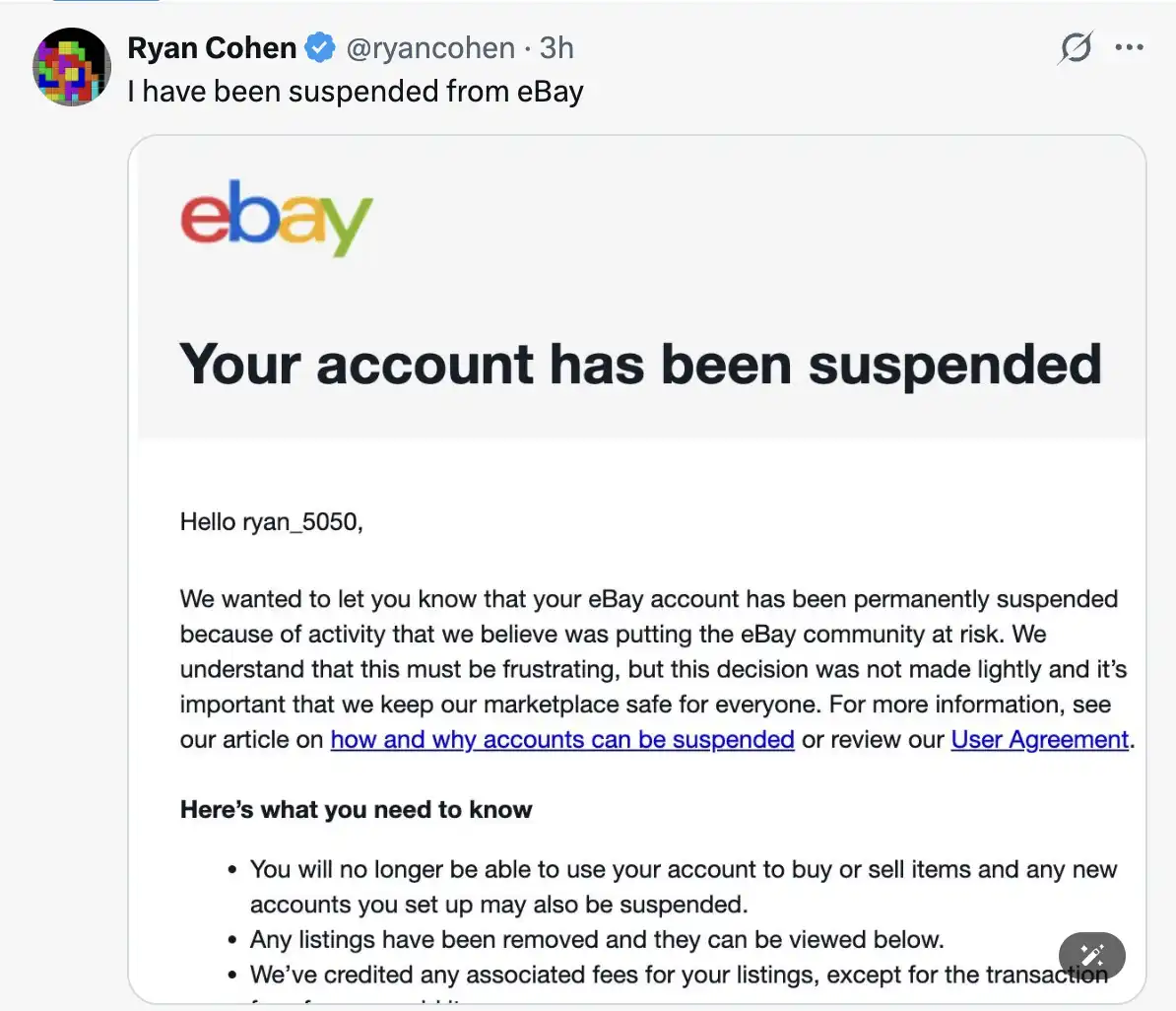
Early on May 7, GameStop CEO Ryan Cohen posted a screenshot on X.
eBay notified him that his account had been permanently suspended, citing "our belief that the activity is putting the eBay community at risk."
24 hours earlier, he had listed a pair of socks on his personal eBay account with the caption: "Selling things on eBay to raise money to buy eBay."
It sounds like a joke, but he's serious. Just three days ago, he presented eBay's board with a $56 billion acquisition offer.
An untenable offer
On May 4, GameStop announced a non-binding takeover offer for eBay at $125 per share.
In a statement, GameStop said the acquisition offer will be paid in equal shares of cash and GameStop common stock, representing a 20% premium over eBay’s closing price of $104.07 on Friday and a 46% premium over the closing price on February 4, when the gaming retail giant began increasing its stake in the company.
On Monday, eBay shares rose about 5% to around $109, well below GameStop's $125 acquisition offer. GameStop shares, however, fell about 10%, indicating investor skepticism about the deal's feasibility.
GameStop's current market capitalization is approximately $11.2 billion, a fraction of its $56 billion deal size. Despite receiving a letter of intent from TD Bank for $20 billion in funding, the company still faces a significant funding gap.
What about the rest? Cohen gave the answer on CNBC: "We offer a 50/50 cash and stock deal, and we have the capacity to issue new stock to complete the transaction."
In other words, it's printing stock. Using shares of a company with a market capitalization of $11.2 billion to exchange for equity in a company valued at $55.5 billion. And for eBay shareholders to accept GameStop stock as consideration, GameStop's stock price would likely have to increase fivefold first.
So how does the market view this?
Kalshi traders believe there is only a 26% chance that GameStop will complete the acquisition in 2026, despite the low total value of the new contract, which is just over $2,000.
On the Polymarket platform, traders are even more pessimistic. Traders on the platform believe there is only a 15% chance that GameStop will complete the acquisition.
Semafor, citing sources familiar with the matter, reported that eBay's board of directors met this week to review the offer, but the deal "appears to be dead in the water," as Cohen failed to convince any major shareholder to publicly support him.
A meticulously designed play
On May 6, 48 hours after the invitation was sent out, Cohen began listing items on his personal eBay account: socks, miscellaneous items, and personal belongings. The total bids reached tens of thousands of dollars.
He also launched a barrage of attacks on the eBay board on Twitter, accusing them of mismanagement. That day, he first received a notification from eBay stating that he had reached his monthly limit on listed orders. Then his account was suspended.
The phrase "poses a risk to the eBay community" in the account suspension notice, coupled with the image of someone attempting to acquire eBay, creates an utterly absurd picture.
But this was just Cohen's performance. Since the offer couldn't scare the board, he used noise to activate GME's retail investor base. He wanted the stock price to soar first, and only then would there be shares to use as consideration.
Why did Cohen initiate the acquisition?
Here's some background. In early 2026, GameStop's board of directors adjusted Cohen's compensation package. If the company's market capitalization reaches $100 billion, he could receive up to $35 billion in stock incentives. Currently, GameStop's market capitalization is only about $11.2 billion. Reaching $100 billion by selling game discs is virtually impossible, so the only way to increase its market capitalization is through acquisitions.
Cohen's entire "sock-selling acquisition of eBay" script was never written for the board of directors, but for retail investors on the WSB subreddit on Reddit.
From Bitcoin to eBay
Zoom out a bit, and you'll see that from Bitcoin to eBay, Cohen's script has always been the same.
In February 2025, he flew to meet Saylor. Three months later, he announced his entry. According to Reuters, GameStop spent $513 million to buy 4,710 bitcoins, at an average cost of approximately $108,917.
While Saylor was bolstering Strategy's entire balance sheet by issuing bonds and leveraging its investments, buying every week, Cohen stopped after purchasing $500 million, which only accounted for 10.4% of GameStop's cash reserves at the time. Strategy was adding to its holdings almost every week, but GameStop didn't increase its holdings at all.
Around January 23, 2026, GameStop transferred all 4,710 Bitcoins to Coinbase Prime in preparation for liquidation.
After transferring his Bitcoin holdings, Cohen gave a series of interviews to several foreign media outlets, in which he discussed his acquisition plans and vowed to transform GameStop into an investment holding platform "similar to Berkshire Hathaway." When reporters pressed him on his Bitcoin strategy, he uttered his oft-quoted statement: "This strategy is more attractive than Bitcoin."
What would be a “more attractive strategy”? It now appears to be the acquisition of eBay for $56 billion.
The logical chain is now closed: first, use the Bitcoin narrative to boost stock price and attention; once paper losses appear, turn around and switch to the next, even grander narrative: acquiring and controlling platforms, building a Berkshire-like multi-billion dollar empire. Each story is bigger than the last, but none of them ever truly come to fruition.
Saylor is a belief, but Cohen is a true actor. He doesn't need a closed-loop transaction system; a closed-loop narrative is enough. The Bitcoin narrative is finished, so let's talk about eBay. eBay is finished, what's next? Nobody knows, but there will definitely be a next one.
Why eBay?
eBay has stable cash flow, stable GMV, and stable shareholder returns. It is a target with $31 billion in annual revenue. As long as the merged company maintains eBay's valuation multiple, its market value may exceed the threshold.
What is Cohen after?
One explanation is that he needs a bigger story than Bitcoin.
GameStop's core problem has never been a lack of cash; its $9.4 billion cash reserves are solid ammunition. However, as a game retailer that started with brick-and-mortar stores, physical games, and the resale market, GameStop's traditional business has long been eroded by digital downloads, platform-owned stores, and subscription services, and can no longer support its $11.2 billion market capitalization.
Retail investors are buying Cohen, meme, and the possibility of "the next Berkshire Hathaway."
But possibilities need to be constantly nurtured.
Bitcoin can feed the coffers for a while. But once the flywheel reverses, it'll be time for something more exciting. Acquiring a publicly traded company five times its size—that's a thrilling story.
Whether the deal goes through or not is unimportant.
The important thing is that after this invitation is sent out, CNBC will invite him to their show, the Wall Street Journal will write an interview, Reddit will be buzzing again, and GME's stock price will experience several days of dramatic fluctuations. Amidst this volatility, long option holders can make money, retail investors can have the illusion of "we've won again," and Cohen himself can cash out some of his stock incentives.
Selling socks and banning accounts can bring in a large amount of free traffic.
When performance art collides with the capital market
It's important to note that Cohen is a serial entrepreneur with a proven track record; he sold Chewy for $3.35 billion to PetSmart. He knew that eBay's board wouldn't sell the company to a competitor with only one-fifth of its market capitalization, and the $56 billion acquisition was highly unlikely. He knew that TD Bank's $20 billion wouldn't be enough, and printing stock would be directly rejected by eBay shareholders.
But he didn't care; all he needed to do was perform.
The true audience for this performance is liquidity, the attention economy itself. In an era where all assets are priced based on narratives, whoever can create the loudest noise can acquire the most liquidity in the short term.
Getting your account suspended for listing socks is a hundred times more effective than issuing a proper press release. Overnight, all financial media outlets were writing about Cohen, and all social media platforms were sharing that screenshot of the suspended account. The free global exposure was worth far more than the sales revenue of the socks he listed.
In today's capital markets, it's hard to distinguish between performance art and investment. In the past, offers were made for genuine mergers and acquisitions; now, offers are made to manipulate stock prices. Price fluctuations generate profits, and profits provide an exit strategy. Cohen and his group are masters of this.
Cohen never truly bets; he's always preparing for the next performance. But one thing is clear right now: when a publicly traded CEO has to prove he's serious about the eBay acquisition by hanging socks on eBay, only to be permanently banned by eBay for "posing a risk to the community," that in itself is the most accurate footnote to the capital markets of our time.
When the tide recedes, those who rush in and out are always the followers, while true believers may disdain the performance.